📅 Last updated: 05.07.2026
In the early 17th century, as European colonial powers carved up Africa with little regard for its sophisticated kingdoms, one woman rose to challenge the narrative—Queen Nzinga Angola, a name that still echoes through the corridors of Angolan history as a symbol of unyielding resistance. She was not merely a queen; she was a strategist, a diplomat, a military commander, and a master of political theatre who outmaneuvered the Portuguese empire for decades. To understand Nzinga is to understand a pivotal chapter in Africa’s struggle against colonialism, a story that is as much about power as it is about identity, resilience, and the reclamation of a continent’s narrative.
- The Kingdom of Ndongo: A World Before the Portuguese
- Queen Nzinga Angola: The Diplomat Who Wouldn't Bow
- The Rise of the Warrior Queen: From Ndongo to Matamba
- Key Dates in the Life of a Legend: A Timeline of Resistance
- Beyond the Battlefield: Nzinga as a Ruler and Strategist
- The Legacy of Queen Nzinga Angola: A Modern Icon
- Conclusion: Why Nzinga Matters Today
The Kingdom of Ndongo: A World Before the Portuguese
Long before the Portuguese set their sights on the region, the area now known as Angola was home to a complex tapestry of kingdoms and states. The most prominent among them were the kingdoms of Ndongo and Matamba, both inhabited by the Mbundu people. These were not primitive backwaters but sophisticated societies with established systems of governance, trade, and social hierarchy. Ndongo, in particular, was a powerful state that controlled vital trade routes and had a robust military structure.
The Portuguese arrived in the late 15th century, initially as traders. They were drawn by the promise of spices, ivory, and, tragically, human beings. By the time Nzinga was born around 1583, the Portuguese presence had shifted from tentative trading posts to aggressive territorial expansion. They had established a foothold at Luanda Island and were increasingly interfering in Ndongo’s internal affairs, demanding tribute and slaves. The kingdom was already under immense pressure, a pressure that would define Nzinga’s life from the very beginning.
Nzinga was born into royalty, the daughter of Ngola Kiluanje Kia Samba, the king of Ndongo. The title “Ngola” is where the modern name “Angola” is derived, a linguistic reminder of the kingdom’s profound legacy. Her birth was said to be marked by a prophetic event—the umbilical cord was wrapped around her neck, which in Mbundu tradition was a sign that she would one day become a great and powerful leader. It was a prophecy that would prove remarkably accurate.
Queen Nzinga Angola: The Diplomat Who Wouldn’t Bow
By the 1620s, the situation in Ndongo was dire. Her brother, Ngola Mbandi, had become king, but he was a hesitant and indecisive leader. The Portuguese, under Governor João Correia de Sousa, were pressing hard, demanding ever-larger tributes of slaves and threatening to overthrow the kingdom entirely. It was in this crisis that Nzinga emerged from the shadows of the court.
In 1622, Ngola Mbandi sent Nzinga to Luanda to negotiate a peace treaty with the Portuguese governor. What transpired is one of the most famous episodes in African history, a masterclass in diplomatic defiance. The governor, eager to assert his superiority, had placed a floor mat for Nzinga to sit on while he sat on an elevated chair. This was a deliberate act of humiliation, a way of signaling that she was beneath him. Nzinga, however, was not to be so easily cowed.
She calmly ordered one of her attendants to kneel down, and she sat on the woman’s back—a move that was both practical and profoundly symbolic. By creating her own throne, she refused to accept a position of inferiority. She then proceeded to negotiate with the governor as an equal, securing a peace treaty that, on paper, recognized Ndongo’s sovereignty and allowed for limited Portuguese trade. The story of Nzinga sitting on her servant’s back has become legendary, but it is crucial to understand its deeper implications. It was not a mere act of pride; it was a calculated political statement that the Kingdom of Ndongo would not bow to any foreign power.
This treaty, however, was fragile. The Portuguese had no intention of honoring it fully, and internal dissent within Ndongo made it difficult to enforce. Nzinga understood that diplomacy alone would not save her people. The real battle was yet to come.
The Baptism and the Name Change
During this same diplomatic mission, Nzinga was baptized as a Catholic, taking the Christian name Dona Ana de Sousa. This was a deeply pragmatic decision. In a world where the Portuguese used religion as a tool of control, converting to Catholicism gave Nzinga access to certain diplomatic channels and allowed her to be seen as a legitimate ruler in European eyes. It was a classic example of strategic adaptation—using the colonizer’s own tools against them. She never truly abandoned her traditional beliefs; she simply added another layer to her complex identity. This dual identity would serve her well, allowing her to play both sides of the cultural divide.
The Rise of the Warrior Queen: From Ndongo to Matamba
After her brother’s death—by some accounts, suicide—in 1624, Nzinga assumed the throne. But her rule was immediately contested. The Portuguese propped up a rival candidate, Hari a Ngola, a puppet who would do their bidding. Nzinga was forced to flee Ndongo with her loyal followers. This exile, however, was not an end but a transformation.
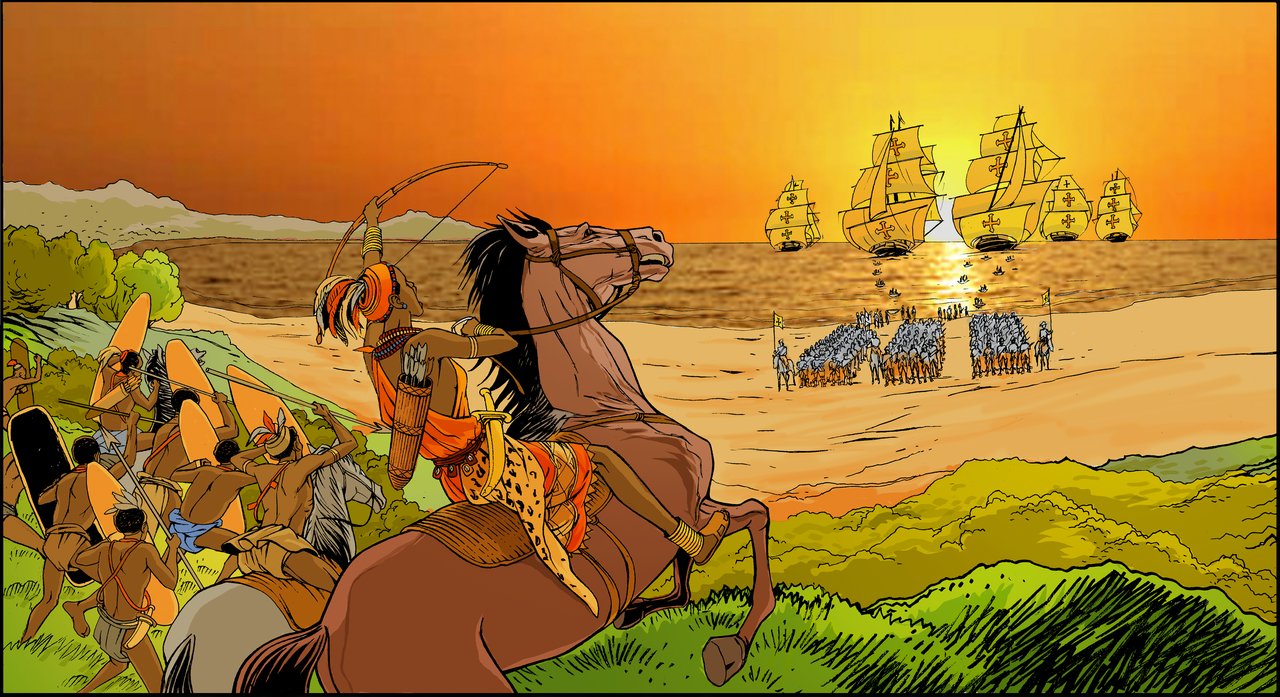
She did not simply retreat. She regrouped, reorganized, and forged a new power base. Her first major move was to conquer the neighboring Kingdom of Matamba, a strategically located state that controlled key trade routes. By 1631, she had established herself as the ruler of Matamba, creating a new kingdom that would become the heart of her resistance. From this base, she waged a relentless guerrilla war against the Portuguese and their allies.
Nzinga’s military tactics were revolutionary for the time. She understood that she could not defeat the Portuguese in a pitched battle, where their superior firearms and fortified positions gave them an advantage. Instead, she used the dense Angolan forests and swamps to her advantage. Her armies were highly mobile, using hit-and-run tactics, ambushes, and psychological warfare. She also made a strategic alliance with the Dutch, who had captured Luanda in 1641. This alliance gave her access to European firearms and military training, leveling the playing field for a time.
Her army was also notable for its inclusion of women. Nzinga maintained a personal guard of female warriors, often referred to as her “Amazon” guard. These women were fiercely loyal and highly trained, serving as both bodyguards and shock troops. This was not merely a novelty; it was a deliberate statement about the power of women in her society and a direct challenge to the patriarchal norms of both Portuguese and many African societies. She herself led her troops into battle well into her 60s, a testament to her indomitable spirit.
“She is a cunning and prudent princess… so much that for many years she has governed her kingdoms with great skill.”
— Giovanni Antonio Cavazzi, a 17th-century Italian missionary who lived in Nzinga’s court.
Key Dates in the Life of a Legend: A Timeline of Resistance
| Year | Event | Significance |
|---|---|---|
| c. 1583 | Birth of Nzinga in the Kingdom of Ndongo | Born into royalty, her birth predicted her future leadership. |
| 1622 | Diplomatic mission to Luanda | Famous “sitting on her servant” incident; negotiated a peace treaty. |
| 1624 | Assumes throne of Ndongo | Faces immediate Portuguese opposition and is forced into exile. |
| 1631 | Conquers the Kingdom of Matamba | Establishes a new power base for her resistance campaign. |
| 1641-1648 | Alliance with the Dutch | Gains access to firearms and military training; heightens conflict. |
| 1656 | Signs a peace treaty with Portugal | Secures her kingdom’s autonomy and ends the war of attrition. |
| 1663 | Death of Nzinga at the age of 80+ | Dies a respected ruler, having preserved her kingdom’s independence. |
Beyond the Battlefield: Nzinga as a Ruler and Strategist
To reduce Nzinga to simply a warrior is to miss the full scope of her genius. She was also a supremely effective administrator. In Matamba, she built a stable and prosperous kingdom. She reformed the tax system, controlled trade in ivory and slaves, and established a sophisticated intelligence network. She was known to be a shrewd judge of character, surrounding herself with capable advisors and military commanders. She also used marriage strategically, marrying multiple men to secure alliances and consolidate her power. She famously kept a harem of male consorts, who were required to dress as women—a radical inversion of gender norms that further cemented her authority.
Her relationship with the slave trade is a complex and often uncomfortable topic. Nzinga herself participated in the slave trade, selling prisoners of war and criminals to the Portuguese and Dutch in exchange for weapons and goods. This was not a moral failing unique to her; it was a brutal reality of the time. In the 17th century, the slave trade was an entrenched global system, and African rulers were often both victims and participants. Nzinga’s primary goal was always the survival and independence of her kingdom. She used the slave trade as a tool, a means to an end. It is a stark reminder that historical figures are rarely simple heroes or villains; they are products of their time, navigating impossible choices.
Her diplomatic skills were legendary. She maintained correspondence with the Pope in Rome, the King of Portugal, and the Dutch West India Company. She understood the power of information and propaganda, carefully crafting her image to project strength and legitimacy. She was a master of the long game, consistently outthinking her opponents. When the Dutch were expelled from Luanda in 1648, she lost her most powerful ally. But she did not surrender. She adapted once again, retreating to the interior and continuing her guerrilla campaign for nearly another decade.
The Final Peace: A Pragmatic End to a Long War
By the 1650s, both Nzinga and the Portuguese were exhausted. The war had been costly for both sides. In 1656, Nzinga signed a peace treaty with Portugal. The terms were far more favorable than any she could have dreamed of in 1622. She was recognized as the ruler of Matamba and parts of Ndongo. Portuguese sovereignty was nominal; in practice, her kingdom remained independent. She also secured the return of her sister, who had been held captive by the Portuguese for years. This peace was not a surrender; it was a strategic victory. She had fought the Portuguese to a standstill and secured her legacy.
She spent her final years consolidating her power and preparing for succession. She died in 1663, reportedly at the age of 80 or more, having outlived most of her contemporaries. Her kingdom remained independent for decades after her death, a direct testament to the foundations she had laid. The Portuguese would not fully conquer the region for another 200 years.
The Legacy of Queen Nzinga Angola: A Modern Icon
Today, Queen Nzinga Angola is far more than a historical figure; she is a cultural icon. In Angola, her image appears on the national currency, the kwanza. Streets, schools, and even a major hospital in Luanda bear her name. She is celebrated as a national hero, a mother of the nation who stood up to colonial oppression. Her story is taught in schools and performed in plays and films. She represents the resilience of the Angolan people and their long struggle for self-determination.
Beyond Angola, Nzinga has become a global symbol of female power and resistance. She has been cited as an inspiration by feminists, civil rights leaders, and Pan-Africanists. Her story challenges the dominant Western narrative of Africa as a passive victim of history. She is a powerful example of an African woman who shaped her own destiny and the destiny of her people. Her legacy also forces a necessary re-examination of African history, moving beyond simplistic tales of victimhood to celebrate the agency, intelligence, and courage of African leaders who fought back.
In recent years, there has been a resurgence of interest in her life. New scholarship has dug deeper into the archives, providing a more nuanced understanding of her reign. Documentaries, novels, and even a Brazilian telenovela have brought her story to a wider audience. She has been featured in the video game “Civilization VI” as a leader of the Kongo civilization, a nod to her enduring relevance in popular culture. This renewed interest is part of a broader movement to decolonize history, to tell the stories of Africa from an African perspective, and to restore the dignity of the continent’s past.
Conclusion: Why Nzinga Matters Today
The real story of Queen Nzinga is not a simple fairy tale of good versus evil. It is a story of complexity, strategy, and survival in a brutal world. It is a story about a woman who refused to accept the roles assigned to her—by her own culture and by a foreign empire—and who carved her own path through sheer force of will. She was a diplomat who could charm a governor, a warrior who could lead an army, and a ruler who could build a kingdom from the ashes of defeat. She made compromises, she made enemies, and she made history.
Her life offers profound lessons for our own time. In an era still grappling with the legacies of colonialism, systemic inequality, and the fight for gender justice, Nzinga stands as a beacon of what is possible when courage meets intelligence. She reminds us that resistance can take many forms—from diplomatic negotiations to guerrilla warfare, from strategic alliances to cultural adaptation. She shows us that leadership is not about being perfect, but about being effective in the service of a larger cause. The story of Queen Nzinga Angola is not just a chapter in Angolan history; it is a vital part of the global story of human resilience, a story that continues to inspire and instruct us today. Her kingdom may be gone, but her spirit remains, a fierce and unyielding force in the heart of Africa.