📅 Last updated: 05.07.2026
In the heart of what is now central and northern Nigeria, long before the rise of the great empires of Ghana, Mali, and Songhai, a mysterious and sophisticated civilization flourished. This is the Nok culture, West Africa’s earliest known civilization, a society of remarkable artists, iron-smelters, and farmers who left behind a legacy of hauntingly beautiful terracotta sculptures and laid the technological groundwork for the region’s future. Their story, pieced together from fragments unearthed from the earth, challenges simple narratives of African history and forces us to reconsider the depth and complexity of innovation on the continent.
- The Accidental Discovery and the Dawn of an Enigma
- Masters of Terracotta: The Art of the Nok Culture
- Iron Before the Pharaohs? The Technological Revolution of the Nok Culture
- A Timeline of the Nok Culture: Key Dates and Periods
- Life and Society: Farmers, Blacksmiths, and Artists
- The Mystery of the Nok Culture's Decline
- Rediscovering the Nok Culture: Modern Research and Challenges
- Legacy and Connections: The Nok Culture and a Modern Africa
- The Unfinished Story: What Remains to Be Discovered
The Accidental Discovery and the Dawn of an Enigma
The story of the Nok culture begins not in a university archive or with a grand archaeological expedition, but in the tin-mining pits of the Jos Plateau in 1943. While mining for tin near the village of Nok, a worker unearthed a striking terracotta head, a fragment of a larger sculpture. This chance discovery caught the attention of Colonel J. Dent-Young, a colonial administrator with a passion for antiquities, who sent the piece to the National Museum in Jos. It was, however, the work of Bernard Fagg, a young British archaeologist, that truly brought the Nok culture to the world’s attention. Fagg, who would later become the director of the Federal Department of Antiquities in Nigeria, recognized the significance of the find. He meticulously documented the sites, conducted systematic excavations, and, crucially, used thermoluminescence dating to establish the age of the sculptures. His work revealed a civilization that thrived from roughly 1500 BCE to 500 CE, making it one of the oldest known centralized societies in sub-Saharan Africa.
The name “Nok culture” is itself a geographical convenience, taken from the village where the first major find was made. The culture’s actual name for itself is lost to time, a poignant reminder of the vast, unwritten histories that lie beneath the African soil. The core area of the Nok culture is believed to have covered a region of about 78,000 square kilometers on the Jos Plateau and surrounding lowlands, an area larger than the Republic of Ireland. This was not a tiny, isolated settlement but a widespread, interconnected network of communities.
Masters of Terracotta: The Art of the Nok Culture
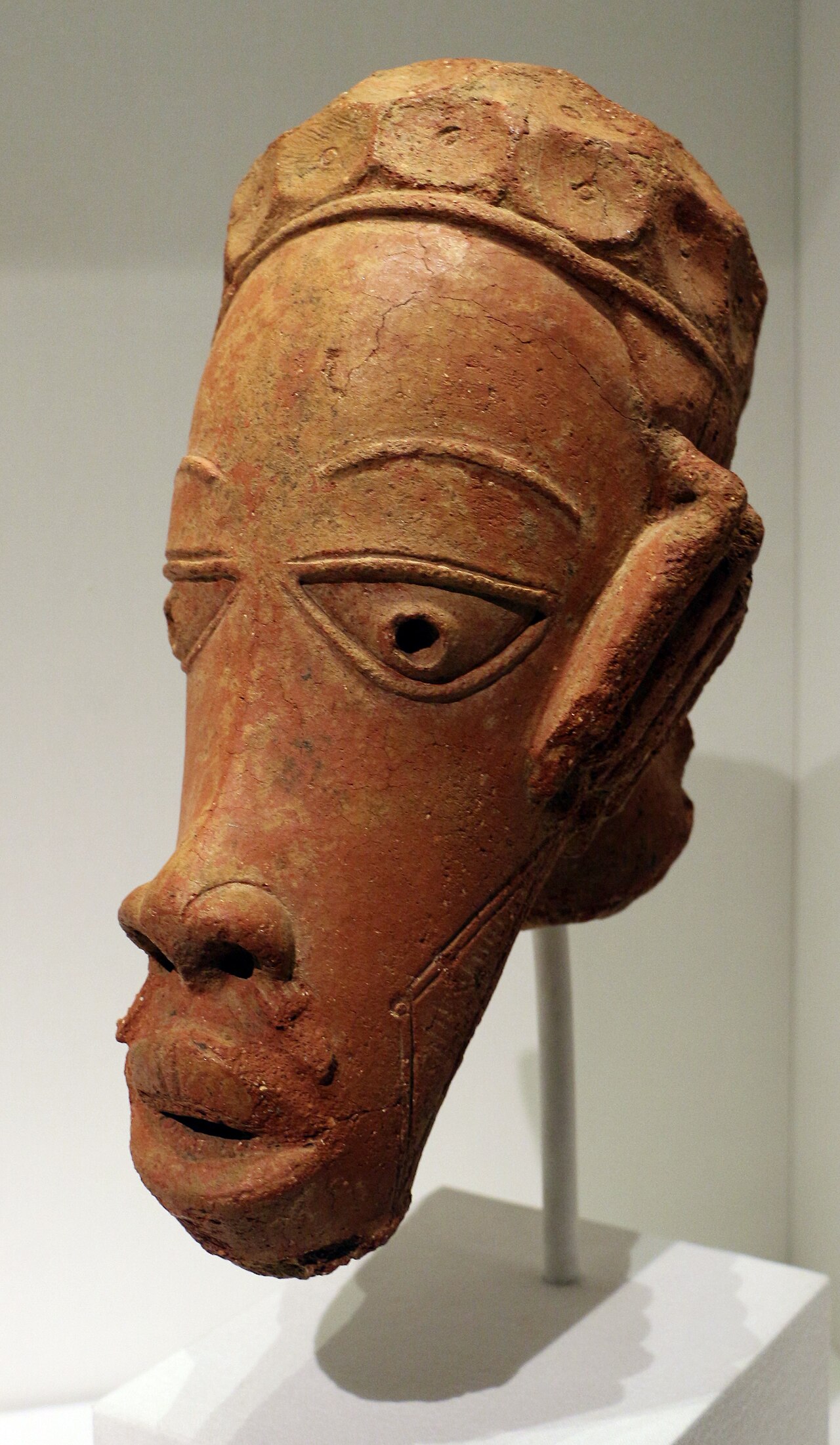
The most famous legacy of the Nok culture is its stunning terracotta sculpture. These are not crude, primitive figurines. They are highly stylized, technically accomplished works of art that display a sophisticated understanding of form, volume, and expression. The sculptures are predominantly human heads and figures, though fragments of animals, such as elephants, monkeys, and snakes, have also been found. The human figures are often depicted seated, kneeling, or standing, sometimes with elaborate hairstyles, beaded necklaces, bracelets, and anklets. One of the most iconic pieces is a seated figure from Jema’a, a serene, cross-legged man with an elaborate, conical headdress, his hands resting on his knees.
Stylistic Hallmarks
What makes Nok art instantly recognizable are its distinctive stylistic features:
- The Triangular or “Coffee Bean” Eye: The most famous feature is the pierced, triangular eye, resembling a coffee bean or an inverted triangle. The pupil is a deep hole, creating a powerful, penetrating gaze that seems to follow the viewer.
- Elaborate Hairstyles and Headdresses: The figures wear incredibly detailed and varied hairstyles, from intricate braids and buns to elaborate conical or cylindrical headdresses, likely indicating social status, age, or ritual role.
- Perforated Features: The eyes, nostrils, mouths, and ears are often deeply perforated, a technique that allowed for the circulation of air during firing and prevented cracking in the kiln. This was a sophisticated solution to a practical problem.
- Abstract Naturalism: While the forms are naturalistic enough to be recognizable, they are also highly abstract. Heads are often large in proportion to the body, and features are stylized into geometric patterns. This is not a simple attempt at photographic realism but a deliberate artistic convention.
- Grog-Tempered Clay: The Nok sculptors used a specific type of clay, heavily tempered with grog (crushed, fired pottery) and coarse sand. This gave the clay strength and reduced shrinkage during drying and firing, allowing for the creation of large, hollow figures.
The sheer scale of some of these works is also astonishing. Complete figures could reach over a meter in height, requiring immense skill to fire without cracking. These were not mass-produced trinkets; they were monumental, public artworks, likely used in religious or funerary contexts. The Nok culture’s terracotta tradition is considered the earliest known sculptural tradition in sub-Saharan Africa, predating the famous bronze and ivory art of the Kingdom of Benin by over a thousand years.
Iron Before the Pharaohs? The Technological Revolution of the Nok Culture
While the terracotta heads are visually arresting, the Nok culture’s most consequential innovation may have been its mastery of iron smelting. The Nok people were among the earliest iron-smelters in all of sub-Saharan Africa, with evidence of ironworking dating back to at least 600-500 BCE, possibly earlier. This places them at the very forefront of the Iron Age in the region, contemporaneous with or even predating the early ironworking centers in the Great Lakes region and the Sahel.
This was not a borrowed technology. For decades, a diffusionist model argued that ironworking spread from the Middle East and North Africa across the Sahara. However, the Nok evidence increasingly supports a case for independent invention. There is no clear archaeological evidence of a gradual introduction of ironworking into the Nok area from the north. Instead, the technology appears suddenly, fully formed, with sophisticated furnaces and smelting techniques. The Nok people built clay furnaces that used natural drafts and bellows to achieve the high temperatures needed to smelt iron ore from local laterite deposits. They produced not just weapons, but also tools like hoes, axes, and knives.
The impact of this innovation was revolutionary. Iron tools were far more durable and effective than their stone or wooden predecessors.
Consequences of the Iron Revolution
- Agricultural Intensification: Iron hoes and axes allowed the Nok people to clear the dense forest and savanna woodlands of the Jos Plateau for farming. This led to more productive agriculture, supporting a larger, more concentrated population. Crops like yams, millet, and oil palms were likely cultivated on a new scale.
- Social Stratification: The control of iron technology and the trade of iron tools would have created new forms of wealth and power. Blacksmiths likely held a special, perhaps even sacred, status in society. The ability to produce superior weapons also gave certain groups a military advantage, leading to the emergence of a more hierarchical, centralized political structure.
- Trade and Exchange: Iron tools and weapons became valuable trade goods. The Nok culture likely engaged in extensive trade networks, exchanging iron for other resources not available on the plateau, such as salt, stone for grinding, and possibly exotic materials for their art.
The Nok culture’s mastery of iron and their unique art are two sides of the same coin. The economic surplus generated by iron-farming enabled the specialization of labor needed to produce such elaborate art. The civilization was not just a footnote; it was a dynamic, prosperous, and technologically advanced society.
A Timeline of the Nok Culture: Key Dates and Periods
Understanding the chronology of the Nok culture is essential to appreciating its longevity and evolution. The following table summarizes the key periods based on current archaeological consensus, though dates are subject to refinement as new discoveries are made.
| Period | Approximate Dates | Key Developments |
|---|---|---|
| Early Nok | 1500 BCE – 900 BCE | Earliest known settlements. Evidence of stone tool use and early pottery. The transition from the Late Stone Age to settled agriculture begins. No iron or terracotta figures yet. |
| Middle Nok | 900 BCE – 500 BCE | The “Classic” period. Emergence of iron smelting technology. The first terracotta sculptures appear. The distinctive Nok artistic style (triangular eyes, elaborate headdresses) becomes established. Population growth and trade networks expand. |
| Late Nok | 500 BCE – 1 CE | Peak of the Nok culture. Large-scale settlements and monumental art. Ironworking is widespread. Sophisticated social hierarchy is evident. Terracotta art reaches its most complex and refined forms. |
| Terminal Nok | 1 CE – 500 CE | Gradual decline. Some settlements are abandoned. The quality and quantity of terracotta sculpture decline. The reasons for the decline are debated (climate change? resource depletion? internal conflict?). The culture eventually fades, but its influence likely lived on in later societies. |
Life and Society: Farmers, Blacksmiths, and Artists
The Nok culture was not a single, monolithic empire with a single capital city. It was a network of autonomous or semi-autonomous villages and towns spread across the Jos Plateau. They lived in round or oval houses made of wattle and daub (mud and twigs), with thatched roofs. These were not temporary camps but permanent, planned settlements, some of which, like the site of Samun Dukiya, show evidence of continuous occupation for centuries.
Economy and Daily Life
The Nok people were primarily farmers. Their diet was based on:
- Cereals: Pearl millet was a staple crop, well-suited to the plateau’s climate.
- Tubers: Yams were also cultivated, providing a carbohydrate-rich food source.
- Oil and Fruit: The oil palm was a vital resource, providing oil for cooking and lighting, as well as fruit, wine, and building materials.
- Domesticated Animals: They kept goats, sheep, and possibly cattle, for meat, milk, and hides. Hunting and fishing supplemented their diet.
Beyond farming and ironworking, the Nok people were skilled craftspeople. They produced a wide range of pottery for storage, cooking, and ritual use. Stone tools, such as grinding stones for grain and polished axes, were still used, even after the advent of iron. The presence of elaborate stone beads and quartz lip plugs (labrets) suggests a concern for personal adornment and a sense of aesthetic beauty that extended beyond their terracotta art.
Ritual and Belief
We can only speculate on the belief system of the Nok culture, as no written records exist. However, the art provides powerful clues. The fact that the terracotta sculptures were often found in fragmented states, sometimes deliberately broken and buried in pits, suggests they were not simply decorative objects. They were likely used in specific rituals and then decommissioned, perhaps as part of a funerary rite or a periodic renewal ceremony. The prominent display of elaborate headdresses and jewelry on the figures points to a society with clear social hierarchies, where leaders, priests, or ancestors were commemorated in art. The consistent focus on the human form, often with an expression of serene authority, suggests a deep reverence for ancestors and the continuity of lineage.
The Mystery of the Nok Culture’s Decline
Around 500 CE, the Nok culture began to disappear. The production of terracotta art ceased, ironworking declined, and many settlements were abandoned. For decades, this decline was a puzzle. The most compelling theory, supported by recent research, points to a dramatic shift in climate. The Jos Plateau experienced a period of increasing aridity and deforestation. The intensive iron smelting required vast amounts of charcoal, which in turn demanded the felling of countless trees. This deforestation, combined with a drying climate, may have led to soil degradation, erosion, and a decline in agricultural productivity. The very technology that had fueled the Nok culture’s rise may have contributed to its downfall.
This is a cautionary tale from the deep past. The Nok people were not passive victims of their environment. Their actions had profound, unintended consequences. The lesson is as relevant today as it was two thousand years ago: environmental sustainability is not a modern concern but a perennial challenge for any civilization that draws heavily on its natural resources.
It is also important to note that the Nok culture did not simply vanish without a trace. The people likely migrated, merged with other groups, or adapted to the new conditions. Their artistic traditions and ironworking knowledge did not die out. Instead, they were passed down, influencing later cultures in the region. The sophisticated bronze-casting traditions of Igbo-Ukwu (9th-10th centuries CE) in southeastern Nigeria and the Yoruba city-states of Ife (11th-15th centuries CE) show striking parallels with Nok art, particularly in the naturalistic treatment of the human face and the emphasis on elaborate regalia. While a direct, unbroken lineage is difficult to prove, the influence of the Nok culture on the later artistic flowering of West Africa is undeniable.
Rediscovering the Nok Culture: Modern Research and Challenges
Today, the study of the Nok culture is a vibrant and evolving field. The Goethe University Frankfurt in Germany has been leading a major, long-term research project in collaboration with the National Commission for Museums and Monuments (NCMM) in Nigeria. This project has used advanced techniques like magnetometry to map underground features, including ancient furnaces and settlement walls, without excavation. They have also conducted detailed paleoenvironmental studies, analyzing pollen and soil samples to reconstruct the ancient landscape and climate.
However, the Nok culture faces a grave threat: looting. The high artistic and monetary value of Nok terracottas on the international art market has fueled a wave of illegal excavation. Thousands of Nok sculptures have been looted from their archaeological contexts, their provenance destroyed. A sculpture ripped from the ground loses its scientific value. We can no longer know where it was found, what it was buried with, or what it meant to the people who made it. It becomes a beautiful but mute object, a piece of a puzzle that can never be completed. This illicit trade robs not only Nigeria but all of humanity of its shared heritage.
There is hope. The NCMM, with support from international partners, is working to improve site security, train local archaeologists, and raise public awareness. Museums in Nigeria, including the magnificent National Museum in Lagos and the Jos Museum, hold important collections of Nok art that are properly documented and cared for. These institutions are not dusty mausoleums. They are dynamic centers of learning and national pride, where Nigerians and visitors alike can connect with the deep history of the land.
Legacy and Connections: The Nok Culture and a Modern Africa
The Nok culture is not a relic of a bygone age. Its legacy is woven into the fabric of modern Nigeria and West Africa. The technological and artistic innovations of the Nok people are part of a continuous thread of African creativity and ingenuity. The drive to create, to innovate, and to express complex ideas through art is not new to the continent. It is as old as the Nok terracotta heads themselves.
Visiting the Jos Plateau today, you can see the descendants of that ancient world. The people of the region, including the Berom, Afizere, and Anaguta communities, are vibrant, modern Africans living in a landscape that bears the marks of its deep past. They are not “living in the past.” They are doctors, lawyers, farmers, and artists themselves, using mobile phones, driving cars, and engaging with the global economy. But their history is a source of pride. The Nok culture is taught in Nigerian schools. It is a symbol of the country’s rich and complex heritage, a powerful counterpoint to any narrative that suggests Africa has no history before colonization.
“To know the Nok is to know that Africa has always been a place of profound innovation and beauty. They were not a ‘lost’ civilization, but a found one. They remind us that the story of humanity is not a linear march from the West, but a complex, multi-centered tapestry of invention and expression. The Nok culture is our shared inheritance.” — Dr. Abidemi Babalola, Archaeologist at the University of Cambridge
The Unfinished Story: What Remains to Be Discovered
The story of the Nok culture is far from over. Every new excavation has the potential to rewrite what we know. Major questions remain unanswered. What language did they speak? What was the exact nature of their political organization? Was there a single, unifying Nok identity, or were they a collection of related but distinct groups? What was the precise function of their magnificent terracotta art? Where are their burial grounds, and what can they tell us about their health, diet, and beliefs?
The answers lie in the red earth of the Jos Plateau, waiting to be uncovered by a new generation of African and international archaeologists. The Nok culture is not just a chapter in a history book. It is a living question, an invitation to explore, to learn, and to marvel at the incredible capacity of the human spirit to create, adapt, and endure. It is a testament to the fact that West Africa’s earliest known civilization was not a simple beginning, but a brilliant, complex, and deeply human story that continues to unfold.