📅 Last updated: 05.07.2026
- The Cradle of Scholarship: How Timbuktu Became a City of Books
- The Near Extinction: Jihadists and the Race to Save the Timbuktu Manuscripts
- What the Manuscripts Tell Us: A Window into a Sophisticated World
- The Modern Fight: Digitization, Restoration, and the Future of the Manuscripts
- Beyond Timbuktu: The Wider Manuscript Tradition of West Africa
- Cultural Rebirth: Timbuktu and the Manuscripts Today
- The Legacy in Ink: What the Manuscripts Mean for Africa and the World
- A Final Word: The Unfinished Story
The first thing that strikes you about the Timbuktu manuscripts is not their age, though many are centuries old, nor their fragility, though the desert air has turned their pages to brittle lace. It is the sheer, staggering volume of them. Huddled in private homes, buried beneath the sand, or stacked in ancient family libraries, these documents represent one of the most extraordinary intellectual legacies on the planet. The Timbuktu manuscripts are not a single collection but a scattered archipelago of knowledge, a testament to a time when this dusty city on the edge of the Sahara was not the end of the world, but its vibrant, beating heart.
To speak of Timbuktu today is often to conjure images of exotic remoteness, of camel caravans and salt slabs. But for centuries, between the 13th and 17th centuries, it was a powerhouse of commerce, culture, and—most critically—scholarship. The manuscripts that survive are the physical proof of that golden age. They are letters, legal contracts, astronomical charts, medical textbooks, works of Sufi mysticism, and beautiful calligraphy. They are Africa’s memory, written in ink made from soot and gum arabic, on paper traded from as far away as Italy and the Middle East. This article explores the story of this fragile legacy: its creation, its near destruction, and its defiant survival.
The Cradle of Scholarship: How Timbuktu Became a City of Books
The rise of Timbuktu as a center of learning was no accident. Founded around the 5th century as a seasonal Tuareg camp, its location at the crossroads of the Niger River and the trans-Saharan trade routes made it inevitable that it would become a wealthy entrepôt. Gold from the south, salt from the north, and slaves from the interior all passed through its bustling markets. But true power, in the medieval world, was knowledge.
The transformation began in earnest under the Mali Empire, particularly during the reign of Mansa Musa (c. 1280–1337). His legendary pilgrimage to Mecca in 1324 put Timbuktu on the map of the Islamic world. He brought back not just gold but scholars, architects, and books. The great Sankore Mosque was established not just as a place of worship, but as a madrasa, a university. It was not a single building but a system of independent colleges, each run by a distinguished scholar, attracting students from across North Africa and the Middle East.
Beyond Religion: The Breadth of Knowledge
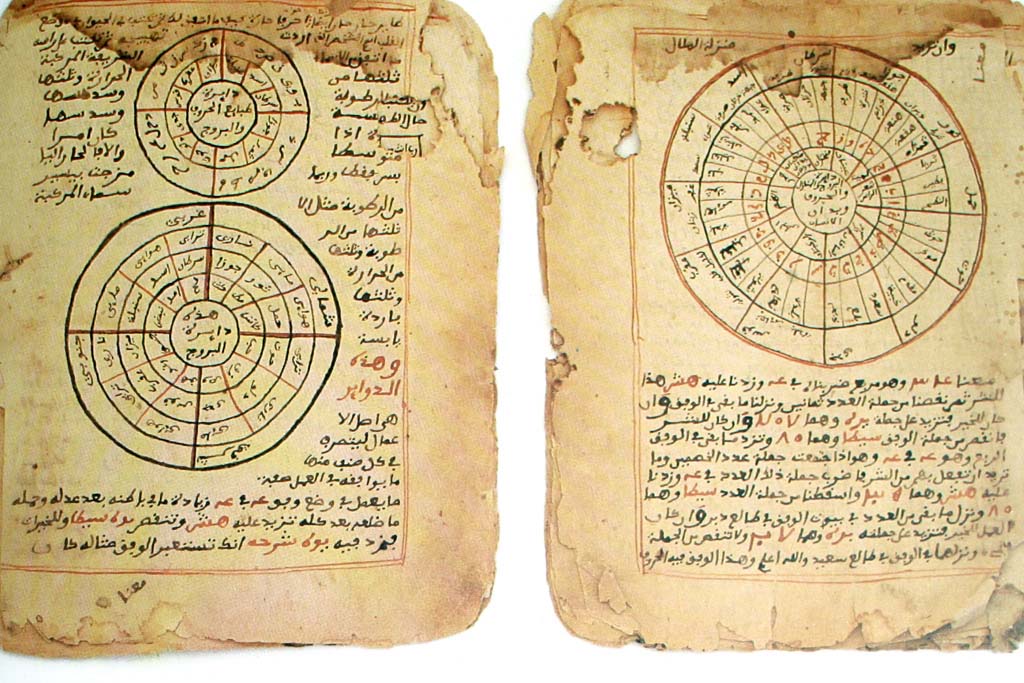
It is a common misconception that the manuscripts are purely religious texts. While the Quran and works of Islamic jurisprudence form a core part of the collections, the intellectual curiosity of Timbuktu’s scholars was breathtakingly wide. The manuscripts reveal a sophisticated society deeply engaged with the world. They include:
- Astronomy and Mathematics: Detailed tables for calculating the movement of celestial bodies, used for navigation and determining prayer times.
- Medicine and Pharmacology: Prescriptions for herbal remedies, surgical techniques, and treatises on diseases like smallpox and leprosy.
- Literature and Poetry: Love poems, epics, and satirical works, often written in beautiful Arabic calligraphy or the local Songhai language transcribed in Arabic script (Ajami).
- Law and Governance: Thousands of legal documents, including contracts for the sale of a house, marriage certificates, and rulings on trade disputes, offering a granular view of daily life.
- Philosophy and Sufism: Works of deep theological debate, exploring the nature of God, the soul, and the path to spiritual enlightenment.
This was not a closed, insular tradition. The scholars of Timbuktu corresponded with their peers in Cairo, Fez, and Granada. They debated the works of Ibn Sina (Avicenna) and Aristotle. The Timbuktu manuscripts prove that Africa was not a passive recipient of knowledge from the outside world; it was an active participant in the global intellectual currents of its time.
The Near Extinction: Jihadists and the Race to Save the Timbuktu Manuscripts
For centuries, the manuscripts lay largely undisturbed, passed down through families, hidden in trunks and mud-brick vaults. The colonial era saw some loss and neglect, but the greatest threat came in the 21st century. In 2012, a rebellion by Tuareg separatists was hijacked by Islamist militant groups, including Ansar Dine and Al-Qaeda in the Islamic Maghreb (AQIM). They seized control of northern Mali, including Timbuktu.
The jihadists saw the manuscripts not as a heritage to be protected, but as a heresy to be destroyed. They systematically attacked the city’s ancient Sufi shrines and mausoleums, smashing them with pickaxes as a violation of their strict interpretation of Islam. The Ahmed Baba Institute, a modern library built to house thousands of manuscripts, was a prime target. Everyone knew the manuscripts were in mortal danger.
The Librarians’ Secret Operation
What happened next is one of the most remarkable acts of cultural preservation in modern history. A small, clandestine group of librarians, archivists, and ordinary citizens, led by figures like Dr. Abdel Kader Haidara, devised a daring plan. They could not stop the militants from burning the books, but they could move them.
Under the noses of the occupying forces, they began an extraordinary evacuation. The operation was a masterpiece of deception and courage:
- False Inventories: They created fake lists of manuscripts to show the militants, claiming the real treasures had already been moved.
- The Nighttime Caravan: The manuscripts were packed into metal trunks, loaded onto donkeys, carts, and trucks, and smuggled out of the city under cover of darkness.
- The River Route: Many were taken by pirogue (traditional wooden boat) down the Niger River to the relative safety of the southern city of Bamako.
- Hiding in Plain Sight: Some were hidden in the homes of trusted families in Timbuktu itself, concealed in false walls or buried under floors.
The operation moved an estimated 350,000 to 400,000 manuscripts. It was a logistical triumph, but a personal one too. The librarians risked execution. They were threatened, beaten, and their families were put in danger. When the jihadists finally torched the Ahmed Baba Institute in January 2013, they found mostly empty shelves. They had been outsmarted. A small number of manuscripts were lost, but the vast majority were saved. The story of the Timbuktu manuscripts became a global symbol of resistance against cultural erasure.
What the Manuscripts Tell Us: A Window into a Sophisticated World
The rescue was only the first chapter. The second, ongoing chapter is the work of preservation, digitization, and study. As scholars carefully unroll these fragile pages, they are rewriting the history of Africa. The manuscripts challenge the long-held, racist narratives that Africa had no written history or complex intellectual traditions before European colonialism.
Consider just a few specific examples. One 16th-century manuscript, the Tarikh al-Sudan (History of the Sudan), written by the scholar Abd al-Rahman al-Sa’di, provides a detailed chronicle of the Songhai Empire. It describes the reign of Askia Muhammad, a brilliant administrator and military leader, and the grandeur of the court at Timbuktu. Another, the Tarikh al-Fattash, offers a complementary account.
Then there are the scientific texts. A 17th-century manuscript on astronomy contains a diagram of the lunar phases and a table for calculating their duration. A medical treatise describes the symptoms of diabetes and recommends a diet of specific grains and vegetables. A legal document from 1498 details the sale of a slave, but also includes complex clauses about the slave’s rights and the owner’s responsibilities—a stark reminder that the society, while intellectually vibrant, was also deeply flawed by the standards of modern human rights.
A Table of Key Manuscript Collections and Their Focus
To understand the scale and diversity of the collections, here is a table of some of the most important private and public libraries in Timbuktu and their specialties:
| Library / Collection Name | Approximate Size (Pre-2012) | Notable Focus Areas |
|---|---|---|
| Ahmed Baba Institute (IHERI-AB) | ~30,000 | State-sponsored collection; broad range including theology, law, science, and literature. |
| Mamma Haidara Commemorative Library | ~40,000 | Founded by Dr. Abdel Kader Haidara; strong in Sufi texts, poetry, and astronomy. |
| Fondo Kati (Library of Ismaël Diadié Haïdara) | ~12,000 | Contains the library of a 16th-century scholar, Ali bin Ziyad al-Quti; includes texts from Muslim Spain (Al-Andalus). |
| Al-Wangari Library | ~3,000 | Focus on legal texts, contracts, and historical correspondence from the Songhai Empire. |
| Private Family Collections | Varies (thousands of small caches) | Often single-family archives; personal letters, local histories, and everyday legal documents. |
This table only scratches the surface. There are dozens of other private libraries, some containing just a few dozen manuscripts, others hundreds. The total number of surviving Timbuktu manuscripts is estimated to be between 300,000 and 700,000, scattered across Mali and beyond.
The Modern Fight: Digitization, Restoration, and the Future of the Manuscripts
Today, the manuscripts are safe from the jihadists, but they face new and equally insidious enemies: the climate of the Sahel, with its extreme heat and humidity; the ravages of insects and mold; and the simple, tragic reality of paper turning to dust. The work of preservation is a race against time.
Organizations like the Tombouctou Manuscripts Project (based at the University of Cape Town) and the Hill Museum & Manuscript Library (HMML) in the USA are leading the digitization effort. High-resolution cameras and specialized scanners are being used to capture every page. The goal is to create a digital archive that is accessible to scholars worldwide, while also ensuring that the physical originals can be stored in climate-controlled conditions.
Restoration: A Delicate Art
The process of restoring a single manuscript can take weeks or even months. Conservators in Bamako and Timbuktu work with painstaking care. The steps are meticulous:
- Assessment: The manuscript is examined for damage—rips, tears, water stains, insect holes, and fading ink.
- Cleaning: Dust and dirt are removed with soft brushes and specialized erasers.
- Deacidification: Acidic paper becomes brittle. A gentle alkaline solution is often applied to neutralize the acid.
- Mending: Tears are repaired using Japanese tissue paper and a starch-based adhesive. Lost corners are reconstructed.
- Re-binding: Many manuscripts have lost their original bindings. New, historically appropriate covers are created.
This is not just about saving old paper. It is about preserving the material culture of a civilization. The inks, the paper watermarks, the leather bindings—all of these tell a story of trade routes and technological exchange. The paper, for instance, often came from Italy, bearing the watermarks of Renaissance paper mills. The ink was made locally, a recipe of carbon black and gum arabic. The leather was tanned in the city’s own workshops.
Beyond Timbuktu: The Wider Manuscript Tradition of West Africa
While Timbuktu is the most famous repository, it is crucial to understand that the manuscript tradition is not unique to one city. Across the Sahel, from Senegal to Chad, there are vast, hidden libraries. The cities of Djenné, Gao, and Segou in Mali all have their own collections. In northern Nigeria, the city of Kano was a major center of Islamic learning, with its own manuscript legacy. In Mauritania, the libraries of Chinguetti and Oualata hold thousands of texts.
This tradition is a powerful counter-narrative to the idea of a “Dark Continent.” It shows a region deeply connected to the wider world of Islam and classical learning, but also fiercely independent, adapting those traditions to local languages, customs, and political realities. The Timbuktu manuscripts are the most famous, but they are part of a much larger, richer, and more complex intellectual ecosystem.
Cultural Rebirth: Timbuktu and the Manuscripts Today
The city of Timbuktu is slowly recovering. The mausoleums have been rebuilt. Tourists, though still few, are beginning to return. The annual Festival in the Desert, a celebration of Tuareg music and culture, has been revived in a different form. But the soul of the city remains in its libraries.
Walking through the sandy streets today, you can still find the descendants of the great scholarly families. They will invite you into their homes, offer you sweet mint tea, and then, with a quiet reverence, open a trunk. Inside, wrapped in cloth, are the manuscripts. They are not museum pieces. They are living documents, still read, still studied, still a source of family pride and identity.
The new Ahmed Baba Institute, rebuilt after being torched, now houses a state-of-the-art conservation lab and a reading room for scholars. The librarians who risked their lives are now celebrated as national heroes. They have trained a new generation of Malian conservators and archivists. The story of the manuscripts is no longer just a story of the past; it is a story of resilience, of a people who refused to let their history be stolen.
The Legacy in Ink: What the Manuscripts Mean for Africa and the World
The true significance of the Timbuktu manuscripts extends far beyond the dusty streets of a remote Saharan city. They are a powerful tool for reimagining African identity. For centuries, the narrative of Africa was written by outsiders, a story of savagery, victimhood, and a lack of history. The manuscripts shatter that narrative.
They provide a tangible, undeniable link to a sophisticated, literate, and globally engaged African past. They show that African scholars were not just consumers of knowledge but producers of it. They debated philosophy, practiced medicine, charted the stars, and wrote poetry. They were part of a global conversation.
For the African diaspora, the manuscripts hold a particular resonance. They offer a connection to a pre-colonial intellectual heritage that was systematically erased by the slave trade and colonialism. They are proof that the ancestors were not just laborers and slaves, but thinkers, scientists, and artists. They are a source of profound pride and a tool for healing.
The manuscripts also have a universal message. They are a reminder that knowledge is fragile, that it can be burned or buried, but that it can also be saved by the courage of ordinary people. The librarians of Timbuktu are a testament to the power of the human spirit to resist barbarism. They did not fight with guns. They fought with boxes, donkeys, and a deep, unwavering belief that a book is worth more than a life.
A Final Word: The Unfinished Story
The story of the lost libraries of Timbuktu is not a closed chapter. It is a living, breathing narrative. Thousands of manuscripts remain in private hands, un-catalogued, slowly deteriorating. The digitization process is slow and expensive. The political situation in Mali remains fragile. The threat of a new insurgency is never far away.
Yet, there is reason for hope. A new generation of African scholars, trained in the West and at home, is now engaging with these texts. They are asking new questions, looking for new connections. They are using the manuscripts to write a more accurate, more complex history of their continent. The Timbuktu manuscripts are no longer a lost legacy. They are a found one, a treasure that is being slowly, carefully, and joyfully reclaimed. They are a reminder that in the heart of the desert, the human mind once flourished, and that its light, though dimmed, has never been extinguished. The ink has not dried. The story continues.