📅 Last updated: 05.07.2026
Standing in the heart of northern Ethiopia, the Aksum Obelisks Ethiopia represent one of the ancient world’s most audacious architectural achievements, a silent testament to a civilization that commanded trade routes from the Mediterranean to the Indian Ocean. These towering granite needles, some soaring over 30 meters into the highland sky, are not mere monuments—they are the surviving fragments of a kingdom that rivaled Persia, Rome, and China in its imperial reach. To walk among them is to walk through a history carved in stone, where every chisel mark tells a story of power, faith, and human ingenuity.
- The Kingdom That Built the Sky: Context of the Aksum Obelisks
- How They Were Carved and Raised: The Engineering of the Aksum Obelisks Ethiopia
- Sacred Geometry and Symbolism: What the Obelisks Represent
- A Timeline of Triumph and Loss: Key Dates for the Aksum Obelisks Ethiopia
- Rediscovery and Restoration: The Aksum Obelisks Ethiopia in the Modern Era
- Living Legacy: The Aksum Obelisks Ethiopia in Contemporary Culture
- Comparisons and Contrasts: The Aksum Obelisks Ethiopia in Global Context
- Visiting the Obelisks Today: A Practical Guide
- Conclusion: The Aksum Obelisks Ethiopia as a Mirror of Human Ambition
The Kingdom That Built the Sky: Context of the Aksum Obelisks
Long before the obelisks rose, the Kingdom of Aksum had already established itself as one of the great civilizations of the ancient world. By the 1st century CE, Aksum controlled a vast territory spanning modern-day Eritrea, northern Ethiopia, and parts of Sudan and Yemen. The Periplus of the Erythraean Sea, a Greek navigational text from the 1st century CE, describes Aksum’s port of Adulis as a bustling hub for ivory, gold, frankincense, and slaves. The kingdom minted its own gold coins, developed the Ge’ez script, and constructed massive stone reservoirs like the Mai Shum Dam, which still holds water today.
The obelisks were not built in isolation—they were part of a sophisticated urban landscape. The ancient city of Aksum, now a UNESCO World Heritage Site, contained palaces, tombs, and churches, all organized around a central plaza. The obelisks served as stelae, or funerary markers, for Aksum’s elite. They were carved from single blocks of nepheline syenite, a granite-like stone quarried from nearby hills, and transported over distances of up to four kilometers. The largest surviving obelisk, the Great Stele (now fallen and broken), stood an estimated 33 meters high and weighed over 500 tons. To put that in perspective, it is heavier than a fully loaded Boeing 747.
How They Were Carved and Raised: The Engineering of the Aksum Obelisks Ethiopia
The question that has baffled historians and engineers for centuries is simple: how did a civilization without iron tools, pulleys, or cranes manage to carve, transport, and erect these colossal monoliths? The answer lies in a combination of meticulous planning, immense human labor, and a deep understanding of local geology.
Quarrying the Monoliths
The quarries at Gobedra, just north of Aksum, still bear the scars of ancient extraction. Workers used dolerite hammers, a stone harder than the syenite itself, to pound channels around the desired block. They then inserted wooden wedges into natural fissures and soaked them with water. The expanding wood split the rock along clean lines—a technique that required precise knowledge of the stone’s grain. Evidence suggests that a single obelisk could take months or even years to extract, with teams of hundreds working in shifts.
Transporting the Giants
Moving a 500-ton block over uneven terrain without wheels or draft animals (the tsetse fly made oxen impractical in the region) demanded extraordinary logistics. Researchers believe workers used a combination of wooden rollers, sledges, and massive teams of laborers—potentially thousands—to drag the stones on carefully prepared causeways. The ground was first leveled and lubricated with mud or plant oils. At steep sections, workers would dig trenches to reduce the angle of ascent. The journey from quarry to city could take weeks, with the entire community mobilized for the task.
Erecting the Obelisks
The most awe-inspiring feat was the raising itself. The obelisk was dragged to a prepared foundation pit, then tilted using a system of earth ramps and levered counterweights. Workers would slowly raise one end while packing stones beneath it, building a sloping ramp. Once the obelisk reached a critical angle, it was guided into its socket using ropes and sheer manpower. The process required extraordinary coordination—a single misstep could shatter the monument. Yet, the surviving obelisks stand with near-perfect vertical alignment, their carved details still crisp after 1,700 years.
A local legend, recorded by the 16th-century historian Francisco Álvares, claims that the obelisks were raised by a queen named Eleni using “the art of the spirits.” While fanciful, the story reflects the awe these structures inspired even centuries later.
Sacred Geometry and Symbolism: What the Obelisks Represent
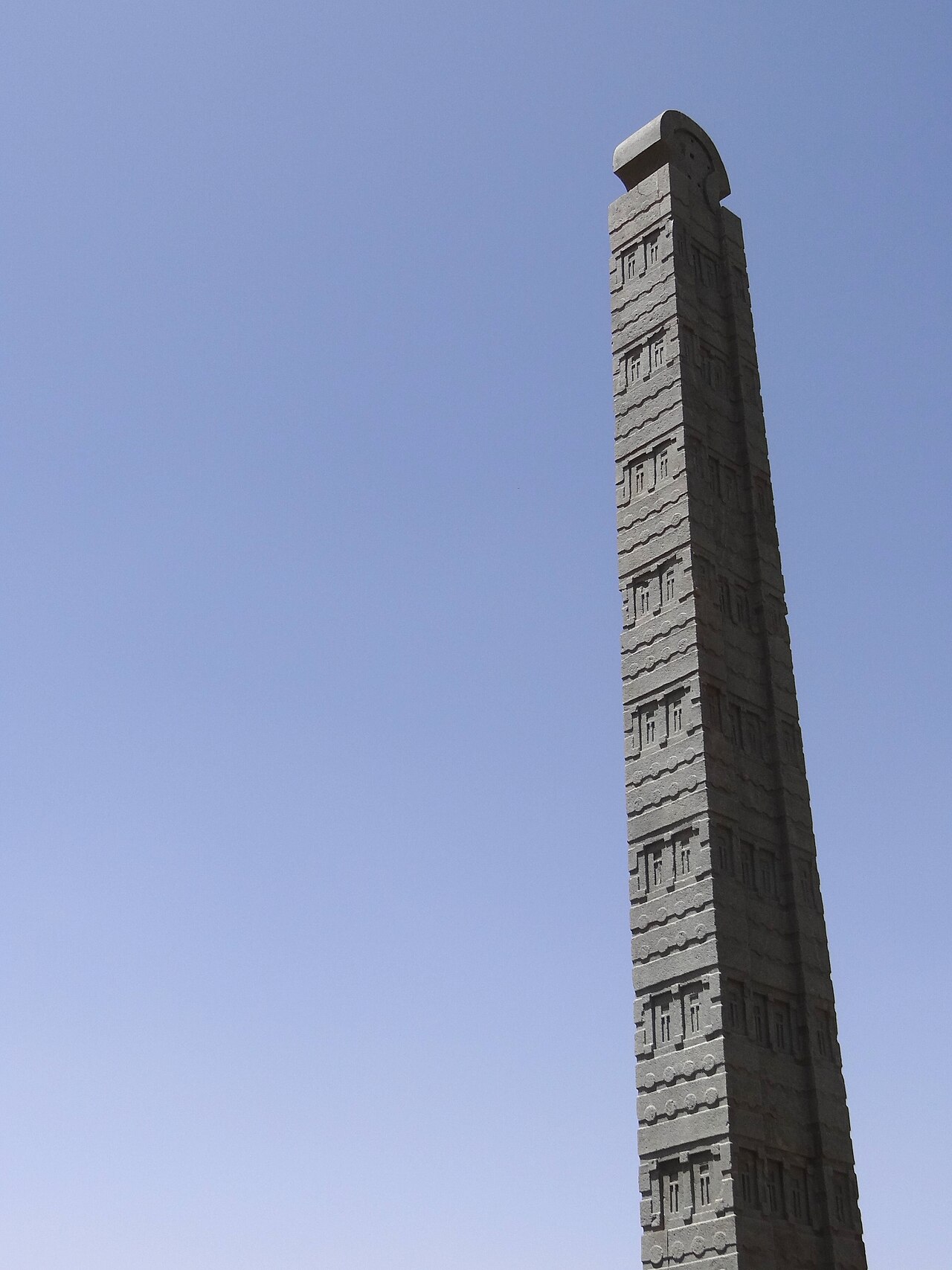
The obelisks are not random pillars—they are architectural narratives of Aksumite identity and cosmology. Each obelisk is carved to resemble a multi-story building, complete with false doors, windows, and beam ends. This design is unique in the ancient world: these are not abstract forms but stone representations of Aksumite palaces or temples, perhaps intended to house the spirit of the deceased.
The most famous example, the Obelisk of Axum (re-erected in 2008 after decades in Italy), stands 24 meters high and features eleven stories of carved windows and doors. At its base, a false door is carved with iron rings—symbolic knockers for the spirit to enter the afterlife. The top is rounded, representing a shield, while the sides are adorned with a pattern of interlocking rectangles that mirror the architectural motifs found in Aksumite buildings.
Scholars believe the obelisks served multiple functions:
- Funerary markers: Each obelisk was erected over a tomb, likely belonging to a king or noble. The size and complexity of the obelisk reflected the social status of the deceased.
- Religious symbols: The obelisks may have been associated with the worship of Astar, a pre-Christian deity, before being repurposed as Christian monuments after the kingdom’s conversion in the 4th century.
- Astronomical alignments: Some researchers suggest that the obelisks were aligned with the movement of the sun and stars, serving as calendars for agricultural and religious festivals.
A Timeline of Triumph and Loss: Key Dates for the Aksum Obelisks Ethiopia
| Date | Event | Significance |
|---|---|---|
| ~200–400 CE | Peak of Aksumite kingdom; major obelisks erected | Construction of the Great Stele (fallen), Obelisk of Axum, and others |
| 1937 | Obelisk of Axum taken by Italian fascist forces | Removed to Rome as war booty; stood near the Ministry of Colonies |
| 1947 | UN agreement for its return | Italy pledged to return the obelisk, but repatriation stalled for decades |
| 2003–2008 | Complex repatriation and re-erection | Obelisk cut into three sections, flown back, and reassembled in Aksum |
| 2008 | Official re-inauguration ceremony | Marked the return of a national symbol; attended by Ethiopian and Italian officials |
The return of the Obelisk of Axum in 2008 was a moment of profound national pride. It was not merely the restoration of a monument—it was the recovery of a piece of Ethiopia’s soul. The project cost over $4 million and required Italian engineers to work alongside Ethiopian archaeologists, using both modern technology and ancient techniques.
Rediscovery and Restoration: The Aksum Obelisks Ethiopia in the Modern Era
The obelisks have not always stood in peace. By the 20th century, many had fallen due to earthquakes, erosion, and human activity. The Great Stele, once the tallest, lies shattered where it fell, a reminder of the fragility of even the most ambitious human works. But the 20th and 21st centuries have seen a concerted effort to study, preserve, and restore these monuments.
The Italian Interlude and Repatriation
In 1937, during Italy’s occupation of Ethiopia, Benito Mussolini ordered the removal of the Obelisk of Axum to Rome. It was transported by ship and re-erected in the Piazza di Porta Capena, near the Circus Maximus, as a symbol of fascist imperial ambition. For decades, Ethiopia demanded its return. Finally, in 2003, after years of diplomatic pressure and a UNESCO-mediated agreement, the obelisk was dismantled and flown back to Ethiopia on three separate Antonov cargo flights. The re-erection, completed in 2008, was a delicate operation involving steel reinforcements and computer modeling to ensure stability.
Preservation Challenges
Today, the standing obelisks face new threats. Weathering from wind and rain, seismic activity in the Rift Valley, and encroaching vegetation all take their toll. The Ethiopian government, in partnership with UNESCO and the World Monuments Fund, has implemented a comprehensive conservation plan. This includes:
- Regular monitoring of structural integrity using laser scanning and drone photography.
- Treatment of stone surfaces with consolidants to prevent flaking and cracking.
- Installation of drainage systems to reduce water damage at the bases.
- Community engagement programs to train local guides and raise awareness among residents.
One of the most innovative projects involved using 3D scanning to create digital replicas of the obelisks. These models allow researchers to study the carvings in minute detail without physical contact, and they serve as a permanent record should any monument be damaged or destroyed.
Living Legacy: The Aksum Obelisks Ethiopia in Contemporary Culture
The obelisks are not frozen in time—they remain a vibrant part of Ethiopian identity. They appear on the national currency, the birr, and feature prominently in school textbooks. In Aksum, local children play in their shadows, and elders still tell stories of the kings who raised them.
The obelisks have also inspired modern architects and artists. The African Union’s headquarters in Addis Ababa, designed by Chinese architects, incorporates obelisk-like forms in its facade. Ethiopian painter Afewerk Tekle, in his famous work “The Birth of Aksum,” depicted the obelisks as symbols of African creativity and resistance. In 2019, the Ethiopian Space Science Society even used satellite imagery to map the underground tombs beneath the obelisks, revealing previously unknown chambers.
Tourism, too, has brought new life to the site. Before the Tigray War (2020–2022), Aksum attracted over 50,000 visitors annually, many from the Ethiopian diaspora. The conflict caused significant damage, including looting and vandalism, but local communities and heritage workers have begun the slow process of restoration. The obelisks, standing resilient, have become symbols of hope for the region’s recovery.
Comparisons and Contrasts: The Aksum Obelisks Ethiopia in Global Context
While the obelisks of Egypt are better known globally, the Aksumite versions are in many ways more remarkable. Egyptian obelisks were typically carved from single blocks of granite from Aswan, but they were smaller on average—the Lateran Obelisk in Rome, the largest surviving Egyptian obelisk, stands 32 meters tall and weighs about 455 tons. The Great Stele of Aksum, had it remained standing, would have been slightly taller and heavier.
But the differences go beyond size. Egyptian obelisks were smooth-sided, covered in hieroglyphic inscriptions, and often erected in pairs at temple entrances. Aksumite obelisks are carved with architectural details, lack extensive text, and were erected singly over tombs. More strikingly, the Aksumite obelisks were carved in situ from local stone, while Egyptian obelisks were quarried hundreds of kilometers from their final destinations and transported on massive barges.
A comparison with other monumental stone traditions is instructive:
- Moai of Easter Island: Like the obelisks, these were carved from volcanic tuff and moved using ropes and wooden sledges. However, the Moai are statues of human figures, not architectural representations, and were erected on stone platforms (ahu) rather than in pits.
- Olmec heads of Mexico: Carved from basalt, these colossal heads weigh up to 50 tons and were transported over 100 kilometers. Like the obelisks, they required immense labor and sophisticated planning, but they represent individual rulers rather than abstract forms.
- Stone circles of Senegal and Gambia: These laterite pillars, dating from the 8th–15th centuries, are smaller and more numerous, but they share a funerary purpose and a deep connection to the landscape.
What unites these traditions is the universal human desire to mark the landscape with symbols of power and memory. The Aksum Obelisks Ethiopia stand as one of the most ambitious expressions of that desire.
Visiting the Obelisks Today: A Practical Guide
For those inspired to see the obelisks in person, Aksum is accessible by road or air from Addis Ababa. Ethiopian Airlines operates daily flights to Aksum’s airport, a 20-minute drive from the city center. The stelae field is open to visitors from 8:00 AM to 6:00 PM, with an entrance fee of around 200 birr (about $4 USD). Guided tours are available and highly recommended—local guides offer insights that no guidebook can capture.
Nearby attractions include the Church of St. Mary of Zion, said to house the Ark of the Covenant (though only the guardian priest may see it), and the tombs of King Kaleb and King Gebre Meskel, with their underground burial chambers. The Aksum Museum, recently renovated, displays artifacts including coins, pottery, and the original iron knockers from the obelisks.
A few practical tips for travelers:
- Best time to visit: October to March, when temperatures are mild and rains are rare.
- What to bring: Comfortable walking shoes, a hat, sunscreen, and plenty of water. The stelae field is exposed and can be hot.
- Cultural sensitivity: Dress modestly, especially when visiting churches. Photography is allowed in the stelae field but may be restricted inside religious sites.
- Safety: Check current travel advisories, as the Tigray region has experienced instability. As of 2024, the situation is improving, but it is wise to consult local authorities and your embassy before traveling.
Conclusion: The Aksum Obelisks Ethiopia as a Mirror of Human Ambition
Standing before these monoliths, one feels the weight of centuries—not just of stone, but of human will. The Aksum Obelisks Ethiopia are more than archaeological relics; they are a testament to what a society can achieve when it organizes its resources, knowledge, and labor toward a shared vision. They remind us that Africa has always been a continent of builders, thinkers, and dreamers, capable of works that rival any in the ancient world.
Their story is also one of loss and recovery—of monuments toppled by earthquakes, looted by colonizers, and slowly, painstakingly restored. In their endurance, they mirror the resilience of the Ethiopian people themselves, who have weathered empire, war, and famine while holding fast to their heritage. As you walk among them, listen closely. In the wind that whistles through their carved windows, you might just hear the echo of a kingdom that once touched the sky.