📅 Last updated: 05.07.2026
- The White Gold of the Sahara: Why Salt Was Worth a King's Ransom
- Geography of a Golden Road: The Great Mines and the Caravan Cities
- The Architects of the Trade: The Peoples of the Desert Edge
- From Camel to Cargo Ship: The Decline of the Classical Trade
- The Salt Routes in a Modern World: A Living Tradition Under Threat
- Beyond the Slab: The Cultural and Culinary Legacy
- The Salt Routes of the Sahara: A Legacy of Resilience and Exchange
The Saharan salt trade was not merely a commercial exchange; it was the arterial system of medieval West Africa, pumping life, wealth, and ideas across a seemingly impassable ocean of sand. For over a millennium, long before the first European caravels rounded the coast of Guinea, the fortunes of empires rose and fell on the back of this most humble of minerals. Salt, a substance we now take for granted, was once worth its weight in gold, and the epic journeys undertaken to secure it forged a legacy that still shapes the economies, cultures, and identities of the Sahel and Sahara today.
The White Gold of the Sahara: Why Salt Was Worth a King’s Ransom
To understand the ferocious value of the Saharan salt trade, one must grasp a fundamental biological and economic reality of pre-modern West Africa. In the hot, humid climates of the forest zones south of the Niger River, the human body loses salt through perspiration at a prodigious rate. Without sufficient dietary salt, muscle cramps, fatigue, and severe health problems quickly set in. While the coastal regions had fish as a salt source, the vast inland empires of Ghana, Mali, and Songhai had a critical deficiency.
Meanwhile, in the Sahara, the situation was perfectly reversed. The desert, particularly the ancient seabeds of the north, was rich in salt but lacked the most essential resource for life: the gold mined in the forests of Bambuk, Bure, and Akan. This created a perfect, symbiotic economic equation. The empires of the Sahel controlled the gold; the Berber and Arab traders of the north and the Sahara controlled the salt. The exchange was brutally simple yet profoundly powerful.
Salt was not just a condiment. It was a preservative essential for storing food through the dry season and for long journeys. It was a vital dietary supplement for livestock. It was a currency for paying armies and purchasing slaves. In the great trading cities of Timbuktu, Djenné, and Gao, a slab of salt from the legendary mines could buy a slave, a horse, or a small fortune in gold dust. The 14th-century Moroccan traveler Ibn Battuta famously described the exchange in the town of Tichitt, where salt was sold for its weight in gold, a testament to its staggering value in the markets of the south.
Geography of a Golden Road: The Great Mines and the Caravan Cities
The sources of this “white gold” were not evenly distributed. A handful of extraordinary sites in the central and western Sahara held a virtual monopoly on the trade for centuries.
The Legendary Mines of Taghaza
Perhaps the most famous—and most brutal—of the salt mines was Taghaza, located in what is now northern Mali. The town was a grim spectacle. Its houses, its mosque, and even its minaret were built entirely from slabs of rock salt. The conditions were hellish. The sun scorched a landscape of blinding white salt pans, with no water, no shade, and no vegetation for miles. Workers, many of them slaves or indentured laborers, quarried the salt with iron tools in the intense heat. The only food source was dates and millet brought in by caravan. Ibn Battuta described it as “a village with no good in it,” yet it was the engine of the empire. The salt was cut into standard-sized slabs, weighing roughly 30 to 40 kilograms, and loaded onto the backs of camels for the perilous 700-kilometer journey south to Timbuktu.
The Enduring Legacy of Taoudenni
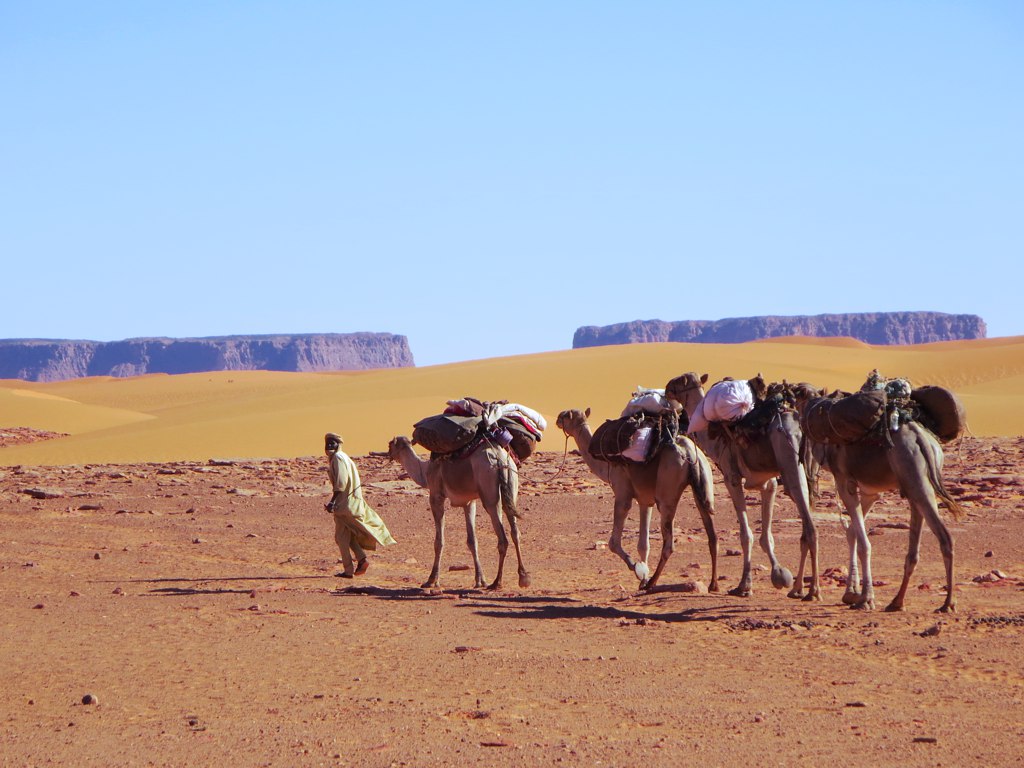
When Taghaza’s salt gave out or became too difficult to work in the 16th century, the focus shifted further north to Taoudenni, a site even more remote and inhospitable. To this day, Taoudenni remains one of the most isolated inhabited places on Earth. The salt is still mined by hand, using the same ancient techniques: cutting, levering, and breaking the salt into slabs. The journey from Taoudenni to Timbuktu, a 20- to 25-day camel trek across open gravel plains and dune fields, is one of the last great traditional Saharan caravans still operating. While the scale is a fraction of its medieval peak, the sight of a line of hundreds of camels, their flanks laden with white slabs, is a living echo of the past.
The Gateway Cities: Timbuktu, Gao, and Djenné
These mines were useless without a market. The cities of the Niger River bend were the great clearing houses. Timbuktu, founded around 1100 C.E. by the Tuareg, became the most famous of them all. It was not a production center but a point of exchange. Salt from the north was unloaded, taxed, and traded for gold, slaves, textiles, and kola nuts from the south. This commercial wealth funded the legendary University of Sankore, turning Timbuktu into a world-renowned center of Islamic learning, science, and literature. The city’s scholars, libraries, and mosques were all built on the profits of salt.
Djenné, further southwest, was the terminus for salt destined for the goldfields. Its magnificent mud-brick mosque, the largest in the world, stands as a monument to the prosperity the trade brought. Gao, the capital of the Songhai Empire, controlled the eastern branch of the trade, linking the salt mines of the Bilma region (in modern Niger) with the markets of Hausaland and Bornu.
The Architects of the Trade: The Peoples of the Desert Edge
The trade was not a monolithic enterprise. It was a complex ecosystem of specialized groups, each playing a crucial role.
- The Tuareg and the Moors (Berbers): The masters of the desert. They were the camel breeders, the guides, and the caravan leaders. Their knowledge of stars, winds, and water sources was legendary. They owned the camels, the “ships of the desert,” and controlled the northern routes. To this day, Tuareg culture is deeply intertwined with the memory and practice of the salt caravans, known as the Azalai.
- The Songhai and the Soninke: The great empire-builders of the riverine Sahel. The Soninke founded the Ghana Empire (not to be confused with modern Ghana), and the Songhai built the largest empire in West African history. They controlled the southern termini, taxed the goods, provided the market infrastructure, and supplied the gold and slaves that the northern traders craved.
- The Hausa: The great merchants and artisans of the central Sudan. They were the processors and distributors of salt and other goods into the forest zone. Their trading networks stretched from the Sahara to the Atlantic coast. Their city-states, like Kano and Katsina, became wealthy manufacturing centers, using Saharan salt to preserve leather and indigo-dyed cloth.
- The Wangara (Dyula): A specialist class of Mande-speaking Muslim merchants. They were the diaspora traders who connected the Sahelian empires with the gold-producing regions of the deep south. They were masters of credit, bookkeeping, and long-distance communication, operating secret trading networks that spanned hundreds of miles.
“The salt comes from the north, the gold from the south, and the silver from the country of the white men, but the word of God and the things of wisdom are found in Timbuktu.” – A West African proverb, often cited by 16th-century European geographers, capturing the city’s tripartite role as a hub of trade, faith, and knowledge.
From Camel to Cargo Ship: The Decline of the Classical Trade
The system that had worked for nearly a thousand years began to unravel in the 15th and 16th centuries, not from within, but from the Atlantic Ocean. The arrival of Portuguese caravels off the coast of modern Ghana and Côte d’Ivoire in the 1470s broke the Saharan monopoly on gold. Europeans could now trade directly for gold on the coast, exchanging textiles, guns, and—ironically—European sea salt for the precious metal. This diverted a massive flow of gold away from the trans-Saharan routes, weakening the empires that depended on it.
The final blow came with the Moroccan invasion of the Songhai Empire in 1591. The Moroccans, armed with arquebuses and cannons, shattered the largest state the region had ever known. They seized Timbuktu, Gao, and Djenné, but they could not replace the Songhai administration. The region descended into a long period of political fragmentation and insecurity. The great caravans became smaller, more frequent, and more dangerous. The intellectual and commercial golden age of the Sahel was over.
The Salt Routes in a Modern World: A Living Tradition Under Threat
Despite the rise of Atlantic trade, colonialism, and modern nation-states, the Saharan salt trade never completely died. It adapted. Today, it operates on a smaller, more regional scale, but it remains a vital economic lifeline for some of the most marginalized communities in the Sahara.
The Azalai of the Tuareg
The most famous surviving caravan is the Azalai from Taoudenni to Timbuktu. Every year, hundreds of Tuareg and Arab camel herders make the grueling 20-day round trip. They carry out dates, millet, and basic goods, and return with up to 400,000 slabs of salt. This salt is not for export to Europe; it is destined for the local markets of Mali and Niger, where it is still used to season food, feed livestock, and preserve fish. For the herders, it provides a crucial source of cash income in a region where few other economic opportunities exist.
New Challenges: Climate, Conflict, and the Modern Economy
But this tradition is under severe pressure. The modern era has introduced three major threats.
- Climate Change: The Sahara is expanding, and the Sahel is drying. The droughts of the 1970s and 1980s decimated camel herds. The traditional pasturelands are shrinking, making it harder for the Tuareg to maintain the large herds of camels needed for a major caravan. The water points along the routes are becoming less reliable.
- Armed Conflict and Insecurity: Since the Tuareg rebellion of 2012 and the subsequent French-led intervention, northern Mali has become a volatile region, riven by jihadist insurgencies, ethnic militias, and state violence. The routes between Taoudenni and Timbuktu pass through areas controlled by various armed groups. Caravans are at risk of robbery, extortion, or being caught in crossfire. The cost of security has skyrocketed, and many young men no longer see the caravan as a viable, safe career.
- The Rise of Industrial Salt: Cheap, iodized industrial salt from factories in Senegal, Morocco, and even Europe is now widely available in West African markets. It is cheaper, cleaner, and more convenient than the heavy, rock-hard slabs from Taoudenni. While many older consumers prefer the taste and purity of Saharan salt, the younger generation is increasingly turning to the industrial alternative.
A Table of Transition: The Old vs. The New
| Feature | Classical Saharan Salt Trade (c. 800-1591) | Modern Saharan Salt Trade (21st Century) |
|---|---|---|
| Primary Product | Rock salt slabs (from Taghaza, Taoudenni, Bilma) | Rock salt slabs (primarily from Taoudenni) |
| Transportation | Camels (the only option for long-distance desert travel) | Camels, plus a small number of 4×4 trucks on shorter routes |
| Primary Market | Gold, slaves, textiles from the empires of Ghana, Mali, Songhai | Cash (CFA francs), dates, millet, livestock |
| Political Context | Stable, centralized empires that controlled and taxed the trade | Fragile states, armed conflict, weak governance in northern Mali |
| Main Competitor | None (Saharan salt had a monopoly on the West African interior) | Industrial sea salt, cheap imports from coastal nations |
| Cultural Significance | Central to identity, power, and wealth of the Sahelian empires | A symbol of Tuareg heritage and resilience, but fading in economic importance |
Beyond the Slab: The Cultural and Culinary Legacy
The impact of the Saharan salt trade is not just a matter of history books or dusty caravans. It is baked into the very fabric of West African life today. You can taste it, hear it, and see it.
In the kitchens of Mali and Niger, the slab of Taoudenni salt is a valued possession. It is not ground into a shaker. Instead, a block is kept in the kitchen, and the cook scrapes a small amount into the pot as needed. The flavor is distinct—cleaner, less bitter than industrial salt, with a subtle minerality.
The trade also left a profound genetic and linguistic mark. The centuries of contact between Berber, Arab, and Sub-Saharan African peoples created new ethnic groups, such as the Arma (descendants of Moroccan soldiers and Songhai women) and the Kunta (a powerful Arab-Berber clerical tribe). The Songhai, Hausa, and Tuareg languages are filled with loanwords from each other, a legacy of centuries of market-place conversation.
Even the architecture tells the story. The great mud mosques of Djenné and Mopti, with their intricate facades and soaring minarets, were not built by accident. They were funded by the taxes on salt. The wealthy merchants who commissioned them were showcasing the fruits of the trade. The style of construction, using mud reinforced with salt-tolerant materials, is a direct response to the environment the trade created.
The Salt Routes of the Sahara: A Legacy of Resilience and Exchange
The story of the Saharan salt trade is ultimately a story of human ingenuity and connection. It is a powerful counter-narrative to the persistent stereotype of the Sahara as a barrier, an empty void separating North Africa from Sub-Saharan Africa. In reality, the desert was a highway, a bridge that connected worlds.
It was a system built on brutal labor and stark inequality, yet it also fostered the creation of some of Africa’s most sophisticated and cosmopolitan states. It bankrolled the university of Timbuktu, where scholars debated law, astronomy, and medicine. It brought the faith of Islam to millions. It created a shared economic and cultural space that transcended ethnic and linguistic boundaries.
Today, as the last of the great camel caravans struggle to survive against the forces of climate change, conflict, and globalization, we are witnessing the end of an era. But the legacy of the salt routes is not confined to the past. It lives on in the resilience of the Tuareg people, in the flavors of a Malian stew, in the very shape of the great mosques of the Niger River, and in the memory of a time when a simple mineral could build an empire. The routes themselves may be fading, but the story they tell—of courage, commerce, and the unbreakable human will to connect—remains as vital and as valuable as the white gold that first carved them into the sand.