📅 Last updated: 05.07.2026
The image of the Dahomey Amazons warriors, a phalanx of women armed with gleaming machetes and rifles, charging into battle with a ferocity that unnerved even hardened European colonizers, is one of the most potent and often misunderstood symbols of pre-colonial African power. They were not mythic figures or a footnote in history; for nearly two centuries, the Ahosi (meaning “king’s wives”) or Mino (“our mothers”) constituted the elite shock troops of the Kingdom of Dahomey, a militaristic state that thrived in what is now the Republic of Benin. Though frequently romanticized in the West as a singular anomaly, the Dahomey Amazons were a complex, evolving institution born of political strategy, spiritual belief, and a unique social order that granted women a level of martial authority unheard of in 19th-century Europe or the Americas. To truly understand these warriors is to understand the intricate and often brutal world of Dahomey itself—a kingdom that waged war not for conquest alone, but for slaves, tribute, and its very survival against the encroaching Atlantic world.
- The Birth of the Dahomey Amazons Warriors: From Royal Guard to Elite Corps
- Training, Discipline, and the Cult of the Warrior
- The Amazons in Battle: From Abeokuta to the French Wars
- A Timeline of the Kingdom and Its Warriors
- Legacy, Myth, and Modern Memory
- The Enduring Question: What Do We Make of Them?
The Birth of the Dahomey Amazons Warriors: From Royal Guard to Elite Corps
The origins of the all-female military corps are not found in a single decree but in a gradual evolution tied directly to the rise of Dahomey as a regional power in the 17th and 18th centuries. The kingdom, founded by the Fon people around 1600, was perpetually surrounded by more powerful neighbors like the Oyo Empire to the east. Dahomey’s survival depended on a centralized, highly disciplined army. Early European accounts from the 1720s, such as those by the Dutch merchant Bosman, mention women serving as bodyguards and hunters for the king. This was not pure chivalry; it was a brutally pragmatic solution. After devastating wars with Oyo, the Fon population had a severe gender imbalance, with many men lost in battle. Arming women, particularly those in the king’s harem, was a way to replenish the army’s ranks with loyal, expendable, and highly motivated fighters.
The corps truly crystallized under the reign of King Ghezo (r. 1818–1858), a transformative figure who modernized the Dahomean state. Ghezo, a warrior-king, understood that the kingdom’s wealth—derived from the slave trade and tribute from conquered peoples—required a formidable military. He dramatically expanded the female contingent, transforming them from a palace guard into a professional, full-time standing army. By the 1840s, estimates from European visitors like the British naval officer Commander Frederick E. Forbes placed the number of female soldiers at between 4,000 and 6,000, roughly a third of the entire Dahomean army. They were not a secret weapon; they were the main weapon. Forbes, who was deeply conflicted in his admiration, wrote of their “martial appearance” and “admirable precision” during the annual military reviews, also known as the “Grand Customs.”
The Social Fabric: Becoming a Mino
How did a woman become one of the Dahomey Amazons warriors? The path was diverse. Some were recruited directly from the royal harem—the king’s several hundred wives—who were seen as the ultimate personal property of the monarch. Others were “given” to the king by their families as a form of tribute or to secure favor. A significant number were volunteers, often young women seeking to escape the drudgery of village life, forced marriages, or seeing it as a path to immense social prestige. For a woman in 19th-century Dahomey, the army was the only avenue to power, wealth, and status outside the confines of domesticity and motherhood.
Once recruited, a woman severed all ties to her former life. She was considered married to the king, a wife of the state. She was forbidden to marry any other man, could not bear children (though some did, secretly), and lived in the royal palace complex under strict military discipline. Her life was the army. This celibacy was not just a moral code; it was a military necessity. A warrior without the competing loyalties of a husband or child was a warrior whose absolute allegiance belonged to the king and her unit. The corps had its own hierarchy, from common soldiers to sergeants, lieutenants, and ultimately, a supreme commander, often a woman of formidable intelligence and ruthlessness. They were armed with a mix of traditional weapons—long, curved machetes called hwi, clubs, and bows—and, increasingly in the 19th century, muskets and rifles acquired from European slave traders in exchange for captives.
“These women were not merely auxiliaries; they were the backbone of the Dahomean offensive. To see them in battle was to witness a force of nature—disciplined, fearless, and utterly without mercy.” — Adapted from the writings of Sir Richard Burton, British consul to Dahomey, 1863.
Training, Discipline, and the Cult of the Warrior
The reputation of the Dahomey Amazons warriors for ferocity was not accidental; it was systematically cultivated. Training was brutal and unrelenting, designed to weed out the weak and forge an unbreakable collective spirit. Recruits were subjected to grueling physical tests: long forced marches under the tropical sun carrying heavy loads, obstacle courses that involved scaling thorny acacia walls, and endless drills with weapons. The most famous—and most shocking to European observers—was their training with live targets. Prisoners of war, often captured from rival kingdoms, were tied to stakes and used as human dummies for machete practice. This was not mere sadism; it was a calculated method to desensitize the warriors to the act of killing, to ensure that when the moment came, they would not hesitate.
Discipline was absolute. Cowardice in battle was punishable by death, often at the hands of one’s own comrades. The warrior code demanded victory or death; retreat was a disgrace. This ethos was reinforced by a powerful spiritual belief system. The Amazons were devotees of the Fon pantheon, particularly the god of war, Gu, and the powerful serpent spirit, Dan. Before battle, they would undergo rituals, consume potent concoctions, and paint their bodies with protective charms. They genuinely believed that if they died in battle, they would be reborn as powerful spirits, returning to the king to serve him again. This fusion of martial discipline and spiritual zeal made them a terrifying opponent. They were not fighting for land or plunder alone; they were fighting for their immortal souls and the divine mandate of their king.
Weaponry and Tactics
Contrary to the popular image of the Amazons as solely machete-wielding shock troops, they were highly tactical and adaptable. Their armament evolved with the changing nature of warfare in the region. A typical Amazon unit would be organized into several specialized groups:
- The Machete Corps (Hwi-no): The most famous. These were frontline assault troops, armed with a long, heavy machete (the hwi) often sharpened to a razor’s edge. Their tactic was to charge the enemy line, breaking their formation with sheer ferocity.
- The Rifle Corps (Vodun-no): Equipped with flintlock muskets and, later, breech-loading rifles, these women were trained markswomen. They provided covering fire and were often deployed in ambushes or to soften enemy positions before a charge.
- The Artillery Corps: In the later years of the kingdom, under King Glélé and King Béhanzin, the Amazons even operated captured cannons. While not highly effective compared to European artillery, their willingness to crew these weapons showed their adaptability.
- The Scouts and Spies: Young, agile women were trained as scouts, moving ahead of the main army to gather intelligence, harass supply lines, and conduct night raids.
Their tactics emphasized speed, surprise, and relentless aggression. They favored dawn attacks and would often feign retreat to draw the enemy into a trap. Their discipline in formation was legendary; they could execute complex battlefield maneuvers with the precision of a well-drilled European regiment, a fact noted with grudging respect by British and French officers.
The Amazons in Battle: From Abeokuta to the French Wars
The true test of the Dahomey Amazons warriors came not in drills but in the crucible of war. Their most famous—and devastating—campaigns were the repeated assaults on the Egba stronghold of Abeokuta (in modern-day Nigeria) in 1851 and 1864. The Egba were a powerful Yoruba subgroup who had established a fortified city-state. In both campaigns, the Amazons led the assault. In the 1851 attack, described by European missionaries who were inside the city, the Amazon charge was initially successful, breaching the outer walls. However, the Egba defenders, armed with superior British-made rifles and fighting from behind strong fortifications, inflicted horrific casualties. The Dahomeans were repulsed, losing thousands, including a significant number of Amazons. The 1864 campaign was an even greater disaster, with the Amazons again taking the lead in a futile assault that ended in a bloody rout. These defeats exposed a key weakness: their ferocity could not overcome superior firepower and prepared defenses.
Despite these setbacks, the Amazons continued to be the core of Dahomean military power. They fought in numerous smaller campaigns against the Mahi, the Ouatchi, and other neighboring peoples, ensuring the flow of slaves and tribute that sustained the kingdom. Their true apocalypse came with the Franco-Dahomean Wars (1890–1894). France, seeking to expand its colonial empire inland from the coastal trading post of Porto-Novo, faced the determined resistance of King Béhanzin, the last independent king of Dahomey. Béhanzin, a brilliant and stubborn leader, relied heavily on his Amazon corps, which by then numbered perhaps 1,500–2,000 elite fighters.
The war was a clash of eras: 19th-century colonial firepower against a pre-industrial African kingdom. The French, armed with modern repeating rifles, machine guns (the Mitrailleuse), and cannon, faced a Dahomean army that relied on courage, machetes, and obsolete muskets. Yet, the Amazons fought with a tenacity that shocked the French. At the Battle of Dogba (1890) and the Battle of Adégon (1892), the Amazons charged French defensive positions in waves, often at night, engaging in brutal hand-to-hand combat. French accounts describe them as “incredibly brave” and “fanatical,” fighting even when wounded, refusing to surrender. In one famous incident, a French officer reported seeing an Amazon, both arms shattered by a bullet, charge a soldier and bite his throat. They were not just fighting for a king; they were fighting for the extinction of their world.
A Timeline of the Kingdom and Its Warriors
| Date | Event | Significance for the Amazons |
|---|---|---|
| ~1720s | King Agaja uses women as elephant hunters and bodyguards. | Earliest documented evidence of women in a military role in Dahomey. |
| 1818–1858 | Reign of King Ghezo. | Massive expansion and professionalization of the Amazon corps. Peak of their power and numbers (4,000-6,000). |
| 1851 & 1864 | Failed wars against Abeokuta. | First major defeats; exposed the limits of their tactics against fortified positions and modern firearms. |
| 1890–1894 | Franco-Dahomean Wars. | Final, heroic, and tragic stand against French colonial forces. The corps is decimated. |
| 1894 | King Béhanzin surrenders; Dahomey becomes a French colony. | The Amazon corps is officially disbanded. Many survivors fade into obscurity. |
Legacy, Myth, and Modern Memory
The end of the Dahomey Amazons warriors was not a single battle but a slow, painful dissolution. After Béhanzin’s surrender in 1894, the French, wary of their fighting spirit, disbanded the corps. Some women were killed in the final battles; others committed suicide rather than surrender. A few were allowed to live in the villages that had grown up around the old palace in Abomey. The last surviving Amazon, a woman named Nawi, died in 1979 in a village near Abomey. She was reportedly over 100 years old. For decades, she had been a living legend, visited by tourists and historians, a fragile link to a vanished world. Her death marked the end of a living tradition that had lasted nearly two centuries.
In the decades since, the Amazons have been subject to both erasure and romanticization. Colonial history often depicted them as bloodthirsty anomalies or, conversely, as tragic victims of a savage king. The 2022 Hollywood film The Woman King, starring Viola Davis, brought them to a global audience, but it also sparked fierce debate. The film took significant liberties, portraying the Amazons as proto-abolitionists fighting against a slaving Oyo Empire, while downplaying Dahomey’s own central role in the slave trade. This historical distortion, while creating a compelling narrative, risks replacing one myth with another. The real Amazons were neither simple heroines nor simple villains. They were the products of a complex, brutal, and sophisticated African kingdom that built its power on warfare and human trafficking. To celebrate their courage without acknowledging the moral context of their service is to do them a disservice.
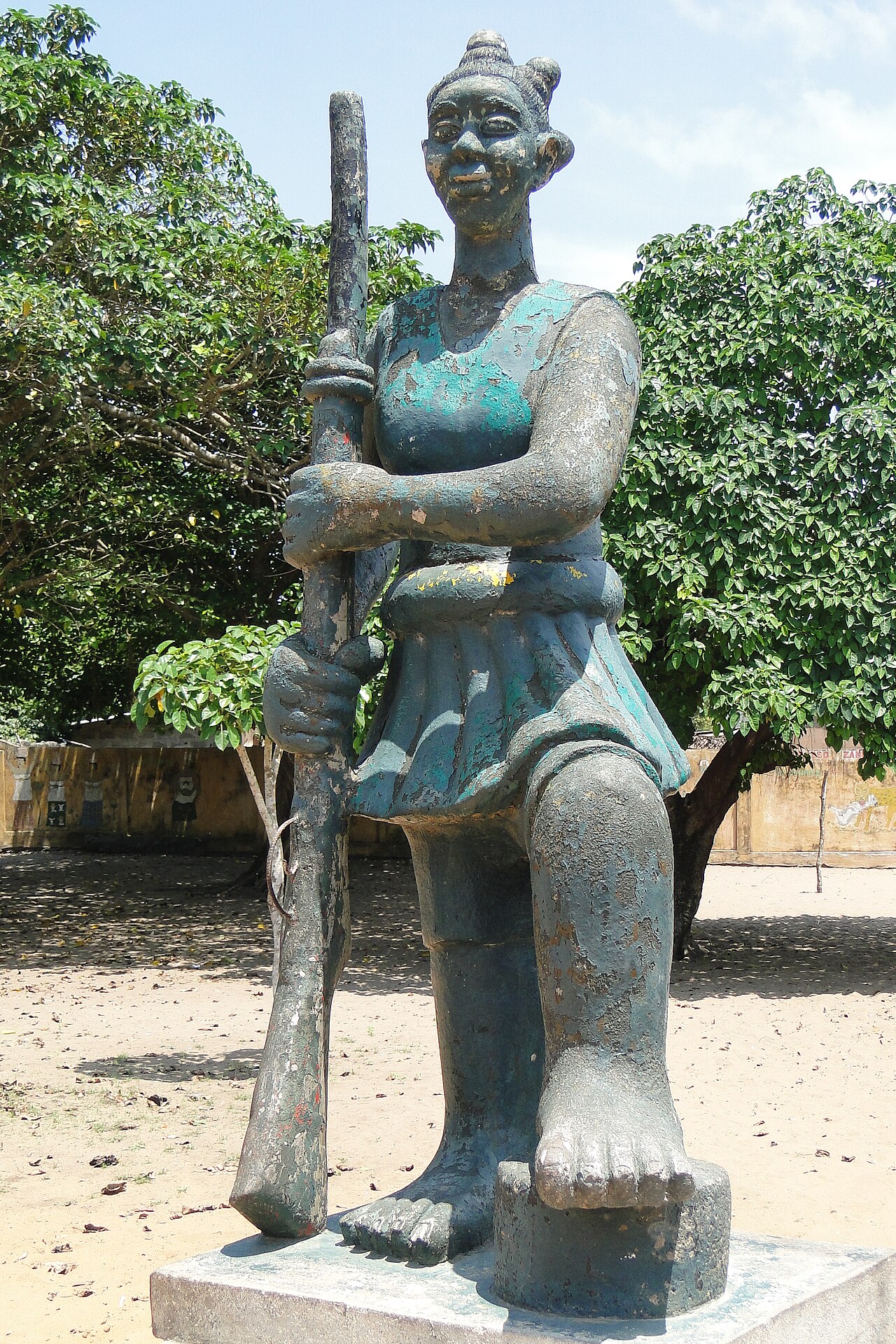
Today, their legacy is being reclaimed with greater nuance. In the Republic of Benin, the Amazons are national icons. Their image appears on currency, in statues, and in the national narrative of resistance against colonialism. The Palais Royaux d’Abomey, a UNESCO World Heritage Site, houses a museum with artifacts and bas-reliefs depicting their exploits. Benin’s modern women’s football team, the Lady Sharks, are often referred to as “The Amazons” in a nod to this martial heritage. The story of the Mino is a powerful reminder that the history of Africa is not a simple story of victimhood. It is a story of incredible complexity, where women could be both warriors and slaves, where a kingdom could resist European colonialism while simultaneously participating in the Atlantic slave trade, and where the most formidable army in the region was composed entirely of women. The Dahomey Amazons were not a feminist utopia; they were a reflection of a specific, time-bound, and deeply human reality—a reality that demands to be understood on its own terms, not ours.
The Enduring Question: What Do We Make of Them?
The story of the Dahomey Amazons warriors resists easy categorization. They were not simply “girl bosses” of the 19th century, nor were they mere pawns of a tyrannical king. They were highly skilled, professional soldiers who lived a life of immense hardship and discipline, and who wielded terrifying power over the enemies of their state. They were also, in many ways, the ultimate expression of Dahomean state power—a power built on the violent extraction of human beings. Their courage is undeniable. Their discipline is legendary. Their loyalty was absolute. But we must also remember what they fought for: a slave-trading empire that thrived on the destruction of other African communities.
This tension is the heart of their story. It forces us to confront a history that is neither black-and-white nor easily celebrated. The Amazons were extraordinary women who did extraordinary things in an extraordinary time. To honor them honestly is to see them in full—not as symbols of a simple cause, but as complex, flawed, and utterly human figures who carved a unique place in history through blood, iron, and an indomitable will. Their legacy is not a lesson in morality, but a testament to the vast, surprising, and often brutal range of human experience. And in that, they remain, centuries later, one of the most compelling stories Africa has ever produced.