📅 Last updated: 05.07.2026
Perched on a granite ridge overlooking the serene Khami Dam, the Khami ruins Zimbabwe offers a quieter, yet no less profound, encounter with the country’s pre-colonial past than its more famous cousin, Great Zimbabwe. While Great Zimbabwe draws the crowds and dominates the historical narrative, Khami remains a hauntingly beautiful testament to the sophistication, artistry, and resilience of the Torwa and Rozvi states that flourished here centuries after the decline of the first great Shona empire. This is not a mere satellite or a lesser copy; Khami is a distinct masterpiece—a city of terraced hills, intricate stonework, and a unique cultural fusion that speaks to the dynamic, interconnected history of southern Africa. To walk its silent passages is to trace the evolution of a civilization, to hear the whispers of a people who adapted, innovated, and built a capital that stood as a beacon of power and refinement for nearly two centuries.
- Unearthing the Legacy: Why the Khami Ruins Zimbabwe Matter
- Architectural Splendor: The Stonework of Khami
- A Timeline of Power: Key Dates at the Khami Ruins Zimbabwe
- Life in the City: Society, Economy, and Daily Existence
- Art and Symbolism: The Hidden Meanings in Stone
- Conservation and the Modern Visitor
- Khami in the Context of Modern Zimbabwe
- Conclusion: The Enduring Whispers of a Lost City
Unearthing the Legacy: Why the Khami Ruins Zimbabwe Matter
To understand the Khami ruins Zimbabwe, one must first place them within the grand tapestry of the country’s pre-colonial urban centers. Most visitors to Zimbabwe are familiar with the iconic Great Zimbabwe, the massive stone city that served as the capital of the Kingdom of Zimbabwe from the 11th to the 15th centuries. But history does not stop with the decline of one empire. After Great Zimbabwe’s abandonment around 1450, its people and their knowledge did not vanish. They dispersed, carrying their architectural traditions and political structures to new lands. One of the most significant successor states was the Torwa dynasty, which established its capital at Khami, approximately 22 kilometers west of modern-day Bulawayo.
The site’s importance cannot be overstated. It is a UNESCO World Heritage Site, recognized in 1986 for its outstanding universal value. Unlike Great Zimbabwe, which is associated with the peak of the Zimbabwean plateau’s first great civilization, Khami represents the continuation and transformation of that civilization. It is a vital link in the chain of Zimbabwean state formation, bridging the gap between the Great Zimbabwe period and the later Rozvi Empire under the Changamire dynasty. The architecture here is not a simple imitation; it is a deliberate evolution. The stone walls at Khami are characterized by intricate chevron and herringbone patterns—decorative motifs far more elaborate than those found at Great Zimbabwe. This stylistic shift suggests a society that was not only preserving its heritage but actively innovating, creating a new aesthetic language of power.
Furthermore, Khami’s location tells a story of strategic adaptation. While Great Zimbabwe was situated in the eastern highlands near the Indian Ocean trade routes, Khami was built further west, closer to the open grasslands and the Limpopo River basin. This shift indicates a reorientation of trade networks, possibly towards the Portuguese-controlled markets on the Mozambican coast and the emerging gold and ivory trade routes to the south. The Torwa rulers were not isolated; they were shrewd participants in a globalized medieval world, exchanging goods and ideas across vast distances. The ruins are not just a pile of stones; they are a physical record of a society’s response to changing economic and political realities.
Architectural Splendor: The Stonework of Khami
Beyond the Granite: A Masterclass in Dry-Stone Masonry
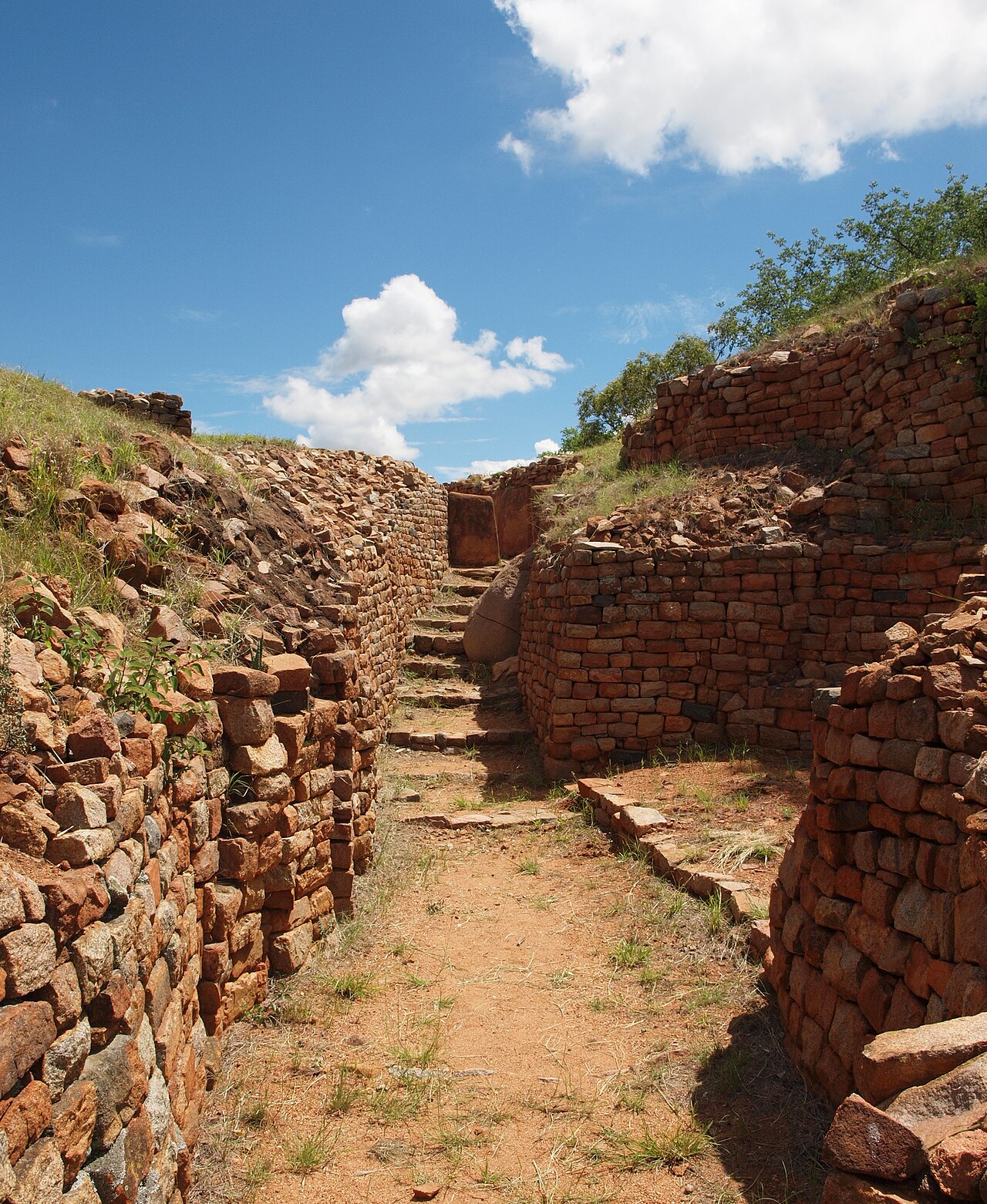
What immediately strikes the visitor to Khami is the sheer artistry of the stonework. The walls are built using the same dry-stone technique as Great Zimbabwe—no mortar, just carefully selected granite blocks fitted together with astonishing precision. But Khami’s builders took this art form to a new level of decorative complexity. The most famous feature is the Precipice Wall, a towering, multi-tiered structure that once formed the retaining wall for the royal palace on the hilltop. Its face is adorned with a repeating chevron pattern—a zigzag design that runs in horizontal bands across the entire length of the wall. This pattern is not merely decorative; it is a statement of royal authority, a visual symbol of the king’s power and the order he imposed upon his realm.
Other walls feature herringbone, checkered, and even dentelle (tooth-like) patterns. The builders achieved these effects by using different colors of granite—some stones are a dark grey, others a lighter, lichen-covered hue—creating a subtle, textured tapestry. This is not the work of anonymous laborers; it is the product of master craftsmen who understood geometry, balance, and the aesthetic impact of their materials. The walls are not just functional barriers; they are works of public art, designed to impress and to communicate the sophistication of the court.
The Hill Complex: The Heart of Power
The central feature of the Khami ruins Zimbabwe is the Hill Complex, a massive, terraced granite outcrop that served as the royal enclosure. Unlike Great Zimbabwe, where the main royal residence was the Great Enclosure in the valley, Khami’s rulers chose to build their palace on a commanding hilltop. This was a deliberate act of separation and control. From the summit, the king could survey his domain—the grazing cattle, the approaching visitors, the river below. The hill was artificially sculpted and terraced with stone walls, creating a series of platforms and passages that led to the inner sanctum. This layout is reminiscent of later Rozvi capitals, where the mambo (king) lived in a secluded, elevated position, reinforcing his semi-divine status.
Excavations on the Hill Complex have revealed the remains of daga (sun-dried mud) huts, which once stood within the stone enclosures. These were not simple dwellings; they were the homes of the royal family and their most trusted advisors. The presence of imported goods—Chinese celadon porcelain, Persian faience beads, and Portuguese glass—confirms that Khami was a node in a vast Indian Ocean trade network. These objects were not just trinkets; they were status symbols, tangible links to a wider world. They demonstrate that the Torwa and later Rozvi kings were cosmopolitan rulers, engaged in diplomacy and commerce with distant powers.
A Timeline of Power: Key Dates at the Khami Ruins Zimbabwe
To grasp the full scope of Khami’s history, a timeline is essential. The following table summarizes the key phases of occupation and development at the site, connecting it to broader regional events.
| Period | Key Developments at Khami | Regional Context |
|---|---|---|
| c. 1450 – 1500 | Initial settlement by the Torwa dynasty after the decline of Great Zimbabwe. Construction of basic stone terraces and walls begins. | Decline of Great Zimbabwe; rise of the Mutapa Empire in the north. Portuguese explorers begin to appear on the Mozambican coast. |
| c. 1500 – 1640 | Peak of the Torwa period. Major expansion of the Hill Complex. Construction of the Precipice Wall and intricate decorative patterns. Khami becomes a major trading center. | Portuguese establish permanent settlements at Sofala and Sena. Gold and ivory trade intensifies. Mutapa Empire reaches its zenith. |
| c. 1640 – 1683 | Torwa rule weakens. Internal strife and pressure from the rising Rozvi under Changamire Dombo. Khami enters a period of transition. | Rozvi expansion from the south. Changamire Dombo defeats Portuguese armies at the Battle of Maungwe (1684). |
| c. 1683 – 1830 | Rozvi conquest of Khami. The site becomes a secondary capital of the Rozvi Empire. Further modifications, but decline in overall population. | Rozvi Empire controls the Zimbabwe plateau. Trade routes shift. Rise of the Nguni kingdoms to the south. |
| c. 1830 – 1900 | Final abandonment of Khami due to the Mfecane (wars of upheaval) and the Ndebele migration northwards. The site falls into ruin and is largely forgotten by the outside world. | Mfecane devastates the region. Ndebele under Mzilikazi settle in western Zimbabwe. European explorers and missionaries begin to document the ruins. |
Life in the City: Society, Economy, and Daily Existence
The People of Khami: A Stratified Society
The Khami ruins Zimbabwe were not a ghost town; they were a living, breathing capital. Archaeological evidence paints a picture of a highly stratified society. At the top was the king, a semi-divine figure who mediated between the ancestors and the living. Below him were the nobility, the priests, and the military commanders, who lived in the stone enclosures on the hill. The common people—farmers, herders, craftsmen, and traders—lived in the surrounding valley in clusters of daga huts. The spatial arrangement of the site physically reinforced this hierarchy: the elite lived on high, the commoners below.
One of the most fascinating aspects of Khami is the evidence of specialized craft production. Archaeologists have found extensive remains of iron smelting, gold working, and pottery manufacture. The site was a major production center for copper and bronze ornaments, including bangles, beads, and ceremonial objects. These items were not just for local use; they were traded far and wide. The presence of crucibles and slag deposits indicates a sophisticated understanding of metallurgy. The people of Khami were not just consumers of imported goods; they were producers whose craftsmanship was valued across the region.
Economy: Cattle, Gold, and the Indian Ocean
The economic foundation of Khami was a blend of pastoralism, agriculture, and long-distance trade. Cattle were the primary measure of wealth and status—a tradition deeply rooted in Shona culture. The surrounding grasslands provided ample grazing, and the king’s herds were vast. But the real engine of Khami’s prosperity was gold. The Torwa and Rozvi controlled access to the rich gold deposits of the Zimbabwe plateau, particularly the mines in the Gwanda and Filabusi areas. This gold was not just for local adornment; it was the primary export that fueled the Indian Ocean trade.
The trade network was remarkably complex. African traders brought gold, ivory, and copper to the coast. In return, they received cotton cloth, beads, porcelain, and glassware from India, China, and Persia. The Portuguese, who arrived in the 16th century, tried to monopolize this trade, but they were never fully successful. The rulers of Khami were skilled negotiators, playing different European and Swahili merchants against each other. This trade brought immense wealth to the city, funding the construction of its monumental stone architecture and supporting a class of non-producing elites.
Art and Symbolism: The Hidden Meanings in Stone
The decorative patterns at Khami are not random; they are laden with meaning. The chevron pattern, for example, is often interpreted as a symbol of fertility and rain—a vital concern for an agricultural society. The herringbone pattern may represent the backbone of a fish or the scales of a crocodile, both creatures associated with water and the spirit world. Some scholars believe these patterns were also linked to the royal lineage, each pattern encoding a specific clan name or praise poem. The walls of Khami were, in effect, a text written in stone, a visual language that spoke to those who understood its codes.
Beyond the walls, Khami has yielded a remarkable collection of soapstone and ceramic figurines. These include stylized human figures, birds, and animals. Perhaps the most famous is the Khami Bird, a soapstone carving similar to the famous Zimbabwe Birds but with distinct stylistic features. These birds are believed to be representations of the shiri yaMwari (the bird of God), a messenger between the human world and the spiritual realm. The presence of these carvings confirms that Khami was not just a political capital but also a major religious center, where the king acted as the chief priest and intermediary with the ancestors.
Conservation and the Modern Visitor
Preserving the Legacy: Challenges and Triumphs
Today, the Khami ruins Zimbabwe face the same challenges as many archaeological sites in Africa: encroaching vegetation, erosion, vandalism, and the pressure of tourism. However, significant efforts have been made to preserve the site. The National Museums and Monuments of Zimbabwe (NMMZ) maintains a permanent team of conservators at Khami. Their work is painstaking: removing invasive plant roots that crack the stone walls, stabilizing loose blocks, and monitoring the impact of weather. In recent years, there has been a push to involve local communities in conservation, recognizing that the site is not just a relic but a living part of their heritage.
Visitors to Khami today will find a site that is remarkably unspoiled. Unlike the bustling crowds at Great Zimbabwe, Khami offers a sense of solitude and contemplation. The site is well-maintained, with clear walking paths and informative signboards. A small museum at the entrance displays artifacts found during excavations, including pottery, beads, and metalwork. The guides are local men and women who are deeply knowledgeable about the site’s history and its place in the broader narrative of Zimbabwe’s past. They are not reciting a script; they are sharing a story that is part of their own cultural identity.
How to Visit: Practical Information
If you plan to visit the Khami ruins, here are a few practical tips to enhance your experience:
- Getting there: The ruins are located about 22 kilometers west of Bulawayo, Zimbabwe’s second-largest city. The drive takes about 30 minutes via the A5 road. Taxis and guided tours are available from Bulawayo.
- Best time to visit: The dry winter months (May to August) are ideal, as the weather is cool and the vegetation is less dense, making the stonework more visible. The summer rains (November to March) can make paths slippery but also bring the landscape to life.
- What to bring: Comfortable walking shoes, sun protection, and plenty of water. The site is spread over a large area, and you will be doing a fair amount of climbing. A hat and sunscreen are essential.
- Guided tours: Strongly recommended. The guides provide invaluable context and can point out details you might otherwise miss. They are also a direct source of income for the local community.
- Nearby attractions: Combine your visit with a trip to the Matobo National Park (about an hour away), home to ancient San rock art and the grave of Cecil John Rhodes. The contrast between these two sites—one a monument to African civilization, the other a monument to colonialism—is deeply thought-provoking.
Khami in the Context of Modern Zimbabwe
For modern Zimbabweans, the Khami ruins Zimbabwe are more than just a tourist attraction. They are a source of national pride and a reminder of a sophisticated pre-colonial past. In a country that has often been defined by its colonial history and its more recent political struggles, sites like Khami offer an alternative narrative—one of African innovation, statecraft, and artistic achievement. They challenge the outdated notion that Africa had no great civilizations before the arrival of Europeans.
Young Zimbabweans are increasingly reclaiming this heritage. University students from the nearby National University of Science and Technology (NUST) in Bulawayo often visit the site for research and inspiration. Local artists and musicians draw on the patterns and symbols of Khami in their work. There is a growing movement to teach the history of these sites in schools, not as a footnote but as a central chapter in the nation’s story. Khami is not a dead monument; it is a living symbol of resilience and cultural continuity.
Conclusion: The Enduring Whispers of a Lost City
The Khami ruins are not merely a collection of old stones; they are a testament to the enduring human spirit. They tell the story of a people who, after the fall of one great empire, had the vision and skill to build another. They speak of trade routes that connected the heart of Africa to the shores of the Indian Ocean, of kings who commanded both spiritual and political authority, and of artists who turned granite into poetry. In the quiet of the afternoon, as the sun casts long shadows across the chevron-patterned walls, it is easy to imagine the city as it once was: alive with the lowing of cattle, the clang of a blacksmith’s hammer, the murmur of a crowd gathered to hear the king’s decree.
To visit Khami is to engage with a profound truth: that Africa’s history is not a blank slate waiting to be written by outsiders. It is a rich, complex, and deeply human story, etched in stone and carried in the memories of its people. The lost city of Khami has been found again, and its whispers are as powerful today as they were five centuries ago. It is a marvel that deserves not just to be seen, but to be understood, respected, and celebrated as a vital part of our shared human heritage. For those who take the time to listen, Khami has much to say. And its message is one of resilience, creativity, and the unbroken spirit of a civilization that refused to be forgotten.