📅 Last updated: 05.07.2026
From the sun-baked peaks of the High Atlas Mountains to the golden sands of the Sahara and the bustling medinas of Fez and Marrakech, Berber culture North Africa stands as one of the most ancient, resilient, and vibrant indigenous traditions on the planet. Often referred to by their own endonym, Imazighen (meaning “free people” or “noble men”), the Berbers are not a single monolithic group but a rich tapestry of tribes, languages, and customs that have shaped the very soul of the Maghreb for thousands of years. To understand North Africa—its food, its music, its architecture, and its politics—one must first understand the Imazighen, a people whose story is one of profound continuity, adaptation, and a powerful modern renaissance.
The Ancient Roots of Berber Culture North Africa
The history of the Berbers begins long before the arrival of the Phoenicians, Romans, Arabs, or French. Archaeological evidence, including the iconic rock art of the Tassili n’Ajjer in southeastern Algeria (a UNESCO World Heritage site), dates back to at least 10,000 BCE. These stunning carvings and paintings depict a very different Sahara: a lush, green savanna teeming with elephants, giraffes, and cattle, inhabited by ancestors of the Imazighen. This period, known as the Neolithic Subpluvial, was the cradle of Berber pastoralism.
Linguistically, the Berber languages (called Tamazight in its various forms) belong to the Afro-Asiatic family, making them distant cousins of ancient Egyptian, Semitic (Arabic, Hebrew), and Cushitic languages. This deep linguistic heritage is a direct line to antiquity, predating the Indo-European languages of Europe by millennia. The earliest written attestations of Berber culture come from Egyptian records, where they were referred to as the Libu or Mashwesh. Later, the Greek historian Herodotus wrote extensively about the Garamantes of the Fezzan (modern-day Libya), a sophisticated Saharan civilization that built underground irrigation systems (foggara) and controlled trans-Saharan trade routes long before the camel was widely used.
- The Ancient Roots of Berber Culture North Africa
- The Arabization and Islamization of Berber Culture North Africa
- The Geography of Identity: Where Berber Culture Lives Today
- Key Expressions of Berber Culture: Language, Art, and Festivals
- Key Dates in the Modern Berber Cultural Revival
- The Berber Diaspora: Carrying the Culture Across the World
- Modernity and Tradition: The Berber Future
- A Living Legacy, A Future Unwritten
The Berbers and the Mediterranean Powers
From the 12th century BCE, the Phoenicians established trading posts along the coast, most famously Carthage (near modern Tunis). Far from being a simple colonial narrative, the relationship between the Imazighen and the Carthaginians was complex. Berber kings like Massinissa (c. 238–148 BCE) of the Massylii tribe became central players in the Punic Wars, first allying with Carthage and then switching to Rome. Massinissa is a pivotal figure: he unified Numidia (a Berber kingdom spanning modern Algeria and parts of Tunisia) and introduced advanced agricultural techniques, making the region a breadbasket for the Mediterranean. His story is a testament to Berber political sophistication and statecraft long before the Arab conquest.
When Rome destroyed Carthage in 146 BCE, the Berber kingdoms did not simply vanish. They resisted, adapted, and integrated. Figures like Jugurtha (c. 160–104 BCE) became legendary for his guerrilla warfare tactics against the Roman Republic, a story immortalized by the historian Sallust. Even under Roman rule, Berber culture thrived. The cities of Timgad (Algeria) and Volubilis (Morocco) were not merely Roman copies; they were vibrant, multicultural hubs where Latin, Punic, and Berber languages mixed. The Romano-Berber kings, such as Juba II and Ptolemy of Mauretania, were patrons of the arts and sciences, with Juba II writing extensively on history and geography.
“The Imazighen have never been a people who simply disappear. They are the bedrock of North Africa, absorbing, resisting, and reshaping every empire that has touched their shores.” — Dr. Fatima Sadiqi, Professor of Linguistics and Gender Studies, University of Fez.
The Arabization and Islamization of Berber Culture North Africa
The arrival of Islam in the 7th century CE was a transformative, yet deeply complex, chapter. The initial Arab conquests were met with fierce resistance. The most iconic resistance leader was Dihya, known to history as Al-Kahina (“the Sorceress”), a Berber queen of the Jarawa tribe in the Aurès Mountains (modern-day Algeria). For nearly a decade (c. 690–703 CE), she united many Berber tribes against the Umayyad Caliphate, leading a powerful army. Her story, blending historical fact and legend, is a powerful symbol of Berber female leadership and defiance. She was eventually defeated, but her legacy looms large.
However, the conversion to Islam was not a passive acceptance. The Imazighen brought their own traditions, legal systems, and spiritual practices into the faith. The rise of the Almoravid (11th century) and Almohad (12th century) dynasties were distinctly Berber movements. The Almoravids, originating from the Sanhaja Berbers of the Sahara, swept north to conquer Morocco and Al-Andalus (Muslim Spain), puritanical in their Sunni Islam but profoundly Berber in their tribal structure. The Almohads, founded by the Masmuda Berber theologian Ibn Tumart, were a reformist movement that built an empire stretching from the Atlantic to Tripoli. These dynasties were not “Arab” empires; they were Berber empires that ruled in the name of Islam, creating some of the most magnificent architecture in the Islamic world, including the Koutoubia Mosque in Marrakech and the Giralda in Seville.
Despite this synthesis, Arabization was a slow, centuries-long process, accelerated by the migration of Bedouin Arab tribes (the Banu Hilal and Banu Sulaym) in the 11th century, which disrupted Berber pastoral and agricultural systems in the plains. Over time, many Berbers adopted Arabic as their first language, especially in urban centers and coastal plains. Yet, in the mountains, the deserts, and the remote valleys, the Berber language and identity remained the bedrock of daily life.
The Geography of Identity: Where Berber Culture Lives Today
Today, the Imazighen are estimated to number between 25 and 40 million people across North Africa, with the largest populations in Morocco (where they comprise roughly 40-50% of the population) and Algeria (where they make up 25-30%). Significant communities also exist in Tunisia, Libya, Mauritania, Mali, Niger, Burkina Faso, and a substantial diaspora in France, Belgium, the Netherlands, and Canada. This is not a relic of the past; it is a living, breathing culture that adapts to modernity.
Morocco: The Atlas Mountains and the Souss Valley
In Morocco, Berber culture is most visible in three main regions:
- The Rif Mountains (north): Home to the Riffian (Tarifit) people, known for their fierce independence (the Republic of the Rif, led by Abd el-Krim, fought both Spain and France in the 1920s) and their distinctive blue-and-white architecture in towns like Chefchaouen.
- The Middle and High Atlas Mountains: Dominated by the Tamazight (Central Atlas) and Tashelhit (Shilha) speakers. This is the heartland of the iconic Berber carpet, the argan oil cooperatives run by women, and the dramatic ksars (fortified villages) like Aït Benhaddou.
- The Souss Valley and Anti-Atlas: A fertile region where Tashelhit is the dominant language. The city of Agadir is a major urban center of Berber identity, and the region is famous for its music, including the Rwais troubadour tradition.
Algeria: Kabylia, the Aurès, and the Mzab
Algeria’s Berber communities are equally diverse and politically significant:
- Kabylia: A mountainous region east of Algiers, home to the Kabyle (Taqbaylit) people. Kabyles have been at the forefront of the Berber cultural and political revival, known as the Printemps Berbère (Berber Spring) of 1980, when massive protests forced the government to recognize Berber identity. The region is known for its dense olive groves, its fierce secularism, and its diaspora communities in France.
- The Aurès Mountains: The land of the Chaoui (Tacawit) people, a rugged, arid region that was a major center of resistance during the Algerian War of Independence (1954-1962). The Chaoui are known for their distinctive music and their strong, independent spirit.
- The Mzab Valley: A UNESCO World Heritage site, this is a dramatic, arid valley where the Mozabite (Tumzabt) people, followers of the Ibadi sect of Islam, built five perfectly preserved fortified towns (ksour). Their unique, egalitarian social structure and strict water management are a marvel of adaptation.
Key Expressions of Berber Culture: Language, Art, and Festivals
To truly appreciate Berber culture North Africa, one must look at its tangible and intangible expressions. It is a culture that speaks through symbols, music, and a deep connection to the land.
The Tifinagh Script and the Fight for Linguistic Recognition
The Berber language, Tamazight, has its own ancient script, Tifinagh, which evolved from the Libyco-Berber script used over 2,500 years ago. For centuries, it was a script of the Tuareg (the “blue people” of the Sahara) and was largely unknown to other Berber groups. However, in the late 20th century, a modernized version of Tifinagh (called Neo-Tifinagh) was developed and promoted by Berber cultural activists. In 2003, Morocco officially recognized Tamazight as a national language, and in 2011, it was elevated to an official language alongside Arabic. Algeria followed a similar path, recognizing Tamazight as a national language in 2002 and an official language in 2016. This was a monumental victory for a language that was once banned from schools and public life. Today, you can see Tifinagh script on government buildings, road signs, and school textbooks across the Maghreb.
Art, Weaving, and the Symbolism of the Berber Carpet
Berber art is geometric, abstract, and deeply symbolic. The most famous expression is the Berber carpet (often called a kilim or rag rug in the West, though there are many distinct types like the Zanafi from the Middle Atlas or the Boucherouite from the High Atlas). These are not merely decorative items; they are woven narratives. Each tribe, each family, and often each woman has her own repertoire of symbols—diamonds for protection, zigzags for water, crosses for the four corners of the earth, and stylized representations of the mother goddess (a pre-Islamic motif). The dyes are often natural: henna for brown, saffron for yellow, indigo for blue, and pomegranate for red. The act of weaving is a meditative, communal practice, passed down from mother to daughter.
Festivals: The Beat of the Tamazgha
Berber festivals are a vibrant explosion of music, dance, and color, often tied to the agricultural calendar. Here are some of the most important:
- Yennayer (Berber New Year): Celebrated on January 12th (or 13th in some communities), this is the most important secular holiday. It marks the start of the agricultural year. Families gather to eat a special meal, often a couscous with seven vegetables (symbolizing abundance) or a chicken tagine. It is a day of feasting, storytelling, and reaffirming family ties.
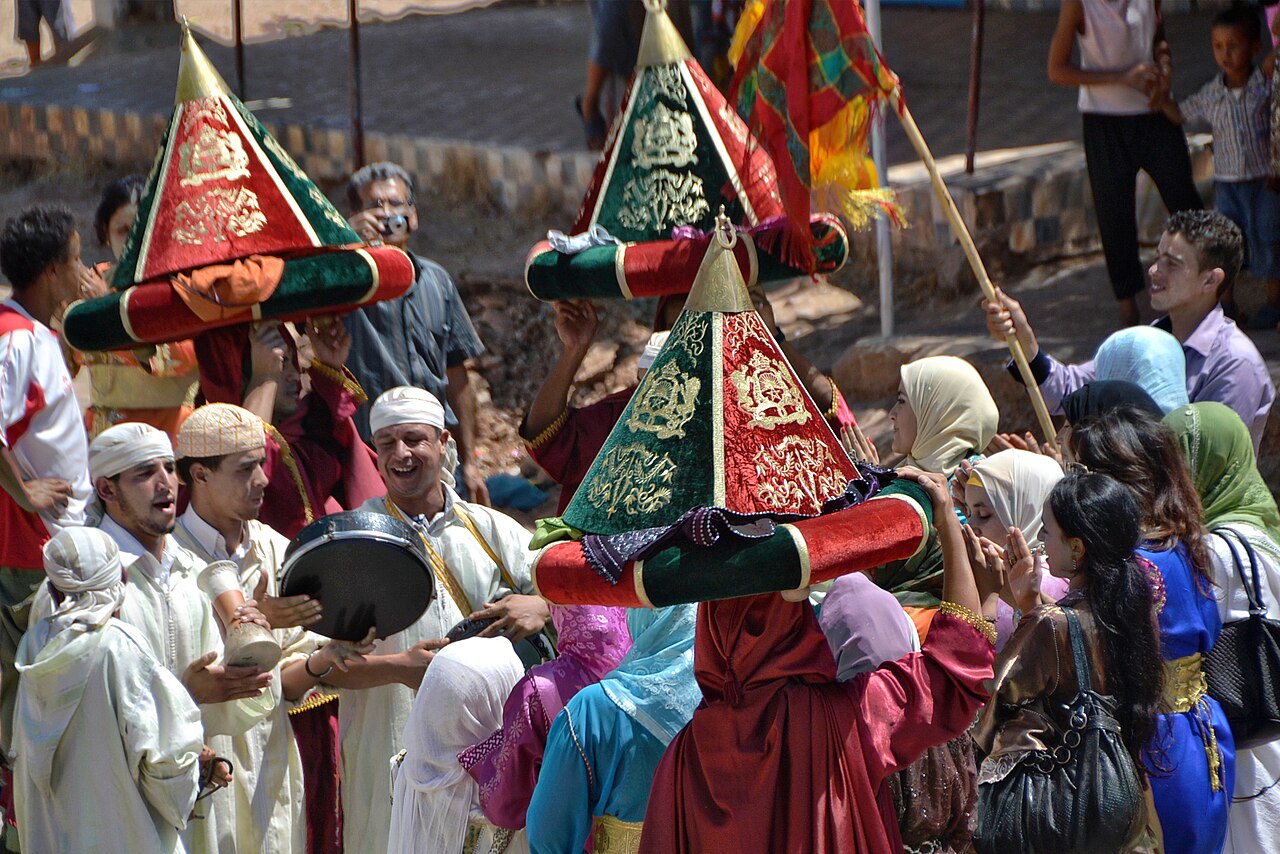
- Imilchil Marriage Festival (Morocco): Held annually in September in the High Atlas, this is a unique “brides’ fair” where young men and women from the Aït Haddidou tribe can meet and choose a partner. It is a vibrant, joyful event filled with music, dancing, and the famous fantasia (a traditional horse-riding display).
- Ghadames Festival (Libya): In the “Pearl of the Desert,” the Tuareg people of Ghadames hold a festival of music, poetry, and camel races, celebrating their nomadic heritage in the stunning setting of a UNESCO-listed desert oasis.
- Festival of the Sahara (Douz, Tunisia): A major event celebrating the culture of the Mrazig Berbers, featuring camel racing, traditional tent living, and nightly performances of folk music and dance.
Key Dates in the Modern Berber Cultural Revival
The struggle for recognition has a clear timeline. The following table highlights critical milestones in the modern history of Berber identity.
| Year | Event | Significance |
|---|---|---|
| 1945 | Creation of the Académie Berbère in Paris | A key early step in standardizing the Tifinagh script and promoting Berber culture among the diaspora. |
| 1980 | Tafsut Imazighen (Berber Spring) in Kabylia, Algeria | Massive protests and a general strike after a lecture on Berber poetry was banned. The state violently suppressed the protests, but it became a foundational moment for the modern Berber movement. |
| 1994 | King Hassan II of Morocco declares “Tamazight is a national treasure” | A major rhetorical shift for Morocco, though it took years for real policy to follow. The same year, the first Berber satellite TV channel (Berbère Télévision) launched in France. |
| 2001 | Creation of the Royal Institute of Amazigh Culture (IRCAM) in Morocco | A state-funded body tasked with promoting and preserving Tamazight language and culture. It has been instrumental in developing curricula and publishing materials. |
| 2011 | Tamazight becomes an official language of Morocco (via new constitution) | After the Arab Spring protests, Morocco’s new constitution elevated Tamazight to official status alongside Arabic, a historic legal victory. |
The Berber Diaspora: Carrying the Culture Across the World
The Berber story is not confined to North Africa. A massive diaspora, primarily in France (estimated at 2-4 million people), but also in the Netherlands, Belgium, Canada, and the United States, plays a crucial role in the cultural revival. For many second and third-generation Imazighen, the struggle for identity is personal. They navigate between the secular, individualistic societies of the West and the collectivist, traditional values of their parents.
This diaspora has become a powerhouse of cultural production. Berber music, particularly the fusion genre of Assouf (meaning “nostalgia” in Tamasheq, the Tuareg language), has found a global audience. The band Tinariwen, from the Tuareg region of Mali, won a Grammy Award in 2012 for their album Tassili, blending electric guitars with ancient desert rhythms and songs of resistance. In France, artists like Idir (the late, legendary Kabyle singer) and Souad Massi (an Algerian singer-songwriter) have brought Berber poetry and melodies to international pop and folk audiences. Diaspora filmmakers, such as the Moroccan-Dutch director Mourad Boucif, create documentaries and films that explore the complexities of Berber identity in Europe. The internet and social media have also been transformative. Facebook groups, YouTube channels, and apps like Tamazight (a language-learning app) are connecting Berbers worldwide, creating a virtual Tamazgha that transcends national borders.
Modernity and Tradition: The Berber Future
Berber culture is not a museum piece. It is a dynamic force in contemporary North Africa. In politics, Berber activism has shifted from a focus on language rights to broader issues of democracy, civil liberties, and social justice. The Hirak Rif movement in northern Morocco (2016-2017) was a massive, popular protest led by a young Berber activist named Nasser Zefzafi. It was not just about economic inequality; it was a demand for dignity and a rejection of a centralized, Arab-centric state. The movement was brutally suppressed, but it demonstrated the enduring political power of Berber identity.
Economically, Berber regions are experiencing a boom in rural tourism and cooperative-based economies. Women’s argan oil cooperatives in the Souss region of Morocco have become a global success story, empowering women financially while preserving traditional knowledge. The demand for authentic Berber crafts—carpets, pottery, jewelry—has created a sustainable economic model for many mountain communities, though it also faces the challenges of commodification and exploitation. The key is to ensure that the benefits of this economic activity flow back to the communities themselves.
There are also significant challenges. The continued dominance of Arabic in education and media means many young Berbers are losing fluency in Tamazight. The rural-to-urban migration empties villages of their youth, weakening the transmission of oral traditions. And climate change is devastating the traditional pastoral and agricultural lifestyles in the Atlas and the Sahara. Yet, the resilience that has defined the Imazighen for millennia remains. The fight for recognition has been won at a legal level in Morocco and Algeria; the next battle is for true implementation and for the culture to be seen not as a “folkloric” relic but as a living, modern, and essential part of North Africa’s future.
A Living Legacy, A Future Unwritten
To speak of Berber culture North Africa is to speak of a people who have never surrendered their essence. They are the weavers of the finest carpets, the singers of the most haunting desert blues, the builders of the most beautiful ksour, and the keepers of a language that echoes the very dawn of civilization. From the ancient rock art of the Sahara to the protest chants of the Hirak, from the cooperative women pressing argan oil to the Tuareg rebels driving pickup trucks across the Sahel, the Imazighen are a testament to the power of identity. They remind us that “free people” are not a thing of the past, but a constant, evolving, and defiant presence in the heart of Africa. Their story is not over; it is being written every day, in the red earth of the Atlas, the blue of the Mediterranean, and the global circuits of the diaspora. It is a story of survival, creativity, and an unbreakable connection to the land and the ancestors. It is, in every sense, the story of a people who have never stopped being free.