📅 Last updated: 05.07.2026
In late 1897, a British military expedition sacked the ancient city of Benin, in what is now Nigeria, and in the process, they stole thousands of masterpieces of royal art — objects that the world would come to know as the Benin Bronzes. These were not mere curiosities; they were the pinnacle of West African artistry, a thousand-year chronicle of a powerful kingdom cast in brass, copper, and ivory. Today, over a century later, these works are at the center of a global movement for restitution, a story that weaves together colonial violence, aesthetic genius, and the long, complex journey home.
- The Art of the Edo Kingdom: More Than Metal
- The Punitive Expedition: How the Benin Bronzes Were Looted
- The Global Diaspora of the Bronzes
- The Case for Return: Restitution and Justice
- Museums and the Politics of Possession
- The Long Road Home: Logistical and Political Challenges
- The Future of the Benin Bronzes: A New Chapter
- A Homecoming, Not a Conclusion
The Art of the Edo Kingdom: More Than Metal
To understand the Benin Bronzes, one must first understand the kingdom that created them. The Oyo Empire may have dominated the savannah, and the Asante Confederacy the gold-rich forests, but the Edo Kingdom of Benin, with its capital at the heart of the Niger Delta, was a civilization of unparalleled sophistication. By the 15th century, the Oba (king) ruled from a sprawling palace complex filled with courtyards and galleries. It was here that a guild of master craftsmen, the Igun-Eronmwon, perfected the art of lost-wax casting.
The so-called “Bronzes” are actually a misnomer; many are made of brass, a fact that reveals the kingdom’s deep engagement in global trade. Portuguese traders, who arrived in the late 15th century, brought manillas — horseshoe-shaped brass bracelets used as currency — which Edo smiths melted down to create their art. This was not a culture isolated from the world; it was a dynamic, discerning power that absorbed foreign materials and transformed them into something uniquely its own.
What the Bronzes Depict
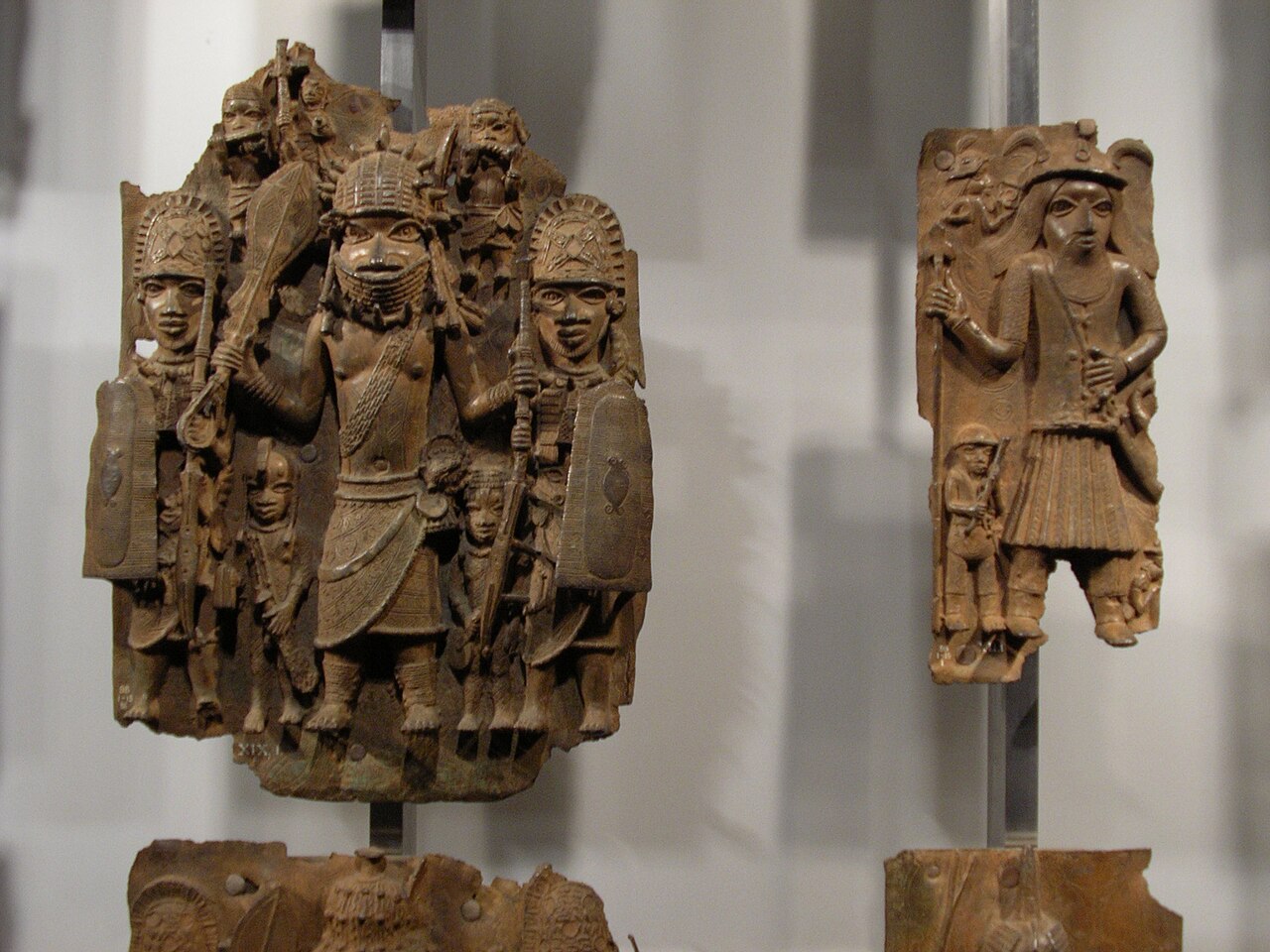
The plaques, which once adorned the wooden pillars of the Oba’s palace, are a visual encyclopedia of Edo life. They show warriors in elaborate coral-bead regalia, Portuguese mercenaries with matchlock muskets, leopards symbolizing the Oba’s power, and scenes of courtly ritual. The heads of Obas, cast in brass, were placed on ancestral altars, each one a conduit between the living ruler and his predecessors. There were also intricate ivory tusks, carved with scenes of sacrifice and history, and staffs of office so finely wrought they seem to defy the hardness of their material.
The skill is breathtaking. The pieces are cast with a precision that rivals the Renaissance bronzes of Italy, but their aesthetic is entirely their own — a formal, symmetrical, yet intensely expressive style that conveys power, spirituality, and social order. As the Nigerian writer and Nobel laureate Wole Soyinka once remarked, these works are not just art; they are “the archives of a civilization.”
The Punitive Expedition: How the Benin Bronzes Were Looted
The story of the Benin Bronzes is inseparable from the violence of 1897. The official British narrative claimed the expedition was a “punitive measure” in response to the ambush and killing of a British delegation led by Acting Consul General James Phillips. The Edo version, supported by historical evidence, is more nuanced: Phillips had repeatedly ignored Edo warnings not to enter Benin City during a sacred ritual period. He was perceived as a threat, and his party was attacked.
The British response was swift and ruthless. A force of approximately 1,200 Royal Marines and local troops, armed with Maxim guns, marched on Benin City. They met fierce resistance from Edo warriors, but the technological disparity was overwhelming. The city fell after a few days of fighting, and the British ordered it burned. The Oba was captured and exiled to Calabar.
What followed was a systematic looting of the royal palace. Captain Herbert Boisragon, one of the few survivors of the earlier attack, later described the scene: “The quantity of loot was enormous. Brass heads, ivory tusks, carved wooden figures, coral beads — all were taken.” The British officers and men were given permission to take whatever they wanted. The objects were then sold off in London to pay for the cost of the expedition. They entered the collections of the British Museum, the Ethnologisches Museum in Berlin, the Musée du Quai Branly in Paris, and dozens of other institutions across Europe and North America.
The scale of the theft was staggering. Estimates suggest that over 4,000 objects were taken. Today, fewer than 200 remain in Nigeria. The rest are scattered across the globe, the spoils of a colonial war that has never been fully acknowledged.
The Global Diaspora of the Bronzes
For over a century, the Benin Bronzes have been the subject of scholarly study, public admiration, and bitter controversy. They have been displayed in the world’s great museums, often as the centerpiece of African art galleries, yet their presence there has always carried a shadow. They are, in the words of one curator, “celebrated objects with a contested history.”
Below is a brief timeline of key moments in the post-1897 life of the Bronzes:
| Year | Event | Significance |
|---|---|---|
| 1897 | The Punitive Expedition and looting of Benin City. | Over 4,000 objects dispersed globally. |
| 1910 | First major exhibition of looted Benin art in Europe (Berlin). | Catapulted the Bronzes into the Western art canon. |
| 1930s-1960s | Nigerian independence movement and early repatriation requests. | Initial demands largely ignored by European museums. |
| 1977 | FESTAC ’77 (Second World Black and African Festival of Arts and Culture) in Lagos. | A single ivory mask became the festival’s emblem, symbolizing the loss. |
| 2022 | Germany signs a joint declaration with Nigeria to return over 1,100 objects. | A watershed moment in the restitution movement. |
The Bronzes have not only been in museums; they have been in private collections, auction houses, and even used as diplomatic gifts. A single brass head of an Oba sold at Christie’s in 2021 for over £10 million — a price that underscores both the immense value of the works and the irony of their continued commodification.
The Case for Return: Restitution and Justice
The argument for returning the Benin Bronzes to Nigeria is not simply about property. It is about justice, cultural sovereignty, and the healing of historical wounds. For the Edo people, the Bronzes are not just art; they are living objects, imbued with spiritual power and intimately connected to the Oba’s throne. To have them locked away in glass cases in London or Berlin is a form of cultural amputation.
Legal and Ethical Arguments
The legal case is complex. Most European museums argue that the objects were acquired legally under the laws of the time, or that they are protected by statutes that prevent deaccessioning. However, international law has evolved. The 1970 UNESCO Convention on the Means of Prohibiting and Preventing the Illicit Import, Export and Transfer of Ownership of Cultural Property, though not retroactive, has created a new ethical standard. More importantly, the 2019 report by French art historian Bénédicte Savoy and economist Felwine Sarr, commissioned by President Emmanuel Macron, argued forcefully that objects taken without consent during colonial conquests should be returned.
The ethical case is even stronger. The Benin Bronzes were not bought or traded; they were stolen in a military campaign that was itself a war crime. To insist on keeping them is to defend the fruits of colonial violence. As the Oba of Benin, Ewuare II, has stated: “These objects are part of our history, our identity, our soul. They were taken from us by force, and they must be returned.”
The Nigerian Response
Nigeria has not been passive. The National Commission for Museums and Monuments has pursued claims for decades. The Edo State Government, under Governor Godwin Obaseki, has been particularly proactive, establishing the Edo Museum of West African Art (EMOWAA) in Benin City. Designed by the acclaimed Ghanaian-British architect Sir David Adjaye, the museum is being built on the grounds of the Oba’s palace, designed to house the returned Bronzes in a context that honors their original function. This is not a request for charity; it is a demand for restoration.
Museums and the Politics of Possession
The response from Western museums has been mixed, ranging from grudging acknowledgment to outright obstruction. The British Museum, which holds the largest collection of Benin Bronzes outside Nigeria (approximately 900 objects), has been the most intransigent. It argues that the 1963 British Museum Act prevents it from returning objects permanently, and that the Bronzes are part of a “universal heritage” that should be shared with the world. Critics call this a colonial argument in disguise — a way for the former empire to maintain control over the narrative of its own crimes.
Other institutions have been more progressive. The University of Aberdeen in Scotland and the Horniman Museum in London have both returned Bronzes to Nigeria. The Smithsonian Institution in Washington, D.C., has also agreed to return 39 objects. But these are small gestures compared to the scale of the diaspora. The real breakthrough came in 2022, when Germany signed a joint declaration with Nigeria to transfer ownership of over 1,100 Benin Bronzes from its state museums. This was the largest single restitution agreement in history, and it sent shockwaves through the museum world.
Germany’s decision was not purely altruistic. It was driven by a growing awareness of its own colonial past in Africa (notably in present-day Tanzania, Namibia, and Togo) and by pressure from a new generation of activists and scholars. But the move also exposed the hypocrisy of other nations. As a German official noted, “If we can do it, why can’t the British?”
The Long Road Home: Logistical and Political Challenges
Returning the Benin Bronzes is not as simple as putting them on a plane. There are profound logistical, political, and cultural challenges. The first question is: where will they go? The EMOWAA museum is still under construction, and there are concerns about security, climate control, and conservation in a city that faces regular flooding and infrastructural deficits. Critics within Nigeria have also raised questions about governance: will the returned objects be controlled by the federal government, the Edo State government, or the Oba’s palace? These are not trivial issues.
There is also the problem of the “orphan” objects — those in private hands or in small museums that may be difficult to trace or recover. And then there is the question of compensation. Some Nigerian voices have argued that the return should be accompanied by financial reparations for the damage done to the kingdom’s cultural fabric.
Despite these challenges, the momentum is clearly in favor of return. A new generation of museum professionals in Africa and the diaspora is reframing the debate. They are not just asking for objects back; they are demanding a new relationship between African cultural institutions and the global museum community — one based on partnership, not paternalism.
The Future of the Benin Bronzes: A New Chapter
The return of the Benin Bronzes is not an end, but a beginning. It opens the door to a deeper reckoning with the legacies of colonialism, not just in Africa, but across the Global South. It also offers an opportunity to rewrite the narrative of African art — not as a “primal” or “ethnographic” curiosity, but as a living, evolving tradition that continues to inspire contemporary artists.
In Lagos, the young artist Victor Ehikhamenor has created works that directly reference the Bronzes, using digital media and mixed materials to critique their absence. In Benin City, a new generation of brass casters is reviving the techniques of the Igun-Eronmwon guild, creating works that speak to both the past and the present. The Bronzes are not frozen in time; they are catalysts for a cultural renaissance.
What the Return Means for Africa
The return of the Bronzes is a symbol of Africa’s assertion of its own narrative. For too long, African history was written by outsiders, its art displayed in foreign museums as evidence of a “lost” civilization. The Bronzes are proof that the Kingdom of Benin was not lost; it was stolen. Their return is a small but powerful act of reclamation.
It also sets a precedent. If the Benin Bronzes can be returned, then what about the Ethiopian Maqdala treasures in the British Museum? The Asante gold in the V&A? The Okukor (a Benin bronze cockerel) at Jesus College, Cambridge? The list is long, and the pressure will only grow. The Benin Bronzes are the vanguard of a movement that will reshape the global cultural landscape for decades to come.
A Homecoming, Not a Conclusion
The story of the Benin Bronzes is not a simple tale of victims and villains. It is a story of extraordinary artistic achievement, of brutal colonial violence, of resilience and resistance, and of a long, patient struggle for justice. As the first objects begin to arrive in Benin City, they will be greeted not with triumphalism, but with ceremony — a recognition that they are coming home to a place that has never forgotten them.
For the Edo people, the return of the Bronzes is a restoration of dignity. For the rest of the world, it is a lesson in humility — a reminder that the great museums of the West are not just repositories of beauty, but also archives of loss. The Bronzes are finally coming home, and with them, a small piece of a story that was always meant to be told in Africa. The journey is far from over, but the direction is clear. The future of the Benin Bronzes is not in a glass case in London; it is in the hands of the people who made them, and who will now decide their fate.