📅 Last updated: 05.07.2026
From the ancient, sun-scorched coral ragstones of Kilwa to the labyrinthine, carved wooden doors of Lamu, the story of the Swahili Coast civilizations is not a footnote in world history, but a vibrant, thousand-year epic of ingenuity, cosmopolitanism, and resilience. These were not mere outposts of foreign empires, but sophisticated, independent city-states—a unique civilization forged in Africa, by Africans, that became the vital commercial and cultural hinge between the interior of the continent and the vast maritime world of the Indian Ocean. To walk their shores today is to walk through a living museum of trade, faith, and fusion.
- The Crucible of the Monsoon: Geography and the Birth of Swahili Coast Civilizations
- The Golden Age: Kilwa, Mombasa, and the Zenith of Swahili Power
- Architecture in Coral and Mangrove: A Distinctly African Aesthetic
- The Swahili People: Language, Faith, and a Cosmopolitan Identity
- Trade, Gold, and the Indian Ocean World: The Economic Engine
- Clash of Empires: The Portuguese Conquest and Swahili Resistance
- Legacy and Modern Revival: The Swahili Coast Today
- Conclusion: Beyond the Ruins—A Civilization of the Future
The Crucible of the Monsoon: Geography and the Birth of Swahili Coast Civilizations
The very existence of the Swahili Coast civilizations was dictated by the rhythm of the wind. The monsoon winds—the Kaskazi blowing from the northeast from December to March, and the Kusi from the southwest from May to October—created a predictable, two-way sailing highway across the Indian Ocean. This natural phenomenon was the engine of the Swahili world.
Stretching roughly 1,800 miles from Mogadishu in modern-day Somalia down to the Zambezi River in Mozambique, the coast offered a series of deep, sheltered harbors and fertile islands. The earliest settlements, dating back to the 1st millennium CE, were small fishing and farming villages inhabited by the Bantu-speaking ancestors of the Swahili people. They built with mud-and-wattle, fished the rich coral reefs, and traded locally. This was the African foundation upon which everything else would be built.
By the 8th century, these villages began to transform. The monsoon winds brought not just seasonal rain, but also merchants from Southern Arabia, the Persian Gulf, and later, India and China. The local people, who called themselves WaSwahili (people of the coast), did not passively receive these visitors. They actively engaged, becoming the indispensable middlemen and cultural brokers. They controlled the trade routes inland, mastered the art of long-distance dhows, and developed a sophisticated urban culture that was entirely their own.
The Golden Age: Kilwa, Mombasa, and the Zenith of Swahili Power
The peak of the Swahili Coast civilizations is often placed between the 12th and 15th centuries, a period of unprecedented wealth and architectural splendor. This was the age of the great stone cities.
Kilwa Kisiwani: The Jewel of the Coast
Perhaps no city epitomizes this golden age more than Kilwa Kisiwani, on an island off the coast of modern-day Tanzania. By the 13th century, under the powerful Mahdali dynasty—which claimed descent from the Prophet Muhammad’s lineage—Kilwa became the dominant commercial power on the coast. Its wealth was legendary, derived largely from controlling the gold trade from Great Zimbabwe in the interior.
The 14th-century Moroccan traveler Ibn Battuta visited Kilwa and described it as “one of the most beautiful and well-constructed towns in the world.” The city’s Great Mosque, built in the 11th century and expanded over centuries, is a masterpiece of coral stone architecture, with a stunning, multi-domed roof that required no central supports. The Husuni Kubwa palace, a sprawling, multi-tiered complex with over a hundred rooms, terraces, and a swimming pool, testifies to the sophistication and luxury of its sultans. Kilwa minted its own copper coins, a sign of its economic autonomy and sophistication. At its height, the city’s population is estimated to have been around 20,000, a massive urban center for its time.
Mombasa and the Northern City-States
Further north, Mombasa was Kilwa’s great rival. Built on an island, it was a natural fortress and a bustling entrepôt. The Portuguese explorer Vasco da Gama was met with hostility when he arrived there in 1498, a sign of the city’s independent power and its established trade networks that had no desire for European interference. The old town of Mombasa, with its towering, intricately carved doors and the formidable Fort Jesus (built later by the Portuguese), still whispers of this era of intense competition.
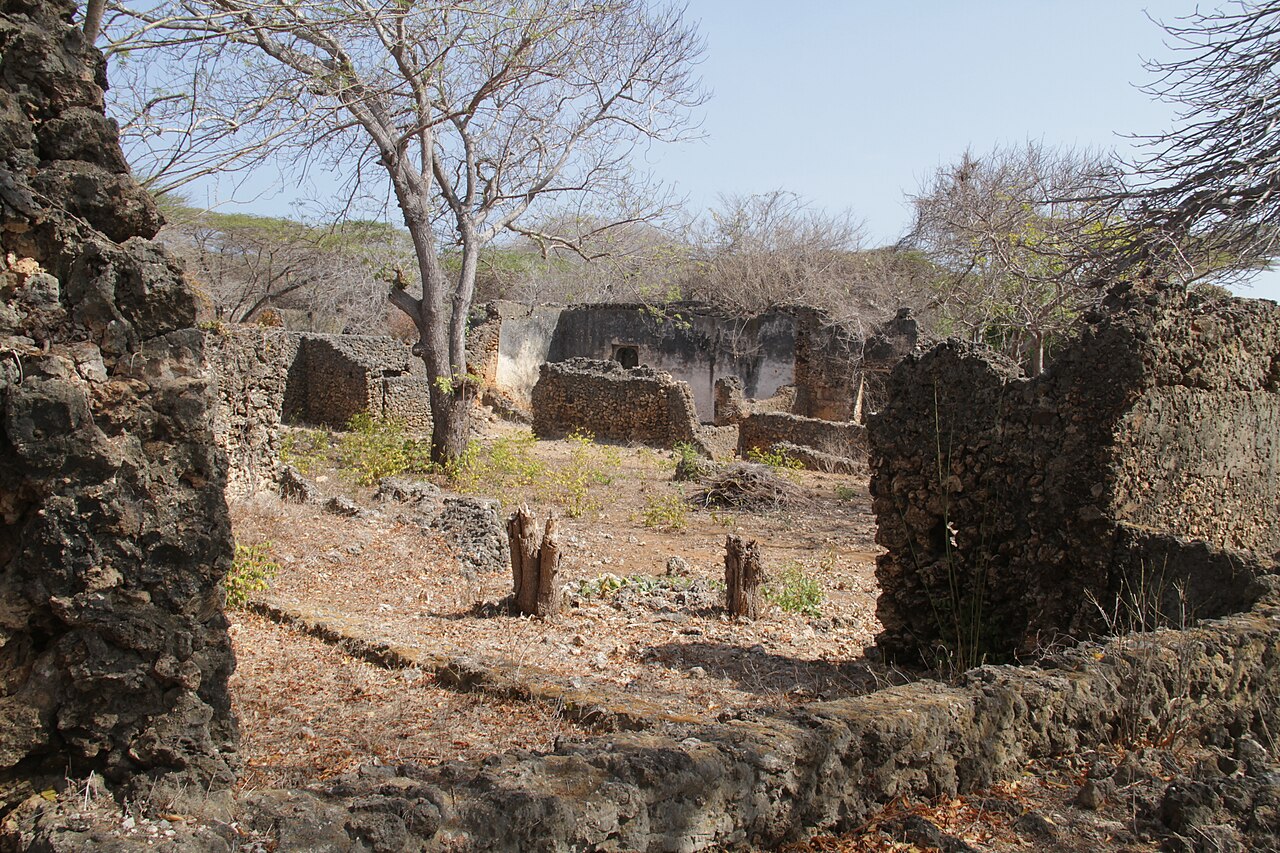
Lamu, on its own archipelago, developed a more insular and aristocratic culture, famous for its poets, scholars, and the unique, graceful architecture of its stone houses. Pate Island, meanwhile, was known for its historical chronicles, including the Pate Chronicle, which details the city’s own king lists and its conflicts and alliances. Gedi, a city in the Kenyan hinterland, was mysteriously abandoned, but its well-preserved ruins of mosques, palaces, and houses show a standard of urban planning that included flushable toilets and running water—centuries ahead of much of Europe.
Architecture in Coral and Mangrove: A Distinctly African Aesthetic
The architecture of the Swahili Coast is one of its most powerful legacies. It is not simply “Islamic architecture” transplanted to Africa; it is a uniquely Swahili synthesis. The primary building material was coral ragstone—blocks cut from fossilized coral reefs, which were light, durable, and easily carved. This was bound with a lime mortar made from burnt coral, creating a strong, white-washed surface that gleamed in the tropical sun.
The iconic element of Swahili architecture is the carved wooden door. These massive, often iron-studded doors are not just functional; they are status symbols and works of art. The lintels and jambs are densely carved with Quranic verses, geometric patterns, and motifs like the lotus flower (an ancient symbol from Egypt and India) and the fish. They represent the fusion of cultures that defined the coast.
Houses were built around a central courtyard, providing privacy and ventilation. The most distinct interior feature is the ndani—a deep, recessed niche with raised platforms on either side. Used for receiving guests and sleeping, it was the social heart of the home. This architectural form is found nowhere else in the Islamic world but is perfectly adapted to the Swahili climate and social structure. The narrow, winding streets of Lamu Town, a UNESCO World Heritage site, were designed for pedestrian traffic and to funnel the cooling sea breezes—a brilliant example of pre-modern urban planning.
The Swahili People: Language, Faith, and a Cosmopolitan Identity
At the core of these Swahili Coast civilizations was a unique cultural and linguistic identity. The Swahili people are not a single ethnic group but a people defined by their shared language, Kiswahili, and their urban, mercantile culture. Kiswahili is a Bantu language—its grammar and core vocabulary are unmistakably African—but it has absorbed a vast number of loanwords from Arabic (for trade, religion, and governance), as well as from Persian, Hindi, Portuguese, and English. This linguistic adaptability is a perfect metaphor for the culture itself: deeply rooted in Africa but eternally open to the world.
By the 13th century, Islam had become the central faith of the urban elite. It was not forced upon them by Arab conquerors, but adopted voluntarily by African merchants and rulers who found it to be a unifying faith that connected them to a vast international network of trust and law. The Swahili embraced Islam and adapted it to their own context, creating a tolerant, coastal form of the religion that often incorporated local traditions. Women in Swahili society, while living in a patriarchal structure, often held significant economic power as traders and property owners, a fact noted with surprise by many European visitors.
Trade, Gold, and the Indian Ocean World: The Economic Engine
The wealth of the Swahili coast was built on trade. They were the masters of a complex system that connected the interior of Africa to the markets of Asia.
| Trade Good from Interior Africa | Sourced From | Trade Good from Indian Ocean | Sourced From |
|---|---|---|---|
| Gold | Great Zimbabwe, Mutapa Empire | Porcelain & Silk | China (Ming Dynasty) |
| Ivory | African savannahs (via African hunters) | Cotton Cloth & Beads | India (especially Gujarat) |
| Timber (Mangrove poles) | Coastal mangrove forests | Spices & Glassware | Persia & Arabia |
| Slaves | Interior conflicts and trade (a tragic reality) | Carpets & Dates | Persia & Arabia |
| Amber & Tortoiseshell | Coastal waters and islands | Weapons (e.g. swords) | India & Arabia |
This table is not an exhaustive list, but it shows the symmetry of the trade. The Swahili did not merely transship goods; they added value. They built the dhows that sailed the ocean, processed ivory, and acted as financiers and insurers. The Chinese admiral Zheng He visited the coast in the early 15th century with his massive treasure fleet, bringing giraffes and other exotic goods to the Ming emperor. This was not a colonial visit, but a meeting of equals between two major trading powers.
Clash of Empires: The Portuguese Conquest and Swahili Resistance
The arrival of Vasco da Gama in 1498 marked the beginning of the end for the golden age of the independent city-states. The Portuguese, driven by a crusading zeal and a desire to monopolize the spice trade, were not interested in partnership. They were conquerors. They saw the wealthy, Muslim Swahili cities as enemies and rivals.
In 1505, a Portuguese fleet under Francisco de Almeida attacked Kilwa and Mombasa, sacking them with horrific violence. They built Fort Jesus in Mombasa (1593-1596) to cement their control. The Portuguese system was brutal and extractive. They imposed a cartaz system—requiring all ships to buy a costly license—and tried to force all trade through their own ports. This strangled the Swahili economy.
However, the Swahili were not passive victims. There was fierce resistance. The city-states of the north, particularly Lamu, Pate, and Malindi, often played the Portuguese off against their rivals from Oman in a complex game of survival. In 1631, the Sultan of Mombasa, Dom Jerónimo (who had been baptized a Christian), massacred the Portuguese garrison and renounced his faith, a dramatic act of rebellion. Eventually, the Omani Arabs, who had built a powerful maritime empire, were invited by the Swahili to help expel the Portuguese. In 1698, after a two-year siege, the Omanis captured Fort Jesus. The Portuguese era was over, but the Swahili coast was now under a new, albeit more culturally similar, imperial master.
Legacy and Modern Revival: The Swahili Coast Today
The legacy of the Swahili Coast civilizations is not confined to a museum or a history book. It is a living, breathing part of East Africa today. Kiswahili has become a lingua franca for over 150 million people across the African Great Lakes region and is an official language of the African Union. The trading spirit is still alive in the bustling markets of Mombasa, Dar es Salaam, and Zanzibar.
Today, there is a powerful cultural revival. A new generation of Swahili artists, musicians, and writers is reclaiming and reinterpreting their heritage. The annual Lamu Cultural Festival celebrates the dhow-building traditions, poetry, and henna art of the coast. Taarab music, a fusion of Swahili, Arabic, Indian, and African rhythms, is a global sensation. Archaeologists and historians, many of them African and from the diaspora, are working to correct the old colonial narratives that dismissed the Swahili as mere “Arab colonists.” They are proving, through genetic studies, linguistics, and material culture, that the Swahili are fundamentally African, a civilization that chose its own path of cosmopolitanism.
The ruined mosques and palaces of Kilwa and Gedi are no longer seen as “lost cities” of a vanished race, but as monuments to a brilliant, African-led era of globalization. The carved doors of Lamu are not just antiques; they are the enduring symbol of a people who built a world at the crossroads of continents, proving that Africa has always been a central player in the story of human connection.
Conclusion: Beyond the Ruins—A Civilization of the Future
The story of the Swahili Coast civilizations is a powerful counter-narrative to the idea of a static, isolated Africa. These were dynamic, literate, urban societies that were at the cutting edge of global trade for centuries. They were built not on conquest, but on negotiation, adaptation, and an openness to the world that is still their most defining characteristic. As modern Africa looks to build its own future of interconnected trade and cultural exchange, it could do worse than look back at its own Swahili coast—a testament to the fact that the continent’s most profound global connections are not a recent invention, but a deep, ancient, and proudly African tradition. The stones of Kilwa may be silent, but the story they tell is one of immense possibility and enduring brilliance.