📅 Last updated: 05.07.2026
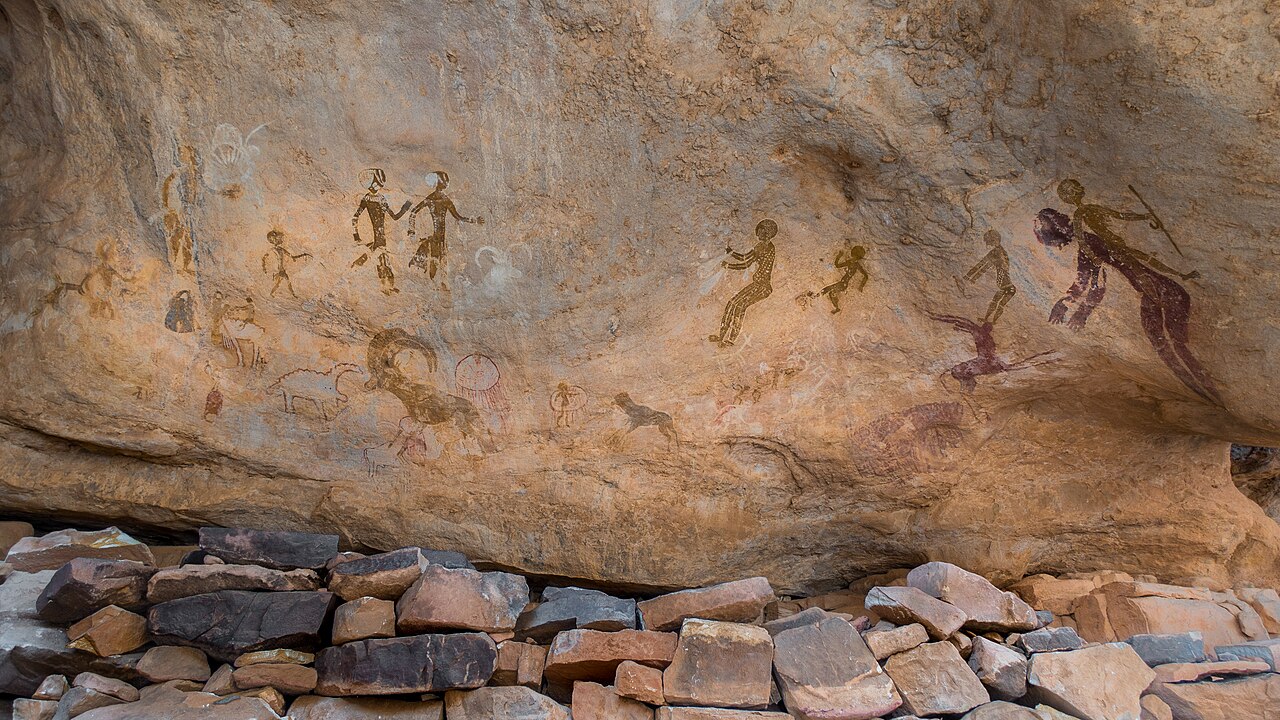
In the heart of the Sahara, on a vast, otherworldly plateau in southeast Algeria, lies one of humanity’s greatest and least-visited artistic treasures: the Tassili n’Ajjer rock art. This is not a gallery of simple stick figures; it is a vast, open-air museum spanning over 72,000 square kilometres, a UNESCO World Heritage site that holds more than 15,000 engravings and paintings. These images, etched and painted onto sandstone cliffs and cave walls, chronicle a story that defies the modern image of the Sahara as a lifeless sea of sand. They depict a green and fertile land, teeming with wildlife and bustling with human activity, a place where elephants, giraffes, and hippopotami roamed freely, and where herders guided their cattle through lush grasslands. The Tassili n’Ajjer rock art is not merely a collection of ancient graffiti; it is a profound and beautiful visual archive of a world that vanished thousands of years ago, a testament to the ingenuity, spirituality, and artistry of the early peoples who lived there.
The Geological Canvas: How Time Shaped the Art
The Tassili n’Ajjer plateau itself is a masterpiece of geological sculpture. Its name, in the Tamahaq language of the Tuareg people, means “plateau of the rivers,” a poignant reminder of a wetter past. Over millions of years, wind and water have carved the soft sandstone into a surreal landscape of towering rock arches, deep canyons, and labyrinthine “forests” of stone pillars. This dramatic, eroded terrain provided the perfect natural canvas for prehistoric artists. The overhangs and deep, shaded rock shelters offered protection from the elements, preserving the pigments for millennia. The artists were not passive users of this landscape; they actively selected locations with specific acoustic properties, orientations to the sun, and strategic views, suggesting a deep, symbiotic relationship between the art, the land, and the cosmos.
A Palette from the Earth
The colours of Tassili n’Ajjer are as striking as the subjects they depict. The artists were expert chemists, creating a vibrant palette from locally sourced minerals. Reds and oranges came from iron oxides (ochre and hematite), whites from kaolin clay or gypsum, blacks from charcoal or manganese dioxide, and yellows from limonite. These pigments were ground into a fine powder and then mixed with a binder, likely egg white, animal fat, plant resin, or blood, to create a durable paint. The application methods were equally sophisticated: fingers, brushes made from chewed twigs or animal hair, and even blowing pigment through hollow bird bones to create stippled effects. The result is a body of work that, in many places, retains its vividness and clarity, even after enduring the harsh Saharan sun and wind for five, six, or even ten thousand years.
The Four Great Epochs of Tassili n’Ajjer Rock Art
To make sense of this vast visual narrative, archaeologists and art historians, most notably the French ethnographer Henri Lhote in the 1950s and 60s, have divided the art into distinct chronological periods. This framework is not rigid, but it provides a powerful tool for understanding the dramatic environmental and cultural shifts that the art documents. The Tassili n’Ajjer rock art is a story told in four chapters, each with its own style, subject matter, and ecological context.
The Archaic (Great Wild Fauna) Period (c. 10,000 – 6,000 BCE)
The earliest art on the plateau is a window into the “Green Sahara,” a period known as the African Humid Period. The climate was radically different, with regular monsoon rains filling vast lakes and rivers. The art from this era is dominated by large, naturalistic depictions of savannah animals. These are not the camels and goats of the modern Sahara. Instead, we see life-sized or even larger-than-life images of:
- Elephants with their tusks curled upwards, a now-extinct subspecies.
- Rhinoceroses and hippopotamuses, indicating deep, permanent water sources.
- Giraffes with incredibly long, elegant necks, one of the most common and beautifully rendered subjects.
- Buffalo of an extinct species (Pelorovis antiquus), with enormous, sweeping horns.
- Antelopes, ostriches, and wild asses.
The human figures in this period are rare, small, and often depicted as hunters armed with clubs, throwing sticks, and axes. The style is naturalistic and highly skilled, revealing a keen observation of animal anatomy and movement. The famous “Great God” of Sefar, a gigantic, stylized figure with a round head and a halo-like crown, is often placed in this period, though its exact meaning remains a mystery. It is a powerful, enigmatic presence, perhaps a deity or a masked shaman.
The Pastoral Period (c. 6,000 – 2,000 BCE)
This is the golden age of Tassili n’Ajjer. As the climate began its slow, irreversible drying, the people of the Sahara adapted. They domesticated cattle, sheep, and goats, and the art’s focus shifted dramatically. The magnificent wild animals are still present, but the central subject becomes the cow. The Tassili n’Ajjer rock art from this period is a stunning record of a pastoral society. We see:
- Vast herds of cattle, painted in intricate detail. The cows are depicted with a variety of coat patterns, horn shapes, and even collars.
- Scenes of daily life: women milking cows, men leading herds, families living in large, domed huts made of woven grass or hides.
- Elaborate social rituals, including dances, feasts, and processions. Some scenes show people wearing elaborate headdresses and body paint.
- The famous “Round Head” figures, a distinctive and mysterious style. These are large, schematized human figures with featureless, rounded heads, often depicted floating or in dynamic poses. They are frequently shown wearing masks or with strange, mushroom-like growths on their heads, leading to speculation about shamanic trance states and ritual use of hallucinogenic plants. The Round Head artists were masters of composition, creating multi-figure tableaus of great complexity and energy.
The sheer volume and quality of this period’s art is staggering. It is a loving, detailed, and celebratory portrait of a successful and culturally rich society. This is the era that produced the most famous and iconic images of the Tassili n’Ajjer rock art.
The Horse (or Equid) Period (c. 2,000 – 1,000 BCE)
Around 2000 BCE, the drying of the Sahara accelerated. The grasslands shrank, the lakes disappeared, and the great cattle herds could no longer be sustained. The people of the plateau began to rely more on horses and donkeys, animals better suited to the arid environment. This period is marked by the arrival of the horse-drawn chariot. The art becomes more dynamic and martial. We see:
- Horses and chariots racing across the rock faces, often shown in a stylized, flying gallop.
- Figures of warriors armed with spears, shields, and bows.
- The appearance of the Libyan-Berber script, an ancient alphabet that is the ancestor of the modern Tifinagh script still used by the Tuareg. This is one of the earliest forms of writing in Africa.
The chariots are a fascinating subject. While some may depict actual warfare, many scholars believe they were symbols of prestige and status, or perhaps representations of solar deities. The presence of the chariot in this isolated region also hints at long-distance trade and contact with the Mediterranean world, from which the horse and chariot technology likely spread. The art is less naturalistic than the pastoral period, favouring a more schematic, linear style.
The Camel Period (c. 1,000 BCE – Present)
The final chapter of the Tassili n’Ajjer rock art story begins around 1000 BCE with the introduction of the dromedary camel from Arabia. The camel was the key to the modern Sahara, a ship of the desert that allowed for the trans-Saharan trade routes to flourish. The art of this period is the most recent and often the crudest in execution. It depicts:
- Camels, often with riders and heavily laden with goods.
- Scenes of warfare, trade, and caravan travel.
- Tuareg warriors on horseback, wearing their distinctive flowing robes and veils (the litham).
- Inscriptions in Arabic and Tifinagh.
This period marks a decline in the artistic quality and creativity of the earlier eras. The art becomes more functional, more like a record of daily life and a form of territorial marking. It is a poignant end to a magnificent tradition, reflecting the final transformation of the Sahara from a habitable, green landscape into the harsh desert we know today.
| Period | Approximate Dates | Climate & Environment | Dominant Subjects | Artistic Style |
|---|---|---|---|---|
| Archaic (Great Wild Fauna) | 10,000 – 6,000 BCE | Humid, lush savannah with lakes and rivers | Large wild animals (elephant, giraffe, rhino, hippo) | Naturalistic, life-size, deeply engraved/painted |
| Pastoral | 6,000 – 2,000 BCE | Drying, but still with seasonal grasslands | Domestic cattle, human figures, rituals, Round Heads | Highly detailed, narrative, vibrant polychrome |
| Horse (Equid) | 2,000 – 1,000 BCE | Arid, desert conditions forming | Horses, chariots, warriors, Libyan-Berber script | Dynamic, schematic, linear |
| Camel | 1,000 BCE – Present | Hyper-arid desert, similar to today | Camels, caravans, Tuareg warriors, Arabic script | Cruder, more functional, less creative |
Deciphering the Meaning: Shamans, Hunters, and Herders
What drove these people to create such an immense and enduring body of work? The Tassili n’Ajjer rock art is not simply decorative. It was created with profound purpose. While we can never be certain of their exact intentions, several powerful theories have emerged.
Ritual and Shamanism
The most compelling explanation, particularly for the Archaic and Pastoral periods, is that the art was central to ritual and shamanic practice. The “Round Head” figures, with their blank, floating forms, are a key piece of evidence. They strongly resemble the imagery of altered states of consciousness reported by shamans worldwide. The strange “mushroom” motifs on their heads have been linked to the psychedelic properties of the Psilocybe mushroom, which grows in the region. The act of painting or engraving an animal may have been a way to gain power over its spirit, to ensure a successful hunt, or to promote the fertility of the herds. The deep, resonant rock shelters, with their unique acoustics, would have been perfect settings for ritual drumming, chanting, and vision quests.
Social Record and Identity
The art also served as a powerful social document. The pastoral scenes of cattle, families, and daily life are a declaration of identity and prosperity. A clan or tribe’s wealth and status were measured in cattle, and to depict your herd on the enduring stone walls of a sacred site was to proclaim your success to the world, and to the spirits. These were not just pictures; they were titles, histories, and legal documents. They marked territory, recorded important events (a great hunt, a ritual, a battle), and reinforced social cohesion. The art was a public, communal act, a way of telling the story of the people to themselves and to future generations.
A Magical Connection to the Cosmos
The placement of the art was never random. Many of the most important panels are positioned at the entrances to deep canyons, on the walls of natural amphitheatres, or at points where the sun or moon cast dramatic light and shadow. Some images are oriented towards the cardinal points or align with celestial events. This suggests a sophisticated understanding of astronomy and a belief that the art could mediate between the human world and the larger forces of nature and the cosmos. The “Great God” of Sefar, with its radiating halo, might be a solar deity. The art was a magical technology, a way to ensure the return of the rains, the fertility of the land, and the cyclical renewal of life.
The Modern Challenge: Preservation in a Changing World
Today, the Tassili n’Ajjer rock art faces a new and urgent set of threats. While the harsh desert climate has preserved these masterpieces for millennia, modern forces are proving more destructive. The site is remote, but not immune to human impact. The key challenges are:
- Climate change: More extreme temperature swings and increasingly violent, sporadic rainfall events cause physical erosion and salt crystallization on the rock surfaces, flaking the art away.
- Vandalism and graffiti: The remoteness of the site makes it difficult to police. Tourists and locals have defaced ancient images with modern carvings and spray paint.
- Unregulated tourism: The very act of visiting can be damaging. The oils from human hands, the dust kicked up by vehicles, and the development of unofficial paths and campsites all take a toll.
- Resource exploitation: Oil and gas exploration in the region, as well as potential mining activities, pose a long-term threat to the integrity of the plateau.
In response, the Algerian government, working with UNESCO and international bodies like the Getty Conservation Institute, has launched several initiatives. These include:
- Training a new generation of Tuareg guides and park rangers in site management and conservation techniques.
- Creating detailed digital records (photogrammetry and 3D scanning) of the most vulnerable panels to create a permanent virtual archive.
- Developing a responsible, low-impact tourism model that limits visitor numbers and requires official guides.
- Working with local communities to foster a sense of ownership and pride in the heritage, positioning the art as a source of economic opportunity and cultural identity.
As Dida Badi, an Algerian archaeologist and expert on Saharan rock art, has stated, “The Tassili is not just the heritage of Algeria. It is the heritage of all humanity. Its message of human adaptation, creativity, and resilience is one that the entire world needs to hear.”
Tassili n’Ajjer Rock Art: A Living Legacy
The story of the Tassili n’Ajjer rock art does not end in the ancient past. It is a living legacy, kept alive in the traditions and identity of the Tuareg people who now call this plateau home. The Tuareg are the inheritors and custodians of this landscape. Their own oral traditions, their music, and their distinctive Tifinagh script—which is a direct descendant of the Libyan-Berber script found on the rock faces—connect them directly to the artists of the horse and camel periods. For them, the images of warriors, camels, and cattle are not just ancient history; they are part of a continuous, unbroken thread of life in the Sahara. Visiting the Tassili today is not just a journey into the past; it is an encounter with a living culture that finds its own reflections in the stone. The art remains a source of inspiration for contemporary Tuareg artists and musicians, and it is a powerful symbol of their enduring connection to this harsh and beautiful land. The figures on the rock are not dead; they are ancestors, watching over the plateau and its people.
To stand before a life-sized giraffe, painted with a master’s hand 8,000 years ago, is to feel a direct, humbling connection to a fellow human being across an unimaginable gulf of time. Their world is gone, buried under the sand and the sun. But their art remains, a defiant and beautiful whisper from a green Sahara. The Tassili n’Ajjer rock art is one of the world’s great cultural treasures, a testament to the human capacity for creation, adaptation, and wonder. It is a story that Africa gave to the world, and one that we must work together, with respect and urgency, to preserve for all the generations yet to come.