📅 Last updated: 24.09.2026
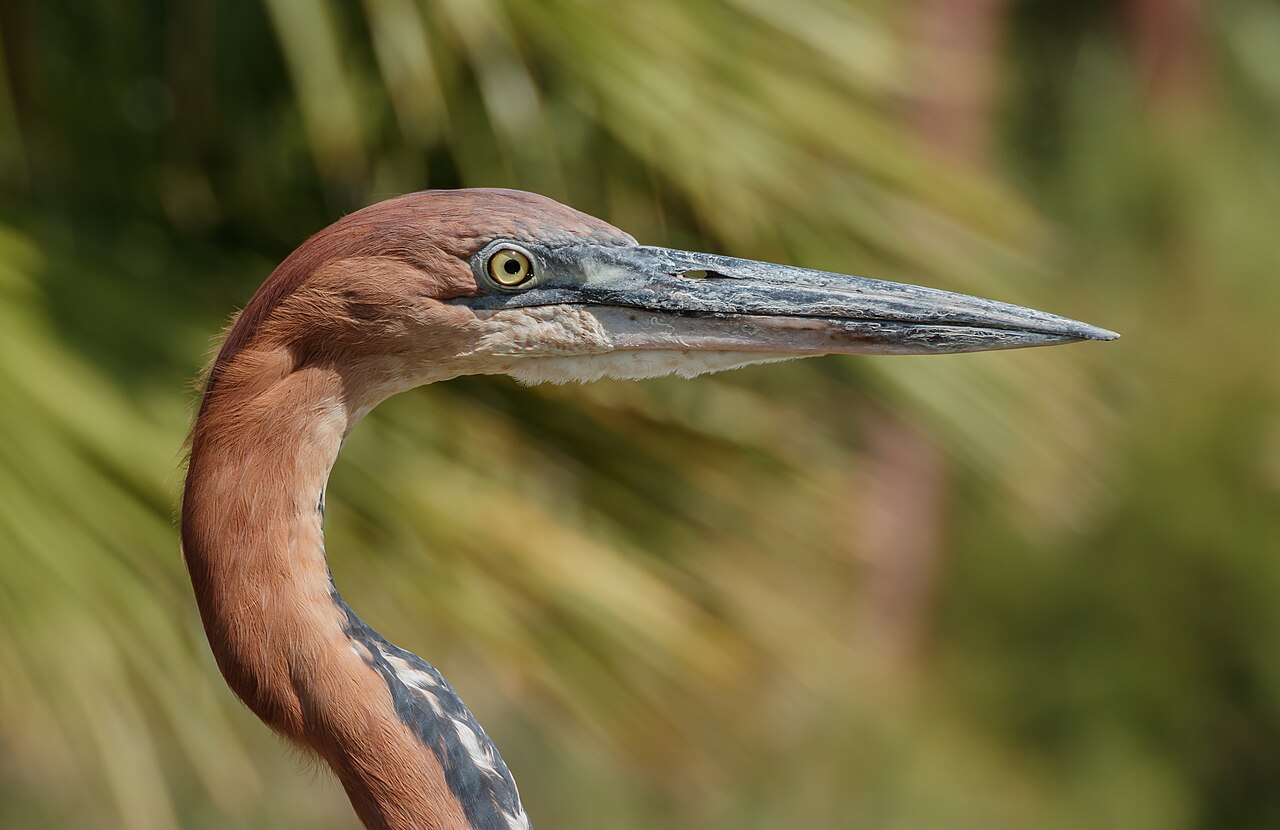
The Goliath Heron is the largest heron on Earth, a slate-grey giant that stands up to 1.5 metres tall and haunts the shallows of Africa’s great rivers, lakes, and mangroves. It is a bird of contradictions: enormous yet easily overlooked, solitary yet never far from water, and capable of swallowing a fish whole that would feed a family. To watch one hunt is to witness patience turned into a weapon.
- What Makes the Goliath Heron So Extraordinary?
- Where the Goliath Heron Lives: Africa's Wetland Heartlands
- How the Goliath Heron Hunts: Patience, Precision, Power
- A Year in the Life: Breeding, Nesting, and Raising Giants
- Goliath Heron vs. Other African Herons: A Quick Comparison
- Threats: What Endangers Africa's Largest Heron?
- Cultural and Scientific Significance
- Where to See the Goliath Heron in Africa
- A Giant Worth Protecting
Yet for all its size, the Goliath Heron remains one of the least studied large waterbirds in Africa. It does not gather in showy flocks like flamingos, nor does it perform acrobatics like the African fish eagle. Instead, it lives quietly at the edge of the continent’s wetlands — from the Okavango Delta to the Nile’s Sudd, from the Congo Basin to the coastal estuaries of KwaZulu-Natal — carrying out one of the most specialised fishing routines in the avian world.
This article explores the bird’s biology, its hunting techniques, the wetlands it depends on, and the pressures threatening its future. Along the way, we’ll meet the scientists studying it, the fishermen who share its waters, and the conservation efforts working to keep this remarkable species on Africa’s rivers.
What Makes the Goliath Heron So Extraordinary?
At first glance, the Goliath Heron (Ardea goliath) looks like an oversized version of its smaller relatives — the grey heron or the purple heron. But scale changes everything. An adult stands between 120 and 152 centimetres tall, with a wingspan that can exceed 2.1 metres. Males are typically larger than females, though the difference is subtle. Its weight ranges from roughly 4 to 5 kilograms, making it heavier than many eagles.
Its plumage is a study in restraint. The crown and crest are a rich chestnut, the neck is pale buff with dark streaking, and the back and wings are a deep slate-grey. In flight, the bird’s enormous size becomes obvious: slow, deliberate wingbeats, the neck folded back in the classic heron S-shape, and long legs trailing behind like a crane’s. The bill is dagger-like, stout, and pale yellow — a tool built for impaling, not pecking.
Unlike many herons, the Goliath Heron has no close relatives in the same size class. Its closest genetic relatives are the white-bellied heron of the Himalayas and the great-billed heron of Southeast Asia and Australasia. Together, these three form a group of giant, fish-specialist herons that evolved independently across the Old World tropics. Africa’s version is the most widespread and, arguably, the most successful.
A Bird of Records
- Tallest heron: Up to 152 cm, taller than a grey heron by roughly 30 cm.
- Heaviest heron: Up to 5 kg, comparable to a large Egyptian goose.
- Longest bill: Up to 20 cm from base to tip, ideal for seizing large prey.
- Largest prey: Fish up to 60 cm long and 2 kg in weight have been recorded.
These figures matter because they define the bird’s ecological niche. The Goliath Heron is not a generalist that picks at small fry. It is a specialist that targets big, slow-moving fish in shallow water — and it has evolved the body to match.
Where the Goliath Heron Lives: Africa’s Wetland Heartlands
The Goliath Heron is found across sub-Saharan Africa, with a range that extends from Senegal and the Gambia in the west, through the Sahel and the Congo Basin, down to South Africa’s Eastern Cape. It also occurs along the Nile Valley, the Red Sea coast, and parts of the Middle East — including southern Iraq, Iran, and the Arabian Peninsula. But Africa is its stronghold.
Its preferred habitats are large, undisturbed wetlands: slow-moving rivers, freshwater lakes, coastal lagoons, mangroves, and flooded grasslands. It avoids fast-flowing streams and deep open water, where hunting would be impossible. Instead, it favours the margins — the shallow shelves where reeds meet open water, where fish must pass.
Key Strongholds
- Okavango Delta, Botswana: Perhaps the most reliable place in Africa to see the species. The delta’s crystal-clear channels and floodplains support a healthy population.
- Bangweulu Wetlands, Zambia: A vast swamp system where Goliath Herons nest in papyrus and reed beds.
- Lake Victoria and the Nile Basin: The Sudd of South Sudan — a 30,000-square-kilometre swamp — is a major refuge.
- iSimangaliso Wetland Park, South Africa: This UNESCO World Heritage Site protects coastal lakes and estuaries where the bird hunts in brackish water.
- Djoudj National Bird Sanctuary, Senegal: A Ramsar site on the Senegal River delta, important for wintering and resident birds.
In East Africa, the species is common around Lake Naivasha and Lake Baringo in Kenya, and along the Rufiji River in Tanzania. In West Africa, it persists in the Niger Delta and the coastal lagoons of Ghana and Côte d’Ivoire, though populations there are less well monitored.
What unites these places is not just water, but structure — submerged vegetation, fallen trees, sandbars, and reed fringes that give the heron cover and ambush points. Remove that structure, and the bird disappears.
How the Goliath Heron Hunts: Patience, Precision, Power
Watching a Goliath Heron hunt is an exercise in delayed gratification. The bird typically stands motionless in shallow water, often for 10 to 20 minutes at a time, its neck coiled and its eyes fixed on the water’s surface. Unlike the great egret, which stalks slowly, the Goliath prefers a “stand-and-wait” strategy. It may also use its wings to create shade, reducing glare and attracting fish seeking cover.
When it strikes, the movement is explosive. The neck extends like a released spring, the bill opens, and the fish is seized crosswise. If the prey is small, it is swallowed head-first in one gulp. If it is large — a tilapia, a catfish, or a barbel — the heron may need several minutes to manoeuvre it into position. There are documented cases of Goliath Herons drowning after attempting to swallow prey that was too large or too spiny.
A Specialist’s Diet
Fish make up the overwhelming majority of the diet, but the species is opportunistic. Studies from southern Africa and East Africa have recorded:
- Fish: Tilapia, catfish, barbel, lungfish, and cichlids — often 15–40 cm long.
- Amphibians: Large frogs and tadpoles, especially during the rainy season.
- Reptiles: Small snakes, terrapins, and even baby crocodiles.
- Insects and crustaceans: Crabs, prawns, and water beetles, particularly in coastal populations.
- Small mammals and birds: Rarely, but recorded — including moorhen chicks and rats.
The bird’s digestive system is built for volume. Its gizzard is muscular, and its stomach acid is strong enough to dissolve fish bones within hours. Indigestible material — scales, bones, and insect exoskeletons — is regurgitated as pellets, much like an owl’s.
“The Goliath Heron is not a bird you find by accident. You find it because you have learned to read the water — the way a shadow moves, the way a reed bends. It is a master of stillness.”
— Dr. Doug Harebottle, ornithologist, University of Cape Town, in an interview on African waterbird ecology.
A Year in the Life: Breeding, Nesting, and Raising Giants
Goliath Herons are largely sedentary in Africa, though some populations move seasonally in response to water levels. Breeding is tied to the rains — typically the long rains in East Africa (March to May) and the summer rains in southern Africa (November to March). In West Africa, nesting often coincides with the peak of the flood season.
They are monogamous within a season, and pairs may reunite in subsequent years. Courtship involves elaborate displays: the male performs a “stretch” display, extending his neck upward and snapping his bill, while the female responds with a “snap” of her own. Once bonded, the pair builds a large stick nest — up to 1.5 metres across — in a tree, often a mangrove, fig, or acacia, usually 3 to 10 metres above water. Nests are sometimes placed on the ground in dense reed beds.
Clutch and Care
The female lays 2 to 4 pale blue eggs, which she and the male incubate for about 25 to 30 days. Chicks hatch altricial — naked, blind, and helpless — and are fed regurgitated fish by both parents. Sibling rivalry is intense: the older chick often dominates, and in years of poor food supply, only one may survive. Fledging takes around 45 to 60 days, after which the young birds remain dependent on their parents for several more weeks.
Breeding success is low compared to smaller herons. A study in the Okavango Delta found that fewer than 40% of nests produced a fledgling. Predation by African fish eagles, monitor lizards, and even crocodiles takes a toll, as does human disturbance.
Goliath Heron vs. Other African Herons: A Quick Comparison
Africa is home to around 20 heron and egret species. The Goliath stands apart not just in size, but in behaviour and habitat. The table below summarises the key differences.
| Species | Height | Weight | Primary Habitat | Hunting Style |
|---|---|---|---|---|
| Goliath Heron | 120–152 cm | 4–5 kg | Large rivers, lakes, mangroves | Stand-and-wait ambush |
| Grey Heron | 90–100 cm | 1.5–2 kg | Widespread, adaptable | Slow stalking |
| Purple Heron | 80–90 cm | 1–1.5 kg | Reed beds, marshes | Skulking, ambush |
| Great Egret | 85–100 cm | 0.9–1.2 kg | Open water, wetlands | Active stalking |
| Black-headed Heron | 90–100 cm | 1–1.5 kg | Grasslands, wet fields | Terrestrial stalking |
The Goliath Heron’s size gives it access to prey that smaller herons cannot handle, but it also makes it more vulnerable to habitat loss. It needs larger territories, more food, and more undisturbed nesting sites. It is, in ecological terms, a “large-bodied specialist” — the first to disappear when wetlands degrade.
Threats: What Endangers Africa’s Largest Heron?
The Goliath Heron is currently listed as Least Concern by the IUCN, with a global population estimated at 10,000 to 100,000 individuals. But that broad classification masks local declines. In parts of West Africa, the species has become rare; in the Nile Delta, it is largely confined to protected areas.
The main threats are familiar across Africa’s wetlands:
- Habitat loss: Damming, irrigation, and drainage destroy the shallow-water zones the bird depends on. The construction of dams on the Nile, Zambezi, and Niger rivers has altered flood cycles.
- Pollution: Pesticides and heavy metals accumulate in fish, which biomagnify up the food chain. Studies in South Africa’s Vaal River have found elevated mercury levels in fish-eating birds.
- Disturbance: Boating, fishing, and tourism can flush birds from nests, leaving eggs and chicks exposed to predators and heat.
- Climate change: Changing rainfall patterns are shrinking wetlands. The Okavango Delta, for example, depends on Angolan rainfall that has become increasingly unpredictable.
- Persecution: In some areas, herons are killed by fishermen who see them as competitors. This is rare but locally significant.
There is also a subtler threat: the loss of large, old trees for nesting. In many parts of Africa, riparian forests are logged for firewood and timber, leaving herons without suitable nest sites. Conservationists in Zambia and Botswana have responded by erecting artificial nesting platforms in key areas — a simple intervention that has shown promising results.
Conservation Successes
Not all news is grim. In South Africa’s iSimangaliso Wetland Park, a 2018 survey recorded 47 breeding pairs — up from 22 in 2005. The recovery followed the removal of invasive alien plants and stricter controls on fishing. In Senegal’s Djoudj National Bird Sanctuary, regular water-level management has maintained nesting habitat for herons and other waterbirds.
In Kenya, the Lake Naivasha Riparian Association has worked with local flower farms to reduce pesticide runoff, improving water quality for fish and birds alike. These efforts show that the Goliath Heron can thrive when wetlands are managed with care.
Cultural and Scientific Significance
In many African cultures, large herons are associated with patience, wisdom, and the spirit of the waters. In the Okavango region, the Goliath Heron is sometimes called the “river sentinel” by local guides — a bird whose presence indicates a healthy fishery. In the Congo Basin, some communities regard herons as messengers between the living and the ancestors, though this varies widely across ethnic groups.
Scientifically, the species is a valuable indicator of wetland health. Because it feeds high on the food chain and requires large, undisturbed territories, its presence signals a functioning ecosystem. Researchers use it as a flagship species — a charismatic animal that can rally support for broader conservation.
Ornithologists are also studying its genetics. A 2019 study led by Dr. Claudia Hofmann at the University of Potsdam found that African Goliath Herons have low genetic diversity compared to Asian populations, suggesting a historical bottleneck. This has implications for conservation: low diversity can reduce resilience to disease and climate change.
Where to See the Goliath Heron in Africa
For travellers and birdwatchers, the Goliath Heron is a sought-after species. Here are some of the best places to find it, with practical notes.
- Okavango Delta, Botswana: Best from June to September, when water levels are high and vegetation is lush. Look along the Boro and Moremi channels.
- Chobe River, Botswana/Namibia: Boat safaris often encounter herons fishing along the banks at dawn.
- iSimangaliso Wetland Park, South Africa: The St Lucia estuary is a reliable spot, especially in the austral winter.
- Lake Naivasha, Kenya: A boat trip to Crescent Island usually produces sightings.
- Djoudj National Bird Sanctuary, Senegal: Best from November to March, when thousands of waterbirds congregate.
- Bangweulu Wetlands, Zambia: Accessible via Kasanka National Park; guided walks offer close views.
Wherever you go, the key is patience. The Goliath Heron does not perform. It waits. And when it finally strikes, the moment is over in a flash — a reminder that in Africa’s wetlands, the most spectacular things are often the quietest.
A Giant Worth Protecting
The Goliath Heron is more than a big bird. It is a barometer of Africa’s rivers and lakes — a species that tells us whether our wetlands are healthy, whether our fish stocks are intact, and whether our conservation efforts are working. Its decline in some areas is a warning; its recovery in others is a reason for hope.
As Africa’s human population grows and demands on water increase, the fate of the Goliath Heron will depend on decisions made far from its nesting trees — in boardrooms, government offices, and international climate negotiations. But it will also depend on local actions: protecting a mangrove, restoring a riverbank, or simply leaving a nesting pair undisturbed.
For those of us lucky enough to share the continent with this bird, the Goliath Heron offers a lesson in restraint and resilience. It stands in the shallows, patient and watchful, asking nothing more than clean water and a place to fish. In return, it gives us a glimpse of Africa at its most wild and most magnificent. That is a bargain worth honouring.