📅 Last updated: 03.11.2026
The Aksumite Empire rose from the highlands of northern Ethiopia to become one of the ancient world’s great commercial powers, minting its own gold coinage and trading goods from Rome to India. At its height between the 3rd and 6th centuries CE, this African kingdom controlled the Red Sea port of Adulis, commanded trade routes into the Arabian Peninsula, and built monumental granite obelisks that still stand today. Yet outside specialist circles, few people know its name.
The Aksumite Empire was a major trading state centered in the northern Ethiopian highlands that flourished roughly from the 1st to the 7th century CE. It controlled the Red Sea port of Adulis, minted gold, silver, and bronze coins, adopted Christianity in the 4th century under King Ezana, and developed its own Ge’ez script. At its peak, Aksum traded with Rome, Persia, Arabia, and India, and its monumental stelae at Aksum remain among the tallest single-stone structures ever erected.
- Where Was the Aksumite Empire Located and Why Did It Matter?
- How Did the Aksumite Empire Become a Trading Power?
- What Was the Role of the Aksumite Empire in World Trade?
- What Were the Monumental Achievements of the Aksumite Empire?
- Key Facts and Timeline of the Aksumite Empire
- How Did Christianity Shape the Aksumite Empire?
- Why Did the Aksumite Empire Decline?
- What Does the Aksumite Empire Teach Us About Africa's Past?
- The Enduring Legacy of the Aksumite Empire
Where Was the Aksumite Empire Located and Why Did It Matter?
Look at a map of the ancient world and the Red Sea appears as a narrow corridor connecting the Mediterranean to the Indian Ocean. Whoever controlled that corridor controlled a fortune. The Aksumite Empire sat at the western mouth of the Red Sea, in what is now the Tigray region of Ethiopia and parts of Eritrea, with its capital at Aksum and its principal port at Adulis on the Eritrean coast.
The geography was almost unfairly good. From the highland plateau, Aksumite merchants could move goods down to Adulis and load them onto ships bound for Roman Egypt, Yemen, or Gujarat. Inland, the kingdom reached toward the Blue Nile and the gold-bearing regions that supplied its mints. The combination of agricultural highlands, mineral wealth, and maritime access made Aksum a natural hinge between Africa, Arabia, and the wider Indian Ocean world.
This was not a marginal kingdom on the edge of civilization. The 1st-century Periplus of the Erythraean Sea, a Greek mariner’s guide to Indian Ocean trade, describes Adulis as a legitimate market town and notes that the ruler of Aksum was a significant commercial figure. Roman writers knew of the kingdom too. The 3rd-century prophet Mani, founder of Manichaeism, listed Aksum alongside Rome, Persia, and China as one of the four great powers of the world — a remarkable ranking for a state that most modern readers have never heard of.
How Did the Aksumite Empire Become a Trading Power?
Aksum’s rise was gradual and strategic. The kingdom emerged around the 1st century CE from earlier cultural foundations in the Ethiopian highlands, including the D’mt civilization that had flourished centuries before. But the real catalyst was maritime trade.
The Port of Adulis and Indian Ocean Networks
Adulis was the engine room. Excavations there have uncovered imported pottery from Egypt, glassware from the Mediterranean, and goods that trace routes toward India. Aksumite ships carried ivory, tortoiseshell, rhinoceros horn, gold, emeralds, and frankincense north to Roman markets. They brought back textiles, glass, wine, olive oil, and spices.
This trade was not passive. The Periplus records that Aksumite merchants were active participants, not just suppliers of raw materials. The kingdom taxed commerce at Adulis and used the revenue to fund monumental architecture and military campaigns. Coin finds from Aksum have turned up in India, Arabia, and the Mediterranean, tangible evidence of how far its commercial reach extended.
Coinage as a Statement of Sovereignty
Perhaps the most striking proof of Aksum’s sophistication is its coinage. Aksum was one of the few ancient states outside the Mediterranean world to mint its own coins in gold, silver, and bronze. The coins carried the king’s image and name in Ge’ez script, and later examples featured the cross after the kingdom adopted Christianity. Minting gold coinage was a declaration: Aksum was a sovereign power with the economic capacity to back its currency.
- Gold coins signaled international prestige and facilitated high-value trade in the Red Sea corridor.
- Silver and bronze coins supported local and regional commerce, evidence of a monetized internal economy.
- Ge’ez inscriptions on the coins demonstrate a literate, administratively sophisticated state.
What Was the Role of the Aksumite Empire in World Trade?
Between roughly 200 and 600 CE, the Aksumite Empire functioned as a clearing house between three major economic zones: the Roman (later Byzantine) Mediterranean, the Sasanian Persian world, and the Indian Ocean trading system. Goods moved through Aksumite ports and highland markets, and so did ideas.
The 6th-century Byzantine writer Procopius records diplomatic exchanges between Aksum and Constantinople. The kingdom was valuable enough that emperors sought its alliance against Persia. Aksumite rulers, in turn, intervened across the Red Sea in Yemen, at times controlling territory in southern Arabia — a military reach that underlined the kingdom’s strategic importance.
Trade also brought cultural exchange. Aksumite elites adopted architectural and artistic motifs from the Mediterranean world, while Aksumite products and people traveled outward. The kingdom was not a passive recipient of civilization from the north; it was an active broker with its own aesthetic, language, and political traditions.
What Were the Monumental Achievements of the Aksumite Empire?
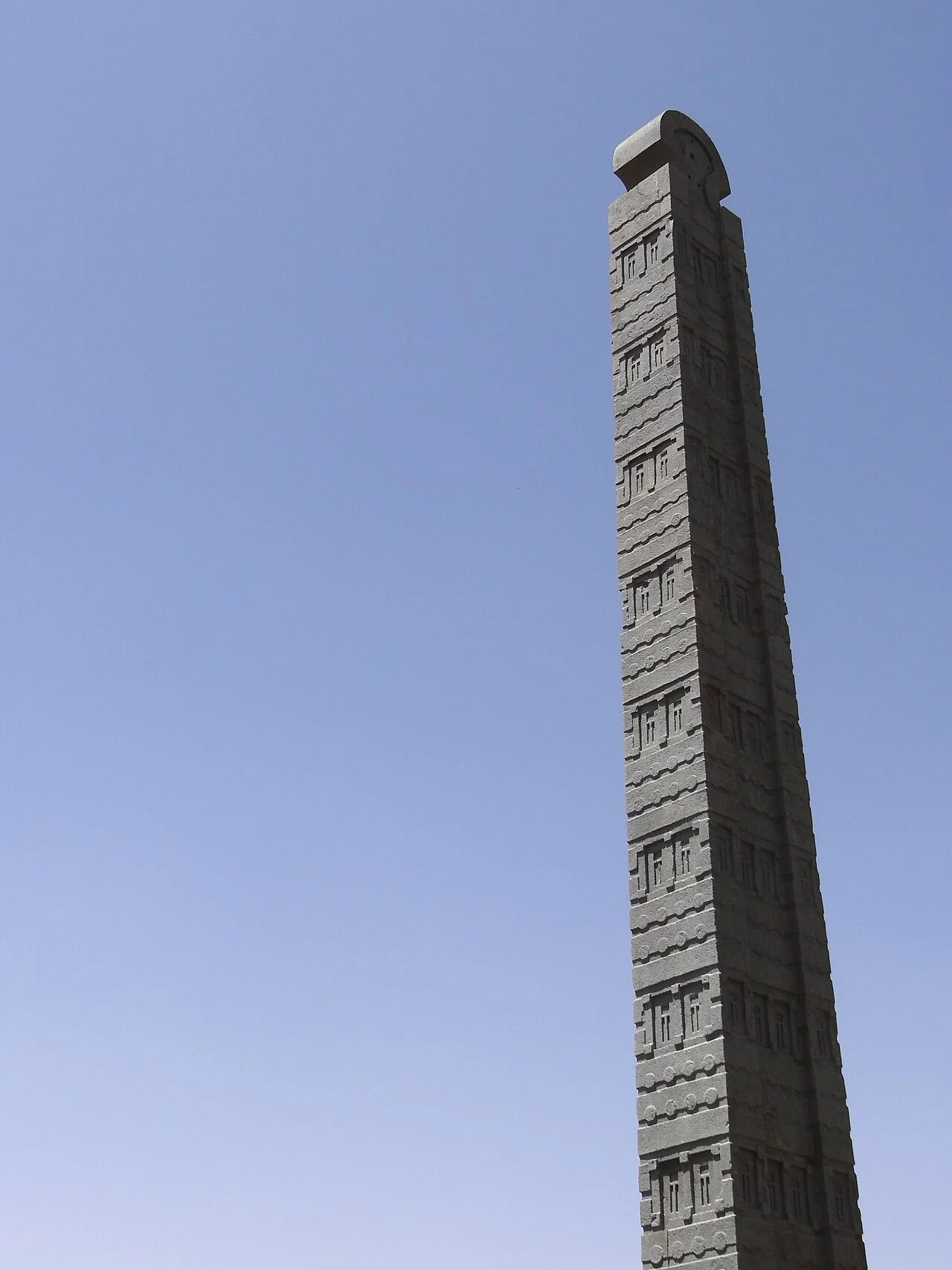
Travel to Aksum today and the first thing you notice is the stelae field. These towering granite obelisks, carved from single blocks of stone, mark the royal tombs of Aksumite kings. The largest ever quarried — the Great Stele — measured around 33 meters and weighed an estimated 520 tonnes before it toppled, likely during construction. The tallest still standing, the Obelisk of Aksum, rises about 24 meters; it was looted by Italian forces in 1937 and finally returned from Rome in 2005.
These monuments were engineering achievements of a high order. Carving, transporting, and erecting single-piece granite obelisks of that size required organized labor, technical skill, and a state capable of marshaling resources on a grand scale. The stelae are decorated with carved false windows and architectural details, suggesting that they represented multi-story buildings in stone — a style that influenced later Ethiopian architecture.
Aksum also built impressive palaces, reservoirs, and dams. The kingdom’s engineers developed sophisticated water management systems in the highlands, and the ruins of elite residences suggest a stratified society with a wealthy ruling class. The archaeological record reveals a state that invested heavily in permanence.
Key Facts and Timeline of the Aksumite Empire
| Period | Key Development | Significance |
|---|---|---|
| c. 1st century CE | Rise of Aksum as a regional power; Adulis emerges as a major port | Foundation of the maritime trading state described in the Periplus of the Erythraean Sea |
| c. 200–300 CE | Expansion of coinage; Aksumite trade reaches its widest extent | Gold, silver, and bronze coins minted; trade links with Rome, Arabia, and India |
| c. 320–350 CE | Reign of King Ezana; adoption of Christianity | One of the earliest states in the world to adopt Christianity as a state religion |
| c. 520s CE | Military intervention in Yemen under King Kaleb | Demonstrates Aksum’s reach across the Red Sea and its strategic importance |
| c. 7th century CE | Decline following the rise of Islamic powers and shifting trade routes | Loss of Red Sea dominance; the kingdom’s political center eventually shifts south |
How Did Christianity Shape the Aksumite Empire?
The conversion of King Ezana in the mid-4th century is one of the defining moments in African religious history. According to tradition recorded in later texts, Ezana was converted by Frumentius, a Syrian Christian who had been captured and brought to the Aksumite court as a young man. Frumentius was later consecrated bishop by Athanasius of Alexandria, tying the Ethiopian church to the Coptic tradition.
Ezana’s coins changed with his faith. Early coins show the king with a disc and crescent, reflecting pre-Christian religious symbols. Later coins bear the cross. Inscriptions from his reign declare his trust in the Christian God, and the kingdom’s official ideology was transformed.
This adoption had lasting consequences. The Ethiopian Orthodox Tewahedo Church traces its institutional roots directly to the Aksumite period, and the Ge’ez language and script preserved through the church became the foundation of Ethiopian literature. The kingdom’s Christian identity also shaped its diplomacy: Aksum aligned itself with the Christian Byzantine world against the Zoroastrian Sasanians and later against Islamic expansion.
Ge’ez: A Script and a Legacy
Aksum developed and used the Ge’ez script, an indigenous writing system that evolved from earlier South Arabian influences into a distinctly Ethiopian form. The script was used for royal inscriptions, coins, and religious texts. Its descendant scripts are still used in Ethiopia and Eritrea today, making Ge’ez one of the world’s longest continuously used writing traditions.
Why Did the Aksumite Empire Decline?
No single cause explains Aksum’s decline. The 7th century brought a cascade of changes. The rise of Islam transformed the political landscape of the Red Sea and Arabian Peninsula, and the new Islamic powers gradually displaced Aksumite influence in the region. Trade routes shifted, and the port of Adulis declined as commerce reoriented.
Environmental factors likely played a role as well. Deforestation and soil erosion in the highlands, combined with climate variability, may have strained the agricultural base that supported the kingdom’s population. Internal political fragmentation followed, and the center of Ethiopian power shifted southward over the following centuries toward the Zagwe dynasty and later the Solomonic line.
Yet the kingdom did not vanish so much as transform. Its language, script, religious institutions, and artistic traditions passed directly into the Ethiopian state that followed. The Aksumite legacy is embedded in Ethiopian identity to this day.
What Does the Aksumite Empire Teach Us About Africa’s Past?
The Aksumite Empire challenges a persistent and lazy assumption: that Africa’s engagement with the wider world began with European contact. Aksum was trading with Rome and India while much of Europe was still recovering from the collapse of the western Roman Empire. It minted its own currency, wrote in its own script, built monuments of staggering scale, and adopted one of the world’s major religions centuries before many European kingdoms did.
This is not a story of isolated achievement but of connected history. Aksumite merchants were participants in the Indian Ocean economy, their coins circulated in foreign markets, and their kings negotiated with Byzantine emperors. The kingdom was African and global at the same time — a reminder that the continent’s history has always been woven into world history.
- Economic sophistication: independent coinage and control of a major trade corridor.
- Cultural innovation: the Ge’ez script and a distinctive architectural tradition.
- Religious significance: one of the earliest Christian states in the world.
- Global connectivity: trade and diplomacy stretching from the Mediterranean to India.
For the African diaspora and for anyone interested in world history, Aksum is a point of pride and a corrective. It is not a curiosity or a footnote. It was a major power whose achievements deserve the same attention given to Rome, Persia, or Byzantium. The obelisks still stand in Tigray, the churches still trace their lineage to Frumentius, and the coins still turn up in archaeological sites far from the Ethiopian highlands. The evidence is there for anyone willing to look.
The Enduring Legacy of the Aksumite Empire
The Aksumite Empire matters because it demonstrates what African states were capable of long before the modern era: sophisticated governance, long-distance commerce, monumental architecture, and cultural innovation on a global scale. Its decline did not erase its influence. The Ethiopian Orthodox Church, the Ge’ez script, and the architectural traditions of northern Ethiopia all carry its DNA.
Today, Aksum is a UNESCO World Heritage Site, and the return of the stolen obelisk from Rome in 2005 was a symbolic reclamation of a heritage that colonialism had tried to diminish. Visitors to the stelae field stand among the tombs of kings whose names — Ezana, Kaleb, Ousanas — echo through Ethiopian history. The kingdom’s story is not a forgotten chapter but a foundational one, and it belongs not only to Ethiopia but to the wider narrative of human civilization.
Africa’s past is full of such stories. Aksum is among the most remarkable, and it is time the world knew its name as well as it knows Rome’s.