📅 Last updated: 18.09.2026
In 1943, on the tin-bearing plateau near the village of Nok in Kaduna State, central Nigeria, a colonial tin-mining operation unearthed something that had no business being there: a finely modelled terracotta head, its almond eyes and flared lips intact after more than two thousand years underground. That head, and the thousands of fragments that followed, introduced the world to the Nok terracotta sculptures — the oldest large-scale figurative art yet found in sub-Saharan Africa, and the signature of a civilisation that thrived on the Jos Plateau between roughly 1500 BC and AD 500. They are not curiosities. They are evidence of a sophisticated, iron-working, agricultural society that produced art of startling emotional power long before the great empires of Ife, Benin, or Mali existed.
- What Exactly Are the Nok Terracotta Sculptures?
- How Were the Nok Terracotta Sculptures Discovered?
- Where and When Did This Culture Flourish?
- Why the Nok Terracotta Sculptures Matter to African History
- Technique and Materials: How Were They Made?
- Preservation, Looting, and the Fight for Context
- Nok Terracotta Sculptures in Global Museums and Scholarship
- What the Nok Terracotta Sculptures Teach Us Today
What Exactly Are the Nok Terracotta Sculptures?
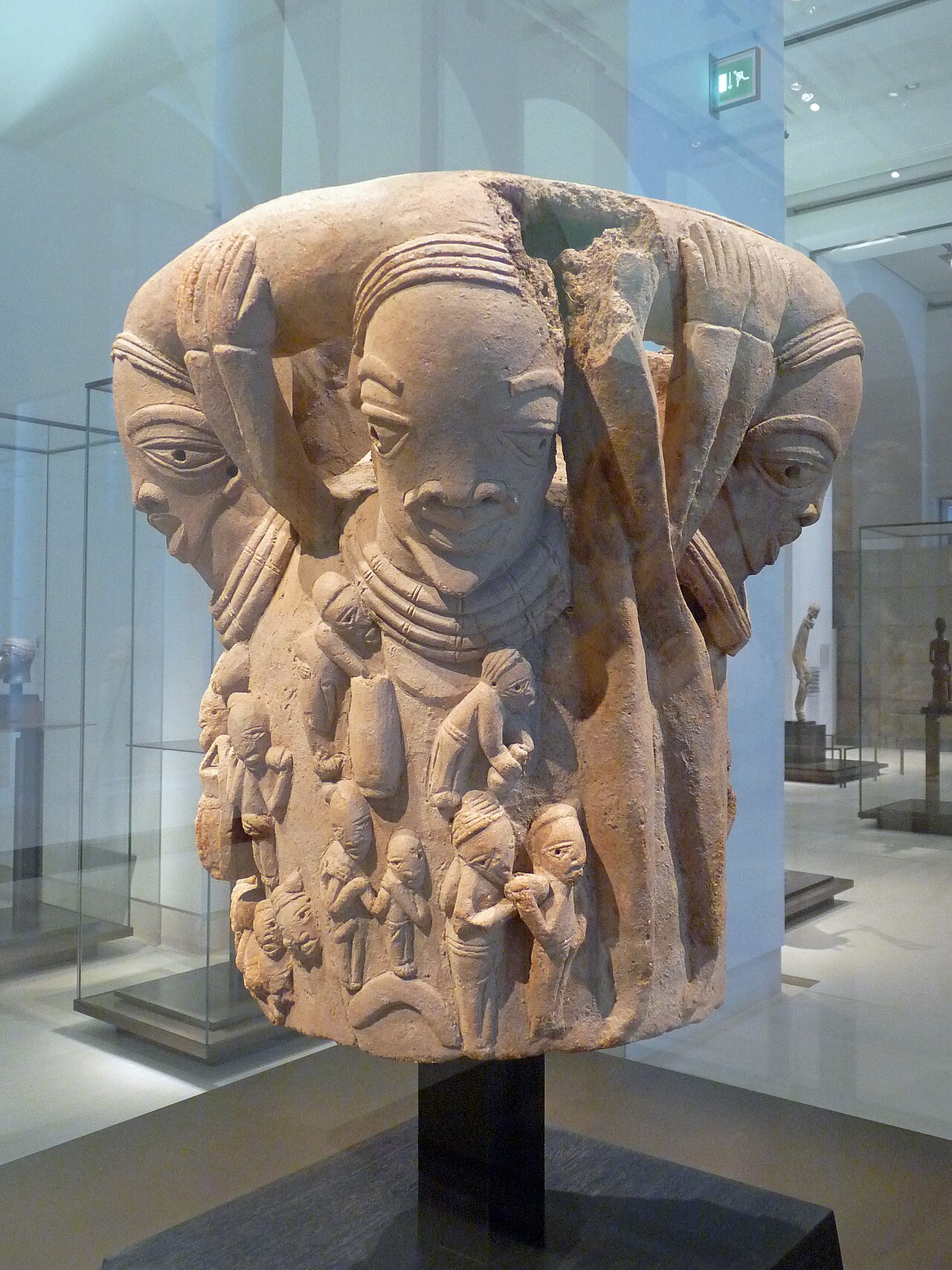
Nok art is a tradition of fired-clay figures — human heads and bodies, animals, and composite creatures — made from coarse, grog-tempered clay and baked at relatively low temperatures. Most surviving pieces are hollow and built up in sections, a technically demanding method that required the sculptor to manage drying, shrinkage, and firing without the whole form cracking. The largest complete figures would have stood close to a metre tall; many more survive only as heads, torsos, or limbs.
The style is instantly recognisable. Heads are often cylindrical or conical, with elaborate hairstyles, buns, and what appear to be beaded or woven headdresses. Eyes are frequently pierced — triangular, oval, or semicircular apertures — a feature unique enough that it has become the diagnostic marker of Nok work. Noses are broad and flared, lips full, and the expressions range from serene to startlingly intense. Some figures wear jewellery: necklaces, bracelets, waistbands. A few hold objects. One famous piece from the Katsina Ala area depicts a figure on horseback, hinting at the importance of equestrianism in later West African political culture.
Animals are equally vivid: elephants, snakes, monkeys, rams, and a recurring creature that scholars call the “Nok quadruped,” sometimes interpreted as a stylised lion or a mythical beast. The range suggests these objects served many purposes — ritual, memorial, protective, and perhaps simply decorative.
How Were the Nok Terracotta Sculptures Discovered?
The 1943 find at Nok was not an accident of archaeology but of industry. British tin companies were strip-mining alluvial deposits on the Jos Plateau, and their bulldozers sliced through burial mounds and occupation layers that had lain undisturbed for millennia. Workers brought up terracotta heads along with tin ore. Some pieces were kept as curiosities; others were lost. It was only in 1928 that a similar head had been reported from the same region, but it was the 1943 discovery that triggered systematic attention.
By the 1950s, the colonial archaeologist Bernard Fagg — later a pioneer of Nigerian museum development — had begun documenting the finds, mapping their distribution, and arguing that they represented a distinct culture rather than isolated objects. Fagg’s work, published in Man and other journals, established the term “Nok culture” and pushed the chronology back by centuries. Radiocarbon dates from associated charcoal and from the terracottas themselves now place the tradition between about 1500 BC and AD 500, with the densest activity between 900 BC and AD 200.
“The Nok terracottas are not merely the oldest sculptures in West Africa; they are the first evidence we have of a complex, iron-using society in the forest-savanna borderlands of Nigeria.” — a sentiment echoed by generations of archaeologists since Bernard Fagg’s pioneering surveys.
Where and When Did This Culture Flourish?
The Nok heartland lies on the Jos Plateau and its surrounding plains in what is now Kaduna, Plateau, Nasarawa, and Niger states — a zone of open savanna, rocky outcrops, and iron-rich soils. This was not a single city or kingdom but a cultural complex spread across tens of thousands of square kilometres, with dozens of known sites including Taruga, Samun Dukiya, Kagoro, and Katsina Ala.
Taruga is especially important. Excavated in the 1960s and 1970s, it produced both terracottas and the earliest evidence of iron smelting in West Africa, with furnaces dated to around 600–500 BC. That combination — art and metallurgy in the same settlements — is what makes Nok so significant. These were not isolated artists but communities embedded in a technological revolution.
| Period | Key Development | Representative Sites |
|---|---|---|
| c. 1500–900 BC | Early Nok settlement; earliest clay figurines | Jos Plateau fringe |
| c. 900–500 BC | Iron smelting begins; terracotta production expands | Taruga, Samun Dukiya |
| c. 500 BC–AD 200 | Peak of figurative sculpture; large hollow figures | Nok, Katsina Ala, Kagoro |
| c. AD 200–500 | Tradition fades; sites abandoned or transformed | Across the plateau |
Why the Nok Terracotta Sculptures Matter to African History
Before Nok, many Western scholars assumed that complex art and iron technology reached sub-Saharan Africa only through external contact — via Egypt, Carthage, or the trans-Saharan trade. Nok demolished that assumption. Here was a society producing world-class sculpture and smelting iron independently, centuries before the Common Era, deep in the West African interior.
The implications ripple outward. If Nok was making iron by 600 BC, then the technology either developed locally or spread through routes that predate the great Saharan trade networks. If Nok was making art of this quality, then the visual traditions of later Yoruba, Igbo, and Edo cultures did not emerge from nothing — they grew from a deep, indigenous root.
Nok also complicates the map of African urbanism. These were not nomads or simple villagers. They lived in settled communities, farmed pearl millet and cowpeas, kept livestock, and buried their dead with grave goods. The terracottas themselves were often found in association with burials, suggesting they played a role in funerary ritual — perhaps as portraits, guardians, or offerings.
Technique and Materials: How Were They Made?
Clay, Grog, and Fire
Nok sculptors worked with local clays mixed with crushed potsherd or stone — a tempering technique that reduces shrinkage and prevents cracking during drying. They built hollow forms by coiling and paddling, then smoothed and detailed the surface with tools and fingers. Firing was likely done in open pits or simple kilns at temperatures between 500°C and 900°C, low enough to preserve the clay’s porosity but high enough to vitrify it.
The Problem of Preservation
Terracotta is fragile. Most Nok figures survive only as fragments, and many were broken in antiquity — deliberately, it seems, as part of ritual deposition. The pieces that reach museums today often come from eroded hillsides or, more troublingly, from illegal excavation. Since the 1990s, a booming international market for Nok art has driven large-scale looting, stripping sites of their context and their stories.
- Diagnostic features: pierced eyes, flared nostrils, elaborate coiffures, cylindrical heads
- Common forms: human heads, kneeling or seated figures, animals, riders
- Typical size: heads 10–40 cm; complete figures up to 1 metre
- Dating methods: radiocarbon on associated charcoal; thermoluminescence on the clay itself
Preservation, Looting, and the Fight for Context
The greatest threat to Nok heritage is not time but greed. In the 1990s and 2000s, a surge in demand from European and North American collectors triggered industrial-scale looting across the Jos Plateau. Villagers, sometimes coerced or paid a pittance, dug up terracottas for dealers who smuggled them through Lagos and onward to Brussels, Paris, and New York. In the process, the archaeological context — the very information that tells us who made these objects, when, and why — was destroyed.
Nigeria has fought back. The National Commission for Museums and Monuments (NCMM) declared Nok sites protected, and in 2013 the Nigerian government, working with the German Archaeological Institute and other partners, launched a major research and conservation project. In 2022, the NCMM and the German government signed agreements to strengthen site protection and train Nigerian archaeologists. Museums in Jos, Kaduna, and Lagos now hold significant Nok collections, and there is growing pressure on Western institutions to return or at least acknowledge looted pieces.
But enforcement is hard. The plateau is vast, remote, and poor. Until local communities see tangible benefit from protecting sites — tourism revenue, jobs, cultural pride — the looting will continue. Some progress is visible: community museums, school programmes, and the work of Nigerian archaeologists like those trained at the University of Ibadan and Ahmadu Bello University are slowly shifting the calculus.
Nok Terracotta Sculptures in Global Museums and Scholarship
Today, Nok pieces are held by the British Museum, the Metropolitan Museum of Art, the Smithsonian’s National Museum of African Art, the Musée du quai Branly in Paris, and the Museum Rietberg in Zurich, among others. Their presence is double-edged. On one hand, they have introduced millions of people to the sophistication of ancient Nigerian art. On the other, many were acquired under circumstances that would now be considered unethical or illegal.
Scholarship has also evolved. Early interpretations framed Nok as a “mystery civilisation” — a patronising trope that implied Africans could not have built it. Modern research, led by Nigerian and international teams, has replaced mystery with nuance. We now know that Nok people lived in small, dispersed settlements; that they practiced a mixed economy of farming, herding, and hunting; and that their art was part of a broader ritual landscape that included burial mounds, stone monuments, and iron-working sites.
There are still gaps. No Nok site has yielded a large-scale settlement or a royal tomb. No writing has been found. The function of the figures remains debated. But the absence of answers is not the absence of achievement. It is an invitation to keep digging — carefully, ethically, and with Nigerian leadership at the centre.
What the Nok Terracotta Sculptures Teach Us Today
For Nigerians, the Nok terracottas are a source of national pride and a reminder that the country’s cultural depth extends far beyond its modern borders and recent history. For the African diaspora, they are a link to a past that predates colonialism, slavery, and the distortions of external narrative. For the world, they are a correction: Africa was not waiting to be discovered. It was creating.
There is also a practical lesson. Heritage is not abstract. It is tied to land, to communities, and to economic justice. When a terracotta head is ripped from its soil and sold on the black market, what is lost is not just an object but a chapter of human history. Protecting Nok means supporting the people who live among its ruins — funding local museums, training custodians, and ensuring that the story of Nok is told by those who inherit it.
The sculptures themselves endure: fired clay, shaped by hands that are long gone, bearing witness to a civilisation that flourished, built, and believed on the Jos Plateau more than two millennia ago. They are not relics. They are ancestors — and they are still speaking.