📅 Last updated: 05.07.2026
From its heartland on the high plateaus of modern-day Ethiopia and Eritrea, the Aksum Empire rose to become one of the ancient world’s most formidable and sophisticated civilizations, a true African trading powerhouse that connected the Roman Mediterranean, the Persian Gulf, and the Indian Ocean. For over seven centuries, from roughly the 1st to the 7th century AD, Aksum was not merely a kingdom but a beacon of wealth, culture, and geopolitical might. It was a civilization that minted its own gold currency, built towering obelisks that still defy the sky, and embraced Christianity as a state religion long before most of Europe. To understand Aksum is to understand a pivotal chapter in global history, one that challenges the outdated narrative of a disconnected, passive Africa.
- The Aksum Empire: A Crucible of Trade and Power
- Kings, Obelisks, and the Rise of Christianity in the Aksum Empire
- The Aksum Empire: A Timeline of Power
- Daily Life in the Aksum Empire: A Sophisticated Society
- Trade and Diplomacy: The Heart of Aksumite Power
- The Decline and Legacy of a Great Civilization
- The Aksum Empire: A Living Heritage
- Lessons from the Aksum Empire for a Modern Africa
The Aksum Empire: A Crucible of Trade and Power
The emergence of the Aksum Empire was no accident of history. It was the culmination of centuries of development in the Horn of Africa, a region already bustling with commercial activity. The port of Adulis, on the Red Sea coast, was the empire’s economic lifeline, a bustling entrepôt where goods from the interior—gold, ivory, frankincense, myrrh, and exotic animals—were exchanged for luxury items from the Roman world, including glassware, wine, olive oil, and fine textiles. This strategic position, perfectly situated between the Nile Valley, the Arabian Peninsula, and the open Indian Ocean, made Aksum an indispensable link in a chain of global commerce. The empire’s kings, who styled themselves as negusa nagast (King of Kings), understood that control of trade routes was the surest path to wealth and influence.
Unlike the more militaristic expansion of Rome or Persia, Aksum’s influence was often projected through economic dominance and strategic alliances. The empire’s agricultural base was equally impressive. The fertile highlands, with their reliable monsoon rains, produced a surplus of crops like teff (an indigenous grain used to make the flatbread injera), wheat, barley, and sorghum. This agricultural wealth supported a dense population and a powerful army, which could be mobilized to secure trade routes or project power across the Red Sea into Yemen. Aksum was, in every sense, a self-sufficient superpower of its age.
The Foundations of Aksumite Wealth
What made the Aksum Empire so uniquely prosperous? The answer lies in a combination of geographic luck and shrewd economic management. The empire controlled the source of several commodities that were in high demand across the ancient world. Ivory from the African interior was perhaps the most prized, used for everything from Roman furniture to Byzantine religious icons. The Aksumites also monopolized the trade in frankincense and myrrh, aromatic resins that were essential for religious ceremonies and medicine in the Mediterranean.
- Gold and Precious Stones: Mined in the western highlands and traded via Adulis.
- Exotic Animals: Live elephants, rhinoceroses, and giraffes were shipped to Roman arenas and zoos.
- Slaves: A regrettable but significant part of the ancient economy, with captives from frontier wars sold in Mediterranean markets.
- Textiles and Spices: Cotton cloth from the interior and spices from the Indian Ocean trade passed through Aksumite ports.
To facilitate this trade, the Aksum Empire developed a sophisticated monetary system. It was one of the first African states to mint its own coins, a privilege that signified sovereignty and economic maturity. The gold, silver, and bronze coins of Aksum, often bearing the image of the reigning king and his regalia, were accepted in markets from Constantinople to Sri Lanka. This currency was not just a medium of exchange; it was a powerful tool of propaganda, projecting the king’s image and authority across vast distances. The coins also provide modern historians with a remarkably detailed chronology of Aksumite rulers, their titles, and their religious affiliations.
Kings, Obelisks, and the Rise of Christianity in the Aksum Empire
The history of the Aksum Empire is a story of ambitious kings. Among the most famous was King Ezana (fl. 320–360 AD), who presided over a period of immense territorial expansion and cultural transformation. Ezana’s reign marks a decisive turning point: he is credited with making Christianity the official state religion of Aksum, decades before the Roman Emperor Theodosius I did the same. This was not a passive adoption of a foreign faith. Ezana’s conversion, likely influenced by his tutor Frumentius (who later became the first Bishop of Aksum), was a calculated political move that aligned the empire with the powerful Christian Roman world and distinguished it from its pagan and Jewish neighbors.
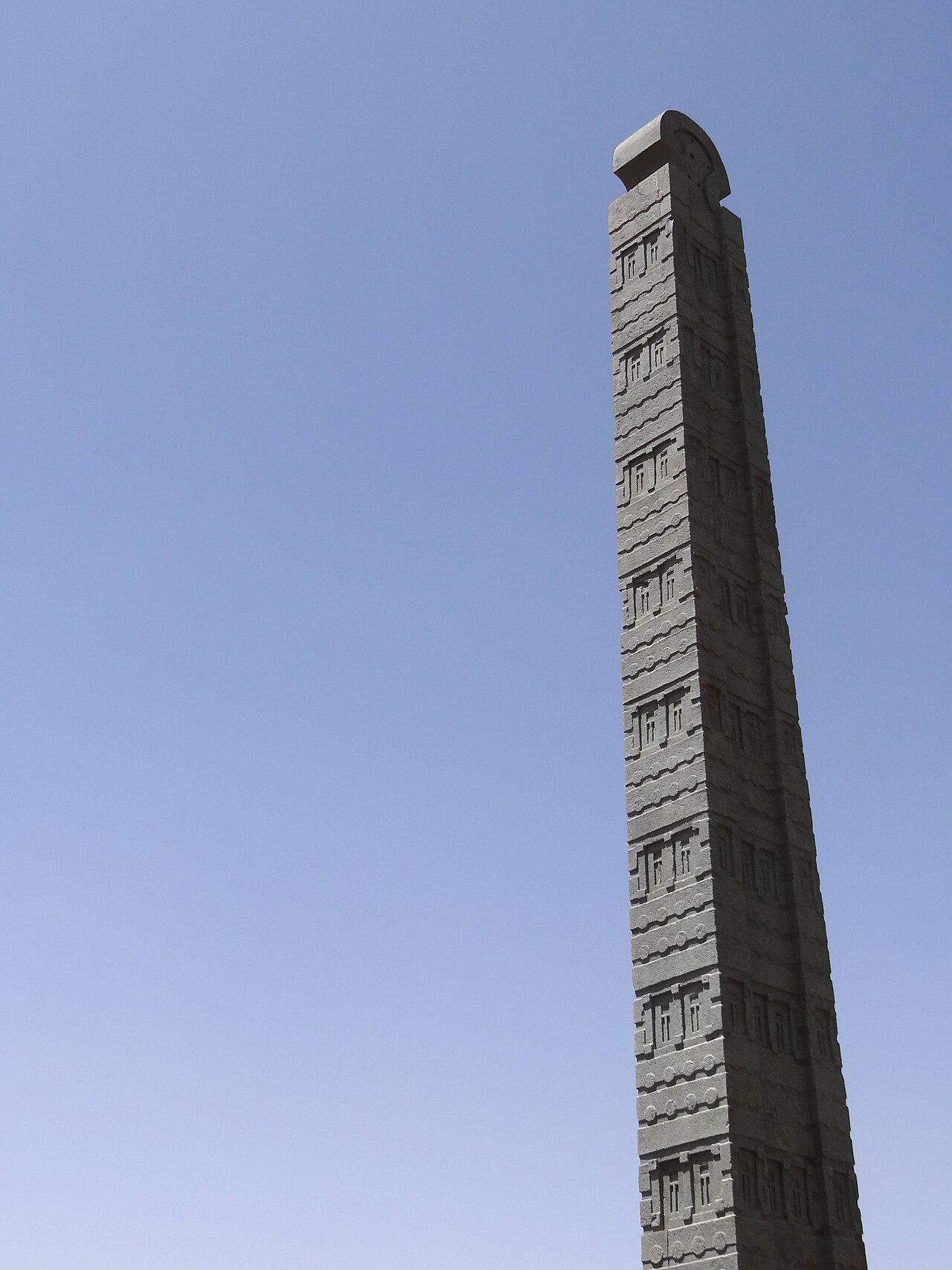
The tangible legacy of Aksum’s power is most visible in its monumental architecture. The city of Aksum, the empire’s capital, was once a sprawling metropolis of palaces, temples, and grand public buildings. The most iconic structures are the giant stelae, or obelisks, carved from single blocks of granite. The largest standing obelisk, the Obelisk of Aksum, stands over 24 meters (79 feet) tall and weighs an estimated 160 tons. These monoliths were not merely decorative; they were funerary markers for the empire’s elite, intricately carved to resemble multi-storied buildings with false doors and windows. The engineering skill required to quarry, transport, and erect these massive stones is a testament to the organizational capacity and technical sophistication of Aksumite society.
The Kingdom of Axum: A Center of Learning and Faith
With the adoption of Christianity, the Aksum Empire became a major center of religious and scholarly activity. The Ethiopian Orthodox Tewahedo Church, which traces its roots directly to this period, developed a unique liturgy and tradition. The Ge’ez language, a Semitic language that was the vernacular of Aksum, became the sacred language of the church, and a rich body of theological, historical, and liturgical literature was written and translated. The empire’s monasteries, often perched on inaccessible mountain tops, became repositories of ancient knowledge, preserving texts that were lost in other parts of the Christian world.
The church was also a powerful landowner and political force. The clergy were deeply involved in the affairs of state, and the patriarch of Alexandria in Egypt held considerable influence over the Ethiopian church. This religious connection created a lasting bond between the Aksum Empire and the broader Christian world, even as the empire’s political and commercial fortunes began to wane. The legend of the Ark of the Covenant, which the Ethiopian faithful believe was brought to Aksum by Menelik I (the son of the Queen of Sheba and King Solomon), is a powerful symbol of this divine connection. The Chapel of the Tablet in Aksum is said to house the Ark, making the city one of the holiest sites in Christendom.
The Aksum Empire: A Timeline of Power
To fully appreciate the arc of this empire, a concise timeline helps place its major achievements and challenges in context. The table below outlines key periods and milestones in the history of the Aksum Empire.
| Period | Key Events & Figures | Significance |
|---|---|---|
| 1st Century AD | Emergence of Aksum as a trading state; port of Adulis flourishes. The Periplus of the Erythraean Sea describes Aksum as a major market. | Establishes Aksum as the dominant power in the Red Sea trade network. |
| 3rd Century AD | King Endubis mints the first Aksumite gold coins. Persian prophet Mani lists Aksum as one of the four great powers of the world (with Rome, Persia, and China). | Peak of Aksumite economic and political influence. Aksum is a recognized global superpower. |
| 4th Century AD | King Ezana converts to Christianity, making it the state religion. Conquest of the Kingdom of Kush (Meroe). | Fundamental cultural and religious shift. Aksum becomes a Christian ally of the Roman Empire. |
| 6th Century AD | King Kaleb leads a campaign to conquer Yemen, protecting Christian communities. Construction of the great stelae continues. | Height of military expansion. Aksum controls territory on both sides of the Red Sea. |
| 7th-8th Centuries AD | Rise of Islam. Muslim conquests disrupt Red Sea trade. Port of Adulis declines. Aksum retreats inland. | Gradual economic and political decline. The empire contracts and becomes isolated. |
Daily Life in the Aksum Empire: A Sophisticated Society
Beyond the grand narratives of kings and trade, the daily life of the Aksumite people was rich and complex. The empire was a hierarchical society, with the king and his court at the top, followed by a class of nobles, priests, and wealthy merchants. The majority of the population were farmers, living in villages and cultivating the fertile highlands. Urban centers like Aksum and Adulis were cosmopolitan hubs, home to artisans, traders, and foreign merchants from Egypt, Arabia, India, and even the Roman Empire.
Architecture and Urban Planning
Aksumite cities were well-planned. The capital itself featured a complex of royal palaces, including the famous Dungur palace, a multi-story structure built with stone and timber. The houses of the wealthy were often built on raised platforms, with walls of dry-stone masonry and roofs supported by wooden beams. Public spaces included markets, reservoirs, and religious buildings. The Aksumites were also master engineers of water management. They built sophisticated dams, cisterns, and irrigation channels to capture and distribute water for agriculture and domestic use. The Mai Shum dam, near Aksum, is a remarkable example of their hydraulic engineering, a testament to their ability to manage their environment.
Art, Culture, and Religion
Aksumite art was distinctive and functional. The most famous examples are the stelae, but the empire also produced beautiful gold and silver jewelry, carved ivory, and intricate pottery. The adoption of Christianity brought a new iconography, with crosses and biblical scenes appearing on coins, stonework, and manuscripts. The Aksumite cross, with its intricate geometric design, remains a powerful symbol of Ethiopian Christianity to this day. The empire was also a melting pot of cultural influences. The Ge’ez script, derived from the Sabaean script of South Arabia, was used for writing, and the language itself shows influences from Cushitic languages of the Horn of Africa. This cultural synthesis was a source of strength, not weakness.
“The Aksumites were not simply passive recipients of outside influences. They actively selected, adapted, and transformed ideas from the Mediterranean, Arabia, and Africa to create a uniquely Aksumite civilization.” — Dr. Tekle Hagos, Ethiopian archaeologist
The religious life of the empire was equally dynamic. Before Christianity, the Aksumites practiced a polytheistic faith that included a chief god, Mahrem (identified with the Greek god Ares), and a host of other deities. The king was considered a divine or semi-divine figure, a mediator between the gods and the people. The transition to Christianity was not sudden or entirely peaceful, but it was ultimately successful. The new religion was integrated into the existing power structures, and the king’s role as a protector of the faith became central to his legitimacy. This fusion of political and religious authority gave the Aksumite state remarkable stability for centuries.
Trade and Diplomacy: The Heart of Aksumite Power
The Aksum Empire’s influence extended far beyond its borders, powered by a sophisticated network of trade and diplomacy. The empire maintained active diplomatic relations with the Roman and Byzantine Empires, exchanging ambassadors and gifts. The Byzantine Emperor Justinian I (6th century AD) actively courted Aksum as an ally against the Sassanid Persian Empire, which controlled the overland spice routes. Aksumite merchants were not merely middlemen; they were active participants in the Indian Ocean trade, sailing directly to ports in India and Sri Lanka. The empire’s control of the Red Sea gave it a stranglehold on a critical artery of global commerce.
The goods that flowed through Aksumite ports tell a story of a truly interconnected world. From the east came spices like pepper and cinnamon, silks from China, and precious stones from India. From the interior came gold, ivory, and slaves. From the Mediterranean came glassware, wine, and olive oil. This trade was not just about material wealth; it was a conduit for ideas, technologies, and cultural practices. The Aksum Empire was a node in a global network, a place where different worlds met, traded, and influenced each other. This cosmopolitanism is one of the most impressive and often overlooked aspects of its history.
The Decline and Legacy of a Great Civilization
No empire lasts forever, and the Aksum Empire’s decline was a gradual process driven by a combination of internal and external pressures. The most significant factor was the rise of Islam in the 7th century AD. The Islamic conquests of Egypt, Syria, and Persia fundamentally reshaped the Red Sea trade. The new Muslim powers were not hostile to Aksum in principle (the Prophet Muhammad had even granted protection to Aksumite Christians), but they disrupted the old trade routes. The port of Adulis was gradually eclipsed by new Islamic ports like Jeddah and Aden. The Aksumite economy, so dependent on maritime trade, began to contract.
Internally, the empire faced environmental challenges. Over-farming and deforestation may have contributed to soil erosion and reduced agricultural productivity. The Aksumites also faced increasing pressure from nomadic groups like the Beja people, who raided the empire’s frontiers. The capital itself was sacked at least once, and the empire’s political center shifted southward into the more defensible highlands of what is now the Amhara region. By the 9th century AD, the Aksum Empire as a unified political entity had largely ceased to exist. Its legacy, however, was far from extinguished.
The Aksum Empire: A Living Heritage
The story of the Aksum Empire does not end in the dust of history. Its legacy is alive and vibrant in modern Ethiopia and Eritrea. The Ethiopian Orthodox Tewahedo Church, which traces its roots directly to the conversion of King Ezana, is a living link to the Aksumite past. The Ge’ez language, though no longer spoken in daily life, is still used in the church’s liturgy. The empire’s architectural traditions, particularly the use of stone and timber, influenced the later architecture of the Zagwe and Solomonic dynasties. The rock-hewn churches of Lalibela, built centuries after Aksum’s decline, are a direct spiritual and artistic descendant of the Aksumite tradition.
For the African diaspora, the Aksum Empire offers a powerful and inspiring counter-narrative to the colonial story of a continent without history. It stands as proof that Africa was home to great civilizations, with complex political systems, advanced technologies, and vibrant cultures. The empire’s achievements in trade, architecture, and statecraft are a source of immense pride. The Aksum Empire was not an isolated anomaly but a central player in the ancient world, a testament to Africa’s long and rich history of innovation, resilience, and global engagement.
Lessons from the Aksum Empire for a Modern Africa
What can we learn from the Aksum Empire today? Its story holds powerful lessons for a modern Africa striving for economic independence and global influence. First, it demonstrates the profound importance of controlling one’s own trade routes and adding value to raw materials. Aksum did not just export raw ivory; it became a hub for finished goods and a center of financial exchange through its coinage. This is a lesson for contemporary African nations seeking to move up the value chain.
Second, the Aksum Empire shows the power of strategic alliances and cultural exchange. It was not a closed, isolated society. It actively engaged with the Roman world, Arabia, and India, borrowing and adapting ideas while maintaining its own distinct identity. This openness was a source of strength, not a weakness. In a globalized world, this lesson is more relevant than ever. Finally, the Aksum Empire’s legacy reminds us that African history is not a footnote to world history; it is a central chapter. The enduring power of the obelisks of Aksum, the gold coins of King Ezana, and the living faith of the Ethiopian Orthodox Church are all testaments to a civilization that shaped the world. The Aksum Empire was, and remains, a beacon of African achievement, a reminder that greatness was built on this continent long ago, and can be built again.