📅 Last updated: 05.07.2026
The story of West Africa is incomplete without the thunderous echo of the Songhai Empire, a realm that, at its zenith, was one of the largest and most sophisticated states in the pre-modern world. To understand Songhai Empire history is to journey into a golden age of power, scholarship, and transcontinental trade that redefined the possibilities of African civilization. Emerging from the ashes of the Mali Empire, Songhai did not merely inherit a legacy; it forged its own, creating an administrative and military machine that stretched from the Atlantic coast to the heart of the Sahara, a testament to the continent’s capacity for grand, centralized governance long before European contact.
- The Foundations of Power: From Gao to Imperial Ambition
- Askia Muhammad: The Architect of Songhai Empire History's Golden Age
- The Economic Engine: Trade, Salt, and Gold
- The Intellectual Brilliance of Timbuktu
- Art, Architecture, and Daily Life
- The Seeds of Decline: Internal Strife and External Threat
- Legacy and Echoes: The Songhai Empire Today
- The Enduring Takeaway: A Model of African Sovereignty
The Foundations of Power: From Gao to Imperial Ambition
The seeds of the Songhai Empire were sown along the banks of the Niger River, in the bustling city of Gao. For centuries, the Songhai people had formed a small kingdom, often paying tribute to their more powerful neighbors, the Mali Empire. But by the late 14th century, as Mali’s star began to wane, Songhai’s leaders saw an opportunity. The man who would catalyze this transformation was Sonni Ali, a warrior-king of legendary—and often controversial—repute.
Sonni Ali: The Warrior-King (1464–1492)
Sonni Ali Ber (Ali the Great) was not a man of books but of action. He understood that empire was built on iron and will. Taking the throne in 1464, he immediately launched a series of relentless military campaigns. His primary target was the wealthy and strategically vital city of Timbuktu, then under the control of the Tuareg, and the scholarly city of Djenné. His genius lay in his use of the Niger River. He built a formidable navy of war canoes, allowing his forces to move troops and supplies with unprecedented speed, striking deep into the heart of enemy territory. The siege of Djenné, which lasted seven years, demonstrated his iron resolve. When the city finally fell around 1475, it was not through a bloody assault but through a negotiated surrender, a testament to his pragmatic ruthlessness.
Sonni Ali’s reign was marked by a complex relationship with the Islamic scholars of Timbuktu, whom he often viewed with suspicion, favoring traditional Songhai religious practices. This created a lasting tension, but his military achievements were undeniable. He unified the central Niger bend, crushed the Mossi raiders to the south, and brought the vital salt mines of Taghaza under Songhai control. When he died in 1492, he left behind a vast, war-hardened state. Yet, his legacy was immediately challenged.
Askia Muhammad: The Architect of Songhai Empire History’s Golden Age
The death of Sonni Ali plunged the empire into a brief but decisive power struggle. His son, Sonni Baru, was defeated in battle by one of his father’s former generals, Muhammad Ture. This general would become the true architect of the Songhai Empire’s classical age, taking the title Askia—a name that would resonate for centuries. Askia Muhammad I, also known as Askia the Great, reigned from 1493 to 1528, and his rule represents the pinnacle of Songhai Empire history.
Where Sonni Ali was a hammer, Askia Muhammad was a scalpel. He was a devout Muslim who understood the power of faith in unifying a diverse empire and connecting it to the broader Islamic world. His first major act was a pilgrimage to Mecca in 1496–97, a journey of immense political and spiritual significance. He traveled with an enormous entourage, including 500 cavalry and 100,000 gold coins, distributing alms and gifts so lavishly that his reputation preceded him in Cairo and Mecca. Upon his return, he was appointed the Caliph of the Sudan by the Abbasid Caliph in Cairo, a symbolic title that granted him immense religious legitimacy.
Administrative and Military Reforms
Askia Muhammad’s true genius was organizational. He transformed a military conquest state into a structured, efficient empire. He created a centralized bureaucracy, appointing governors (Farin) to oversee provinces, and established a system of taxation that was both systematic and fair. He replaced Sonni Ali’s predominantly pagan army with a professional, multi-ethnic force that included a fleet of war canoes, a cavalry corps, and a disciplined infantry. Key to his success was the creation of a standing army stationed in key garrisons across the realm, ensuring rapid response to rebellion.
His administrative reforms were equally profound. He divided the empire into four major provinces, each with a governor and a network of local officials. He appointed a Hari-Farma (Minister of the Navy) and a Fari-Mondyo (Minister of Commerce and Finance). The empire’s legal system was formalized, blending Islamic Sharia law with traditional Songhai customs. This intricate framework allowed for the effective governance of a territory that spanned over 1,400 miles from east to west.
The Economic Engine: Trade, Salt, and Gold
The Songhai Empire was, at its core, a commercial enterprise. Its wealth was not plundered but earned through the control of the trans-Saharan trade routes. The empire sat astride the nexus of North African salt, Mediterranean goods, and the gold, ivory, and slaves of the southern forests. This trade was the lifeblood of the state.
- Salt: The salt mines of Taghaza and later Taoudeni were the empire’s most strategic asset. Salt was literally worth its weight in gold in the south, where it was essential for preserving food and maintaining health. The empire controlled the production and transportation of this white gold.
- Gold: The gold fields of Bambuk, Bure, and Lobi, located in the southern reaches of the empire and beyond, supplied the world. Songhai did not directly mine all the gold, but it controlled the trade routes, taxing every ounce that passed through its customs posts. This gold fueled the economies of North Africa and, ultimately, Europe.
- Kola Nuts and Slaves: From the southern forests came kola nuts, a prized stimulant in North Africa, and slaves, who were used in the salt mines and as domestic servants in North Africa. While often overlooked, the slave trade was a significant, if brutal, component of the economy.
- Textiles and Manufactured Goods: From North Africa came fine textiles, horses, copper, glass beads, and books. Timbuktu and Djenné became vast emporiums where these goods were exchanged.
The empire’s currency was based on cowrie shells (imported from the Maldives), gold dust, and copper bars. The markets of Gao, Timbuktu, and Djenné were legendary, bustling with merchants from as far away as Fez, Cairo, and the Hausa states. The state’s revenue came from a 10% tax on all goods entering the empire, a land tax, and a special tax on harvests.
| Commodity | Origin | Destination | Significance |
|---|---|---|---|
| Gold | Bambuk, Bure (Southern forests) | North Africa, Europe | Primary source of imperial wealth; fueled global trade. |
| Salt | Taghaza, Taoudeni (Sahara) | Sub-Saharan West Africa | Essential for life; literally worth its weight in gold. |
| Slaves | Southern frontiers, war captives | North Africa, Sahara oases | Labor for mines and households; a tragic but integral part of the system. |
| Kola Nuts | Forest kingdoms (modern Ghana/Ivory Coast) | North Africa, Sudan | Stimulant and trade good, highly valued in the north. |
| Books & Manuscripts | North Africa, Andalusia | Timbuktu | Intellectual capital; fueled Timbuktu’s scholarly reputation. |
The Intellectual Brilliance of Timbuktu
No discussion of Songhai Empire history is complete without a deep dive into the intellectual revolution it fostered. While Gao was the political capital, Timbuktu was the spiritual and intellectual heart of the empire. Under Askia Muhammad’s patronage, the city’s famous universities—the Sankore, Djinguereber, and Sidi Yahya mosques—flourished. They were not single buildings but collections of independent schools and libraries, forming a vibrant intellectual ecosystem.
Scholars from across the Islamic world—from Fez, Cairo, and even Andalusia—flocked to Timbuktu. The curriculum was vast, encompassing not just theology and law, but also astronomy, mathematics, medicine, philosophy, and literature. The city’s libraries held hundreds of thousands of manuscripts, many of which survive to this day, a testament to a golden age of African scholarship. The most famous scholar of the era was Ahmed Baba (1556–1627), a prolific writer and jurist whose works are still studied. He was once forced into exile by the Moroccan invasion, but his reputation as the “Sultan of the Scholars” endures.
“The scholars of Timbuktu were not mere imitators. They were innovators who synthesized Islamic knowledge with local traditions, creating a unique intellectual culture that was both deeply African and globally connected.” — Dr. Shamil Jeppie, historian of Timbuktu’s manuscripts.
The city was also a melting pot of cultures. Tuareg, Fulani, Songhai, and Arab merchants and scholars lived side-by-side. The great mosque of Djinguereber, built in the 14th century, still stands today, its mud-brick architecture a symbol of the city’s enduring legacy. The intellectual output of Timbuktu was not an isolated phenomenon but a direct product of the peace, stability, and patronage provided by the Songhai state.
Art, Architecture, and Daily Life
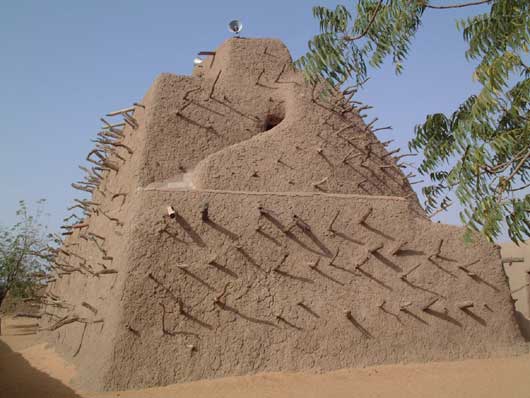
While Timbuktu’s intellectual life is justly famous, the Songhai Empire was also a place of vibrant material culture. The capital, Gao, was a sprawling city of mud-brick houses, royal palaces, and bustling markets. The Askia’s court was a center of ceremony and power. The famous Askia Tomb in Gao, a 17-meter-high pyramid-like structure built of mud-brick, is a UNESCO World Heritage site and a lasting monument to Askia Muhammad’s reign. It is a masterpiece of Sudano-Sahelian architecture, a style that blends Islamic forms with local building traditions.
Daily life for the majority of Songhai people was agricultural. They farmed millet, sorghum, rice, and cotton along the fertile banks of the Niger. Fishing communities thrived on the river’s bounty. Artisans wove cotton cloth, worked leather, and forged iron tools and weapons. The empire’s social structure was hierarchical, with the Askia and his family at the top, followed by nobles, merchants, scholars, farmers, and finally slaves. Despite this hierarchy, social mobility was possible through military service, commerce, or scholarship. Women, particularly in the capital, could hold significant economic power as traders and property owners.
The Seeds of Decline: Internal Strife and External Threat
No empire lasts forever, and the Songhai Empire’s golden age was ultimately undone by its own success. The very centralization that made it strong also created vulnerabilities. After Askia Muhammad’s death in 1538 (he was deposed by his son in 1528), a series of weak and fratricidal successors struggled to maintain control. The long-distance trade routes began to shift, as the Portuguese and other Europeans started trading directly with coastal kingdoms, bypassing the trans-Saharan networks.
The fatal blow came from an unexpected quarter: Morocco. In 1590, the Saadian Sultan of Morocco, Ahmad al-Mansur, coveting the gold of the Sudan, launched a daring invasion. His army was small—around 4,000 men—but it was equipped with something the Songhai had never faced on a large scale: gunpowder. The Moroccan force included arquebusiers (early musketeers) and cannon, while the Songhai army relied on cavalry and spears. At the Battle of Tondibi (1591), near Gao, the superior firepower of the Moroccans shattered the vast Songhai army. The empire collapsed almost overnight. Gao was sacked, and Timbuktu was occupied. The centralized state fragmented into a patchwork of smaller kingdoms, and the golden age of the Sahel was over.
Legacy and Echoes: The Songhai Empire Today
The Moroccan conquest was a catastrophe, but it did not erase the memory of the Songhai Empire. Its legacy is woven into the fabric of modern West Africa. The Songhai language remains widely spoken in Mali, Niger, and Burkina Faso. The epic of Askia Muhammad is still recited by griots, the traditional oral historians. The manuscripts of Timbuktu, though threatened by conflict and neglect, are being painstakingly preserved, a global effort to reclaim Africa’s intellectual heritage. The very idea of a powerful, centralized, and sophisticated African state before colonialism challenges persistent stereotypes of a “dark continent” without history.
The Songhai Empire history is not a distant, irrelevant tale. It is a story of ambition, organization, and cultural brilliance that resonates powerfully today. It reminds us that Africa was not a passive recipient of global history but an active creator of it. The Songhai built a world of learning and commerce that connected the Mediterranean to the Niger, a golden age that still shines, however faintly, in the sands of time. It is a legacy that demands to be remembered, studied, and celebrated—not as a myth, but as a profound historical reality.
The Enduring Takeaway: A Model of African Sovereignty
As we reflect on the Songhai Empire, we see a powerful counter-narrative to the idea that Africa’s pre-colonial past was one of small-scale, tribal societies. The Songhai Empire was a multi-ethnic, multi-lingual, and multi-religious state that functioned on a scale comparable to its European and Asian contemporaries. Its achievements in governance, trade, and scholarship were not accidents but the products of deliberate human ingenuity. The story of Songhai is not just a chapter in a history book; it is a living testament to the capacity of African peoples to build complex, enduring civilizations. It challenges us to look beyond the modern borders and conflicts of the Sahel and see the deep, rich tapestry of power and knowledge that once flourished there. The gold of Songhai was not just in its mines, but in its minds. And that is a treasure no invasion can ever fully steal.