📅 Last updated: 05.07.2026
In the heart of the Asante Kingdom, deep within the forests of what is now modern-day Ghana, there exists a symbol so powerful, so sacred, that for over three centuries it has defined the soul of a nation: the Ashanti Golden Stool. Unlike the opulent thrones of European monarchs, this 18-inch-high, solid gold stool is not meant to be sat upon. It is believed to house the soul (sunsum) of the entire Asante people — a divine, unifying force that binds the living, the dead, and the yet-to-be-born. To understand Ghana is to understand this stool, a relic that survived war, colonialism, and the relentless march of modernity.
- The Divine Descent: How the Ashanti Golden Stool Came to Earth
- More Than a Throne: The Symbolism and Sacred Nature of the Stool
- A Timeline of Conflict: The Ashanti Golden Stool vs. The British Empire
- Where is the Ashanti Golden Stool Today?
- The Ashanti Golden Stool in Modern Ghana: A Living Tradition
- Visiting Kumasi: Walking in the Shadow of the Stool
- Preserving the Sacred: The Stool in the 21st Century
- The Enduring Legacy: What the Ashanti Golden Stool Teaches Us
The Divine Descent: How the Ashanti Golden Stool Came to Earth
The story of the Ashanti Golden Stool (Sika Dwa Kofi) begins not with a blacksmith or a king, but with a priest. In the late 17th century, the Asante were a tributary state of the more powerful Denkyira kingdom. It was a time of oppression and simmering rebellion. According to oral tradition, the paramount chief Osei Tutu I and his brilliant priest and advisor, Okomfo Anokye, sought to unite the fragmented Asante city-states into a single, formidable nation.
One Friday — hence the name Kofi (born on Friday) — Okomfo Anokye summoned the chiefs and their people to a grand gathering at a village called Asantemanso. As the story is reverently told today in Kumasi, the capital, a thick, dark cloud descended from the heavens amid thunder and lightning. Out of the swirling mist, a golden stool, studded with bells, floated down and gently settled onto the lap of Osei Tutu I. Okomfo Anokye declared that the stool contained the spirit of the Asante nation. It was not a throne for a man, but a shrine for a people. From that moment, all Asante chiefs and warriors pledged their allegiance not merely to Osei Tutu, but to the Golden Stool itself. This act of spiritual and political genius created the Asante Confederacy, a state that would become one of West Africa’s most powerful and resilient empires.
More Than a Throne: The Symbolism and Sacred Nature of the Stool
To the Western eye, a stool might seem an unassuming object. But in Akan culture, the stool (asɛsɛ) is deeply symbolic. Every individual, from the humblest farmer to the most powerful king, owns a personal stool that represents their identity and spirit. When a person dies, their stool is blackened with soot and egg yolk and preserved in a family shrine. The Ashanti Golden Stool, however, is the ultimate stool — the repository of the collective soul of the Asante nation.
The Physical Object
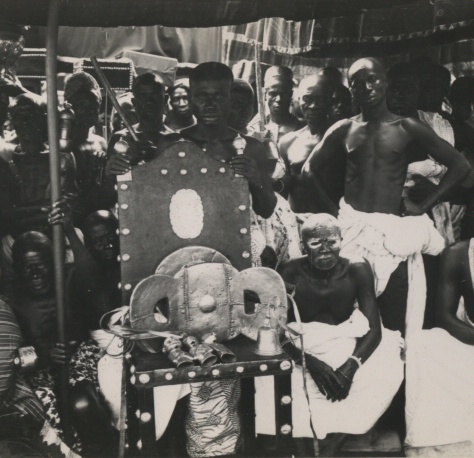
Let’s be precise about what the Ashanti Golden Stool actually is. It is not solid gold, as many imagine. It is a wooden core, carved from a single block of Osese wood, entirely covered in sheets of hammered gold. It measures approximately 46 cm (18 inches) high, 61 cm (24 inches) long, and 30 cm (12 inches) wide. The central platform dips slightly in the middle, and the sides are adorned with intricate patterns and small gold bells, which would tinkle softly as the stool was carried in procession. It is never allowed to touch the ground. It rests on its own throne, a special platform, and is always placed on its side — never upright — to prevent anyone, even the Asantehene (the king), from accidentally sitting on it.
The Soul of a Nation
The stool’s power lies in its spiritual role. It is considered the ultimate symbol of unity. When the Asante fought the British in the 19th century, they did not fight for land or trade routes alone. They fought for the stool. To lose the stool would be to lose their very identity as a people. This belief is captured in a famous Asante proverb:
“The Golden Stool is not the throne of any one chief. It is the throne of the whole Asante nation. The power of the Asante is in this stool. If it is captured, we are all destroyed.”
This sacred object is brought out only on the most momentous occasions — the enstoolment of a new Asantehene, major state funerals, and the climax of the Odwira Festival. When it appears, it is shaded by a massive umbrella, accompanied by drummers, horn blowers, and sword bearers. The entire assembly must bare their chests and remove their sandals as a sign of utmost respect. To even look upon it directly is considered a privilege and a profound act of reverence.
A Timeline of Conflict: The Ashanti Golden Stool vs. The British Empire
The history of the Ashanti Golden Stool is inextricably linked with the colonial struggle against the British. The Anglo-Ashanti Wars, a series of conflicts spanning the 19th century, were driven by British desire for gold and control of the lucrative trade routes. But the final, most dramatic act came in 1900.
| Year | Event | Significance |
|---|---|---|
| 1874 | British sack of Kumasi | After the Third Anglo-Ashanti War, British troops burn parts of Kumasi, but the Ashanti Golden Stool is successfully hidden and protected by the Asante. |
| 1896 | Exile of Asantehene Prempeh I | The British capture and exile the king to the Seychelles. They demand the stool, but the Asante refuse, hiding it deep in the forest. |
| 1900 | The War of the Golden Stool | British Governor Sir Frederick Hodgson demands to sit on the stool. This insult triggers a massive, year-long uprising led by Yaa Asantewaa. |
| 1921 | The Stool is Profaned | African road workers accidentally discover the stool. The British governor seizes it, but later returns it under immense pressure to avoid another war. |
| 1935 | Restoration of the Confederacy | The British, as a gesture of goodwill, allow the restoration of the Asante Confederacy and the return of Prempeh I from exile. |
The Ultimate Insult: Sir Frederick Hodgson’s Folly
The most famous chapter in the stool’s history is the War of the Golden Stool in 1900. The British Governor of the Gold Coast, Sir Frederick Hodgson, arrived in Kumasi and demanded that the Asante produce the Golden Stool so that he, the representative of the Queen, could sit upon it. This was a catastrophic miscalculation. To the Asante, the stool was not a piece of furniture; it was the embodiment of their spirit. The demand was seen as a declaration of war against their very existence.
In response, the Queen Mother of Ejisu, the legendary Yaa Asantewaa, rallied the chiefs and their armies. She famously declared:
“Now I have seen that some of you fear to fight for the Golden Stool. If you, the men of Asante, will not go forward, then we, the women, will. I shall call upon my fellow women. We will fight the white men. We will fight till the last of us falls on the battlefield.”
For several months, Yaa Asantewaa led a fierce guerrilla war against the British. Though she was eventually captured and exiled to the Seychelles, she never revealed the stool’s hiding place. The British never found it. The Ashanti Golden Stool remained hidden, safe, and unprofaned. This war, though a military loss, was a profound moral and spiritual victory for the Asante people. It is a story of resistance that is taught in every Ghanaian school today.
Where is the Ashanti Golden Stool Today?
This is perhaps the most common question visitors to Ghana ask. The answer is both simple and mysterious: the Ashanti Golden Stool is in Kumasi. But you cannot see it. It is not kept in a museum or a public treasury. It is housed in the Manhyia Palace Museum, the official seat of the Asantehene, in a secret, heavily guarded room. Only the Asantehene, his most trusted elders, and a few designated caretakers are permitted to lay eyes upon it.
This secrecy is not about hiding a treasure; it is about profound respect. To display the stool in a glass case, like a museum artifact, would be to profane its sacred nature. It is a living symbol, not a dead relic. However, visitors to the Manhyia Palace Museum can see a magnificent, life-size replica that gives a powerful sense of the original. The museum itself, located in the former palace of the Asantehene, is a must-visit for anyone wanting to understand the depth of Asante history and culture. It is filled with royal regalia, war drums, and photographs of past kings, all telling the story of a kingdom that refused to be erased.
The Ashanti Golden Stool in Modern Ghana: A Living Tradition
In the 21st century, the Ashanti Golden Stool remains a potent force in Ghanaian life. It is not a dusty footnote in history books. Its influence is felt in politics, culture, and daily identity.
Political Power and Legitimacy
Every new Asantehene must be “enstooled” — a process that involves a symbolic, ritual connection to the Golden Stool. The current king, Otumfuo Osei Tutu II, who ascended the throne in 1999, is the 16th occupant of the Golden Stool. His authority, while largely ceremonial in Ghana’s modern democratic system, carries immense moral and cultural weight. He is a key mediator in political disputes, a champion of education and development, and a guardian of tradition. When he speaks, politicians listen. The stool’s spiritual authority translates directly into real-world influence.
Cultural Identity and the Diaspora
For Ghanaians at home and abroad, the Ashanti Golden Stool is a powerful symbol of resilience and identity. It represents the triumph of African spirituality and culture over colonial domination. It is a reminder that Ghana’s heritage was not stolen or destroyed. The stool is a frequent motif in contemporary Ghanaian art, fashion, and music. You will see its stylized image on fabrics, in paintings, and even in modern architecture. For the African diaspora, particularly African Americans and Afro-Caribbeans who visit Ghana for the Year of Return and beyond, the stool represents an unbroken link to a proud, pre-colonial African civilization. It is a tangible connection to a past that was not merely one of slavery and suffering, but of kings, queens, and powerful, organized states.
Visiting Kumasi: Walking in the Shadow of the Stool
To truly feel the presence of the Ashanti Golden Stool, one must visit Kumasi, the spiritual and cultural capital of the Asante region. Kumasi is a bustling, modern city of over two million people, but its heartbeat is still traditional. Here are some key experiences for the traveler:
- Manhyia Palace Museum: As mentioned, this is the starting point. The guided tour provides an excellent overview of Asante history and the significance of the stool. The replica is well-crafted and gives a true sense of scale and artistry.
- Prempeh II Jubilee Museum: Housed in a former palace, this museum has an extraordinary collection of Asante royal regalia, including war attire, ceremonial swords, and personal items of past kings. It provides deeper insight into the material culture surrounding the stool.
- Kumasi Central Market: One of the largest open-air markets in West Africa. Here, the energy of modern Ghana meets ancient trading traditions. You can find everything from kente cloth and gold jewelry to spices and electronics. It is a sensory overload in the best possible way.
- Kejetia Market: Renovated in recent years, this massive market is a hub of commerce. You can see skilled artisans weaving kente, carving stools, and working gold — crafts that have been practiced for centuries in the shadow of the Golden Stool.
- National Cultural Centre: A great place to see traditional dance, drumming, and art performances. It offers workshops on kente weaving, adinkra stamping, and drumming, allowing visitors to engage with living culture.
When visiting Kumasi, always remember to show respect. Dress modestly when visiting the palace or cultural sites. Ask permission before taking photographs of people or sacred objects. Learning a few words of Twi, the local language, such as “Agoo” (excuse me) and “Medaase” (thank you), will be warmly appreciated.
Preserving the Sacred: The Stool in the 21st Century
The preservation of the Ashanti Golden Stool is a matter of national importance. It is not just a historical artifact; it is a living entity. The Asante traditional council, in collaboration with the government of Ghana, takes its protection extremely seriously.
The stool is kept in a climate-controlled, secure environment within the palace. It is regularly inspected and ritually cleansed by the designated caretakers. The gold leaf is carefully maintained, and the wooden core is checked for any signs of decay. This is a delicate balance: preserving a physical object while maintaining its spiritual integrity. The decision to keep it hidden from public view is a conscious one, prioritizing its sacred role over its potential as a tourist attraction. This is a powerful statement about the enduring value of tradition in a rapidly modernizing world.
There have been discussions about creating a more accessible viewing experience, perhaps through a high-quality digital replica or a virtual reality experience. However, for now, the mystery and reverence surrounding the physical stool remain intact. It is a reminder that some things are too sacred to be commodified.
The Enduring Legacy: What the Ashanti Golden Stool Teaches Us
The Ashanti Golden Stool is far more than a historical curiosity or a national treasure. It is a profound lesson in the power of belief, unity, and cultural resistance. It teaches us that a symbol, when imbued with collective meaning, can be more powerful than an army. It survived the British Empire, the chaos of colonialism, and the pressures of globalization. It remains, in the 21st century, a vibrant, living force in the lives of millions of Ghanaians.
For the traveler, the scholar, or the member of the diaspora, the stool invites a deeper understanding of Africa. It challenges the narrative that African societies were simple or primitive. It stands as a testament to the sophisticated political, spiritual, and artistic achievements of the Asante civilization. It is a story of a people who, when faced with the ultimate attempt to erase their identity, chose to fight, to hide, and to preserve their soul.
Ultimately, the Ashanti Golden Stool is a call to respect the sacred, to honor the past, and to recognize that the most powerful thrones are not those made of gold, but those that carry the spirit of a people. It is a symbol of Ghana’s past, a guide for its present, and a promise for its future.