📅 Last updated: 05.07.2026
The first time you witness a Gelede masquerade, you feel it in your chest before you understand it with your mind. The thunder of the bàtá drums, the shimmer of hundreds of brass anklets moving in unison, and the towering, carved wooden headdresses that seem to breathe with a life of their own — this is not mere performance. It is a living archive, a spiritual technology, and a profound statement of social balance, born from the Yoruba people of southwestern Nigeria and the Republic of Benin. In 2008, UNESCO recognized the Gelede masquerade as a Masterpiece of the Oral and Intangible Heritage of Humanity, cementing its status not as a relic, but as a dynamic, evolving art form that speaks to universal themes of power, gender, and community.
- The Spiritual Foundation of the Gelede Masquerade
- The Visual Language of the Gelede Masquerade: Art as Communication
- The Performance: A Symphony of Sound, Movement, and Spirit
- Gelede Masquerade: A Historical Mirror and Modern Reality
- Beyond the Mask: The Social Function of the Gelede Masquerade
- Preserving the Heritage: The Future of Gelede
- The Enduring Spirit of the Gelede Masquerade
To understand Gelede is to understand a worldview where the visible and invisible worlds are not separate, but intertwined. It is a tradition that honors Iyà Nlá, the Great Mother, and the power of women — both benevolent and formidable — in shaping society. Yet, for all its spiritual gravity, Gelede is also a spectacle of immense artistic creativity, a platform for social commentary, and a vibrant celebration of Yoruba identity that continues to thrive in the 21st century.
The Spiritual Foundation of the Gelede Masquerade
At its core, the Gelede masquerade is a ritual of appeasement and protection. Its primary purpose is to honor and placate Àjẹ́, a complex Yoruba concept often translated as “witchcraft” or “innate spiritual power.” In Yoruba cosmology, Àjẹ́ is a neutral force, primarily associated with women, that can be used for creation, healing, and community welfare, or for destruction and chaos. The Gelede ceremony is a public, collective effort to ensure that these powerful forces are kept in balance, channeled for the good of the community, and never turned against it.
Iyà Nlá: The Great Mother and the Power of Women
The entire Gelede tradition is built upon the reverence for Iyà Nlá, “Our Great Mother.” She is the primordial mother, the earth goddess, and the source of all life. She is also the ultimate controller of Àjẹ́. The masquerade is, in essence, a performance dedicated to her. This matrifocal emphasis is a distinctive feature of Gelede. It does not merely acknowledge women; it publicly declares their spiritual supremacy. The elaborate headdresses, often depicting scenes of daily life, animals, or proverbs, are not just art objects. They are coded messages, prayers, and visual offerings to the matriarchal forces that govern the world.
The spiritual urgency of the masquerade is real. A community that neglects Gelede, it is believed, risks incurring the wrath of Àjẹ́, leading to misfortune, infertility, or societal breakdown. The performance is thus a necessary act of social and cosmic maintenance. This belief system is not abstract folklore; it is a lived reality for millions of Yoruba people, from the bustling streets of Lagos and Ibadan to the more traditional kingdoms of Ketu and Shabe.
The Visual Language of the Gelede Masquerade: Art as Communication
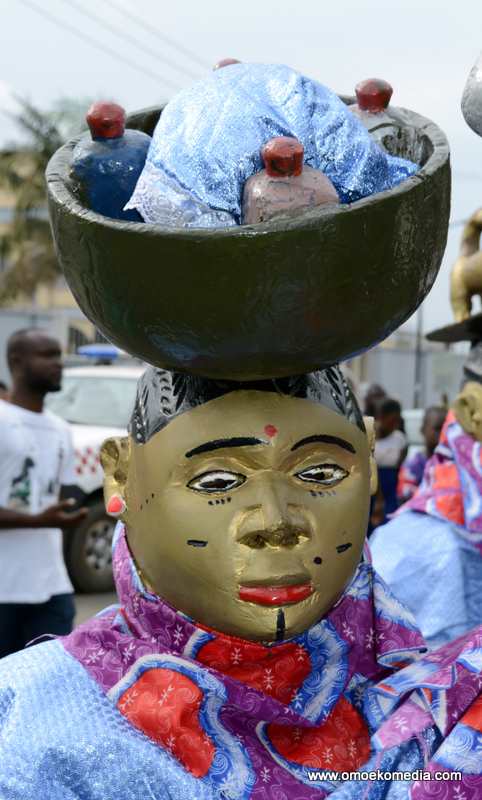
If the drumming and dance are the soul of the Gelede masquerade, the carved headdress, or akó, is its face. These are not mere hats; they are intricate sculptural narratives, often towering over the dancer’s head. The carvers, who are highly respected specialists, undergo years of training, not just in technique but in the esoteric knowledge required to imbue the wood with spiritual meaning.
The iconography is a rich, open book for those who can read it. A headdress might depict a coiled snake, representing the primordial power of the earth. Another might show a mother with a child on her back, a plea for fertility and continuity. A modern headdress might feature a bicycle, a camera, or a colonial officer — symbols of change, power, and the community’s encounter with the outside world. This ability to absorb and comment on contemporary life is a key reason for the tradition’s survival.
Materials and Masters
Traditional Gelede headdresses are carved from lightweight, soft woods like ìrókò (African teak) or òbòchè. The wood is first seasoned, then carved with a set of specialized adzes and knives. Once the form is complete, it is painted with natural pigments — red camwood, white kaolin, black charcoal — or, increasingly, with commercial enamel paints that provide a brilliant, lasting finish. The carving is not just a visual art; it is a sacred act. Before beginning, the carver often offers a prayer or a small sacrifice to the spirit of the tree and to the ancestors who guide his hands.
Renowned carving centers exist in towns like Ketu (in Benin), Ilobu, and Ede (in Nigeria). Masters like the late George Bamidele Aiyegbusi of Ede, whose family has carved for generations, are celebrated for their innovation within tradition. The quality of a Gelede masquerade is often judged by the originality and skill of its headdress, making the carver a central figure in the tradition’s vitality.
| Element | Material/Symbol | Primary Meaning |
|---|---|---|
| Headdress (akó) | Softwood (e.g., ìrókò), pigments | Visual narrative, social commentary, spiritual offering |
| Costume | Cotton cloth, raffia, brass anklets | Conceals the human dancer, transforms into spirit; rhythmic sound |
| Drums | Carved wood, animal skin (bàtá, dùndún) | Summons spirits, sets rhythm, communicates with dancers |
| Face Paint | Kaolin (white), camwood (red), charcoal (black) | Purification, authority, connection to the ancestors |
The Performance: A Symphony of Sound, Movement, and Spirit
A full Gelede masquerade is a multi-stage event, typically performed at night and during the day, often coinciding with annual festivals, funerals of prominent women, or times of communal crisis. It is not a free-for-all; it is meticulously orchestrated by a male-led cult society, the Egbe Gelede, who are initiated into the secrets of the performance. This is a crucial nuance: while the masquerade honors female power, its public execution is largely in the hands of men, highlighting the complex gender dynamics within the tradition.
The night performance, oru, is the more spiritual phase. It begins with the Efe, a masked singer who delivers a long, poetic chant. This is the heart of the social commentary. The Efe singer, standing on a platform or a high stool, uses satire, praise, and proverbs to address the community. He might praise a generous chief, lampoon a corrupt politician, warn a gossip, or advise young wives. His words are potent, and he is protected by his mask from retribution. The night belongs to the voice.
The Day of Dance: The Gelede Masquerade in Motion
The daytime performance, ijó (dance), is the visual climax. One by one, the masked dancers emerge from the ilé Gelede (Gelede house). Each dancer is completely covered in a voluminous costume of cloth and raffia, their feet adorned with dozens of heavy brass anklets. The sound of these anklets, a synchronized, metallic sh-sh-sh-sh, is the signature rhythm of Gelede, a sound that announces the presence of the spirit.
The dance is not random. It is a precise, choreographed dialogue with the drummers. The bàtá drums — three double-headed drums of different sizes, held on the drummer’s lap — speak in a coded language. A specific rhythm tells the dancer to bow low in respect to the elders, to spin rapidly to display the headdress, or to stomp the ground to neutralize negative forces. The dancer’s movements are fluid, powerful, and deeply controlled. The goal is not to be a virtuoso soloist, but to be a perfect vessel for the akó, allowing the carved spirit to come alive.
Gelede Masquerade: A Historical Mirror and Modern Reality
The origins of the Gelede masquerade are traced to the ancient Yoruba kingdom of Ketou, in present-day Republic of Benin. Oral tradition credits the institution to a woman, a powerful queen or priestess, who used the masquerade to address a crisis of social imbalance. From Ketou, the practice spread eastward into Nigeria, carried by migrations and trade. The tradition is strongest today in the western Yoruba regions, particularly in Oyo, Ogun, and Lagos states, and across the border in Benin.
The 19th century, marked by the Yoruba wars and the rise of the slave trade, was a period of intense upheaval. Gelede, with its emphasis on social harmony and the protection of the community, likely grew in importance as a spiritual bulwark against chaos. During the colonial era, Christian missionaries often demonized the masquerade as “pagan idolatry,” forcing it underground in some areas. Yet, it persisted. The resilience of Gelede is a testament to the deep roots of Yoruba culture.
UNESCO Recognition and a Global Stage
The 2008 UNESCO proclamation was a watershed moment. It did not invent Gelede’s importance, but it gave it a global platform and a powerful new tool for preservation. The inscription recognizes the tradition as belonging to both Nigeria and Benin, a shared heritage that transcends modern borders. This recognition has spurred renewed interest among younger generations, who see it not as a backward practice but as a source of cultural pride and identity in a globalized world. Today, you can find videos of Gelede performances on YouTube, scholarly articles in academic journals, and exhibitions of Gelede headdresses in major museums like the British Museum and the Musée du Quai Branly in Paris.
However, this global attention brings challenges. The commodification of sacred art is a real risk. Tourists may see a performance without understanding its spiritual context. Carvers may be pressured to produce “airport art” for quick sale, stripping the headdresses of their ritual meaning. The balance between preservation for the community and presentation to the world is a delicate one that the custodians of the Gelede masquerade navigate every day.
- Cultural Resilience: Survived colonial suppression and missionary condemnation.
- UNESCO Status (2008): Recognized as a shared intangible heritage of Nigeria and Benin.
- Contemporary Challenges: Balancing spiritual authenticity with tourism and commercialization.
- Modern Evolution: Incorporation of new materials, contemporary themes, and digital documentation.
Beyond the Mask: The Social Function of the Gelede Masquerade
It is easy to get lost in the aesthetic beauty of the Gelede masquerade, but to do so is to miss its profound social function. The masquerade is, above all, a mechanism for maintaining equilibrium. It is a public court of opinion, a pressure valve for social tensions, and a didactic tool for teaching values.
The power of the Efe singer cannot be overstated. In a society where open confrontation is often avoided, the masked singer can speak truth to power. He can name a thief, expose an adulterer, or criticize a chief’s greed, all while being protected by the anonymity of his mask and the sacred context of the performance. This is a form of social accountability that operates outside formal legal systems. It is a powerful, community-based check on behavior.
Furthermore, the Gelede masquerade reinforces the role of women as the bedrock of society. By publicly celebrating Iyà Nlá and the power of Àjẹ́, the tradition affirms that female strength, while often invisible in daily politics, is the ultimate foundation of communal well-being. It is a sophisticated cultural acknowledgment that the spiritual and social power of women must be respected, honored, and, if necessary, carefully managed.
Preserving the Heritage: The Future of Gelede
The future of the Gelede masquerade is not guaranteed. Urbanization, the spread of Pentecostal Christianity and Islam, and the lure of modern entertainment all pose threats. Young people in cities may feel disconnected from village traditions. The deep esoteric knowledge required to carve a proper headdress or to master the drum language is not easily passed on in a world of smartphones and social media.
Yet, there are powerful forces working for its survival. The UNESCO recognition has been a catalyst. Cultural organizations in both Nigeria and Benin are working to document performances, archive oral histories, and support master carvers. The annual Gelede festival in towns like Ketu and Ilobu remains a major event, drawing diaspora visitors and scholars. Social media, ironically, has become a new platform. Young dancers share their performances on Instagram and TikTok, reaching a global audience and generating a new kind of cultural currency.
The key to preservation is not to freeze the Gelede masquerade in a museum case. It is to allow it to evolve, as it always has, while safeguarding its core spiritual and social functions. The tradition has already shown remarkable adaptability. The headdresses that once depicted only mythical animals now feature airplanes, politicians, and mobile phones. The music incorporates new instruments and influences. The masquerade is not dying; it is adapting.
The Enduring Spirit of the Gelede Masquerade
To witness a Gelede masquerade is to witness a conversation across centuries. It is a dialogue between the living and the ancestors, between men and the formidable power of women, between the artist and the community, between a small Yoruba town and the wider world. It is a reminder that Africa’s cultural heritage is not a dusty artifact of the past, but a living, breathing, and fiercely relevant force in the present.
The Gelede masquerade teaches us that art can be prayer, that dance can be diplomacy, and that a carved piece of wood can hold the secrets of the universe. It is a testament to the philosophical depth and creative brilliance of the Yoruba people. As long as the drums beat, the brass anklets shake, and the carvers find wood to shape, the Great Mother will be honored, the community will be protected, and the spirit of Gelede will continue to dance. It is not just a heritage to be preserved; it is a wisdom to be learned.