📅 Last updated: 04.10.2026
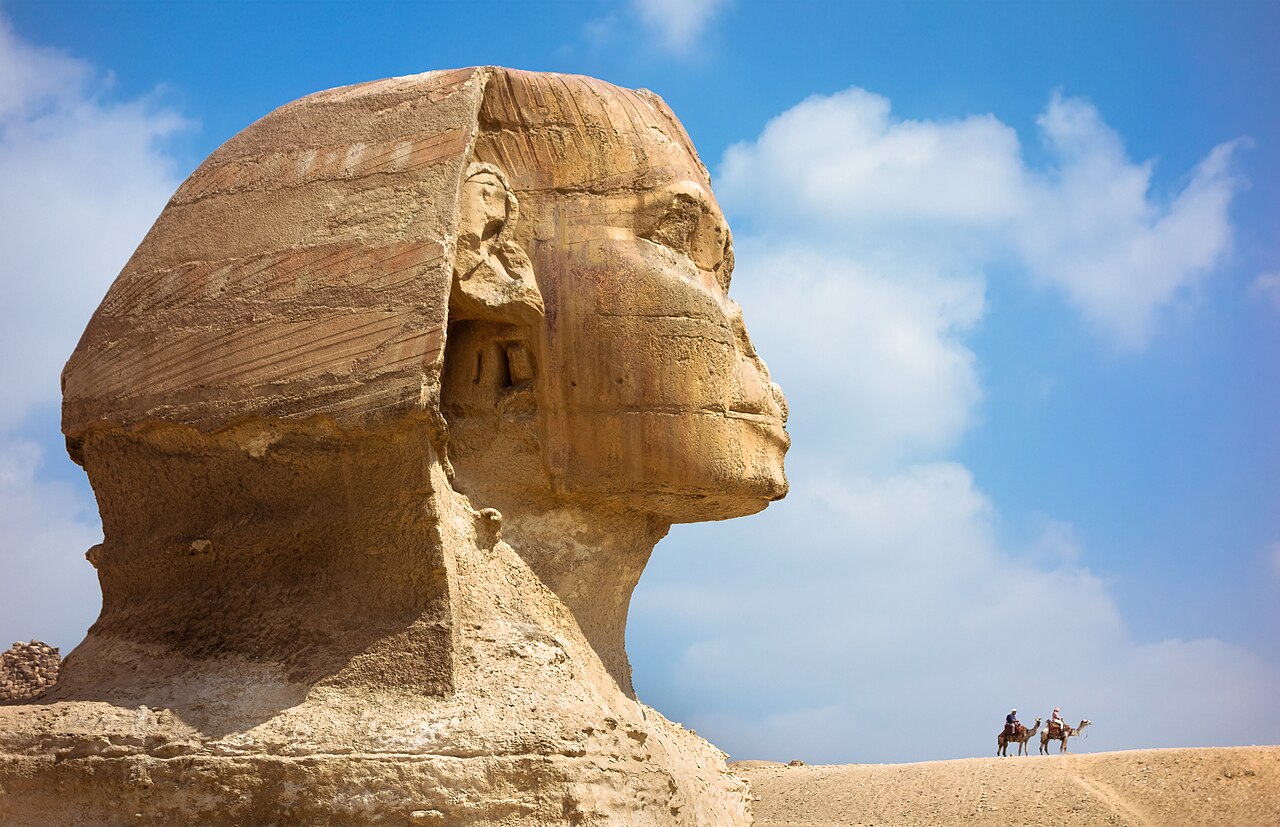
The Great Sphinx of Giza has stared eastward across the Nile Valley for roughly 4,500 years, its lion body and human head carved from a single outcrop of limestone on the Giza Plateau. It is the largest monolithic statue on Earth, and it remains one of the most recognizable silhouettes in human history. Yet for all its fame, the Sphinx is also one of the most debated monuments of the ancient world — a guardian, a riddle, a weather-beaten survivor, and a symbol of Africa’s enduring place at the dawn of civilization.
- What Is the Great Sphinx of Giza?
- Who Built the Great Sphinx of Giza — and When?
- How the Great Sphinx of Giza Was Made
- A Timeline of the Great Sphinx of Giza
- The Dream Stela and the Sphinx's Royal Cult
- Damage, Restoration, and the Missing Nose
- What the Great Sphinx of Giza Means for Africa
- Visiting the Great Sphinx of Giza Today
- Why the Great Sphinx of Giza Still Captivates the World
- The Sphinx as a Bridge Between Past and Future
What Is the Great Sphinx of Giza?
The Sphinx sits on the Giza Plateau on the west bank of the Nile, in what is now Greater Cairo, Egypt. It faces due east, toward the rising sun, with the Great Pyramid of Khufu rising behind it to the west. The statue is carved from the bedrock of the plateau itself — a knoll of soft limestone that was left standing when workers quarried stone for the pyramids nearby.
Its dimensions are staggering. The body is about 73 meters (240 feet) long and roughly 20 meters (66 feet) high. The head alone is around 5 meters (16 feet) wide and 4 meters (13 feet) tall. The face is badly damaged, but its proportions suggest a human head with a royal headdress, though the nose is missing and the beard — fragments of which are now in the British Museum and the Egyptian Museum in Cairo — has fallen away.
Unlike the pyramids, the Sphinx was not built from stacked blocks. It was sculpted in place, which is one reason it has suffered so much erosion. The limestone is layered, with harder and softer bands. Wind, sand, groundwater, and salt have attacked it for millennia, and its body is now deeply grooved and uneven.
The statue is part of the Giza Necropolis, a UNESCO World Heritage Site that also includes the pyramids of Khufu, Khafre, and Menkaure, plus smaller queens’ pyramids, temples, and the Great Sphinx itself. Together they form one of the most studied archaeological landscapes on the planet.
Who Built the Great Sphinx of Giza — and When?
The mainstream scholarly consensus is that the Sphinx was created during the Fourth Dynasty of the Old Kingdom, most likely for the pharaoh Khafre, who ruled around 2558–2532 BCE. Khafre built the second-largest pyramid at Giza, and his valley temple and causeway sit directly in front of the Sphinx. The statue’s face is often said to resemble Khafre, though the damage makes certainty impossible.
The evidence for Khafre is circumstantial but strong. The Sphinx is aligned with his causeway and valley temple. A stela erected much later, around 1400 BCE, by the pharaoh Thutmose IV refers to the Sphinx as a monument of Khafre’s father, Khufu, but that text is fragmentary and contested. Some Egyptologists argue the Sphinx may predate Khafre or belong to another ruler entirely.
What is clear is that the Sphinx was carved from the same quarry used for the pyramids. The “Sphinx ditch” around the statue — the trench left when the surrounding stone was removed — matches the quarrying patterns of the Fourth Dynasty. That geological link is one of the strongest arguments for a Fourth Dynasty date.
Alternative theories abound. Some writers have proposed that the Sphinx is far older, pointing to erosion patterns that they claim were caused by heavy rainfall rather than sand and wind. These ideas, popularized in the 1990s, have been widely rejected by geologists and Egyptologists, who note that the Sphinx’s erosion is consistent with the site’s known climate history and with salt weathering. The debate is a reminder that the Sphinx invites speculation — but the archaeological record still points to the Old Kingdom.
How the Great Sphinx of Giza Was Made
Building the Sphinx required enormous planning. Workers first quarried the limestone around a natural outcrop, leaving a rough shape. Then they carved the details: the paws, the body, the head, and the headdress. The statue was originally painted — traces of red pigment remain on the face and body, and the headdress may have been striped in blue and yellow.
The Sphinx was not carved in isolation. It was part of a larger ritual landscape. A temple now known as the Sphinx Temple sits in front of it, built from huge limestone blocks. The temple’s alignment and the statue’s orientation suggest the Sphinx was meant to be seen from the east, catching the first light of dawn.
Labor was likely organized by the state, using a workforce of skilled craftsmen, quarrymen, and farmers who worked during the Nile’s flood season when fields were underwater. Contrary to the old myth of enslaved laborers, evidence from workers’ villages at Giza — including bakeries, breweries, and medical care — shows a organized, fed, and housed labor force.
- Material: Local limestone bedrock, with some casing stones possibly added later.
- Orientation: Facing east, aligned with the equinox sunrise.
- Original finish: Painted in red, blue, yellow, and possibly black.
- Scale: Roughly 73 meters long, 20 meters high — the largest monolithic statue on Earth.
A Timeline of the Great Sphinx of Giza
The table below summarizes the key phases in the Sphinx’s long life, from its creation to its modern role as a global icon.
| Period | Date | Key Event |
|---|---|---|
| Old Kingdom | c. 2558–2532 BCE | Sphinx carved, likely for Pharaoh Khafre |
| New Kingdom | c. 1400 BCE | Thutmose IV restores the Sphinx and erects the Dream Stela |
| Roman Period | c. 30 BCE–395 CE | Sphinx already ancient; Roman visitors record it |
| Modern Era | 1817–1936 | Major excavations and clearances by Caviglia, Mariette, and Baraize |
| Contemporary | 1980s–present | Conservation efforts and groundwater monitoring |
The Dream Stela and the Sphinx’s Royal Cult
By the New Kingdom, around 1400 BCE, the Sphinx was already over a thousand years old and buried up to its neck in sand. According to the Dream Stela, a young prince named Thutmose was hunting in the desert and fell asleep in the shadow of the Sphinx. In his dream, the Sphinx spoke to him, promising him the throne of Egypt if he cleared the sand from its body.
Thutmose did as he was told, and he became Pharaoh Thutmose IV. He erected the stela between the Sphinx’s paws to commemorate the event. The story is part propaganda, part piety — a classic example of how Egyptian rulers linked themselves to ancient monuments to legitimize their power.
“I am your father, Harmakhis-Khepri-Ra-Atum. I shall give you the kingship over the living, and you shall wear the White Crown and the Red Crown upon the throne of Geb, the heir of Atum.”
— From the Dream Stela of Thutmose IV, c. 1400 BCE
The Sphinx was worshipped as a form of the sun god Horus, often called Hor-em-akhet, meaning “Horus in the Horizon.” Pilgrims left offerings, and priests maintained a cult around the statue. The Sphinx was not just a monument; it was a living deity in the Egyptian imagination.
Damage, Restoration, and the Missing Nose
The Sphinx has been damaged in many ways. Its nose was removed sometime before the 15th century CE. The most common story, recorded by the 15th-century Egyptian historian al-Maqrizi, blames a Sufi Muslim named Muhammad Sa’im al-Dahr, who allegedly defaced the statue in 1378 CE because he considered it an idol. Other accounts suggest the nose was lost earlier, possibly in a deliberate act of iconoclasm or through natural collapse.
The beard, which was attached separately, fell off and was later found in fragments. One piece is in the British Museum, another in the Egyptian Museum in Cairo. The Sphinx’s eyes were also damaged, and its face has been further eroded by wind and salt.
Restoration attempts go back centuries. The Dream Stela records one. In the Roman period, repairs were made. In the 19th and 20th centuries, archaeologists including Giovanni Battista Caviglia, Auguste Mariette, and Émile Baraize cleared sand and stabilized the statue. In the 1980s, a major conservation project began after a block fell from the shoulder.
Today, the Sphinx faces new threats: rising groundwater, air pollution from Cairo, and the pressure of millions of visitors. Egyptian authorities and international teams continue to monitor and conserve it, balancing public access with preservation.
What the Great Sphinx of Giza Means for Africa
The Sphinx is often described as a wonder of the “ancient world,” but it is also a wonder of Africa. It stands in Egypt, a country that has been part of the African continent for all of human history. The civilization that built it — the Old Kingdom of Egypt — was an African civilization, rooted in the Nile Valley and shaped by African peoples, landscapes, and traditions.
This matters because the story of ancient Egypt has sometimes been detached from Africa in popular imagination. The Sphinx, with its unmistakably African setting and its role in the broader history of the continent, is a powerful counterpoint. It belongs alongside the pyramids of Meroë in Sudan, the rock-hewn churches of Lalibela in Ethiopia, the stone city of Great Zimbabwe, and the ancient manuscripts of Timbuktu in Mali — a reminder that Africa’s heritage is deep, diverse, and global in significance.
Modern Egypt is also part of this story. Cairo, just across the Nile from Giza, is one of the largest and most vibrant cities in Africa, home to more than 20 million people in its metropolitan area. The Grand Egyptian Museum, which opened in 2025 near the Giza Plateau, now houses thousands of artifacts, including treasures from Tutankhamun’s tomb. The Sphinx and the pyramids are not relics of a dead past; they are part of a living country that is shaping its own future.
Visiting the Great Sphinx of Giza Today
If you travel to Giza, you will find the Sphinx on the eastern edge of the plateau, just southeast of the Great Pyramid of Khufu and beside the causeway of Khafre. The site is open to visitors, though access to the Sphinx itself is restricted. You can view it from a designated platform, walk around the plateau, and enter the pyramids (with separate tickets).
The best time to visit is early morning, when the light is soft and the crowds are thinner. The site is hot and dusty, so bring water, sun protection, and comfortable shoes. Local guides can explain the history and point out details you might miss. The nearby Grand Egyptian Museum is a natural companion visit.
- Location: Giza Plateau, Greater Cairo, Egypt.
- Nearest city: Cairo, about 15 kilometers (9 miles) from downtown.
- Best time: October to April, when temperatures are cooler.
- Don’t miss: The Dream Stela between the paws, the Sphinx Temple, and the view from the panoramic point.
Responsible tourism matters here. The site is fragile, and visitor pressure is real. Follow the rules, stay on marked paths, and support local guides and businesses. The Sphinx has survived for 4,500 years; with care, it can survive for thousands more.
Why the Great Sphinx of Giza Still Captivates the World
The Sphinx endures because it asks questions we still cannot fully answer. Who exactly built it? What did its face look like? Why was it carved in that particular spot? These mysteries have inspired poets, painters, filmmakers, and scholars for centuries. Napoleon’s soldiers reportedly used it for target practice (a myth, but a telling one). Nineteenth-century travelers wrote home about its melancholy gaze. Today, it appears on Egyptian currency, in Hollywood films, and in the logo of countless brands.
But the Sphinx is more than a riddle. It is a masterpiece of engineering and art, a testament to the organizational genius of ancient Egypt, and a symbol of Africa’s place at the center of human history. It has watched empires rise and fall, religions change, and cities grow around it. It has been buried in sand and dug out again. It has been damaged, restored, and debated. Through it all, it has remained.
For Africans and the diaspora, the Sphinx is a point of pride — not because it belongs to any one group, but because it belongs to all of humanity, and it stands on African soil. It is a reminder that the continent’s contributions to civilization are not a footnote but a foundation. The pyramids, the Sphinx, the temples of Luxor, the tombs of the Valley of the Kings — these are African achievements, and they deserve to be celebrated as such.
When you stand before the Sphinx, you are standing in the presence of something that has outlasted almost everything else humans have made. It is a humbling experience, and an inspiring one. It invites us to think about time, legacy, and what we leave behind. And it reminds us that the story of Africa is long, rich, and far from over.
The Sphinx as a Bridge Between Past and Future
The Great Sphinx of Giza is not just a monument to a dead king. It is a bridge between the ancient world and our own. It connects the engineering brilliance of the Old Kingdom to the modern conservation science that keeps it standing. It connects the Nile Valley to the wider African continent and to the global diaspora. It connects the mysteries of the past to the questions we still ask today.
As Egypt continues to develop — with new museums, new infrastructure, and a growing role in African and global affairs — the Sphinx remains a constant. It is a reminder that Africa’s history is not a single story but a vast, interconnected tapestry. The Sphinx is one thread in that tapestry, but it is a golden one.
So the next time you see an image of the Sphinx, look closer. Notice the eroded body, the damaged face, the outstretched paws. Notice the sunrise it faces, the pyramids behind it, the city around it. And remember that this ancient wonder is African — and that its story is still being written.