📅 Last updated: 29.09.2026
The Nelson Mandela prison years were never meant to be survived, let alone transformed into a foundation for a nation. When a 44-year-old lawyer and freedom fighter was driven across the cold waters of Table Bay in 1964, the apartheid state intended to bury him alive behind limestone and barbed wire. Instead, those 18 years on Robben Island — part of 27 years in prison overall — became the crucible in which Mandela forged the patience, discipline and moral authority that would later help dismantle apartheid without a racial civil war. This is the story of what actually happened inside those walls: the quarry, the cell, the hunger strikes, the secret lessons, and the small daily victories that made a prisoner into a president.
- Why Robben Island? The Road to the Nelson Mandela Prison Years
- Daily Life Inside: The Brutal Routine of the Nelson Mandela Prison Years
- The Limestone Quarry: Where the Nelson Mandela Prison Years Left Their Mark
- Resistance Behind Bars: Strikes, Hunger and Small Victories
- Key Dates and Facts from the Nelson Mandela Prison Years
- The People Who Shared the Island
- Family, Letters and the Cost of Absence
- From Prisoner to Negotiator: The Later Years
- What Robben Island Means Today
- Conclusion: The Long Walk and Its Lessons
Why Robben Island? The Road to the Nelson Mandela Prison Years
Robben Island is not a random prison site. The name comes from the Dutch word for “seal,” and for nearly four centuries the island was used as a place of banishment — by Dutch settlers in the 1600s, by British colonial authorities, and later by the apartheid government. It sits in Table Bay, roughly 7 kilometres off the coast of Cape Town, which is why the isolation was so complete: escape meant a swim through frigid, shark-patrolled Atlantic water, and the nearest mainland was a hostile police state.
Mandela did not arrive there directly from freedom. He was arrested in 1962 near Howick in KwaZulu-Natal after years underground, and convicted of incitement and illegally leaving the country. He was sentenced to five years. Then came the Rivonia Trial, where Mandela and his co-accused — including Walter Sisulu, Ahmed Kathrada, Denis Goldberg, Govan Mbeki, Raymond Mhlaba and others — faced charges of sabotage and conspiracy. On 12 June 1964, Justice Quartus de Wet handed down life imprisonment instead of the death penalty. The next day, Mandela and seven co-accused were flown by military plane to Robben Island.
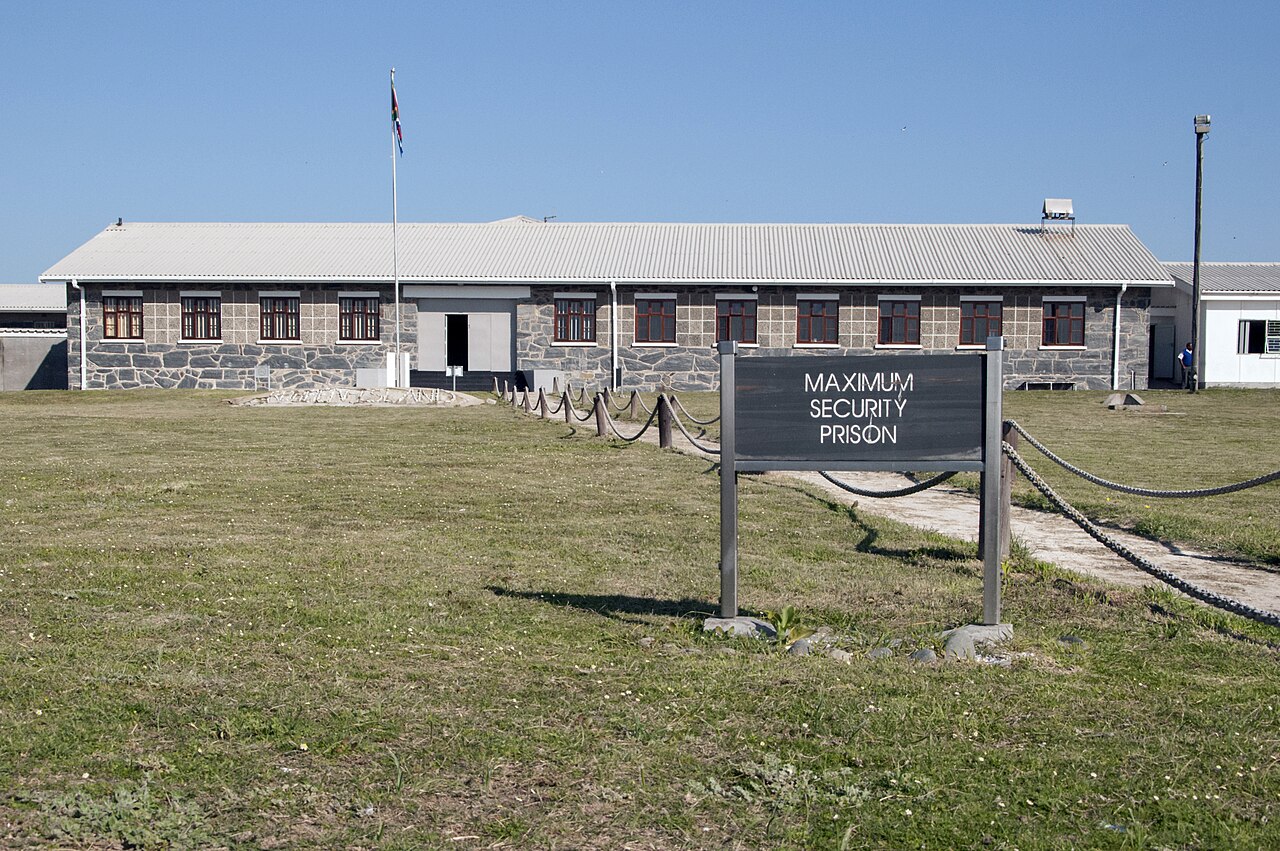
He was initially held in the island’s older prison section, then moved to the maximum-security B-Section, where he would spend most of his incarceration in a cell measuring roughly 2 by 2.4 metres.
Daily Life Inside: The Brutal Routine of the Nelson Mandela Prison Years
The regime on Robben Island was designed to grind a man down through repetition and deprivation. In his memoir Long Walk to Freedom, Mandela described the cell as cold in winter and stifling in summer, with a thin mat on a concrete floor and a single light bulb that burned all night so guards could watch him. The toilet was a bucket. The view was a barred window facing a wall.
Days began before dawn and followed an almost unvarying script:
- 5:30 a.m. — Wake-up, cell inspection, and the issue of a coarse breakfast, often maize porridge.
- Morning — Hard labour. For years this meant the limestone quarry, where prisoners dug, hauled and chipped rock in blinding glare and dust.
- Afternoon — More labour, sometimes crushing stone into gravel or working in the island’s vegetable garden.
- Evening — A meagre supper, a brief period before lockdown, then the cell door slammed shut for the night.
Prisoners were classified by race, and African prisoners received the smallest rations — a deliberate policy of differential treatment that the Red Cross later criticised. Short trousers were issued to African inmates, while others received long trousers. Mandela wore shorts for years, a detail he noted with quiet fury because it treated grown men like boys.
Communication was forbidden. Guards discouraged eye contact. Yet within weeks, the prisoners organised. Mandela and his comrades established an informal “high command” that functioned like a university faculty, allocating study subjects, settling disputes and maintaining discipline. Letters were smuggled between sections. Messages were hidden in food, in walls, and in the hands of sympathetic warders.
“I learned that courage was not the absence of fear, but the triumph over it. The brave man is not he who does not feel afraid, but he who conquers that fear.” — Nelson Mandela, Long Walk to Freedom
The Limestone Quarry: Where the Nelson Mandela Prison Years Left Their Mark
If one image captures the physical cost of Mandela’s imprisonment, it is the lime quarry. For roughly 13 years, Mandela and other prisoners worked in the glare of white limestone, digging and hauling rock with pickaxes and shovels. The dust and reflected sunlight damaged his eyes permanently; tears streamed down his face, and for the rest of his life he could not be photographed in bright flash light without discomfort. The quarry also damaged his lungs.
The work was not merely punitive — it was intended to exhaust men so thoroughly that resistance became impossible. It failed. The quarry became a classroom. Because guards stayed at a distance, prisoners could talk while they worked. Mandela, Sisulu and Kathrada used those hours to teach younger prisoners history, politics, law and English. Ahmed Kathrada, who had trained as a teacher, ran informal classes. Men who arrived barely literate left the island with a political education that would later shape a government.
The garden that grew from rubble
In the courtyard near B-Section, Mandela cultivated a small garden. He grew tomatoes, onions and chilies in old containers and used the garden as both practical food and a psychological anchor. He later wrote that tending plants reminded him that life continues and that patience produces results. The garden was also a cover for hiding messages and a place where prisoners could hold brief, seemingly innocent conversations.
Resistance Behind Bars: Strikes, Hunger and Small Victories
Robben Island was not a passive prison. It was a site of sustained, organised resistance. Prisoners demanded better food, proper clothing, study privileges, and the right to be treated as political prisoners rather than common criminals. The weapon was the hunger strike.
In 1966, prisoners staged a hunger strike over food quality and the treatment of a fellow inmate. In 1970, another strike followed. In 1971, prisoners refused food to protest the beating of prisoners and the denial of study rights. These actions were dangerous — force-feeding and solitary confinement were real threats — but they extracted concessions. Over the years, conditions gradually improved: long trousers were eventually issued, study rights expanded, and the food became marginally less inadequate.
Mandela’s approach to resistance was strategic rather than theatrical. He argued for measured demands that could actually be won, and he insisted on discipline: no violence against guards, no pointless confrontation. This restraint was not weakness. It was a calculated decision to preserve the moral high ground and to keep the prison administration negotiating rather than retaliating.
Learning Afrikaans and studying the enemy
One of Mandela’s most important decisions was to learn Afrikaans, the language of his jailers. He read Afrikaans newspapers and studied the history of the Afrikaner people, including their own experience of British oppression in the Boer War. Understanding the guards as human beings, with their own history and grievances, was a strategic act. It also produced small human moments: guards who began to greet him, warders who quietly passed on news, and a gradual erosion of the dehumanising logic the prison depended on.
Key Dates and Facts from the Nelson Mandela Prison Years
The chronology below summarises the essential milestones of Mandela’s incarceration, from arrest to release.
| Date | Event | Location |
|---|---|---|
| 5 August 1962 | Arrested by police after 17 months underground | Near Howick, KwaZulu-Natal |
| 7 November 1962 | Sentenced to five years for incitement and leaving the country illegally | Pretoria |
| 12 June 1964 | Sentenced to life imprisonment at the Rivonia Trial | Pretoria Supreme Court |
| 13 June 1964 | Arrives on Robben Island; begins 18 years there | Robben Island, Table Bay |
| 1982 | Transferred to Pollsmoor Prison near Cape Town | Cape Town |
| 11 February 1990 | Released from Victor Verster Prison after 27 years | Paarl, Western Cape |
The People Who Shared the Island
Mandela’s imprisonment was collective. Robben Island held hundreds of political prisoners, many of whom became leaders of the post-apartheid state. Understanding the island means understanding the network around him.
- Walter Sisulu — Mandela’s mentor and closest comrade, imprisoned alongside him for 26 years. His cell was near Mandela’s, and their conversations shaped strategy.
- Ahmed Kathrada — Indian South African activist, imprisoned for 26 years, who ran education programmes and kept meticulous records.
- Govan Mbeki — father of future president Thabo Mbeki, a Marxist intellectual who debated Mandela on ideology and economics.
- Raymond Mhlaba — Rivonia co-accused and later premier of the Eastern Cape.
- Denis Goldberg — the only white Rivonia accused, held separately but part of the same struggle.
- Tokyo Sexwale, Jacob Zuma, Kgalema Motlanthe — younger prisoners who arrived later and learned from the Rivonia generation.
The island also held Robert Sobukwe, founder of the Pan Africanist Congress, who was kept in solitary confinement in a separate house for years — a case that became a symbol of the state’s cruelty.
Family, Letters and the Cost of Absence
Behind the political story lies a human one. Mandela was allowed one visit every six months and could write and receive a limited number of letters, which were heavily censored. His wife, Winnie Madikizela-Mandela, was herself subjected to harassment, detention and banishment. His mother died in 1968, and he was refused permission to attend her funeral. His eldest son, Madiba Thembekile, died in a car accident in 1969; Mandela learned of it weeks later, and permission to attend the funeral was again denied.
These losses were part of the punishment. The apartheid state understood that isolating prisoners from family was as effective as any cell. Mandela’s response was to build a surrogate family inside the prison — a community of comrades who celebrated birthdays, marked anniversaries and supported one another through illness and grief.
Books as lifelines
Study privileges were contested terrain. At first, prisoners were denied access to newspapers and most books. Over time, through persistent demands, they won the right to take correspondence courses through the University of South Africa and to receive approved texts. Mandela read widely — politics, history, biography, novels. Kathrada studied for degrees. The prison library, though limited, became a symbol of intellectual resistance: the state could lock up bodies, but not minds.
From Prisoner to Negotiator: The Later Years
In 1982, Mandela was transferred from Robben Island to Pollsmoor Prison in Cape Town, and later to Victor Verster Prison near Paarl. The move reflected a shift in the government’s thinking: as domestic unrest and international pressure mounted, apartheid leaders began to consider negotiating with the ANC. Mandela, by then in his sixties, was seen as the key.
From prison, he initiated secret talks with government representatives. He wrote letters and memoranda, including a famous 1989 letter to President P.W. Botha, and later met with Botha’s successor, F.W. de Klerk. The negotiations that followed — the unbanning of the ANC in February 1990, his release on 11 February 1990, and the multi-party talks that led to the 1994 election — were built on groundwork laid during the prison years. Mandela’s insistence on discipline, his refusal to embrace racial revenge, and his ability to see his jailers as potential partners were not accidental. They were habits forged on Robben Island.
What Robben Island Means Today
Robben Island was declared a UNESCO World Heritage Site in 1999. Today it is a museum and a pilgrimage site, reached by ferry from the V&A Waterfront in Cape Town. Many of its guides are former political prisoners, including men who served time alongside Mandela. Visitors walk through the B-Section corridor, stand in the tiny cell, and see the limestone quarry where men broke rock and, in the process, built a movement.
The island is also a reminder that freedom was not inevitable. It was won through decades of sacrifice by thousands of people, many of whom are less famous than Mandela. The Nelson Mandela prison years are often told as one man’s story, but they are also the story of Walter Sisulu, Ahmed Kathrada, Govan Mbeki, Robert Sobukwe, Winnie Madikizela-Mandela and countless unnamed prisoners who endured and resisted.
Conclusion: The Long Walk and Its Lessons
Mandela spent 18 of his 27 prison years on Robben Island, and those years did not simply delay his life — they shaped it. He entered as a fiery activist and emerged as a strategist, negotiator and symbol of reconciliation. The island taught him that endurance is a form of power, that understanding your opponent is not the same as agreeing with them, and that dignity can be preserved even in a 2-by-2.4-metre cell.
For readers in Africa and across the diaspora, the lesson is not that suffering is noble. It is that organised, disciplined, patient resistance can defeat even the most entrenched injustice. The Nelson Mandela prison years remind us that the struggle against apartheid was carried by ordinary people doing extraordinary things — and that the long walk to freedom was walked one day, one shift in the quarry, and one small victory at a time.