📅 Last updated: 21.11.2026
The Aksumite Empire rose from the highlands of northern Ethiopia and Eritrea to become one of the ancient world’s great trading powers, minting its own gold coinage, building towering granite obelisks, and embracing Christianity within a century of its official adoption in Rome. For nearly eight centuries — roughly from the first century CE to the seventh — Aksum connected the Mediterranean, Arabia, and the Indian Ocean through the Red Sea port of Adulis, and its political, religious, and artistic legacies shaped Ethiopian civilization for the next fifteen hundred years.
The Aksumite Empire was a sophisticated trading state centered at Aksum in the Tigray highlands (modern Ethiopia and Eritrea), flourishing from the 1st to the 7th century CE. It controlled the Red Sea port of Adulis, minted gold, silver, and bronze coins, adopted Christianity around 330 CE under King Ezana, and developed the Ge’ez script and monumental stelae architecture that remain foundations of Ethiopian identity.
- Where did the Aksumite Empire come from?
- How did trade make the Aksumite Empire wealthy?
- What did the Aksumite Empire build? The stelae and the capital
- When did the Aksumite Empire adopt Christianity?
- How did the Aksumite Empire shape Ethiopian language, art, and identity?
- Why did the Aksumite Empire decline?
- What can we learn from the Aksumite Empire today?
- The Aksumite Empire's lasting imprint on Ethiopian civilization
Where did the Aksumite Empire come from?
Aksum’s origins lie in the convergence of two older traditions. To the west, the Kingdom of Da’amat (or D’mt), active from roughly the 10th to the 5th century BCE around Yeha and the highlands near modern Mekelle, had already built temples, carved inscriptions, and traded through Red Sea routes. To the east, Sabaean communities from South Arabia settled along the Eritrean coast, leaving inscriptions in an Old South Arabian script at places like Matara. By the first century CE, these strands had fused into a new polity centered on the town of Aksum, which would give its name to the empire.
The Periplus of the Erythraean Sea, a Greek merchant’s handbook written around 50 CE, offers the earliest external description. Its author notes that the port of Adulis lay a short journey from the capital and that the ruler of Aksum controlled trade routes reaching into the interior as far as the Nile and beyond — a claim archaeology has repeatedly supported. Excavations at Aksum have turned up Roman amphorae, Indian beads, and Alexandrian glass, while Aksumite coins have been found in India and Arabia.
The geography of power
Aksum’s position was strategic in the deepest sense. The highland plateau offered defensible terrain, reliable rainfall, and fertile soils for wheat, barley, and teff. The Red Sea coast, some 150 kilometers to the northeast, gave access to the maritime trade of the Indian Ocean world. Between them lay the route through Adulis, where goods moved by caravan and dhow. From this base, Aksumite rulers projected power into South Arabia, Nubia, and the Horn of Africa.
How did trade make the Aksumite Empire wealthy?
Trade was the engine of Aksumite prosperity. Adulis became one of the busiest ports on the Red Sea, handling ivory, gold, frankincense, myrrh, slaves, and exotic animals from the African interior in exchange for textiles, wine, olive oil, and metalware from the Roman and later Byzantine worlds. The empire’s rulers taxed these flows and used the proceeds to build monuments, mint coins, and fund military campaigns.
What set Aksum apart from most African states of its era was its coinage. Beginning in the late 3rd century CE under King Endubis, Aksum minted gold, silver, and bronze coins bearing the king’s image and, after Ezana, the cross. These coins circulated locally and have been found as far as India, evidence of how far Aksumite commerce reached. The gold coinage — struck to a standard comparable with Roman solidi — is one of the clearest markers of Aksum’s integration into the wider late antique economy.
- Ivory and aromatics from the interior and the Horn were Aksum’s signature exports, prized across the Mediterranean and Arabia.
- Gold from the Ethiopian highlands and beyond underwrote the coinage and diplomatic gifts to foreign courts.
- Control of Adulis gave Aksum a choke point on Red Sea trade between the Roman Empire and India.
What did the Aksumite Empire build? The stelae and the capital
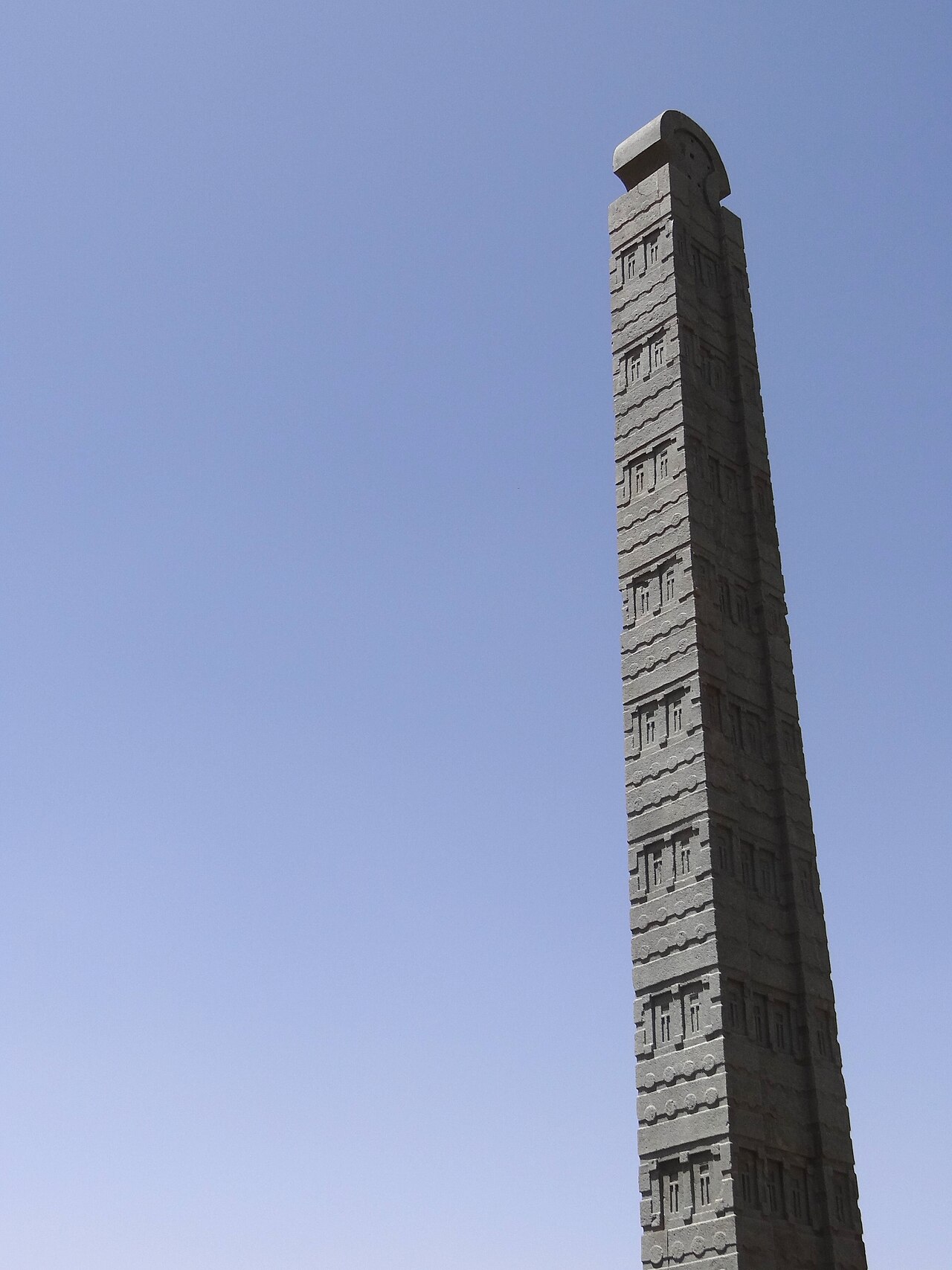
Few ancient sites in Africa are as arresting as the stelae field at Aksum, a UNESCO World Heritage Site since 1980. The largest obelisk, the Great Stele, measures about 33 meters and lies where it fell, likely toppled during construction or an earthquake. The Obelisk of Ezana, standing 24 meters, was looted by Italian forces in 1937 and returned to Ethiopia in 2005 — a repatriation Ethiopians still celebrate. These granite monuments, carved with false doors and windows to resemble multi-story buildings, marked royal tombs and proclaimed the power of the kings who commissioned them.
The capital itself was a substantial city. Archaeologists have mapped palaces, elite residences, reservoirs, and a complex water-management system. The 6th-century king Kaleb built a large palace at Aksum, and the site of Dungur, sometimes called the “Queen of Sheba’s palace,” shows the scale of elite architecture. Nearby, the church of Maryam Tsion (St. Mary of Zion) became the spiritual heart of Ethiopian Christianity, and according to Ethiopian tradition it houses the Ark of the Covenant — a claim that continues to draw pilgrims.
Aksum’s reach beyond the highlands
Aksumite influence extended into South Arabia. In the early 6th century, King Kaleb intervened in the Yemeni kingdom of Himyar, whose ruler Yusuf As’ar Yath’ar (Dhu Nuwas) had persecuted Christians. Kaleb’s campaign, around 525 CE, installed a Christian client king and briefly made Aksum a Red Sea hegemon. The episode is recorded in Byzantine sources, including the account of the historian Procopius, and in Ethiopian tradition.
When did the Aksumite Empire adopt Christianity?
The conversion of King Ezana around 330 CE is the pivotal moment in Ethiopian religious history. According to the 5th-century ecclesiastical historian Rufinus of Aquileia, a Syrian Christian named Frumentius — shipwrecked as a boy on the Red Sea coast and later tutor to the young king — encouraged Ezana to embrace the faith. Ezana’s inscriptions, some in Ge’ez and some in Greek, record his conversion and his dedication to the “Lord of Heaven.” His coins switched from pagan symbols to the cross.
This made Aksum one of the earliest Christian states in the world, adopting the faith decades before the Roman Empire’s official endorsement under Theodosius and roughly contemporaneous with Rome’s own imperial shift under Constantine. The link with the Coptic Church of Alexandria was formalized when Frumentius was consecrated bishop, and the Ethiopian Orthodox Tewahedo Church still traces its lineage to that moment. The Church’s liturgy, its Ge’ez scriptural tradition, and its monastic culture all took shape in the Aksumite era and after.
| Period | Key development | Significance |
|---|---|---|
| c. 1st century CE | Rise of Aksum; Periplus describes Adulis trade | Emergence as a Red Sea trading power |
| c. 270–300 CE | King Endubis mints first Aksumite coins | First indigenous coinage in sub-Saharan Africa |
| c. 330 CE | King Ezana converts to Christianity | Aksum becomes one of the earliest Christian states |
| c. 525 CE | King Kaleb’s campaign in Himyar (Yemen) | Peak of Aksumite regional power |
| 7th–8th century CE | Decline amid Red Sea trade shifts and Islamic expansion | Transition to the Zagwe and later Solomonic dynasties |
How did the Aksumite Empire shape Ethiopian language, art, and identity?
The most durable Aksumite legacy is cultural. The Ge’ez script — an abugida in which each character represents a consonant plus vowel — evolved from the earlier South Arabian script and was adapted to write the Aksumite language. Ge’ez became the liturgical and literary language of the Ethiopian Orthodox Church, and its script is still used today for Amharic and Tigrinya. The Kebra Nagast, Ethiopia’s national epic compiled in the 14th century, weaves Aksumite and biblical traditions into a narrative of Solomonic descent that legitimized later dynasties.
Aksumite art and architecture left a visual grammar that persists. The stelae’s proportions, the cross motifs on coins and manuscripts, and the basilica-style churches of the post-Aksumite period — most famously the rock-hewn churches of Lalibela, carved in the 12th and 13th centuries — all draw on Aksumite precedents. The empire’s tradition of royal inscription, in which kings recorded their achievements in stone, shaped Ethiopian historiography for centuries.
The Ethiopian Orthodox Tewahedo Church
The Church is arguably the single most important institutional heir of the Aksumite Empire. Its patriarchate, its monasteries such as Debre Damo (founded in the 6th century and still active), its fasting calendar, and its distinctive canon — which includes texts like the Book of Enoch not found in most other Christian Bibles — all trace back to the Aksumite conversion. The Church preserved Ge’ez literature through centuries of political upheaval, and its monasteries remain centers of manuscript culture.
Why did the Aksumite Empire decline?
No single cause explains Aksum’s decline. The empire’s fortunes were tied to Red Sea trade, and that trade shifted in the 7th century as the Islamic conquests reshaped the Mediterranean and Indian Ocean economies. Aksumite ports, including Adulis, came under pressure, and the political center of gravity moved south and inland. Environmental factors — including soil exhaustion and climate variability — likely compounded the strain. By the 8th century, the great capital had lost its primacy, and power passed to the Zagwe dynasty, whose most famous king, Lalibela, built the rock-hewn churches that are now a UNESCO World Heritage Site.
Yet the transition was not a collapse into obscurity. The Solomonic dynasty, which took power in 1270 and claimed descent from King Solomon and the Queen of Sheba, explicitly invoked Aksumite legitimacy. Ethiopian emperors continued to be crowned at Aksum, and the city remained a spiritual and symbolic center long after its political eclipse.
- Trade shifts after the rise of Islamic polities redirected Red Sea commerce away from Aksumite ports.
- Environmental stress and the difficulty of sustaining a large highland capital contributed to the move southward.
- Political succession to the Zagwe and later Solomonic dynasties preserved Aksumite legitimacy even as the capital changed.
What can we learn from the Aksumite Empire today?
Aksum challenges any narrative that treats Africa’s past as isolated from the wider world. Its coins, its inscriptions in Greek and Ge’ez, its diplomatic ties with Rome and Byzantium, and its role in Red Sea commerce place it firmly within the connected late antique world. At the same time, its achievements were distinctly its own: the stelae, the Ge’ez script, the early adoption of Christianity, and a coinage tradition unmatched in the region.
Modern Ethiopia and Eritrea both claim Aksumite heritage. The city of Aksum remains a pilgrimage destination, and its archaeological site continues to yield new finds — recent excavations have uncovered churches, tombs, and evidence of the city’s water systems. The return of the Obelisk of Ezana in 2005, the inscription of the stelae field on the World Heritage list, and ongoing research by Ethiopian and international archaeologists keep the Aksumite Empire in public view.
For the African diaspora and for anyone interested in global history, Aksum is a reminder that the continent’s civilizations were builders of cities, minters of coins, and shapers of religious traditions long before many of the states now celebrated in European history books. Its legacy is not a relic but a living inheritance — in the liturgy of the Ethiopian Orthodox Church, in the script on the page, and in the granite pillars that still stand on the Tigray plateau.
The Aksumite Empire’s lasting imprint on Ethiopian civilization
The Aksumite Empire gave Ethiopian civilization its script, its church, its coinage, and its sense of historical continuity. From the Periplus‘s merchants to Ezana’s conversion, from the stelae of Aksum to the rock-hewn churches of Lalibela, the thread runs unbroken. Understanding Aksum is not simply an exercise in ancient history; it is a way of seeing how one of Africa’s great states shaped a nation’s identity for nearly two millennia — and why that identity still matters today.