📅 Last updated: 04.10.2026
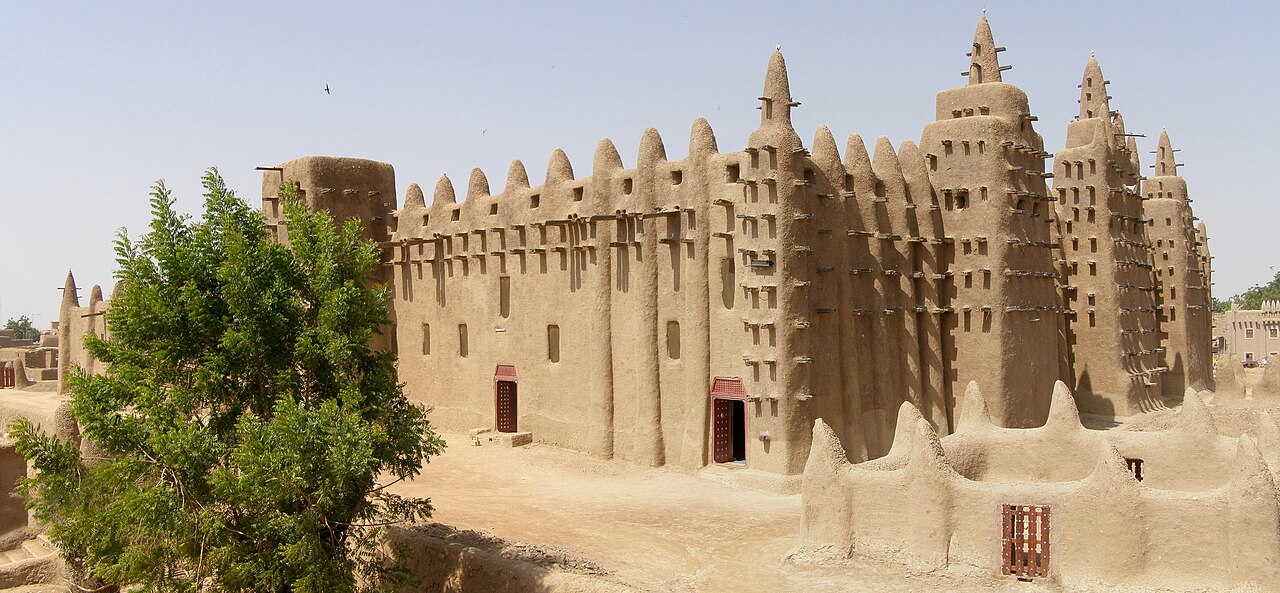
Every spring, as the waters of the Bani River recede and the floodplain around Djenné dries into a cracked, pale clay, thousands of people pick up hoes, buckets, and calabashes and walk toward the biggest mud building in the world. The Great Mosque of Djenné rises from the town like a honey-coloured mountain — a vast, tapering structure of sun-dried earth whose three towers, crowned with ostrich eggs, have been rebuilt by hand, in a single day, more than a hundred times over. It is a monument, a working place of worship, and a collective act of faith rolled into one, and there is nothing quite like it anywhere on Earth.
- What the Great Mosque of Djenné Actually Is
- The Annual Replastering: A Town Paints Its Heart
- Key Facts and Dates at a Glance
- How the Great Mosque of Djenné Was Built — and Rebuilt
- Architecture That Speaks the Language of the Sahel
- Life Around the Mosque: Market, Scholarship, and Community
- The Challenges Facing the Great Mosque of Djenné Today
- Why the Great Mosque of Djenné Matters to the World
- A Living Monument, Not a Ruin
To understand the mosque, though, you have to understand Djenné itself — an ancient trading town on the inland delta of the Niger River, in the Mopti Region of central Mali. This is a place that sat at the crossroads of trans-Saharan trade, where salt from the desert met gold from the south and where Islamic scholarship flourished centuries before many European universities existed. The mosque is the physical memory of that history, and the annual ritual that keeps it standing is one of the most remarkable living traditions in Africa.
What the Great Mosque of Djenné Actually Is
Start with the basics, because they are astonishing enough. The Great Mosque of Djenné is the largest earthen building in the world, constructed in the Sudano-Sahelian architectural style from banco — a mixture of mud, rice husks, straw, and water, sometimes bound with shea butter or gum arabic. The current structure covers roughly 5,625 square metres and its tallest tower reaches around 16 metres. Its walls are thick, its surfaces smoothed by hand each year, and its silhouette bristles with the wooden beams called toron that jut out along the facade like the pegs of some enormous instrument.
Those beams are not decorative. They are permanent scaffolding, allowing climbers to scale the walls during the annual replastering. The ostrich eggs atop the conical towers are an older, pre-Islamic symbol of fertility and purity that the Muslim community of Djenné absorbed into its architecture — a small reminder that Sahelian Islam has always been a conversation between faith and local culture rather than an erasure of it.
Inside, the prayer hall is supported by a forest of thick earthen pillars, and the space is oriented toward Mecca. The mosque is not a museum piece: it is an active place of worship, and non-Muslims are generally not permitted inside. Visitors admire it from the square outside, where the market unfolds and where the building’s full scale becomes clear.
A building that is rebuilt, not merely repaired
Here is the crucial thing about earthen architecture: it is not permanent in the way stone is. Rain erodes it. Cracks open in the heat. Left alone, the Great Mosque of Djenné would slowly melt back into the floodplain from which its material came. Rather than fight that reality, the people of Djenné made maintenance the point. The mosque is designed to be renewed, and the renewal is a festival.
The Annual Replastering: A Town Paints Its Heart
The ritual is called crépissage in French, the language of Mali’s colonial past, but in Djenné it is simply the day the town works on its mosque. It takes place in April or May, at the end of the dry season, before the rains arrive. The mud must be mixed in advance and left to ferment for days; traditionally, young men and boys are responsible for preparing and transporting it, while women have historically supplied water and food, and elders direct the work.
On the day itself, the atmosphere is closer to a carnival than a construction site. Drummers play. Rival groups of masons race one another up the toron beams. Children scoop mud into their hands and slap it onto the walls. There is music, teasing, competition, and a genuine sense of collective ownership. By evening, the mosque has been resurfaced from base to pinnacle, and the town gathers to celebrate.
“The mosque belongs to everyone in Djenné,” local masons have said for generations. “If it falls, we all fall with it.”
That sentiment is not romantic exaggeration. The mosque’s upkeep is organised by the town’s masons’ guild, whose knowledge is passed down through families, and the whole community — young and old, men and women — participates in some capacity. The event has become a symbol of Malian cultural identity far beyond Djenné’s borders.
Key Facts and Dates at a Glance
Because the mosque’s story spans nearly eight centuries, a quick reference helps. The table below outlines the major milestones.
| Period / Date | Event or Feature |
|---|---|
| c. 1200–1300s | First mosque said to be built in Djenné after the town’s ruler, Koy Konboro, converted to Islam; tradition credits him with demolishing his palace to make way for it. |
| 1830s | Fulani leader Seku Amadu, who considered the original structure too ornate, allows it to fall into ruin and builds a simpler mosque nearby. |
| 1906–1907 | The present Great Mosque is rebuilt under French colonial administration, largely following the design of the 13th-century original, using forced labour. |
| 1988 | Djenné’s old town, including the mosque, is inscribed as a UNESCO World Heritage Site. |
| Every April/May | Annual crépissage — the community replasters the entire mosque in a single day. |
How the Great Mosque of Djenné Was Built — and Rebuilt
The story begins with trade and faith. Djenné emerged as a market town around the 9th century and by the 13th century had become a major hub on the trans-Saharan routes, connecting the goldfields of the south to the salt mines of Taghaza in the desert and the Mediterranean markets beyond. Wealth flowed in, and so did ideas. Islam arrived via Berber and Arab merchants and scholars, and the town’s rulers converted — a decision with enormous political and commercial consequences, since it aligned Djenné with the wider Muslim world.
According to local tradition, the first great mosque was built in the 13th century by Koy Konboro, the 26th ruler of Djenné, who is said to have destroyed his own palace to make room for it. That structure stood for roughly five centuries, becoming a centre of learning in a town that was itself a renowned seat of Islamic scholarship. Djenné’s madrasas drew students from across West Africa, and its libraries held manuscripts on astronomy, law, medicine, and theology.
The destruction and the 1907 reconstruction
In the early 19th century, the Fulani jihadist leader Seku Amadu took control of the region and judged the original mosque too elaborate and insufficiently austere. He let it decay and built a plainer mosque elsewhere. For decades, the great structure lay in ruins.
Then came the French. After colonising Mali (then French Sudan) in the late 19th century, the colonial administration decided to rebuild the mosque, partly as a symbol of the grandeur of the town and partly as a demonstration of their own authority over it. The reconstruction was completed around 1906–1907, closely following the design of the medieval original. It was carried out largely with forced labour — a fact that complicates the building’s romantic image and reminds us that colonial heritage projects were never innocent. The result, however, is the mosque we know today: a 20th-century reconstruction of a 13th-century idea, made in the image of its own legend.
Architecture That Speaks the Language of the Sahel
The Great Mosque of Djenné is the most famous example of Sudano-Sahelian architecture, a style found across the Sahel from Mali to Niger, Burkina Faso, and northern Ghana. Its defining features are worth knowing, because they reveal how deeply the design responds to the climate and the culture.
- Banco walls: Thick earthen walls that absorb heat during the day and release it slowly at night, keeping the interior cooler than the outside air.
- Toron beams: Wooden posts embedded in the walls, functioning both as permanent scaffolding and as a way to channel moisture out of the structure.
- Tapering towers: Three tall towers, the central one facing Mecca, crowned with conical spires and ostrich eggs.
- Buttresses: Vertical ribs that add structural strength and create the mosque’s distinctive rippling silhouette.
- Courtyard: A large open space that hosts markets, prayers, and the crowds during the annual replastering.
Compare it to the Great Mosque of Agadez in Niger or the mosque at Bobo-Dioulasso in Burkina Faso and you see a shared architectural grammar — proof of a connected, cosmopolitan Sahel that traded goods, people, and ideas for centuries. This was never an isolated continent; it was a network.
What the ostrich eggs mean
The eggs crowning the towers predate Islam in the region. In many Sahelian cultures, ostrich eggs symbolised fertility, abundance, and protection. Their placement atop a mosque is a striking example of religious syncretism — not a contradiction of Islam, but a local expression of it. Similar eggs appear on other Sahelian mosques, and the practice has survived colonial rule, independence, and the rise of reformist movements that occasionally frown on it.
Life Around the Mosque: Market, Scholarship, and Community
The mosque sits at the edge of Djenné’s Monday market, one of the most vibrant in West Africa. Traders arrive by pirogue along the Bani River and by foot from surrounding villages, selling fish, rice, millet, onions, textiles, and salt. The market and the mosque share the same square, and their rhythms are intertwined: religion and commerce, prayer and trade, have coexisted here for centuries.
Djenné is also home to the Djenné Manuscript Library and numerous family collections of ancient Arabic manuscripts, some dating back to the 14th century. These texts cover everything from Quranic commentary to astronomy, medicine, and contracts — evidence that this was a city of scholars, not merely merchants. The town’s historic core, Djenné-Djenno, a few kilometres away, is one of the oldest known urban settlements in sub-Saharan Africa, occupied as early as 250 BC.
Modern Djenné is not frozen in time. Its residents use mobile phones, run small businesses, and connect to global networks. Young people debate how to preserve heritage while building a future. The mosque is both anchor and aspiration — a reminder that African modernity and African tradition are not opposites but continuations of each other.
The Challenges Facing the Great Mosque of Djenné Today
The mosque’s survival is not guaranteed. Several forces are pressing on it at once.
- Climate change: Shifting rainfall patterns and more intense floods are eroding the earthen fabric faster than in the past.
- Urbanisation and migration: Young people leaving Djenné for Bamako or abroad means fewer hands for the annual replastering and fewer apprentices learning the masons’ craft.
- Insecurity: Since 2012, northern and central Mali have been destabilised by armed conflict, and tourism — a key source of income for Djenné’s guides, hotels, and artisans — has collapsed. Fewer visitors means less revenue for maintenance and less global attention.
- Materials and methods: Debates continue over whether to introduce modern stabilisers into the banco or to preserve traditional techniques at all costs. Purity and practicality are in tension.
UNESCO and Malian heritage authorities have worked to support conservation, but local ownership remains the deciding factor. The mosque has always been maintained by its community, and that community is under real pressure. The annual replastering has continued through difficult years, but it depends on a fragile social contract that must be renewed as surely as the mud.
Why the Great Mosque of Djenné Matters to the World
It would be easy to see the mosque as a picturesque relic — a postcard of mud and mystery. That would miss the point entirely. The Great Mosque of Djenné is a working demonstration of three ideas that matter far beyond Mali.
First, it shows that monumental architecture does not require stone or steel. Earthen building is sophisticated engineering, adapted to a specific climate and culture, and it has lasted — with care — for centuries.
Second, it shows that heritage is not passive. The mosque is not preserved by being sealed off; it is preserved by being used, rebuilt, and loved. The annual crépissage is a model of community-led conservation that many institutions in the Global North could learn from.
Third, it shows the depth and complexity of Islamic history in Africa. This is not a continent that received Islam passively. Djenné was a centre of learning and trade that shaped Islam as much as it was shaped by it, and the mosque stands as proof of a rich, indigenous African Muslim civilisation.
For the global African diaspora, the mosque is also a point of pride — a reminder of what was built, written, and traded on the continent while much of Europe was still emerging from the medieval period. Djenné was a city of scholars when it mattered, and its legacy still does.
A Living Monument, Not a Ruin
The Great Mosque of Djenné is often described as the world’s largest mud building, and that superlative gets the headlines. But the real marvel is not its size. It is the fact that it is still there at all — that for generations, a community has chosen to gather every year, mix mud with its bare hands, and rebuild its most sacred structure from the ground up. In a world that tends to preserve the past behind glass, Djenné keeps its past alive by touching it.
If you ever find yourself in the square at Djenné on a market day, look up at those tapering towers and the eggs catching the light, and remember what they represent: not fragility, but renewal. The mosque is made of the same earth the town stands on, and every year the people of Djenné reach up and put it back where it belongs. That is not nostalgia. That is one of the most powerful statements of cultural continuity anywhere on the planet — and it is happening, right now, in Mali.