📅 Last updated: 04.10.2026
The Timbuktu manuscripts are among the most extraordinary documentary treasures ever produced in Africa — hundreds of thousands of hand-written pages that turned a remote Saharan trading town into one of the world’s great centres of learning. Long before European universities were fully formed, scholars in Timbuktu were debating astronomy, medicine, law, and mathematics, copying and correcting one another’s work, and building private libraries that families would guard for generations. This is the story of those libraries: how they were written, why they were nearly lost, how ordinary families saved them, and why they still matter today.
- Why Timbuktu Became a City of Books
- Inside the Libraries: What the Timbuktu Manuscripts Actually Contain
- Who Wrote and Kept the Timbuktu Manuscripts?
- A Timeline of Threat and Rescue
- The 2012 Crisis and the Great Manuscript Rescue
- What the Manuscripts Reveal About African History
- Preservation, Digitisation, and the Fight Against Decay
- Why the Timbuktu Manuscripts Matter Today
- Conclusion: A Library That Refused to Disappear
Why Timbuktu Became a City of Books
Timbuktu sits at the southern edge of the Sahara in what is today Mali, roughly 20 kilometres north of the Niger River. Founded around 1100 CE by Tuareg pastoralists as a seasonal camp, it became a natural meeting point between the desert and the river, and between the goldfields of West Africa and the salt mines of the Sahara. Gold flowed north; salt, copper, and North African goods flowed south. By the 14th century, Timbuktu was a commercial hub of the Mali Empire, and merchants discovered that it was cheaper to buy books than gold in the markets of the Sahel — a detail recorded by the traveller and chronicler Leo Africanus, who visited around 1510 and marvelled at the trade in manuscripts.
Wealth created the conditions for scholarship. Rulers invested in learning, and the city attracted jurists, astronomers, and theologians from across the Islamic world. The high point came under the Songhai Empire, especially during the reign of Askia Muhammad I (ruled 1493–1528), who made Timbuktu a centre of Islamic scholarship and encouraged the copying and collection of books. The city’s golden age of learning is often dated to the 15th and 16th centuries, when the Sankore mosque became the heart of an informal university system.
What made Timbuktu unusual was the scale of private book ownership. Manuscripts were not confined to rulers or a single institution. Families commissioned copies, bought them in markets, and passed them down as inheritance. The result was a city where libraries were domestic as much as institutional — a tradition that would later prove decisive when outside forces threatened the collections.
Inside the Libraries: What the Timbuktu Manuscripts Actually Contain
The Timbuktu manuscripts are not a single archive but a dispersed constellation of collections, mostly held by private families. Estimates of their total number vary widely: commonly cited figures range from around 300,000 to 700,000 items, with the largest concentrations in Timbuktu itself and in Mali’s capital, Bamako. Their subject matter is remarkably broad, which is precisely why they overturn lazy assumptions about pre-colonial African intellectual life.
They include:
- Qur’anic sciences and tafsir — commentaries on the Qur’an, often with interlinear notes in local languages.
- Fiqh (Islamic jurisprudence) — legal opinions, contracts, inheritance records, and treatises on marriage, trade, and land.
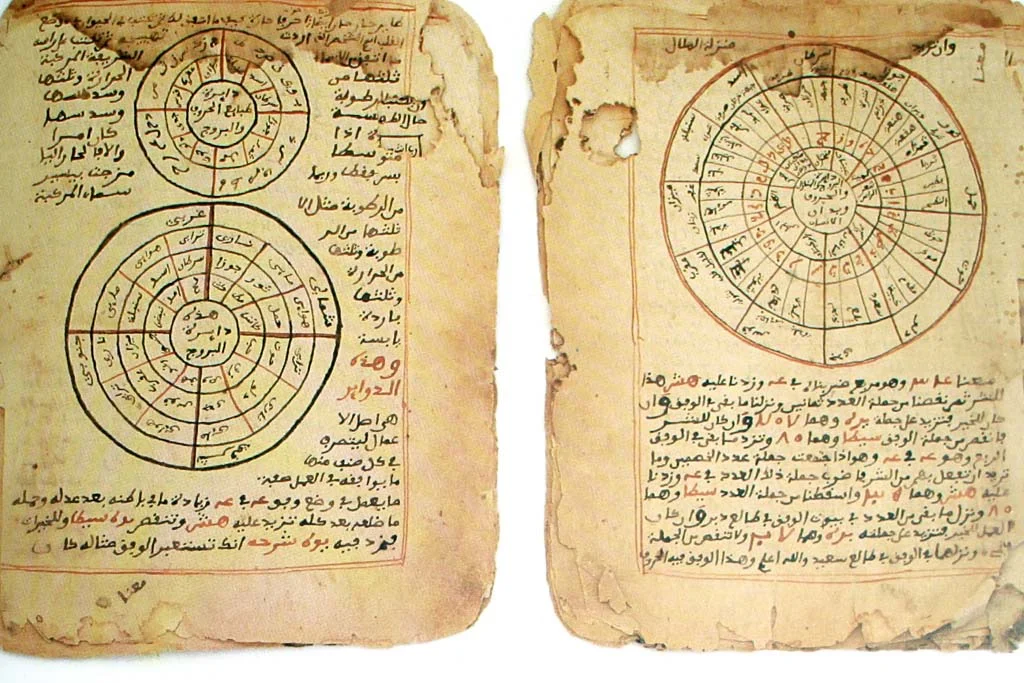
- Astronomy and mathematics — treatises on the movement of the moon and planets, calendars, and the determination of prayer times.
- Medicine — herbal remedies, treatments for fevers and eye diseases, and practical manuals blending Islamic and local knowledge.
- Grammar, rhetoric, and poetry — Arabic linguistics and a rich tradition of verse.
- History and correspondence — letters, genealogies, and chronicles including the famous Tarikh al-Sudan and Tarikh al-Fattash, which record the history of the Songhai Empire.
- Astrology and divination — alongside more strictly scientific texts, revealing a culture comfortable with multiple systems of thought.
The manuscripts were written mainly in Arabic, but also in Ajami — Arabic script adapted to write Songhai, Tamasheq, Fulfulde, and other local languages. That detail matters enormously: it shows literacy was not imported wholesale but adapted to local needs. Scribes worked with reed pens and locally made ink, often on Italian or North African paper traded across the desert, and bound their pages in leather covers tooled with geometric designs.
Who Wrote and Kept the Timbuktu Manuscripts?
The most famous figure associated with Timbuktu scholarship is Ahmad Baba al-Massufi al-Timbukti (1556–1627), a prolific jurist and author who wrote dozens of works and reportedly had a personal library of some 1,600 volumes. His life captures both the brilliance and the fragility of the tradition. In 1591, the Moroccan Saadian army defeated the Songhai Empire at the Battle of Tondibi and occupied Timbuktu. Ahmad Baba was arrested and exiled to Marrakesh in 1593, accused of stirring resistance. He was eventually allowed to return in 1608 and died in Timbuktu, but the occupation marked the beginning of the city’s political decline.
Behind the famous names stood hundreds of anonymous scribes, copyists, and teachers. Scholarship in Timbuktu was a family enterprise: the Kati family produced historians; the Bagayoko and Haidara families built libraries that survive today. Women also played a role, both as owners of manuscripts and as teachers in some contexts, though the surviving records are dominated by male scholars.
The manuscript tradition was not confined to Timbuktu. Related collections exist in Djenné, Gao, and across the wider Sahel, reflecting a regional culture of learning that stretched from present-day Mauritania to northern Nigeria. The Timbuktu collections are the best known, but they are part of a broader West African manuscript landscape.
A Timeline of Threat and Rescue
Understanding the Timbuktu manuscripts requires understanding the repeated threats they have faced — and the repeated acts of courage that saved them.
| Period | Event | Impact on Manuscripts |
|---|---|---|
| 15th–16th century | Golden age of Timbuktu scholarship under the Songhai Empire | Libraries flourish; manuscripts copied, collected, and traded |
| 1591 | Moroccan invasion and Battle of Tondibi | Political decline; scholars exiled; collections begin to disperse |
| 1893–1894 | French colonial conquest of Timbuktu | Manuscripts seized or removed; many end up in European collections |
| 2012–2013 | Armed occupation of northern Mali | Libraries targeted for destruction; mass evacuation of manuscripts |
| 2013 onward | Bamako conservation and digitisation efforts | Manuscripts preserved, catalogued, and increasingly made available online |
Each of these moments reshaped the collections. The Moroccan occupation weakened the institutions that supported scholarship. French colonial rule in the late 19th century removed significant numbers of manuscripts to Paris and other European cities, where many remain. But the gravest and most recent threat came in 2012.
The 2012 Crisis and the Great Manuscript Rescue
In early 2012, Tuareg separatists and Islamist armed groups took control of northern Mali, including Timbuktu. The occupation imposed a harsh interpretation of Islamic law, destroying shrines, banning music, and threatening libraries. In January 2013, as French and Malian forces advanced, fighters from Ansar Dine and al-Qaeda in the Islamic Maghreb burned thousands of manuscripts at the Ahmed Baba Institute, a state-run research centre in Timbuktu. Images of smouldering pages circulated worldwide, and many observers believed a centuries-old heritage had been annihilated.
It had not. In a remarkable operation, librarians, archivists, and ordinary families had already begun moving manuscripts out of the city. Abdel Kader Haidara, a Timbuktu librarian from a family of manuscript owners, helped coordinate the evacuation of hundreds of thousands of items. Manuscripts were packed into metal trunks, hidden in homes, loaded onto donkeys, carts, boats, and pickup trucks, and smuggled south along the Niger River to Bamako.
The scale of the rescue is still debated, but it is widely credited with saving the overwhelming majority of the city’s private collections — often cited as around 350,000 manuscripts. Some were lost to fire, looting, or decay, and the operation was dangerous: couriers risked arrest or worse. Yet the fact that so much survived is a testament to something deeper than logistics. These were family heirlooms. People endangered themselves for books they could not read in many cases, because the manuscripts represented identity, ancestry, and a claim to a dignified past.
“The manuscripts are our heritage. If we lose them, we lose part of ourselves.” — a sentiment echoed by Timbuktu librarians and families throughout the 2012–2013 crisis.
What the Manuscripts Reveal About African History
The Timbuktu manuscripts challenge a persistent myth: that Africa’s past was primarily oral and that written intellectual traditions arrived with Europeans or Arabs. In fact, West Africa had a robust manuscript culture for centuries, rooted in Islamic scholarship but thoroughly local in its concerns.
The texts show scholars engaging with global debates while addressing local realities. They record land disputes, trade contracts, and marriage agreements in a functioning legal system. They calculate the positions of stars for practical religious purposes. They discuss the ethics of slavery, the treatment of neighbours, and the responsibilities of rulers. They contain poetry, satire, and personal letters that reveal humour and everyday life.
They also complicate the story of Islam in Africa. Rather than a monolithic imposition, the manuscripts show a lived, negotiated faith, adapted to local languages and customs. Ajami writing, in particular, demonstrates how African communities made Arabic script their own, using it to write languages that had no written form at the time.
For historians, the manuscripts are a corrective to colonial-era narratives that portrayed Timbuktu as a legendary but ultimately vanished curiosity. They are evidence of continuity: the same families who owned books in the 18th century were safeguarding them in the 21st.
Preservation, Digitisation, and the Fight Against Decay
Today the Timbuktu manuscripts face a quieter threat than fire: humidity, insects, and the passage of time. Many are stored in conditions that are far from ideal, in Bamako and in Timbuktu, where climate control is expensive and electricity unreliable. Conservation requires trained specialists, acid-free materials, and stable environments — resources that are scarce.
Digitisation has become the most powerful tool for both preservation and access. Projects led by the Ahmed Baba Institute, the University of Cape Town, and international partners including the Library of Congress and Google have photographed tens of thousands of pages. The Timbuktu Manuscripts Project and related initiatives have made high-resolution images available to researchers worldwide. This work has two benefits: it reduces handling of fragile originals, and it brings the texts to scholars and readers who will never travel to Mali.
But digitisation is not a substitute for physical conservation, and it raises its own questions. Who owns the digital copies? Who profits from them? How can Malian institutions build the capacity to manage their own heritage rather than depending on foreign universities? These debates are ongoing, and they matter because the manuscripts are not just artefacts — they are living cultural property.
There is also a growing movement to reconnect the manuscripts with their communities. Local historians, teachers, and students are using digitised texts to research family histories, land claims, and genealogy. In a country that has endured conflict and displacement, that connection has real value.
Why the Timbuktu Manuscripts Matter Today
The Timbuktu manuscripts matter for several reasons, and they are not only historical.
- They prove intellectual depth. They demonstrate that West Africa was home to sophisticated scholarship in law, medicine, and astronomy centuries before colonial rule.
- They are a model of preservation. The 2012 rescue showed that communities, not just institutions, are the first line of defence for cultural heritage.
- They are a living resource. Digitised texts are being used for research, education, and cultural renewal, not just museum display.
- They complicate global narratives. They insist that African history is not a footnote to other histories but a subject in its own right.
There is also a practical lesson. Heritage protection is often framed as a matter of international intervention — UNESCO protocols, foreign funding, expert missions. The Timbuktu rescue was all of those things, but it was also a grassroots effort led by Malians who knew their own city and trusted their own networks. That is a model worth studying as conflicts continue to threaten cultural sites from Iraq to Ukraine.
Conclusion: A Library That Refused to Disappear
The Timbuktu manuscripts are often described as Africa’s lost libraries. The phrase is evocative, but it is also misleading. These libraries were not lost. They were threatened, dispersed, hidden, and sometimes burned — but they were never abandoned. Families carried them across the desert. Librarians smuggled them downriver. Scholars digitised them. And today, in Bamako and beyond, they are being read again.
What survives is more than paper and ink. It is a record of a society that valued learning, argued about law and the stars, wrote poetry, and kept its books close. It is a reminder that Timbuktu was not a myth or a mirage but a real city of scholars, and that its legacy belongs not only to Mali but to Africa and to the world. The manuscripts endure because people chose to save them — and that choice, repeated across generations, is the real story.