📅 Last updated: 19.11.2026
The Nyiragongo volcano rises like a dark shoulder above the Congolese city of Goma, and on clear nights its summit glows a deep, arterial red. Unlike most volcanoes on Earth, Nyiragongo holds one of the few persistent lava lakes ever documented — a churning cauldron of molten rock that has drawn volcanologists, filmmakers, and intrepid travelers to the eastern Democratic Republic of the Congo for decades. It is a landscape of extraordinary power and beauty, and also of real danger: the same lava that mesmerizes has twice swept down its flanks into populated valleys, most catastrophically in 1977 and again in 2002.
Nyiragongo volcano is an active stratovolcano in the Virunga Mountains of the eastern Democratic Republic of the Congo, standing about 3,470 meters tall near the city of Goma and Lake Kivu. It is famous for hosting one of the world’s largest and longest-lived lava lakes, and its unusually fluid, fast-moving lava has produced deadly eruptions in 1977 and 2002. The volcano is monitored by the Goma Volcano Observatory and sits within Virunga National Park, Africa’s oldest national park.
- Where Is the Nyiragongo Volcano, and Why Does Its Location Matter?
- What Makes the Nyiragongo Lava Lake So Extraordinary?
- How Dangerous Is the Nyiragongo Volcano? A History of Eruptions
- Who Monitors the Nyiragongo Volcano, and How?
- Can You Visit the Nyiragongo Volcano? The Trek and the Experience
- What Does the Nyiragongo Volcano Mean for the People of Goma?
- Why Does the Nyiragongo Volcano Matter Beyond the DRC?
- Frequently Asked Questions About the Nyiragongo Volcano
- A Mountain That Demands Attention — and Respect
Where Is the Nyiragongo Volcano, and Why Does Its Location Matter?
Nyiragongo sits in North Kivu province, roughly 20 kilometers north of Goma, the bustling provincial capital of around a million people that hugs the northern shore of Lake Kivu. The volcano is part of the Virunga volcanic chain, an eight-peak range that straddles the borders of the DRC, Rwanda, and Uganda. Its neighbor to the north, Nyamuragira, is Africa’s most active volcano by eruption frequency, but Nyiragongo is the one that captures the imagination — and the one that poses the sharper urban hazard.
The geology explains the menace. Nyiragongo is fed by the East African Rift, the tectonic seam where the African continent is slowly splitting apart. The rift’s crust is thin and fractured, allowing magma to rise with remarkable ease. Nyiragongo’s lava is an alkali-rich, silica-poor melt called nephelinite, which flows almost like water compared with the thick, slow lava of volcanoes like Mount St. Helens. During eruptions, these flows have been clocked at speeds of up to 60 kilometers per hour — fast enough to overtake a person on foot, a fact that has shaped evacuation planning in Goma for generations.
That proximity is the defining fact of life here. Goma’s airport runway, its markets, and entire neighborhoods were built on ground that lava has crossed before. The city lives with the volcano the way coastal cities live with the sea: with respect, engineering, and a certain fatalism.
What Makes the Nyiragongo Lava Lake So Extraordinary?
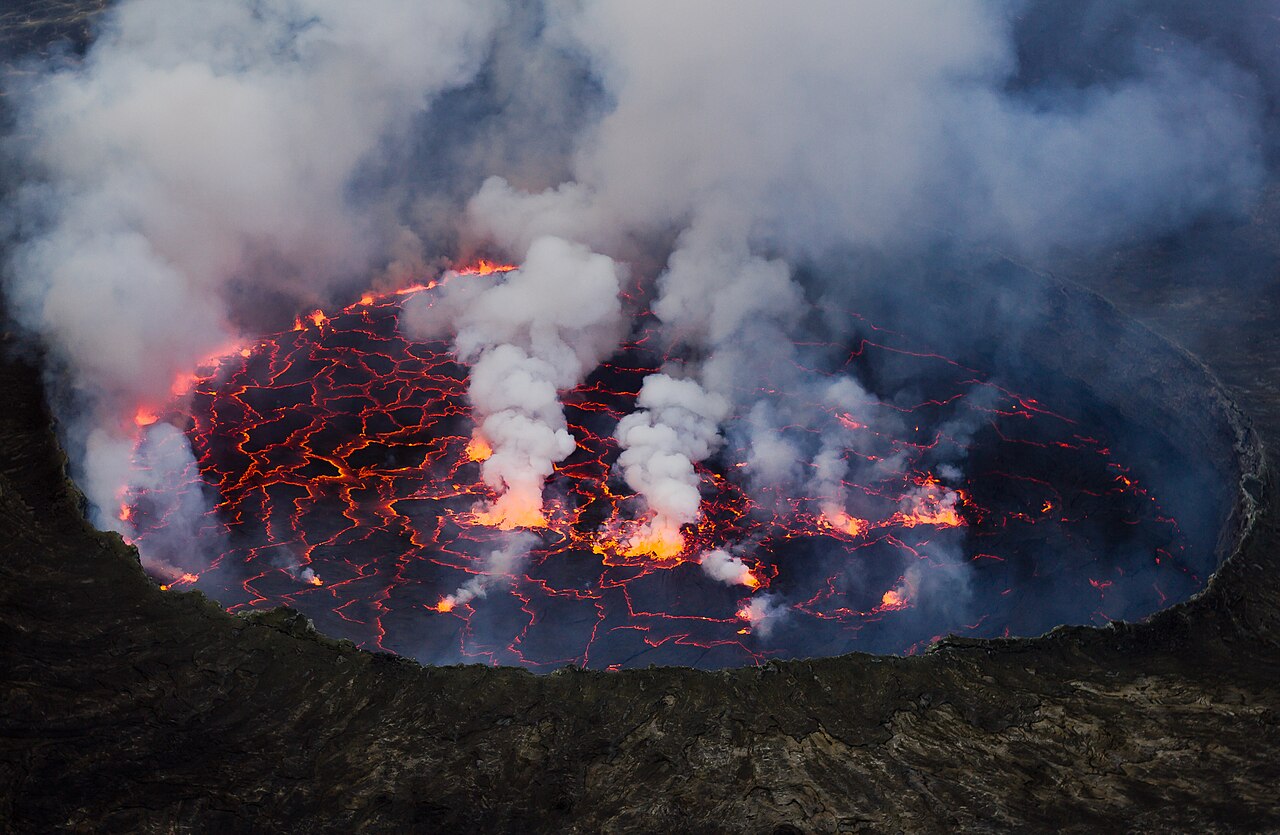
Standing on the crater rim at night is one of the most arresting sights on the continent. The lake, which has waxed and waned over the decades, sits roughly 250 meters below the rim inside a steep-walled caldera about 1.2 kilometers wide. From above, it looks like a wound in the earth — a restless surface of black crust broken by fountains of incandescent orange, with gas plumes curling upward and the roar of escaping gases audible over the wind.
A Lake That Shouldn’t Exist
Most lava lakes are fleeting. They drain, solidify, or collapse within months. Nyiragongo’s has persisted for long stretches since at least the early twentieth century, sustained by a continuous supply of magma from depth. The lake’s longevity is what makes it scientifically precious: it functions as a natural window into the plumbing of a volcano, letting researchers sample gases and measure heat flux without drilling.
Its behavior is also unusually dynamic. The lake level rises and falls, sometimes dramatically. In 2016 and again in 2021, the crater floor fractured and the lake drained internally — not erupting outward, but vanishing into fissures in the rock. Then, in May 2021, the magma found a new path entirely.
The 2021 Eruption: When the Lake Left Home
On the evening of 22 May 2021, fissures opened on the volcano’s southern flank, and lava poured toward Goma. The flow reached the city’s outskirts, stopping about a kilometer short of the airport runway but destroying hundreds of homes and killing at least 32 people, with many more reported missing. The eruption also triggered the temporary evacuation of tens of thousands of residents. It was a stark reminder that the lake’s internal plumbing can redirect itself with little warning.
How Dangerous Is the Nyiragongo Volcano? A History of Eruptions
Nyiragongo’s deadliest day came on 10 January 1977, when the lava lake drained catastrophically. The crater walls fractured and lava raced down the southern slope at extraordinary speed. Estimates of the death toll range widely — often cited at around 70, though some accounts suggest several hundred — and the flows reached within a few kilometers of what was then a smaller Goma. The event shocked volcanologists because of the sheer velocity of the flow, which was later attributed to the low silica content and the geometry of the steep upper cone.
On 17 January 2002, another major eruption sent lava through Goma itself. Flows cut across the city, splitting it in two, burying buildings and reaching Lake Kivu. Around 100 people died, and roughly 12,000 homes were destroyed. Hundreds of thousands fled across the border into Rwanda overnight. The eruption reshaped the city’s geography; some lava-buried streets remain visible today, and the local economy took years to recover.
| Year | Event | Key Impact |
|---|---|---|
| 1977 | Lava lake drainage and flank eruption | Deadly fast-moving flows; toll estimated at 70 to several hundred |
| 2002 | Major eruption through Goma | About 100 deaths; roughly 12,000 homes destroyed; mass evacuation |
| 2016 | Crater floor fracturing | Lava lake drained internally; no major outward eruption |
| 2021 | Southern flank eruption (22 May) | At least 32 deaths; homes destroyed near Goma; airport narrowly spared |
| 2022–present | Renewed crater activity | New lava lake re-established; ongoing monitoring |
The hazards are not limited to lava. Nyiragongo and its neighbor Nyamuragira emit enormous quantities of sulfur dioxide and carbon dioxide. Because CO2 is heavier than air, it can pool in low-lying areas and valleys, creating invisible lethal pockets — a phenomenon that has killed people and livestock near the volcano. The city of Goma also sits on the shore of Lake Kivu, which holds dissolved methane and CO2 in its depths; scientists monitor both the lake and the volcano as linked systems.
Who Monitors the Nyiragongo Volcano, and How?
The Goma Volcano Observatory (Observatoire Volcanologique de Goma, OVG) is the frontline institution. Founded in the 1980s with international support, the OVG operates a network of seismometers, GPS stations, and gas sensors around the volcano. Its scientists have repeatedly raised alarms before eruptions, though funding shortages, equipment theft, and the region’s chronic insecurity have hampered operations. During the 2021 eruption, the observatory’s warnings and the subsequent evacuation were complicated by the chaotic security situation in North Kivu.
International partners, including research teams from Europe and North America, have studied Nyiragongo’s lava lake for decades, using thermal cameras, satellite remote sensing, and gas spectrometry. The lake is also visible from space, and satellite data now provide a continuous record of heat output that complements ground instruments.
Monitoring matters because Nyiragongo’s warning signs can be subtle. Unlike volcanoes that swell visibly before erupting, Nyiragongo’s open conduit system means magma can move quickly. The 2021 eruption, for instance, followed a period of increased seismic activity but unfolded with terrifying speed.
Can You Visit the Nyiragongo Volcano? The Trek and the Experience
For years, the summit trek was one of Africa’s most celebrated adventure experiences. Organized through Virunga National Park, the hike typically began at the Kibati ranger post, about 20 kilometers from Goma, and climbed through montane forest, bamboo, and heathland to the crater rim — a ascent of roughly 3,470 meters that usually took five to six hours. Trekkers spent the night in basic shelters on the rim, watching the lava lake glow and listening to the volcano’s low rumble.
The experience was unforgettable but never casual. The park required armed ranger escorts because of the presence of armed groups in the region, and the route was periodically closed for security reasons. The COVID-19 pandemic and the 2021 eruption disrupted operations further, and access has remained intermittent. Prospective visitors should check current conditions with Virunga National Park and reputable operators before planning; the situation on the ground can change quickly.
What to Expect on the Mountain
- Altitude and cold: The summit is cold at night, often near freezing, despite the tropical latitude. Proper layers and a good sleeping bag are essential.
- Physical demand: The trek is steep and sustained. Reasonable fitness is required, and porters can be hired to carry gear.
- Security logistics: Permits, ranger escorts, and current safety assessments are non-negotiable parts of the planning.
- Weather: The dry seasons (roughly June–August and December–February) offer the best conditions, though volcanic gas can obscure the crater at any time.
What Does the Nyiragongo Volcano Mean for the People of Goma?
Goma is a city of traders, students, aid workers, and entrepreneurs — a place of lively markets, motorbike taxis, and music, not merely a disaster zone. Its residents have adapted to volcanic risk with a pragmatism born of experience. Building codes have evolved, evacuation routes have been mapped, and community groups work with the observatory to spread warnings. Yet the underlying tension remains: the city’s growth continues on ground that lava has crossed twice within living memory.
The volcano is also woven into local identity and faith. Churches in Goma hold services of thanksgiving after eruptions; songs and sermons reference the mountain. For many residents, Nyiragongo is not just a hazard but a presence — a neighbor whose moods are read like weather.
Economically, Virunga National Park and volcano tourism have been significant sources of revenue and employment, though insecurity has repeatedly undercut those gains. The park’s rangers, who risk their lives protecting both wildlife and visitors, are among the region’s most committed public servants.
Why Does the Nyiragongo Volcano Matter Beyond the DRC?
Nyiragongo is a global laboratory. Its lava lake offers rare insight into how magma degasses, how conduits behave, and how eruptions can shift from internal drainage to flank eruption — questions relevant to volcanoes worldwide, from Hawaii’s Kilauea to Iceland’s Fagradalsfjall. Its fast-flowing lava has informed hazard models used in densely populated volcanic regions everywhere.
The volcano also sits at the heart of one of Africa’s most biodiverse landscapes. Virunga National Park, established in 1925, is home to mountain gorillas, okapi, and a staggering range of species. The same tectonic forces that feed Nyiragongo created the fertile soils and dramatic terrain that sustain this biodiversity. Protecting the volcano’s slopes means protecting a UNESCO World Heritage Site of global importance.
And there is a human dimension that resonates far beyond the Great Lakes region: the story of Congolese scientists, rangers, and residents living with a restless mountain is a story of resilience and expertise that rarely makes international headlines. The OVG’s volcanologists, working with limited resources in a conflict zone, represent a scientific tradition that deserves far more recognition than it receives.
Frequently Asked Questions About the Nyiragongo Volcano
Is the Nyiragongo lava lake still active?
Yes. After the 2021 eruption drained and redirected the lake, volcanic activity resumed, and a new lava lake has re-formed in the crater. Activity levels fluctuate, and the Goma Volcano Observatory continues to monitor the summit.
How tall is Nyiragongo?
The summit stands at approximately 3,470 meters (about 11,380 feet) above sea level, making it one of the taller peaks in the Virunga chain.
Can you see the lava lake without climbing?
Not directly. The lake sits deep inside the crater, so a summit trek is required for a ground-level view. Satellite imagery and aerial surveys provide alternative perspectives for researchers.
Is it safe to visit Goma?
Safety conditions vary. Travelers should consult their embassies, Virunga National Park, and reputable tour operators for current advisories. The region has experienced armed conflict and periodic volcanic activity.
A Mountain That Demands Attention — and Respect
The Nyiragongo volcano is many things at once: a geological wonder, a scientific treasure, a tourist draw, and a persistent threat to a million people. Its lava lake is among the most spectacular natural phenomena on the planet, and its eruptions have shaped the history of eastern Congo in ways that are still unfolding. To stand on its rim is to feel the planet’s interior at work — and to understand why the people of Goma watch the mountain’s glow with a mixture of awe and vigilance. Nyiragongo does not offer easy certainties. It offers something rarer: a direct, visceral encounter with the living Earth, and a reminder that Africa’s landscapes are among the most dynamic and extraordinary on the globe.