📅 Last updated: 19.11.2026
Gelede masks are among the most spectacular ritual objects in West Africa, carved wooden headdresses worn by masked dancers in a Yoruba ceremony honouring the mothers — Ìyá Nlá, the Great Mother — and the spiritual power women collectively hold over life, fertility, and social harmony. Performed by communities in south-west Nigeria and in the Yoruba diaspora of Benin and Togo, Gelede festivals blend sculpture, choreography, satire, and communal feasting into a single night-to-dawn event. The masks themselves are a living archive: carved with human faces, animals, and scenes of everyday life, they carry the memory, humour, and moral imagination of the towns that make them.
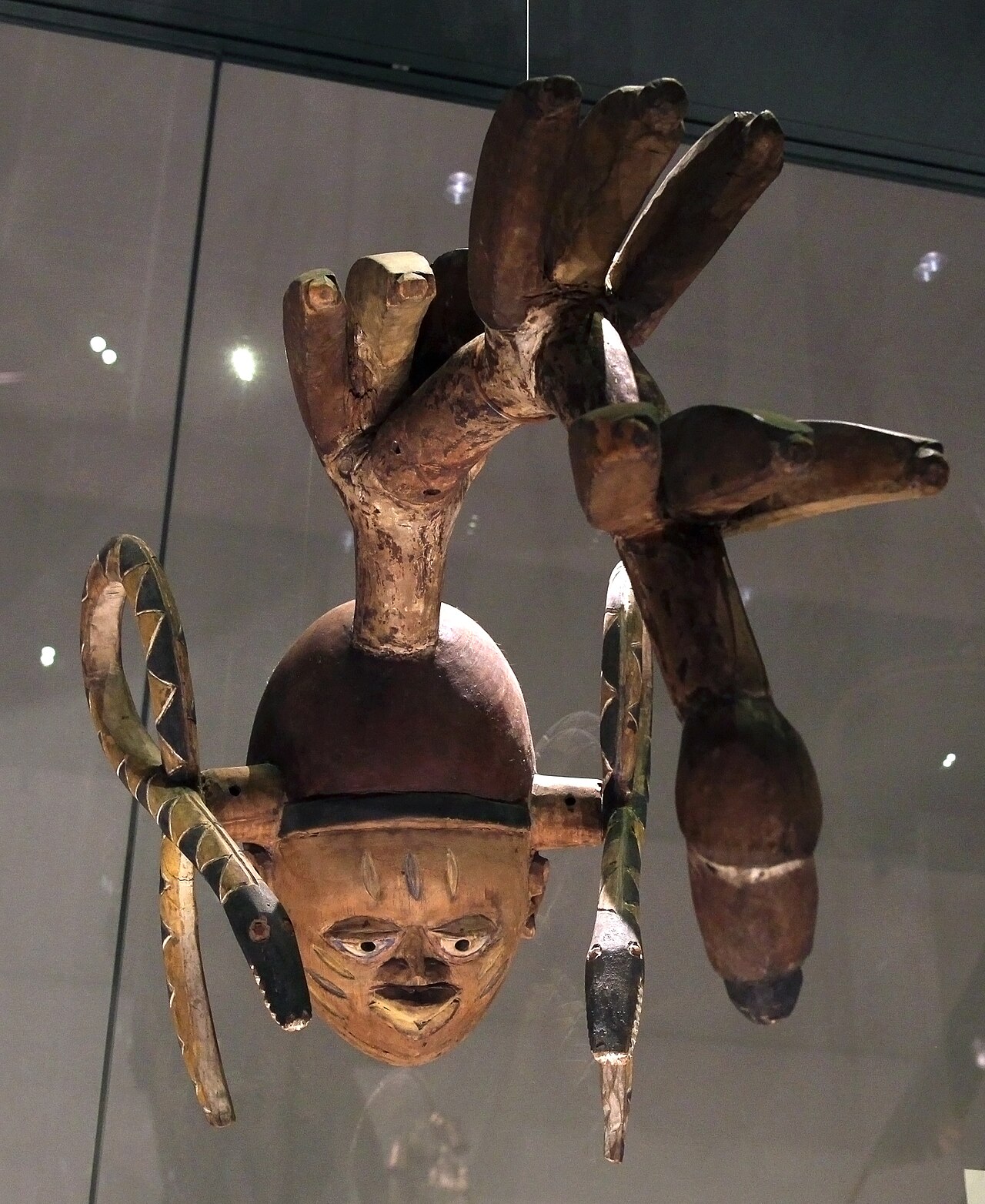
Gelede masks are carved wooden headdresses worn by male dancers in a Yoruba masquerade that honours the power of mothers and women. The masks are typically worn tilted forward on top of the head, paired with layered costumes, and performed in annual or occasional festivals across south-west Nigeria and neighbouring Benin and Togo. UNESCO inscribed the oral heritage of Gelede on its Representative List of the Intangible Cultural Heritage of Humanity in 2008.
- What Are Gelede Masks and Why Do the Yoruba Carve Them?
- How Were Gelede Masks Made and What Do They Depict?
- What Happens During a Gelede Festival?
- Gelede Masks in the Museum and the Market: Heritage, Tourism, and the Art Trade
- Why Is Gelede Masked Dance Considered Sacred?
- How Can Travellers and Researchers Experience Gelede Respectfully?
- What Does Gelede Masks' Legacy Mean Today?
- The Enduring Power of Gelede
What Are Gelede Masks and Why Do the Yoruba Carve Them?
The Yoruba word Gelede is usually explained as coming from egé (a kind of mask or masquerade) and ede (public display or ceremony) — a masquerade brought out into the open. The tradition is concentrated among the western Yoruba: the Egbado (Yewa) towns such as Ilaro and Pobé, the Ketu Yoruba of what is now Benin, and communities around Abeokuta and Lagos. It is closely associated with the worship of Ìyá Nlá, the Great Mother, and with a body of belief that treats women — especially elder women and mothers — as bearers of àṣẹ, the vital force that makes things happen.
The ceremony exists to keep that force in balance. Yoruba thought holds that women’s power is immense and can be either nurturing or destructive; the term ajẹ́, often translated as “witch,” describes women who possess this spiritual force, and it is not automatically evil. Gelede is a public act of respect: the community acknowledges the mothers, honours their authority, and asks for their blessing on children, harvests, and civic peace. The masks are the visible instrument of that respect — carved, danced, and then returned to the shrine or the family compound.
Gelede is not a single national festival. It is a family of local traditions, each with its own shrine, its own drum rhythms, and its own roster of masks. The masks of a town like Ilaro or a Ketu community in Benin differ in style from those of another, yet share a recognisable grammar: a face, often serene or sharply caricatured, mounted on a superstructure of figures, animals, or objects that comment on the world.
How Were Gelede Masks Made and What Do They Depict?
Carving, materials, and the mask-maker’s craft
Gelede masks are carved by specialist artists, usually men, from light, workable woods such as ceiba (silk-cotton) or other local species. The finished headdress is painted with pigments — kaolin white, indigo, ochre, and modern enamel paints in recent decades — and often finished with a glossy sheen. Because the mask sits tilted on top of the dancer’s head, with the face angled upward and forward, its design is calculated for a viewer looking up from below. The dancer’s own face is hidden by a cloth veil or a netted fringe, and the body is covered by a layered costume of cloth, raffia, and sometimes imported fabrics.
Mask styles vary. Some are relatively naturalistic portraits with scarification marks and elaborate coiffures; others are boldly abstract or grotesque. A single festival can present dozens of masks, each sponsored by a family, an age-grade, or a guild, and each with a name and a story.
The iconography: satire, animals, and the modern world
Gelede carving is remarkable for its topicality. Alongside traditional motifs — the mother and child, the bird, the snake, the rider on horseback — carvers depict colonial officers, motorbikes, aeroplanes, cameras, and mobile phones. This is not quaint adaptation; it is the tradition doing what it has always done, holding up a mirror to the community. Masks can mock arrogance, expose adultery or theft, or praise a generous patron. The satire is licensed by the ritual frame: the mask can say what a neighbour cannot.
Animal imagery carries moral weight. The bird often signals the power of mothers, especially the night bird associated with ajẹ́; the snake can evoke transformation or danger; the horse and rider speak to status and authority. A mask’s superstructure is a sentence in visual language, and knowledgeable audiences read it instantly.
- Human faces: calm, dignified portraits honouring specific ancestors or idealised mothers.
- Mother-and-child figures: the central theme of fertility and nurture.
- Animals and birds: carriers of moral and spiritual meaning, especially the bird of the mothers.
- Everyday and modern objects: motorbikes, cameras, colonial figures — satire and social commentary.
What Happens During a Gelede Festival?
The ritual sequence
A Gelede festival is usually held in the dry season, often after the harvest, and can run for several days, with the main masked performance taking place at night and continuing until dawn. The sequence typically begins with preparatory rites at the shrine of Ìyá Nlá, offerings, and the gathering of the community. Drummers — the Ìyáàlù lead drum and its supporting ensemble — establish the rhythmic architecture, and the masked dancers emerge in procession.
The dancers do not perform solo freestyle. Choreography is learned, rehearsed, and judged. The masks are heavy, and the dancer’s skill lies in controlled, rhythmic movement — bending, turning, and gesturing so the carved superstructure catches the firelight or, in contemporary festivals, electric light. The audience is not passive: it comments, laughs at satirical masks, and rewards favoured dancers with money and praise.
Who participates — and who is excluded
The masks are worn by men, even though the ceremony honours women. This apparent paradox is central: the masquerade is a male institution that pays public homage to female power, and the ritual rules keep the two spheres distinct. Women have their own roles — as organisers, singers, cooks, patrons, and as the honoured presence the festival addresses. In some communities, women of the Ìyá Nlá cult hold significant authority over the ceremony’s timing and conduct.
The festival is also an economic and social occasion: feasting, trade, courtship, and the settling of disputes. It draws visitors from neighbouring towns and, increasingly, from the diaspora and international audiences.
Gelede Masks in the Museum and the Market: Heritage, Tourism, and the Art Trade
Gelede masks entered European and American collections during the colonial period and are now among the most sought-after works of African sculpture. Major museums in London, Paris, New York, and Lagos hold examples, and the masks have influenced modern artists and designers. This visibility has a double edge. On one hand, it has raised the global profile of Yoruba carving and supported the livelihoods of contemporary carvers who produce work for collectors and tourists. On the other, the removal of ritual objects from their communities — sometimes through colonial collecting, sometimes through theft — has fuelled ongoing debates about restitution and the ethics of the art market.
In Nigeria, the tradition is sustained by families, shrines, and cultural institutions, and by festivals that continue to draw crowds. In Benin and Togo, Ketu Yoruba communities maintain their own Gelede cycles. The tension between sacred use and commercial demand is real: a mask made for a shrine and a mask made for sale are not the same object, even when they look alike, and communities increasingly assert control over how their heritage is represented.
| Period | Development in Gelede Tradition |
|---|---|
| Pre-colonial era | Gelede develops among western Yoruba communities as a masquerade honouring Ìyá Nlá and the power of mothers; local shrines and carving lineages established. |
| 19th–early 20th century | Regional warfare and colonial conquest disrupt communities; masks and ritual objects begin entering European collections. |
| Mid-20th century | Gelede continues in towns such as Ilaro and Pobé; anthropologists and art historians document the ceremony; masks enter major museum collections. |
| 2008 | UNESCO inscribes the oral heritage of Gelede on the Representative List of the Intangible Cultural Heritage of Humanity. |
| 21st century | Festivals continue in Nigeria, Benin, and Togo; diaspora communities stage Gelede events; debates over restitution and cultural ownership intensify. |
Why Is Gelede Masked Dance Considered Sacred?
The sacredness of Gelede lies in what the ceremony does, not merely in what it looks like. The masks are not decorations; they are vessels. When a dancer puts on a mask, the community understands that the ancestor or spirit represented is present in a mediated way. The performance is an offering, and the rules around it — who may carve, who may dance, when the masks may be seen — protect that presence.
The ceremony also performs a social function that Yoruba communities treat as sacred in its own right: the maintenance of harmony between men and women, elders and youth, the living and the dead. By honouring the mothers publicly, the community affirms that power must be respected rather than suppressed. The satire softens hierarchy; the feast binds neighbours; the night-long drumming marks time in a way that connects the present to the ancestors.
This is why Gelede masks are treated with care even outside the festival. In their communities they are stored in shrines or family houses, not casually displayed, and their handling is governed by custom. The mask is a person-like entity with a name and a history, and that status travels with it.
How Can Travellers and Researchers Experience Gelede Respectfully?
Gelede festivals are living ceremonies, not staged shows, and visitors should approach them as guests. The most reliable route is through a trusted local contact — a cultural centre, a university department, a community organisation, or a tour operator with genuine relationships in the town. Festivals are often announced locally and may shift dates; flexibility matters.
- Ask before photographing. Some masks and ritual moments are restricted; a local guide can advise.
- Dress and behave modestly. Follow the norms of the host community, especially around shrines.
- Pay for what you receive. If you hire a guide, translator, or drummer, agree fees in advance and pay fairly.
- Buy from carvers directly where possible. This supports the tradition and reduces the market for looted objects.
- Do not touch masks or enter restricted spaces without explicit permission.
For researchers, the key is collaboration. Yoruba scholars, local historians, and shrine custodians hold knowledge that is not always in the published literature, and ethical research means crediting and compensating them. Institutions holding Gelede masks should be transparent about provenance and open to dialogue about return.
What Does Gelede Masks’ Legacy Mean Today?
Gelede masks matter today because they show a tradition that is neither frozen nor fragile. Carvers still work, festivals still draw crowds, and the masks still speak to the present — mocking a corrupt official, celebrating a daughter’s graduation, or commenting on a new road. The ceremony has adapted to electric light, video recording, and diaspora audiences without losing its ritual core.
The tradition also carries a message that resonates beyond Yorubaland: that a society’s health depends on how it treats its mothers, and that art can be both beautiful and morally serious. In a world that often reduces African heritage to static artefacts in glass cases, Gelede insists on movement, humour, and participation. The masks are not relics; they are arguments, made of wood and paint, about who holds power and how it should be honoured.
The Enduring Power of Gelede
Gelede masks are a living tradition of the Yoruba world, rooted in the towns of south-west Nigeria and the Ketu communities of Benin and Togo, and carried by diaspora communities far beyond. They honour the mothers, satirise the powerful, and bind communities together in a ceremony that runs from dusk to dawn. The carving continues, the drums still sound, and the masks still tilt upward toward the faces of the crowd — a reminder that in Yoruba culture, the sacred and the everyday are carved from the same block of wood.