📅 Last updated: 09.11.2026
The Ethiopian coffee ceremony is far more than a daily caffeine ritual — it is a living social institution, a performance of hospitality, and one of the most distinctive cultural practices in the world. Rooted in the highlands where Coffea arabica first grew wild, the ceremony transforms the simple act of brewing into a three-hour act of welcome. In homes from Addis Ababa to the villages of Kaffa, the scent of roasting beans signals that guests are honoured and community is being made.
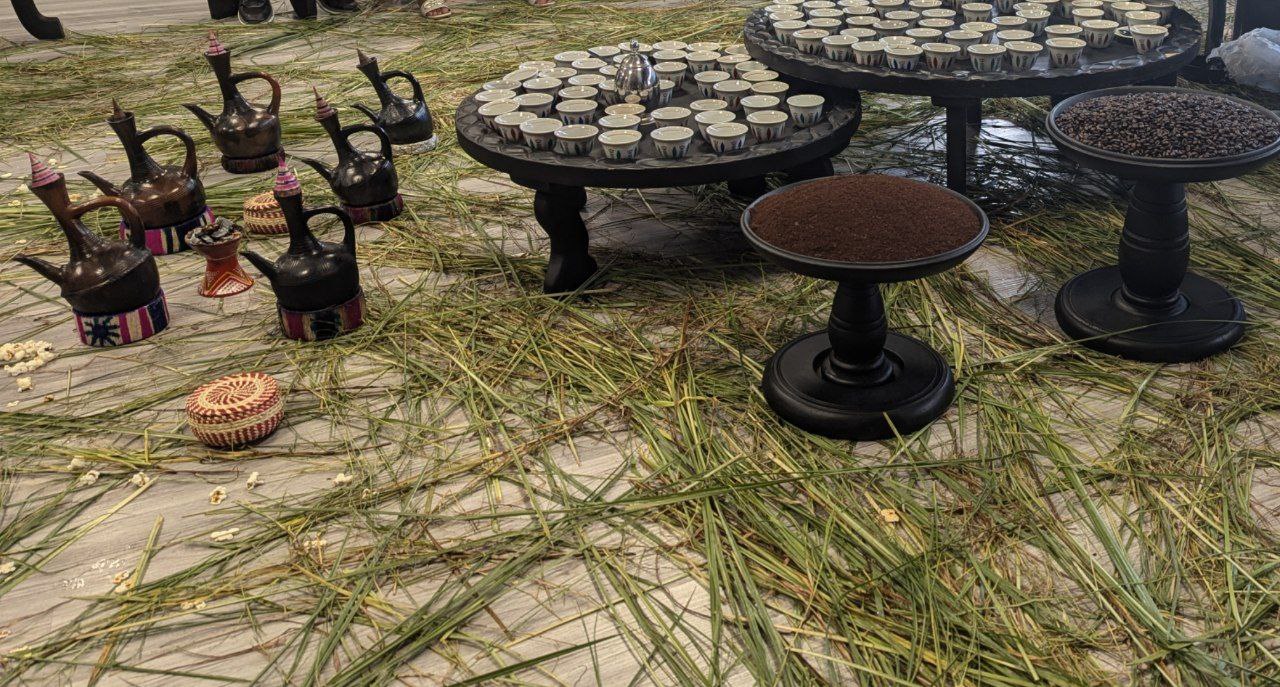
The Ethiopian coffee ceremony (known locally as buna tetu) is a ceremonial preparation and serving of coffee that typically involves roasting green beans over charcoal, grinding them by hand, and brewing in a traditional clay pot called a jebena. It is performed at least once a day in many Ethiopian households and is central to hospitality, social life, and cultural identity, often accompanied by incense, popcorn, and three successive rounds of coffee.
- What Is the Ethiopian Coffee Ceremony and Why Does It Matter?
- How Did the Ethiopian Coffee Ceremony Begin? Legends and History
- Step by Step: Inside the Ethiopian Coffee Ceremony
- What Role Does the Ethiopian Coffee Ceremony Play in Daily Life?
- Regional Variations: One Ritual, Many Expressions
- Why the Ethiopian Coffee Ceremony Matters Today
- A Lasting Perspective on Coffee, Culture, and Welcome
What Is the Ethiopian Coffee Ceremony and Why Does It Matter?
Ethiopia is the birthplace of coffee. The plant Coffea arabica is native to the country’s southwestern highlands — the forests of Kaffa, Illubabor, and Bench Maji — and Ethiopia remains the only place on Earth where coffee grows wild in undisturbed forest. That botanical fact underpins a cultural fact: coffee here is not an import or a habit but an inheritance, woven into the language, the economy, and the social fabric.
The ceremony is the most visible expression of that inheritance. It is performed when guests arrive, at weddings, at funerals, during religious festivals, and on ordinary afternoons. It is led almost always by women, who pass the knowledge from mother to daughter. Anthropologists and Ethiopian writers alike describe it as a form of social theatre: every gesture has meaning, every aroma has a purpose, and every cup is an invitation to stay a little longer.
The practice carries real economic weight too. Coffee is Ethiopia’s largest export, and the country is Africa’s top producer. According to the Ethiopian Coffee and Tea Authority, millions of smallholder households depend on coffee for their livelihoods. The ceremony, in other words, sits at the intersection of a global commodity and an intimate domestic ritual — a reminder that the world’s coffee culture began here.
How Did the Ethiopian Coffee Ceremony Begin? Legends and History
The origins of coffee drinking in Ethiopia are layered with legend, and the most famous story is that of Kaldi, a goatherd from around the 9th century. As the tale goes, Kaldi noticed his goats becoming unusually energetic after eating the bright red cherries of a certain shrub. He took the berries to a monastery, where the monks — depending on the version — either roasted and brewed them or threw them into the fire, from which the aroma of roasting coffee rose.
Historians treat the Kaldi story as folklore rather than documented fact, but it captures something true: coffee’s stimulant properties were recognised in Ethiopia long before the beverage spread to Yemen and the wider world. By the 15th century, coffee was being cultivated in Yemen and traded through Mocha; the word “coffee” itself likely derives from the Arabic qahwa, which some linguists trace to the Ethiopian region of Kaffa.
From forest to ritual
What is well documented is that the ceremony’s structure — roasting, grinding, brewing, and serving in three rounds — developed over centuries as a communal practice. Ethiopian Orthodox Christianity incorporated coffee into fasting and feast-day customs, and the ceremony became a way to mark both sacred and secular occasions. The jebena, the round-bottomed clay pot with a long neck, became the ceremonial centrepiece, and its production became an art form in its own right.
Step by Step: Inside the Ethiopian Coffee Ceremony
Attending a ceremony is to witness a sequence performed with care and consistency. The details vary by region and household, but the core structure is remarkably stable across the country.
Preparation and the roasting
The hostess begins by washing green coffee beans and spreading them on a flat pan, often a menkesha, over hot coals. She roasts them slowly, shaking the pan so the beans brown evenly. The room fills with smoke and the sharp, grassy scent of green coffee turning toasty and dark. When the beans are ready, she carries the pan around the room so each guest can wave the smoke toward their face and inhale — an act of shared anticipation.
Grinding and brewing
The roasted beans are then ground, traditionally with a wooden mortar and pestle called a mukecha and zenezena. The ground coffee goes into the jebena with water and is set over the coals to boil. The hostess watches closely; the pot is removed at the right moment to avoid boiling over, then returned to the heat. When the coffee is ready, it is poured into small handleless cups called sini.
The three rounds
The ceremony is defined by three servings, each with its own name and character:
- Abol — the first and strongest round, served to guests with the greatest honour.
- Tona — the second round, lighter and more relaxed, when conversation deepens.
- Baraka — the third round, whose name means “blessing,” often served with a final prayer or blessing for the guests.
Refusing the third round is considered impolite; accepting it is a sign of respect and friendship. Alongside the coffee, hosts serve popcorn, roasted barley, or kolo (roasted grain), and often burn frankincense or etan (a local incense) to complete the sensory experience.
| Stage | Local Term | What Happens | Cultural Meaning |
|---|---|---|---|
| Roasting | Menkesha over coals | Green beans roasted; smoke waved toward guests | Invitation and sensory welcome |
| Grinding | Mukecha and zenezena | Beans pounded by hand in a wooden mortar | Labour and care; women’s expertise |
| Brewing | Jebena | Coffee boiled and poured into small cups | Craft and patience |
| First round | Abol | Strongest coffee served | Honour to guests |
| Second round | Tona | Lighter coffee; conversation deepens | Relaxation and fellowship |
| Third round | Baraka | Final cup; blessing offered | Blessing and closure |
What Role Does the Ethiopian Coffee Ceremony Play in Daily Life?
In Ethiopia, the ceremony is not reserved for special occasions. Many households perform it at least once a day, often in the morning or after lunch, and it structures the rhythm of social life. Neighbours drop in, relatives visit, and business is discussed over the jebena. In rural areas, the ceremony can last two to three hours; in cities, it may be shortened but rarely abandoned.
The ceremony is also a space for conflict resolution and community decision-making. Elders use it to settle disputes, arrange marriages, and welcome newcomers. In this sense it functions as a kind of informal parliament — a setting where people speak freely because the ritual itself guarantees goodwill.
Gender, hospitality, and the hostess
The ceremony is overwhelmingly led by women, who are its custodians and performers. A skilled hostess is judged on the evenness of her roast, the clarity of her pour, and the warmth of her welcome. Young girls learn by watching and assisting, and the knowledge is passed down within families. The ceremony thus doubles as a vehicle for transmitting gender roles, etiquette, and community values.
Regional Variations: One Ritual, Many Expressions
Ethiopia is a country of more than 80 ethnic groups, and the ceremony reflects that diversity. In the highlands of Amhara and Tigray, the ritual tends to be formal and closely tied to Orthodox Christian practice. In Oromia, the ceremony is often larger and more communal, with extended families gathering. In the coffee-growing southwest — Kaffa, Bench Maji, and Sheka — the ceremony is connected to the harvest and to indigenous spiritual traditions.
Urban Ethiopia has adapted the ritual to modern life. In Addis Ababa, ceremony spaces exist in restaurants and hotels, and coffee chains have begun to reference the ritual in their branding. Yet the home ceremony remains the standard against which all else is measured. The Ethiopian Coffee and Tea Authority and exporters increasingly use the ceremony as a marketing symbol abroad, positioning Ethiopian coffee as a premium, culturally rooted product.
Why the Ethiopian Coffee Ceremony Matters Today
The ceremony is a case study in how a cultural practice can survive and adapt under pressure. Ethiopia’s coffee sector faces real challenges — climate change, disease, and volatile global prices — and the ceremony is part of the country’s response, anchoring coffee’s value in culture as well as commodity. UNESCO has recognised the ceremony’s cultural significance, and Ethiopian diaspora communities have carried it to cities from Washington, D.C. to London.
For visitors, the ceremony is an entry point into Ethiopian hospitality. It rewards patience: the coffee takes time, the conversation takes time, and the welcome is the point. For Ethiopians, it is simply life — a daily act of connection that has outlasted empires and will likely outlast us all.
- Respect the sequence — accept all three rounds if offered; refusing the third can cause offence.
- Engage with the aroma — when the roasting pan is passed, wave the smoke toward you and inhale.
- Expect the accompaniments — popcorn, roasted grain, and incense are part of the experience, not extras.
A Lasting Perspective on Coffee, Culture, and Welcome
The Ethiopian coffee ceremony endures because it does something no espresso machine can: it makes time for people. In a world that prizes speed, it insists on slowness — on roasting, grinding, brewing, and pouring as acts of care. It is a reminder that coffee’s story began not in a café but in a forest, and that its deepest value lies not in the bean but in the welcome it makes possible. To be invited to a ceremony is to be told, in the most concrete way, that you are welcome — and in Ethiopia, that is the highest compliment of all.