📅 Last updated: 17.11.2026
The Nsibidi script is one of Africa’s most sophisticated indigenous writing systems, a body of hundreds of symbols developed by the Ekpe (Leopard) society across what is now southeastern Nigeria and western Cameroon. Long dismissed in colonial-era scholarship as mere “picture writing,” Nsibidi is now recognized as a complex semasiographic system capable of recording court cases, proverbs, trade agreements, ritual knowledge, and even love letters. This is the story of a script that refused to die — and the scholars, artists, and communities bringing it back into the light.
The Nsibidi script is an indigenous writing system of the Ekoi, Efik, Ibibio, and Igbo peoples of southeastern Nigeria and western Cameroon, comprising hundreds of pictographic and ideographic symbols. It emerged within the Ekpe secret society, likely by the early 19th century and possibly much earlier, and was used to record court judgments, proverbs, trade pacts, and ritual knowledge. Today it survives in ceremonial practice and in a growing contemporary art and design revival.
- What Exactly Is the Nsibidi Script?
- Where Did the Nsibidi Script Come From?
- How Was the Nsibidi Script Actually Used?
- Why Was the Nsibidi Script Misunderstood for So Long?
- How Does the Nsibidi Script Compare to Other African Writing Systems?
- Where Is the Nsibidi Script Today?
- What Can the Nsibidi Script Teach Us?
- The Rosetta Stone of Africa: A Script That Refuses to Be Forgotten
What Exactly Is the Nsibidi Script?
The word nsibidi itself is a clue. Among the Ejagham (Ekoi) people, who most scholars credit with the script’s origins, it carries a sense of the secret and the powerful — a fitting name for a writing system that was never meant for everyone. Nsibidi is not an alphabet. It does not spell out sounds the way Latin or Cyrillic letters do. Instead, it is what linguists call a semasiographic system: each symbol or cluster of symbols conveys a concept, an object, an action, or a proverb directly, without passing through spoken syllables.
That makes it closer in logic to Chinese characters or Egyptian hieroglyphs than to the Latin alphabet — but it is neither of those. Nsibidi is its own thing, born of the Cross River basin, and it belongs to a family of graphic traditions that includes the nsibiri of the Ejagham, the ukara cloth symbols of the Igbo, and the uri designs painted by Igbo women on walls and bodies.
Estimates of the number of Nsibidi characters vary widely. Some catalogues list a few hundred core signs; others count well over a thousand when regional variants and compound symbols are included. The script was never standardized in the way a national orthography would be — and that fluidity is part of its character.
Where Did the Nsibidi Script Come From?
The precise origins of Nsibidi are debated, and honest scholarship admits as much. The strongest consensus places its birthplace among the Ejagham people of the upper Cross River region, in what is today Nigeria’s Cross River State and Cameroon’s Southwest Region. From there it spread through the networks of the Ekpe society — a powerful men’s association also known as Egbo — to the Efik, Ibibio, and Igbo communities of the region.
Dating the Script
Dating is genuinely difficult. Because Nsibidi was written on perishable materials — calabashes, woven cloth, skin, wood, and the ground itself — few early examples survive. Some scholars argue for origins in the 18th century or earlier; others, noting the absence of pre-colonial written records, place its formal development in the 19th century, with the Ekpe society as the engine of its spread. What is clear is that by the time European traders and missionaries arrived in the Cross River region in the 19th century, Nsibidi was already deeply embedded in local governance, law, and religion.
The Ekpe Society as Custodian
Nsibidi and Ekpe were inseparable. The society functioned as a judicial and regulatory institution — a kind of indigenous supreme court and enforcement body rolled into one — and Nsibidi was its written language. Knowledge of the script was graded by rank within the society. A junior member learned basic signs; senior members commanded the esoteric vocabulary used in ritual, diplomacy, and the recording of verdicts. This graded access is why colonial observers, who were rarely initiated, consistently underestimated the script’s complexity.
How Was the Nsibidi Script Actually Used?
The range of Nsibidi’s applications is what makes the “Rosetta Stone of Africa” framing more than a headline. This was not a decorative curiosity. It was a working script with legal, commercial, and personal functions.
- Judicial records: Ekpe courts recorded verdicts and case outcomes in Nsibidi, sometimes inscribed on walls or boards at the society’s meeting houses.
- Proverbs and aphorisms: Many symbols encode whole proverbs — a single sign could carry a moral lesson that would take a sentence to speak aloud.
- Trade and diplomacy: Symbols marked goods, sealed agreements, and signaled messages between communities along Cross River trade routes.
- Ritual and esoteric knowledge: The most restricted signs conveyed religious and initiatory meanings reserved for senior ranks.
- Personal communication: Perhaps most remarkably, Nsibidi was used in courtship — symbols painted on calabashes or drawn on the body could carry declarations of love and flirtation.
That last point deserves emphasis. A writing system flexible enough to record a legal judgment and a love letter is a writing system in the fullest sense. The stereotype of pre-colonial Africa as “oral only” collapses the moment you look closely at the Cross River basin.
| Period | Development | Context |
|---|---|---|
| Pre-19th century (disputed) | Early Nsibidi signs develop among Ejagham communities | Origins within ritual and Ekpe society networks |
| 19th century | Script spreads among Efik, Ibibio, and Igbo communities | Ekpe society expansion and Cross River trade |
| 1904 | First serious European documentation by colonial officials | Early attempts to catalogue Nsibidi signs |
| 1911–1912 | J.K. Macgregor publishes detailed studies | Colonial-era scholarship begins to take the script seriously |
| 1980s–2000s | Academic revival; inclusion in Unicode discussions | Nigerian and international scholars reassess the script |
| 2010s–present | Contemporary art, design, and digital revival | Nsibidi appears in fashion, typography, and new media |
Why Was the Nsibidi Script Misunderstood for So Long?
The colonial encounter with Nsibidi was marked by suspicion and, frequently, suppression. Because the script was tied to Ekpe — a society that wielded real authority and was seen by colonial administrators as a rival power structure — Nsibidi symbols were sometimes banned or treated as evidence of “secret societies” to be broken up. Missionary efforts to replace indigenous institutions with European ones further eroded the script’s institutional base.
Early European commentators often described Nsibidi as primitive picture-writing, incapable of abstraction. This was wrong on both counts. The script includes abstract concepts, grammatical relationships, and compound constructions. The misunderstanding was not a failure of the script; it was a failure of the observers, who lacked initiation, context, and — often — the willingness to see African intellectual achievement as such.
Credit where it is due: some colonial officials did document the script carefully. J.K. Macgregor published significant studies in the early 1910s, and his work, however framed by its era, preserved hundreds of signs that might otherwise have been lost. Nigerian scholars — among them J.F.A. Ajayi and later researchers in the Cross River region — built on and corrected this foundation.
How Does the Nsibidi Script Compare to Other African Writing Systems?
Africa has produced a striking number of indigenous scripts, and Nsibidi holds a distinctive place among them. Comparing them clarifies what makes it special.
- Nsibidi (Nigeria/Cameroon): Semasiographic and ideographic; tied to a secret society; encodes concepts rather than sounds.
- Ge’ez script (Ethiopia/Eritrea): A full syllabary with ancient roots, still in daily liturgical and literary use.
- Vai script (Liberia): A syllabary developed in the 19th century, documented and standardized over time.
- Adinkra symbols (Ghana): Ideographic symbols encoding proverbs, though used more for decoration and identity than for running text.
- Tifinagh (North Africa): An ancient Berber script with modern standardized and revived forms.
What sets Nsibidi apart is its combination of conceptual depth, institutional embedding, and regional spread. It was not the private code of a single village; it was a shared graphic language across multiple peoples and polities, transmitted through a society that spanned the Cross River region.
Where Is the Nsibidi Script Today?
Nsibidi did not vanish. It retreated. In communities across Cross River State and beyond, Ekpe society continues to use the script in ritual and ceremonial contexts. Elders still read signs that outsiders cannot. The knowledge is alive, even where it is not widely visible.
The Academic and Digital Revival
Since the late 20th century, a new generation of scholars, artists, and technologists has taken up Nsibidi. Nigerian researchers have worked to document and catalogue signs with greater rigor. There have been proposals to encode Nsibidi in Unicode — a technical milestone that would allow the script to be typed, searched, and displayed on digital devices worldwide, joining the ranks of scripts like Ge’ez and Tifinagh that have already made that leap.
Nsibidi in Contemporary Art and Design
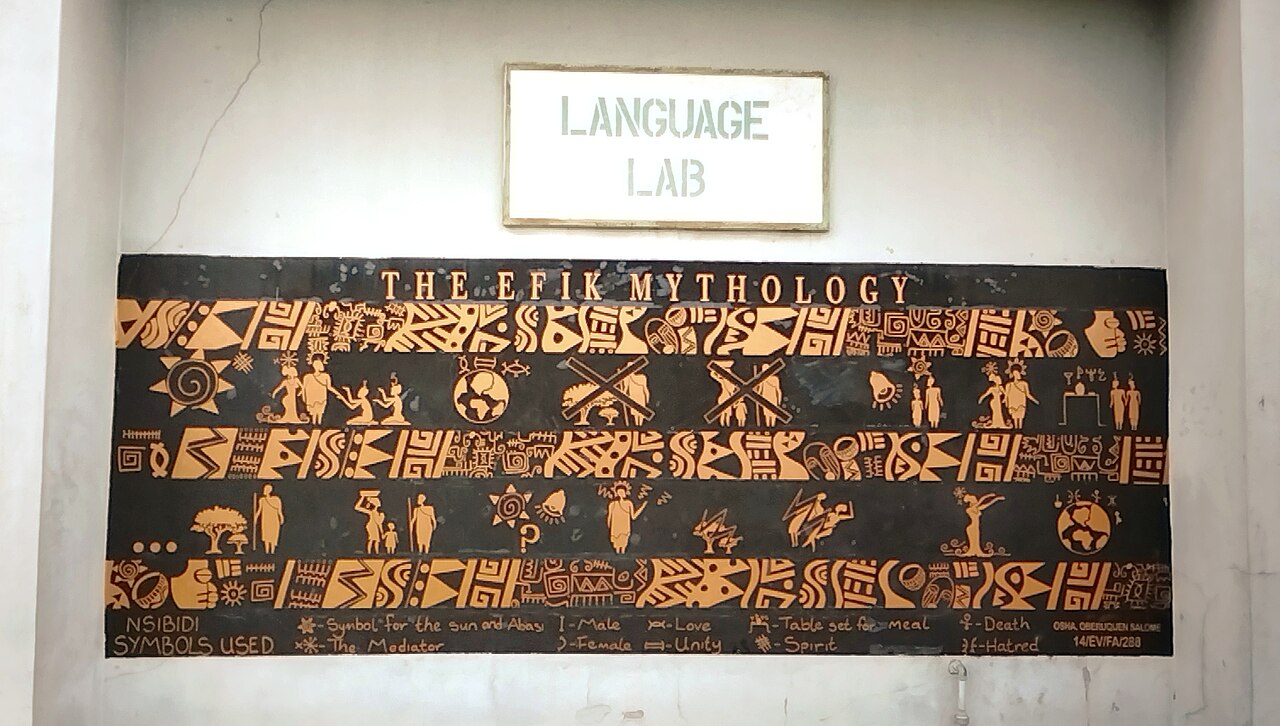
Perhaps the most visible revival is aesthetic. Nsibidi motifs appear in contemporary Nigerian fashion, graphic design, typography, and visual art. Artists draw on the script’s visual power — its bold lines, its compact symbolic density — to assert a modern African identity rooted in deep history. This is not nostalgia. It is the same move made by designers who adapt Adinkra symbols or Ge’ez letterforms: taking a living heritage and putting it to work in the present.
There is a tension worth naming here. Nsibidi was historically restricted knowledge, graded by initiation. Its broad modern use as a design language raises real questions about cultural ownership and respect for the Ekpe tradition. The most thoughtful revivalists acknowledge this, treating the script with the care it deserves rather than reducing it to decoration.
What Can the Nsibidi Script Teach Us?
The Nsibidi script is a corrective to a persistent myth: that Africa’s intellectual traditions were purely oral until outsiders arrived with alphabets. That myth was never true. From the Ge’ez manuscripts of the Ethiopian highlands to the Vai syllabary of Liberia to the Nsibidi signs of the Cross River, African societies developed and refined systems for recording thought, law, and memory.
Nsibidi’s particular lesson is about the relationship between writing and power. The script was powerful precisely because it was controlled — restricted to those who had earned access through initiation. That restriction preserved its depth but also made it vulnerable when the institutions that guarded it were attacked. The modern revival faces the opposite challenge: how to share a heritage widely without flattening it.
For the African diaspora and for anyone interested in the deep history of writing, Nsibidi offers something rare: a script that is simultaneously ancient and contemporary, ceremonial and personal, legal and lyrical. It is not a dead artifact awaiting decipherment. It is a living system with custodians, scholars, and artists actively shaping its future.
The Rosetta Stone of Africa: A Script That Refuses to Be Forgotten
The phrase “Rosetta Stone of Africa” is often used loosely, but in Nsibidi’s case it points at something real. The Rosetta Stone unlocked the meaning of Egyptian hieroglyphs by revealing that a civilization the world had reduced to mystery was in fact legible, literate, and articulate. Nsibidi does the same for the Cross River basin. It shows us a region that governed itself through written law, negotiated through written agreement, and courted through written affection — long before European alphabets arrived.
The work of full documentation and standardization is not finished. Unicode encoding remains a goal rather than an achievement. Many signs have yet to be systematically catalogued. The elders who hold the deepest knowledge are aging. But the trajectory is clear: Nsibidi is moving from the margins of colonial-era dismissal toward the center of a modern African cultural renaissance.
To read Nsibidi is to read a civilization that wrote its own story. The script was never lost. It was waiting — in meeting houses, on calabashes, in the memories of initiates — for the world to look closely enough to see it. That moment is now.