📅 Last updated: 20.09.2026
No one who has sat through an Ethiopian coffee ceremony forgets it. The green beans are washed, roasted over hot coals, pounded in a mukecha, and brewed in a clay jebena while frankincense drifts through the room — and the whole performance is repeated three times, cup by cup, until conversation has run its course. More than a way to drink coffee, the Ethiopian coffee ceremony is the country’s most enduring ritual of hospitality: a slow, deliberate act of welcome that can last two hours and is offered to strangers and heads of state alike.
Ethiopia is where Coffea arabica first grew wild, in the misty forests of the southwest. Today it is Africa’s largest coffee producer and the world’s fifth-largest, with roughly 5 million smallholder families depending on the crop. That a nation so economically bound to coffee has built an entire etiquette around serving it is no accident. The ceremony is both cultural inheritance and economic engine — a daily practice that keeps the country’s most important export woven into the fabric of ordinary life.
Origins: The Birthplace of Arabica
Arabica coffee’s genetic homeland is the Ethiopian highlands, particularly the forests of Kafa, Illubabor, and Bench Sheko in the southwest. Botanists treat these montane forests as the crop’s primary center of diversity: wild arabica populations there carry genetic variation found nowhere else on Earth, which is why seed banks and researchers from the Royal Botanic Gardens, Kew and elsewhere have spent decades collecting and cataloguing them.
The familiar legend — a goatherd named Kaldi noticing his goats dancing after eating red cherries — is folk etymology, not documented history, and Ethiopians themselves tell it with a wink. What is documented is that coffee was being consumed in the region long before it crossed the Red Sea. Sufi mystics in Yemen are often credited with popularizing the roasted, brewed drink in the 15th century, from where it spread to Cairo, Istanbul, and eventually Europe. But the plant, and the habit of gathering around it, began here.
That origin story matters commercially as well as culturally. Ethiopia’s coffee is overwhelmingly heirloom — thousands of undocumented local varieties rather than a handful of commercial cultivars. Regions such as Yirgacheffe, Sidama, Guji, Limu, and Harar have become shorthand for distinct flavor profiles, and the country’s Ethiopia Commodity Exchange, founded in 2008 in Addis Ababa, formalized how those lots are traded. The cup you drink in a ceremony in Jimma or Addis is not a generic blend; it is almost certainly traceable to a specific forest, cooperative, or washing station.
How the Ethiopian Coffee Ceremony Unfolds
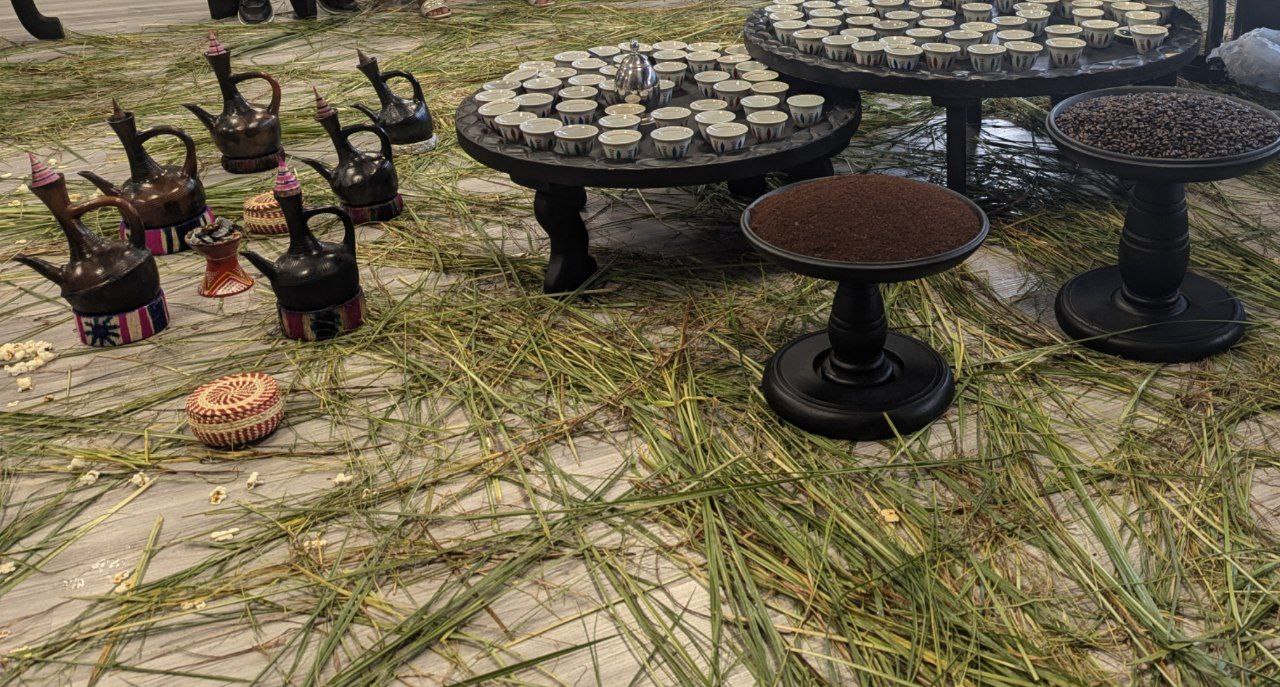
The ritual has a recognizable choreography, though details vary by region and household. Traditionally it is women who perform it — a role passed from mother to daughter — and it is typically staged in a corner of the living room on a bed of fresh grass or aromatic leaves. The full sequence, from green bean to final cup, generally runs like this:
- Preparation. Green coffee beans are spread on a tray and picked over by hand, removing stones and defective beans. Fresh grass or ketema leaves are laid on the floor, and incense — often frankincense or etana — is lit.
- Roasting. The beans go into a flat metal pan over hot coals or a small electric burner. The host shakes the pan constantly so the beans roast evenly, and when they darken and crack, the pan is carried around the room so each guest can wave the smoke toward their face and inhale the aroma.
- Grinding. Still warm, the beans are pounded in a wooden mortar (mukecha) with a pestle (zenezena). Some households now use electric grinders, but the mortar remains the ceremonial standard.
- Brewing. Water is boiled in the clay jebena, a long-necked pot with a spherical base and a narrow spout. Ground coffee is added, the pot is brought back to a boil, and the brew is allowed to settle.
- Serving. The host pours in one continuous stream from a height into small handleless cups (sini) arranged on a tray, moving the spout steadily so grounds stay behind. The first and most honored cup is offered to the eldest or most senior guest.
- Repetition. The grounds stay in the pot and more water is added for a second and third round — abol, tona, and baraka, the last meaning “blessing.”
Snacks accompany the cups: roasted barley or kolo, popcorn, sometimes bread or ambasha. The point is not efficiency. It is presence — the deliberate refusal to hurry a guest.
The Three Rounds: Abol, Tona, Baraka
The three-round structure is the ceremony’s spine, and each cup carries its own social weight. Abol is the first pour, the strongest and most concentrated; it is the cup of formal welcome. Tona is lighter and more relaxed, the point at which conversation loosens. Baraka — literally “blessing” in Amharic — is the final, weakest brew, and drinking it is considered a mark of respect and completion. Leaving before baraka can be read as a mild snub; staying through it signals that the relationship matters.
“Buna dabo naw” — a common Ethiopian saying meaning, roughly, “Coffee is our bread.” It captures how completely the drink is bound up with sustenance, sociability, and survival.
Across Ethiopia the rounds have local names and local customs. In parts of Oromia the ceremony is central to buna qalaa, a blessing rite tied to births, marriages, and reconciliation. In Harar, in the east, coffee is often roasted and chewed rather than brewed, and the city’s dense coffee houses operate on a rhythm of their own. In the Gurage highlands and among the Sidama, ceremony and ritual interlock even more tightly with community decision-making.
Beyond the Home: Coffee, Commerce, and Modernity
The ceremony is not a museum piece. It coexists with, and increasingly feeds, a modern coffee economy. Ethiopia’s annual production hovers around 7 to 8 million 60-kilogram bags in recent years, with roughly half exported — coffee remains the country’s single largest export earner, generating well over a billion dollars a year and supporting millions of livelihoods. Addis Ababa now has a specialty coffee scene that would feel familiar in Melbourne or Portland: roasters, pour-over bars, and cafés in neighborhoods like Bole and Kazanchis serve single-origin Yirgacheffe and Guji lots to a young, urban clientele.
That modernity sits alongside, rather than against, tradition. The same city hosts the annual Ethiopian Coffee Exchange auctions and a growing number of international cupping competitions, while a grandmother in the countryside still roasts over coals each morning. Coffee chains abroad have leaned on Ethiopian beans and imagery for years; within Ethiopia, the ceremony remains a point of pride and a marker of national identity that no export contract can dilute.
Timeline: Coffee in Ethiopia at a Glance
| Period | Milestone |
|---|---|
| Before the 15th century | Coffee grows wild in the southwestern highland forests; local communities consume the cherries and leaves. |
| 15th–16th century | Roasted and brewed coffee spreads via Yemen and the wider region; the drink becomes a social staple. |
| 19th–20th century | Coffee becomes a major cash crop and export; Harar and other regions gain international reputations. |
| 2008 | The Ethiopia Commodity Exchange is founded in Addis Ababa, modernizing how coffee is traded. |
| 2000s–present | Specialty coffee and traceable single-origin lots boost Ethiopia’s global standing; ceremony remains central to daily life. |
Variations Across Ethiopia’s Regions
Ethiopia is a federation of more than 80 ethnic groups, and the Ethiopian coffee ceremony reflects that diversity rather than flattening it. A few regional distinctions are worth knowing:
- Harar (east): Coffee is often roasted, chewed, or brewed with spices such as cardamom and cinnamon; the city’s coffee culture is dense and street-level.
- Oromia (central and south): The buna qalaa blessing ceremony is used at weddings, births, and to seal agreements; elders lead the pouring.
- Sidama and Gedeo (south): Coffee is deeply tied to lineage and land; harvest rituals and ceremonies overlap with the ceremony itself.
- Gurage (southwest): Elaborate hospitality customs; refusal of a cup can carry real social meaning.
- Addis Ababa and other cities: A hybrid form — electric roasters and modern cafés alongside the clay jebena, especially at holidays and family gatherings.
What unites these variations is the underlying logic: coffee is offered, not sold; the guest is served first; and time is given generously. In a country with a long history of hospitality as social insurance — where travelers once depended on the goodwill of strangers — that logic is not decorative. It is practical ethics.
The Ceremony in the Diaspora and the Wider World
Ethiopia’s diaspora, estimated at well over a million people, has carried the ceremony outward. In Washington, D.C. — home to one of the largest Ethiopian communities outside Africa, concentrated along the U Street and Shaw corridors — restaurants and community centers stage full ceremonies for holidays such as Enkutatash (New Year, in September) and Meskel (in late September). In London, Toronto, and Dubai, similar gatherings happen in homes and cultural associations. The ceremony has become a way of transmitting identity to second-generation children who may speak little Amharic.
Meanwhile, the ritual has entered global coffee culture as a kind of reference point. Baristas and roasters cite it when arguing for slower, more attentive service; documentary crews film it; and specialty importers use it to explain why Ethiopian coffee commands a premium. There is a risk in that — of reducing a living practice to a marketing aesthetic. The counterweight is that Ethiopians themselves continue to own and define it, on their own terms, every day.
What the Ceremony Teaches
Strip away the romance and the Ethiopian coffee ceremony is a set of instructions for how to treat another person: notice them, prepare something carefully for them, give them your time, and do it more than once. In an era of instant coffee and one-minute meetings, that is a quietly radical proposition.
It is also, for anyone visiting Ethiopia, the single easiest way to understand the country’s social contract. Accept the cup. Sit through all three rounds. Let the conversation wander. You will learn more about Ethiopia in two hours on a low stool than in a week of guided tours — and you will understand why, for millions of people, “coffee” and “welcome” are the same word.