📅 Last updated: 15.11.2026
The Kingdom of Kush was one of the great powers of the ancient Nile, ruling the river’s Third Cataract region for more than a thousand years and, for nearly a century, governing Egypt itself as its 25th Dynasty. Follow the river south from Aswan into modern Sudan and you enter the heartland of a civilization that built pyramids, traded with Rome, forged iron, and crowned kings and queens whose names still mark the landscape.
The Kingdom of Kush was an ancient Nubian state centred on the Nile Valley in what is now northern and central Sudan, flourishing from roughly 2500 BCE to 350 CE. Its major capitals were Kerma, Napata, and Meroë, and its kings of the 25th Dynasty ruled Egypt between about 747 and 656 BCE. Kush is recognised for its royal pyramids, ironworking at Meroë, a distinct script, and powerful queens known as kandakes.
- Where was the Kingdom of Kush, and why did the Nile shape it?
- Kerma, Napata, and Meroë: how did the Kingdom of Kush evolve?
- Who were the "Black Pharaohs" of the 25th Dynasty?
- What did the Kingdom of Kush build, and what did its pyramids look like?
- Why is Meroë famous for ironworking and its own script?
- How did the Kingdom of Kush interact with Egypt, Rome, and the wider world?
- What role did Kushite women play in politics and religion?
- Why is the Kingdom of Kush "forgotten," and how is it being remembered today?
- What does the Kingdom of Kush mean for Africa and the world today?
Where was the Kingdom of Kush, and why did the Nile shape it?
Kush occupied the Nile Valley between the First Cataract at Aswan and the Sixth Cataract near modern Khartoum. This stretch of river is punctuated by rapids that made navigation difficult but also created fertile floodplains, natural defensive lines, and access to gold, diorite, and copper. The region’s geography dictated its history: the narrow cultivated strip along the river supported dense populations, while the surrounding desert protected them and channelled trade through a handful of corridors.
Kush’s relationship with Egypt was never simple. Egyptian sources from the Old Kingdom refer to the land south of the First Cataract as Ta-Seti, “Land of the Bow,” and to its people as skilled archers. Egypt raided Nubia for gold, slaves, and exotic goods, and at times occupied it outright. But Kushite rulers absorbed Egyptian language, religion, and monumental architecture and then turned those tools to their own purposes. The result was a civilization that was neither a copy of Egypt nor a mere rival to it.
Modern archaeology places Kush’s origins firmly in the Nubian past. Excavations at Kerma, begun by George Reisner in the early twentieth century and continued by Swiss and Sudanese teams, revealed a substantial urban centre with huge mud-brick temples, royal tombs, and workshops dating back to around 2500 BCE. Kerma’s rulers were powerful enough to threaten Egyptian frontier forts during the Middle Kingdom, and the site’s great deffufa — a colossal mud-brick religious structure — still stands today.
Kerma, Napata, and Meroë: how did the Kingdom of Kush evolve?
Kush’s history is usually divided into three phases, each tied to a capital city. Understanding these phases clarifies how a Nubian state became an imperial power and then a distinct African civilization in its own right.
The Kerma period (c. 2500–1500 BCE)
Kerma was the first great Kushite centre. Its kings built monumental tombs and maintained trade networks reaching Egypt, the Red Sea coast, and possibly further south. Egyptian pharaohs of the Middle Kingdom constructed a chain of fortresses along the Second Cataract to contain Kerma’s influence, a sign of how seriously they took the threat. Around 1500 BCE, the New Kingdom pharaoh Thutmose I pushed south and brought Kush into the Egyptian empire for roughly five centuries.
The Napata period (c. 1000–590 BCE)
As Egyptian power waned in the late New Kingdom, a new Kushite dynasty emerged around Napata, near the sacred mountain of Jebel Barkal. Local rulers adopted Egyptian royal titles and burial customs, and by the eighth century BCE they were strong enough to intervene in Egyptian politics. This is the period of the 25th Dynasty, when Kushite kings ruled both lands and presided over a cultural revival in Egypt.
The Meroitic period (c. 590 BCE–350 CE)
After an Egyptian invasion under Psamtik II in 593 BCE, the Kushite court shifted its centre south to Meroë, between the Fifth and Sixth Cataracts. Here Kush developed a distinctive culture: its own script, its own artistic conventions, and an economy based on agriculture, trade, and iron production. Meroë endured for centuries, outlasting the Ptolemies and holding its own against Roman Egypt.
Who were the “Black Pharaohs” of the 25th Dynasty?
The Kushite kings who ruled Egypt are sometimes called the “Black Pharaohs,” a label that captures the visual record — Egyptian and Kushite art depicts them with dark skin and Nubian features — but the dynasty’s significance goes well beyond appearance. Between roughly 747 and 656 BCE, these rulers controlled an empire stretching from the Nile Delta to the confluence of the Blue and White Niles.
Kashta was the first Kushite king to extend influence into Upper Egypt. His successor Piye (also written Piankhy) campaigned north around 730 BCE and recorded his victory on a granite stela at Jebel Barkal. The stela, one of the great historical documents of ancient Africa, describes Piye’s conquest of Memphis and his dealings with local Egyptian princes, and it presents the Kushite king as a defender of Egyptian temple traditions.
Piye’s brother Shabaka consolidated control over the whole country and is credited with reviving Egyptian temple construction and religious practice. Taharqa, arguably the most famous of the dynasty, ruled for about twenty-six years and left monuments at Karnak, Kawa, and Jebel Barkal. He also appears in the Hebrew Bible: 2 Kings 19:9 refers to “Tirhakah king of Ethiopia” marching against the Assyrian king Sennacherib, a passage that places Kushite power on the wider Near Eastern stage.
The dynasty ended under pressure from Assyria. Taharqa’s successor Tantamani attempted to hold Egypt, but Assyrian campaigns under Ashurbanipal pushed the Kushites back south. By 656 BCE, Egyptian rule had passed to the Saite dynasty, and Kush’s political centre of gravity shifted permanently to Meroë.
What did the Kingdom of Kush build, and what did its pyramids look like?
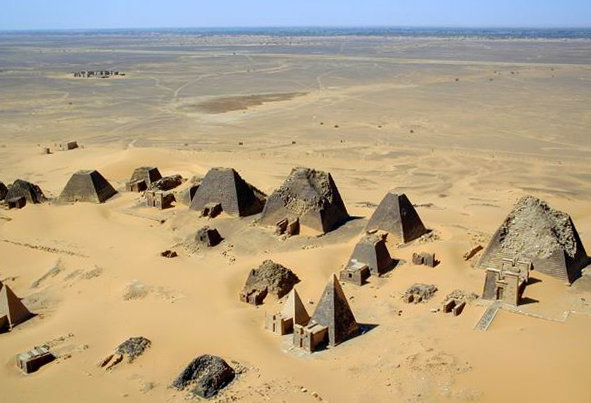
Kush left a monumental legacy that visitors can still walk among. The royal cemeteries at El-Kurru, Nuri, and Meroë contain hundreds of pyramids, more than Egypt itself. These structures are smaller and steeper than their Egyptian counterparts, with narrow bases and sharply angled sides, and many retain offering chapels and decorated burial chambers.
At Nuri, Taharqa’s pyramid is the largest Kushite pyramid ever built, though its superstructure has eroded. At Meroë, the Begrawiya cemetery contains dozens of royal tombs, some with reliefs depicting the deceased king or queen before deities. The site was inscribed on the UNESCO World Heritage List in 2011, alongside the nearby island of Meroë and the royal city.
Jebel Barkal, a sandstone butte near Napata, was considered the home of the god Amun in Kushite belief and became a major religious centre. Egyptian pharaohs of the New Kingdom had built temples there, and Kushite kings expanded them, adding their own monuments and inscriptions. The site, together with the Napatan region, was inscribed on the UNESCO World Heritage List in 2003.
- Royal pyramids: More than 200 Kushite pyramids survive at El-Kurru, Nuri, and Meroë.
- Temples: Major sanctuaries to Amun at Jebel Barkal, Kawa, and Meroë, several with Kushite inscriptions and reliefs.
- Palaces and baths: Excavations at Meroë have revealed royal buildings and a Roman-style bath complex, evidence of Mediterranean contact.
Why is Meroë famous for ironworking and its own script?
Meroë’s reputation rests partly on iron. Slag heaps and furnace remains around the city show that Kushite smiths produced iron on a significant scale, and scholars have debated whether Meroë was a major iron producer or a centre of iron consumption and craft. Either way, iron tools and weapons were part of the economy, and the technology connected Kush to wider African and Mediterranean networks.
Meroitic writing is one of the most intriguing aspects of Kush. The script has two forms — a hieroglyphic version used on monuments and a cursive version used in documents — and it remains only partly deciphered. The language itself is generally classified as an Eastern Sudanic language, related to modern Nubian languages, though the relationship is debated. Because the script has not been fully read, much of Meroitic literature, administration, and religion remains opaque to historians.
Kushite religion blended Egyptian and local traditions. Amun was the supreme deity, but Meroitic inscriptions and reliefs also show lion gods, the goddess Isis, and figures with distinctly Nubian iconography. The kandake — a title for a queen or queen mother — appears in classical sources as a marker of Kushite political culture, where royal women held substantial authority.
How did the Kingdom of Kush interact with Egypt, Rome, and the wider world?
Kush was never isolated. Its trade networks moved gold, ivory, ebony, ostrich feathers, and slaves north to Egypt and the Mediterranean, and brought back manufactured goods, wine, and luxury items. Kushite rulers used Egyptian artisans and Egyptian-trained scribes, and their monuments show a deliberate engagement with Egyptian models.
Relations with Rome were tense. In 25–24 BCE, a Kushite force under a kandake — usually identified as Amanirenas — attacked Roman Egypt, striking at Syene (Aswan) and Philae. The Roman prefect Gaius Petronius counterattacked and pushed as far as Napata before withdrawing. The conflict ended with a negotiated peace, and Kush and Rome maintained diplomatic and commercial ties for centuries. Strabo and other classical writers mention the kandake, indicating that Kushite queens were known in the Mediterranean world.
Kush’s decline is still debated. Possible factors include environmental change, shifts in trade routes, pressure from the rising kingdom of Aksum, and internal political fragmentation. By around 350 CE, Meroë had been abandoned as a royal capital, and the region passed into the hands of successor states, including the Nubian kingdoms of Nobatia, Makuria, and Alodia, which later adopted Christianity.
| Period | Capital | Key developments |
|---|---|---|
| c. 2500–1500 BCE | Kerma | First Kushite state; monumental mud-brick temples; trade with Egypt |
| c. 1500–1000 BCE | Napata region | Egyptian New Kingdom occupation; adoption of Egyptian religious and royal forms |
| c. 747–656 BCE | Napata | 25th Dynasty rules Egypt; Piye, Shabaka, Taharqa, Tantamani |
| c. 590 BCE–350 CE | Meroë | Meroitic script, ironworking, kandake queens, conflict and trade with Rome |
What role did Kushite women play in politics and religion?
Kushite queens and queen mothers appear in inscriptions, reliefs, and classical accounts with a prominence unusual for the ancient world. The title kandake was applied to royal women who could act as regents, co-rulers, or sole rulers. Amanirenas, who led the confrontation with Rome, is depicted on a bronze head found at Meroë — a portrait now in the British Museum — and her name appears in Strabo’s account of the conflict.
Other notable royal women include Shanakdakhete, who is shown on temple reliefs at Meroë in a kingly pose, and Amanishakheto, whose treasure of gold jewellery was discovered in her pyramid in the nineteenth century. These women were not exceptions to a male-dominated system so much as participants in a royal ideology that gave queens substantial religious and political authority.
Why is the Kingdom of Kush “forgotten,” and how is it being remembered today?
The “forgotten” label is partly a matter of Western historiography. Nineteenth- and early twentieth-century archaeology often treated Kush as an appendage of Egypt, and colonial-era scholarship sometimes downplayed or denied African contributions to ancient civilization. The result was a popular narrative in which Egypt was the sole great power of the Nile and Kush was a shadow.
That picture has changed. Sudanese archaeologists, working alongside international teams, have excavated Kerma, Jebel Barkal, Meroë, and dozens of other sites. UNESCO World Heritage listings in 2003 and 2011 brought wider attention. Museums in Khartoum, Boston, Berlin, and London hold major Kushite collections, and the Sudan National Museum in Khartoum displays material from Kerma and Meroë.
Contemporary Sudanese and diaspora scholars and artists have reclaimed Kush as a source of pride. The kingdom’s pyramids, its queens, and its script are now part of public conversations about African history that extend well beyond academic circles.
- Visit: Meroë’s Begrawiya pyramids and Jebel Barkal are accessible from Khartoum and Karima.
- Read: The Piye Victory Stela and Strabo’s account of the Roman-Kushite conflict are primary sources worth seeking out in translation.
- Follow: Sudanese archaeological missions and museum collections publish ongoing discoveries.
What does the Kingdom of Kush mean for Africa and the world today?
The Kingdom of Kush matters because it shows an African civilization shaping its own institutions, art, and writing while engaging with Egypt, the Mediterranean, and the wider Nile Valley on its own terms. Its kings ruled Egypt, its queens negotiated with Rome, and its smiths and scribes built a culture that lasted more than a millennium. That history belongs to Sudan, to Africa, and to anyone interested in how power and creativity have moved along the Nile.
The next time the pyramids of Giza dominate a conversation about ancient Africa, remember the steeper pyramids at Meroë, the kandake who faced a Roman legion, and the script that still waits to be fully read. The Kingdom of Kush was not a footnote to Egypt. It was a Nile empire in its own right, and its story is still being told.