📅 Last updated: 27.09.2026
The wildebeest migration is the largest overland movement of large mammals on Earth — roughly 1.3 million blue wildebeest, joined by some 200,000 zebras and 400,000 Thomson’s gazelles, walking a closed loop of about 1,800 kilometres through the Serengeti–Mara ecosystem each year. It is not a single event you can book a ticket for, like a concert; it is a rolling, weather-driven phenomenon that never truly stops. What follows is a practical and honest guide to seeing it well — where to go, when to be there, how to read the rains, and how to travel in a way that leaves the ecosystem better off.
- What the Wildebeest Migration Actually Is
- When to Go: A Month-by-Month Guide to the Wildebeest Migration
- Where to Go: The Serengeti and the Maasai Mara
- How to Plan a Wildebeest Migration Safari
- Beyond the Herds: What Else You Will See
- How to Watch Responsibly
- Practical Logistics: Getting There and Getting Around
- Why This Journey Matters
What the Wildebeest Migration Actually Is
The herds move in a great clockwise circuit between Tanzania’s Serengeti National Park and Kenya’s Maasai Mara National Reserve, chasing green grass and fresh water across a landscape of roughly 25,000 square kilometres. The engine of the whole system is rain. The Serengeti’s short rains fall around November and December, and its long rains from roughly March to May. The wildebeest follow the new growth that follows each downpour, because short, sweet grass is what a wildebeest needs: their mouths are built for close cropping, and they give birth in a synchronised, three-week explosion of calves that overwhelms predators by sheer numbers.
It helps to understand that the migration is a cycle with no beginning. Calving in the southern Serengeti in February, the long march west and north through the Grumeti and Mara River systems from May to August, the crossing into Kenya’s Maasai Mara, and the return south with the short rains in November — each stage flows into the next. The animals are not migrating “to” anywhere in particular. They are following a moving resource, and the resource moves with the weather.
The scale is hard to absorb. Around 250,000 wildebeest die each year — of thirst, hunger, exhaustion, drowning, and predation — and around 400,000 to 500,000 calves are born. The population is roughly stable, which means the losses and the births are, in a brutal sense, balanced. The migration is not a spectacle laid on for visitors; it is a functioning ecosystem doing exactly what it has done for a very long time.
When to Go: A Month-by-Month Guide to the Wildebeest Migration
There is no single “best” month. There is only the month that matches the stage you want to see. The table below is the honest summary most operators use.
| Period | Where the herds are | What you are likely to see |
|---|---|---|
| January–March | Southern Serengeti and the Ngorongoro Conservation Area plains | Calving season; huge concentrations; predator activity peaks |
| April–May | Central and western Serengeti | The “long rains” move; herds spread out; low-season prices |
| June–July | Western corridor and Grumeti River | Grumeti River crossings; crocodiles; mating season begins |
| August–October | Northern Serengeti and the Maasai Mara | Mara River crossings; the classic “migration” image |
| November–December | Returning south through the eastern Serengeti | Short rains; herds on the move again; quieter parks |
Two warnings. First, the dates shift by two to four weeks in either direction depending on rainfall, so a booking made a year in advance is always a bet on the weather. Second, the famous river crossings are not scheduled. Herds may gather on a bank for three days and then turn away. Guides who promise a crossing on a specific date are selling you a story, not a guarantee.
Calving Season: The Overlooked Highlight
If you can travel in February, do. The southern Serengeti’s short-grass plains turn into a nursery, and the synchronised births — most calves arrive within a three-week window — draw in lions, cheetahs, leopards, and hyenas in numbers that make the river crossings look almost tame by comparison. It is also the least crowded time to be in the Serengeti, and the light in the Rift Valley highlands is extraordinary.
The River Crossings: What They Are Really Like
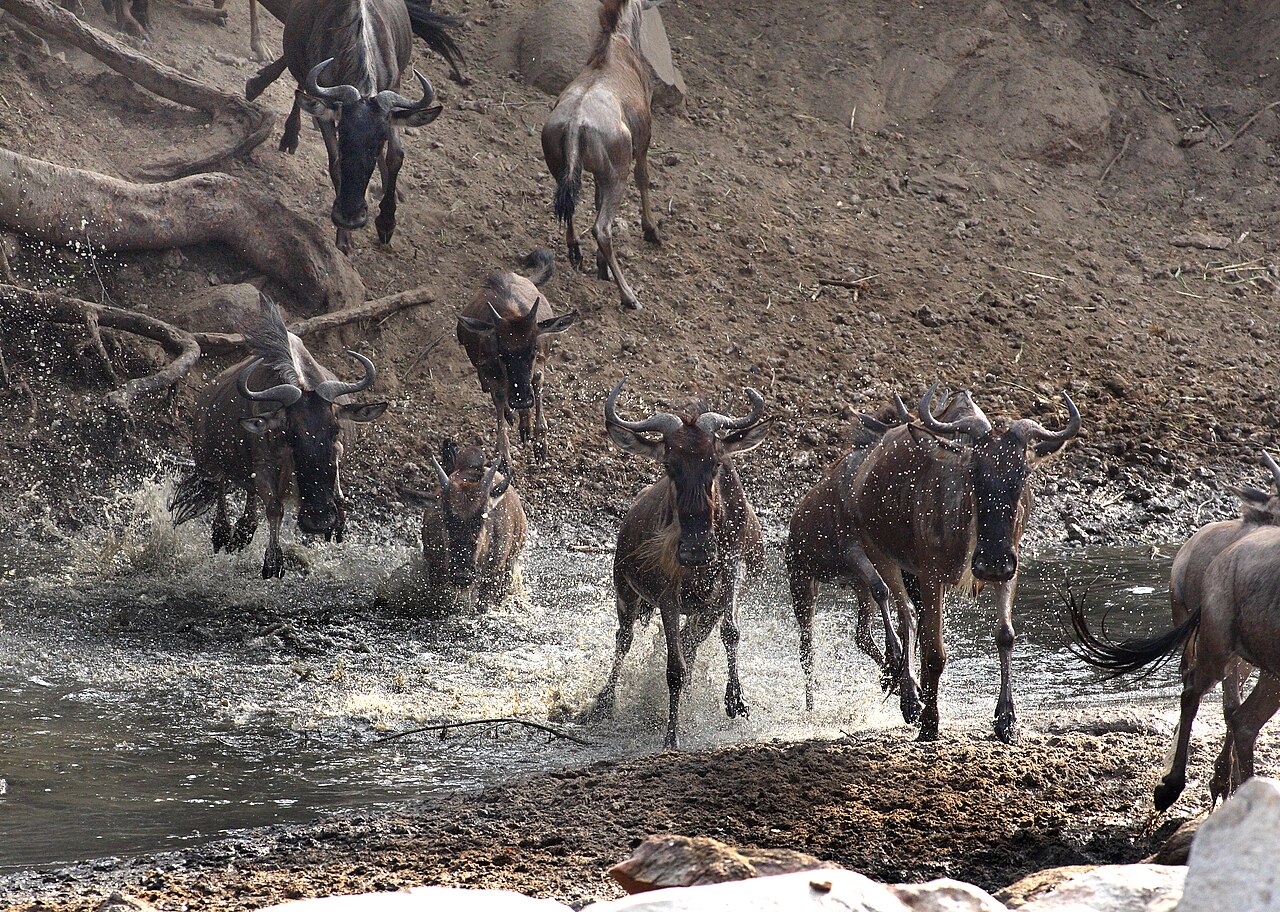
The Mara River crossings, between roughly late July and early October, are the images everyone has seen. In reality, a crossing is chaotic, loud, and often brief. Wildebeest pile up at the water’s edge, hesitate, turn back, and then — for reasons no one fully understands — a few plunge in and the herd follows. Crocodiles take some; the current takes more; the survivors climb the far bank and keep walking. It is not sentimental, and it is not a show. It is one of the great raw events on the planet, and it is worth the patience it demands.
Where to Go: The Serengeti and the Maasai Mara
Almost all of the wildebeest migration happens inside two protected areas and the corridors between them. Understanding the geography is the single most useful thing you can do before booking.
Tanzania: The Serengeti
The Serengeti National Park covers about 14,750 square kilometres and, together with the adjoining Ngorongoro Conservation Area, Maswa Game Reserve, and the Grumeti and Ikorongo reserves, forms a protected complex of around 30,000 square kilometres. It is a UNESCO World Heritage Site. The park divides into recognisable zones:
- Southern plains (Ndutu area): the calving grounds, best from January to March.
- Central Serengeti (Seronera): reliable year-round game viewing because of permanent water; resident predators.
- Western corridor: the Grumeti River and its crossing points, roughly May to July.
- Northern Serengeti (Kogatende, Lamai Wedge): the Mara River and the main crossing points, roughly July to October.
- Eastern Serengeti: the return route in November and December.
The Tanzanian side is vast and, outside the central Seronera area, genuinely wild. A mobile camp that moves with the herds is the classic way to follow the migration, and it is the approach that most rewards the traveller who wants to be in the right place rather than merely near it.
Kenya: The Maasai Mara
The Maasai Mara National Reserve covers about 1,510 square kilometres and adjoins a patchwork of conservancies — Mara North, Olare Motorogi, Naboisho, Ol Kinyei, and others — that together roughly double the protected area available to wildlife. The Mara is smaller and busier than the Serengeti, and during the peak crossing season some riverbank viewpoints can hold dozens of vehicles. The conservancies are the answer: they limit vehicle numbers, allow walking and night drives, and are owned or leased in partnership with Maasai landowners, who receive lease fees and tourism income directly. Choosing a conservancy is both a better wildlife experience and a more equitable one.
How to Plan a Wildebeest Migration Safari
The single biggest mistake first-time visitors make is booking a fixed camp in a fixed place and hoping the herds come to them. They might — or they might be 200 kilometres away. Build the trip around movement.
Choose a Mobile Camp or a Strategic Base
Mobile camps relocate two or three times a season to follow the herds, which is why they cost more and sell out earlier. If you prefer a fixed lodge, pick one with access to two or three zones — for example, a camp in the northern Serengeti that can also reach the Lamai Wedge — and accept that you may drive several hours on some days.
Budget Realistically
Peak-season (July–October) safaris in the Serengeti or Mara typically run from about US$500 to US$1,500 per person per day for mid-range to high-end lodges, with ultra-luxury camps well above that. The green season (April–May) can be 30 to 50 per cent cheaper, and it is beautiful — but the herds are scattered and the roads are muddy. Flights between Seronera, Kogatende, and the Mara’s airstrips are the usual way to reposition quickly; a light-aircraft hop from Kogatende to the Mara takes under an hour.
Book Early and Build in Flexibility
Prime mobile camps in the northern Serengeti and the Mara conservancies are often fully booked 12 to 18 months ahead for August and September. Book early, but hold your itinerary loosely: a good operator will adjust your route mid-trip if the herds shift.
What to Pack
- Neutral-coloured layers; mornings on the plains can be near freezing and afternoons hot.
- Binoculars — 8×42 or 10×42 — and a camera with a 200–400mm lens for predators at distance.
- A dust-proof bag for electronics; the Serengeti’s volcanic dust gets into everything.
- Yellow fever vaccination certificate if arriving from a yellow fever zone; check current requirements for Tanzania and Kenya.
- Anti-malarial prophylaxis, arranged with a travel clinic before departure.
Beyond the Herds: What Else You Will See
The migration is the headline, but the ecosystem around it is the story. The Serengeti–Mara holds one of the densest predator populations on Earth: roughly 3,000 lions, several hundred cheetahs, and leopards in the riverine forest along the Grumeti, Mara, and Seronera rivers. Spotted hyenas are everywhere and are, by biomass, the most successful large carnivore in the ecosystem. Elephants move through the western corridor and the Mara; giraffes, topi, eland, and Grant’s gazelles fill the gaps between the wildebeest columns.
Birdlife is exceptional: more than 500 recorded species in the Serengeti, including the odd-looking secretary bird, kori bustards, and huge flocks of lesser flamingos on the soda lakes of the nearby Rift Valley. And the human story matters too. The Maasai have lived alongside this landscape for centuries, and the name “Serengeti” itself comes from the Maa word siringet, meaning “the place where the land runs on forever.” Visiting responsibly — hiring Maasai guides, staying in community-owned conservancies, buying from local artisans — keeps tourism revenue where it belongs.
“The migration is not a wildlife spectacle. It is the pulse of an ecosystem that has been beating for millennia — and the reason we can still see it is that people chose to protect it.”
How to Watch Responsibly
The wildebeest migration draws hundreds of thousands of visitors a year, and that pressure has consequences. Tanzania and Kenya both enforce rules — vehicles must stay on designated tracks in most areas, off-road driving is banned in the Serengeti, and there are limits on how many vehicles may approach a sighting — but enforcement varies. Your own behaviour matters.
- Keep a respectful distance from riverbanks during crossings; crowding the herd can cause fatal stampedes.
- Never ask a guide to drive off-track for a better photo, and never pressure one to break a park rule.
- Support camps that employ local staff, buy from local suppliers, and pay fair wages.
- Choose conservancies over the busiest reserve zones where you can; you will see more and disturb less.
- Consider carbon offsetting for long-haul flights, and combine a safari with a longer stay rather than a quick fly-in.
There are real threats to this system, and it is worth knowing them. Habitat fragmentation outside protected areas, poaching for bushmeat, climate variability that disrupts the rains, and the pressure of a growing human population around the ecosystem’s edges all matter. The good news is that tourism, done well, funds anti-poaching units, community conservancies, and research. The Serengeti and Mara are among the best-protected landscapes in Africa, and they are not static museums — they are working conservation projects you are helping to fund.
Practical Logistics: Getting There and Getting Around
Most travellers fly into Kilimanjaro International Airport (JRO) near Arusha for the Tanzanian side, or Jomo Kenyatta International Airport (NBO) in Nairobi for the Kenyan side. Many combine both: a northern circuit safari in Tanzania, a hop across the border at Kogatende or the Mara, and a few days in the Maasai Mara before flying back to Nairobi.
Within the ecosystem, light aircraft connect Seronera, Kogatende, Ndutu, and the Mara airstrips. Road transfers between the central Serengeti and the northern Serengeti take six to eight hours in the dry season and considerably longer after rain. If your time is limited, fly. If your budget is limited, accept longer drives and build in a buffer day.
Visas are straightforward for most nationalities: Tanzania offers e-visas and visa-on-arrival for many countries, and Kenya moved to an electronic travel authorisation system. Check current requirements before you travel, and make sure your passport has at least six months’ validity.
A Note on Health and Safety
The usual precautions apply. Take anti-malarials, use mosquito nets where provided, drink bottled or filtered water, and carry a basic medical kit. Wildlife is genuinely dangerous if you leave a vehicle without permission — follow your guide’s instructions without debate. And travel insurance that covers medical evacuation by air is not optional on a safari; it is essential.
Why This Journey Matters
Seeing the wildebeest migration is not really about ticking off a spectacle. It is about standing on a plain at dawn, watching a column of animals that stretches to the horizon, and understanding that you are looking at one of the last places on Earth where a system this large still functions on its own terms. The herds do not know they are a wonder. They are simply following the rain, as their ancestors did, and as their descendants will, if we let them.
Go in the right season, with a guide who knows the land, and with enough time to be patient. The crossing you miss will be replaced by a calving ground, a lion hunt at dusk, or a sky full of stars over the Serengeti. The migration rewards the traveller who comes to witness rather than to collect — and that, in the end, is the only way to see it properly.