📅 Last updated: 27.09.2026
The story of writing in West Africa is far older and stranger than most textbooks admit, and few chapters are as misunderstood as the Nsibidi script. Long before European missionaries arrived with the Latin alphabet, communities in the Cross River region of what is now southeastern Nigeria were pressing signs into calabash, drawing them on walls, and painting them on the bodies of dancers. These were not idle doodles. They were a working graphic system, tied to a secret society, a judicial order, and a spiritual world that outsiders were never meant to read.
- What Exactly Is the Nsibidi Script?
- The Ekpe Society and the Politics of Secrecy
- Nsibidi Script and the Igbo Question
- A Timeline of a Script
- Reading the Signs: How the System Works
- Colonial Encounters and the Fight Over Memory
- Nsibidi Script Today: Revival, Art, and the Digital Turn
- Why Nsibidi Still Matters
- Carrying the Signs Forward
Yet even the name of the article you are reading — Njere — carries a quiet complication. In some Igbo communities, njere or nji refers to the coded signs used by titled men and women, a form of symbolic literacy passed down through initiation. The question of whether Nsibidi is “Igbo writing” or something broader, older, and more tangled is precisely what makes it fascinating. To understand it, you have to leave behind the idea that writing must look like a line of letters marching across a page.
What Exactly Is the Nsibidi Script?
Nsibidi is a system of graphic symbols used historically across the Cross River basin, in an area that spans parts of present-day Cross River State and Akwa Ibom State in Nigeria, and reaching into western Cameroon. The name itself is usually traced to the Ekoid languages, where nsibidi is linked to the idea of being “cruel,” “bloody,” or associated with the leopard — a predator that appears constantly in the visual vocabulary. The leopards, snakes, lizards, and human figures you find in Nsibidi are not decoration. They are concepts.
Unlike the Latin alphabet, Nsibidi is not strictly phonetic. It is what linguists call a semasiographic or partly logographic system — meaning many symbols stand for whole ideas, objects, or actions rather than individual sounds. A symbol might mean “leopard,” but depending on context it could also signal authority, danger, or a specific titled rank. This is why Nsibidi could be understood across communities that spoke entirely different languages. An Efik speaker and an Igbo speaker could, in principle, read the same sign and grasp its meaning even if they could not speak a word to each other.
That cross-linguistic quality is the system’s genius and also its mystery. Nsibidi was never a mass alphabet taught in schools. It was guarded knowledge, controlled by the Ekpe (also called Egbo or Mgbe) leopard society and by other title-holding associations. To read Nsibidi fluently was to hold power — legal, spiritual, and political.
The Ekpe Society and the Politics of Secrecy
To understand Nsibidi, you have to understand Ekpe. The Ekpe society was a powerful fraternal order that spread through the Cross River region and into the Cameroonian grassfields, where it became known as Ngbe. Among the Efik, the Ejagham, the Igbo communities of the Arochukwu area, and the peoples of the Calabar hinterland, Ekpe functioned as a kind of government, court, and police force rolled into one.
Ekpe graded its members into ranks, each with its own signs, dances, and privileges. Nsibidi was the written language of those ranks. A low-ranking member might recognize a handful of signs; a senior member could compose messages, record disputes, and issue judgments in the script. The famous Ekpe “writing” on the walls of meeting houses in Calabar and in villages around the Cross River was not graffiti. It was a public record that only the initiated could fully decipher.
How Nsibidi Was Actually Used
This is where the system becomes concrete and vivid. Nsibidi was not confined to secret documents. It lived in the open, in plain sight of people who simply could not read it.
- On the body: Nsibidi signs were painted or tattooed on dancers during Ekpe ceremonies, turning the human form into a moving text.
- On architecture: The walls of Ekpe houses, shrines, and compounds were covered in symbols, some announcing the rank of the owner, others recording events.
- On objects: Calabashes, brass staffs, drums, and ceremonial swords carried inscribed signs.
- In law: Disputes were sometimes recorded in Nsibidi, and messages could be sent between communities in the script, much like a legal telegram.
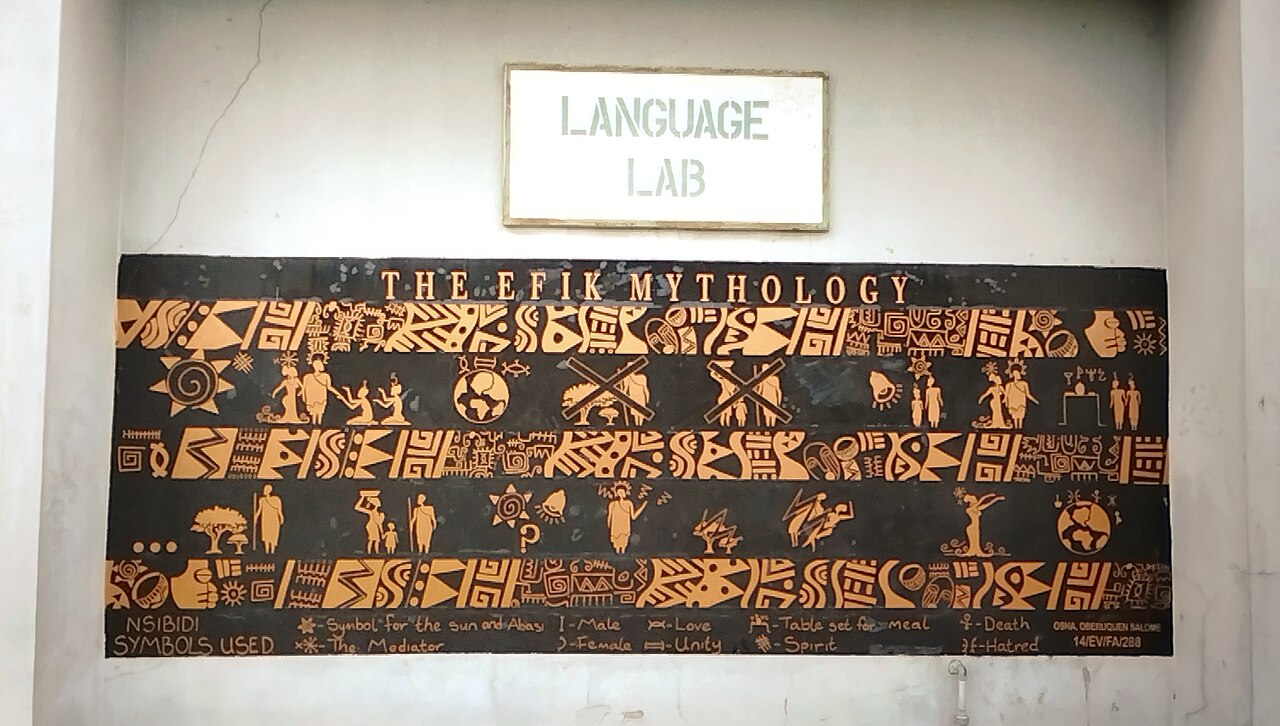
- On cloth: Ukara cloth, the indigo-dyed fabric worn by Ekpe members, is covered in Nsibidi motifs — a wearable archive of rank and meaning.
The Ukara cloth deserves special mention. Woven and dyed in the Cross River region, it is one of the most striking surviving expressions of Nsibidi as a living art. Each motif carries meaning, and the cloth is still made and worn today, particularly among Efik and Ejagham communities. It has also been embraced by contemporary Nigerian artists and fashion designers, who treat it as a bridge between ancient sign-making and modern design.
Nsibidi Script and the Igbo Question
Here is where the story gets politically charged. In the 20th century, as Igbo cultural nationalism grew — especially around the Biafran period and in its aftermath — Nsibidi was sometimes claimed as “the ancient Igbo writing system.” That framing is understandable but not entirely accurate. Nsibidi belongs first and foremost to the Ekpe cultural sphere, which is multi-ethnic. The Ejagham are often credited as its originators, and the Efik, Ibibio, and Igbo communities of the Cross River hinterland adopted and adapted it.
That said, Igbo communities were deeply involved. The Arochukwu people, whose long-distance trade networks shaped much of southeastern Nigeria, used Ekpe and Nsibidi in their operations. And there are genuinely Igbo graphic traditions worth naming. The Nwagu Aneke script, developed in the 20th century in Umuleri, Anambra State, is a distinct invention — a syllabary created by a man named Nwagu Aneke, not a survival of Nsibidi. It shows that the impulse to write did not disappear from Igbo life; it kept re-emerging in new forms.
So when people ask whether “Njere” or Nsibidi is Igbo writing, the honest answer is: it is a writing tradition of the region, shared across ethnic lines, and Igbo speakers were among its custodians. Reducing it to a single ethnic label flattens a genuinely cosmopolitan system.
A Timeline of a Script
Dating Nsibidi is difficult because the symbols were drawn on perishable materials — wood, cloth, skin, and earth — that rarely survive. But historians and archaeologists have assembled a rough chronology from colonial records, oral history, and surviving objects.
| Period | Development |
|---|---|
| Pre-1500s | Graphic symbols develop within Ekpe/Ejagham ritual traditions in the Cross River basin; meanings tied to leopard society ranks. |
| 1600s–1800s | Nsibidi spreads through Efik, Ibibio, and Igbo communities; used in trade, law, and ceremony; Calabar becomes a major hub. |
| Late 1800s | European missionaries and colonial officials document Nsibidi, often mislabeling it as “secret society code” or mere ornament. |
| 1900s | Colonial administration and Christianity weaken Ekpe’s political power; Nsibidi use declines in official life but survives in ritual and art. |
| 2000s–present | Renewed scholarly and artistic interest; Ukara cloth, museum collections, and digital archives bring Nsibidi to global attention. |
Notice what the timeline reveals: Nsibidi did not die a natural death. It was pushed aside by a specific historical process — colonialism, which replaced indigenous legal systems with European courts and indigenous scripts with the Latin alphabet. That is a crucial distinction. The script was not “primitive” and outgrown; it was displaced.
Reading the Signs: How the System Works
Nsibidi symbols fall into recognizable families. There are signs based on animals, on human figures and body parts, on objects like drums and guns, and on abstract geometric forms. Some signs are iconic — a drawing of a leopard looks like a leopard. Others are arbitrary, their meaning learned only through initiation.
Scholars have noted that Nsibidi has both a “public” and a “secret” layer. Public signs might mark a boundary or identify a titled person. Secret signs could convey messages meant only for senior Ekpe members, including warnings, summons, or judgments. This layered quality is what makes Nsibidi so hard to translate. There is no single Nsibidi dictionary that captures every meaning, because meaning depended on rank, context, and community.
Why It Wasn’t a Full Alphabet
A common misconception is that Nsibidi was an alphabet that simply “wasn’t finished.” That misunderstands its purpose. Nsibidi did not need to record every spoken word, because it was not designed for literature or bureaucracy in the European sense. It was designed for ritual, law, and elite communication. Its power came partly from its incompleteness — from the fact that not everyone could read it.
“Nsibidi was not a failed alphabet. It was a successful instrument of power, and it worked precisely because it was not for everyone.”
Compare it to other non-alphabetic systems around the world: Chinese characters, Egyptian hieroglyphs, or the quipu of the Andes. None of them are “incomplete.” They are simply built for different jobs. Judging Nsibidi by the standard of the Latin alphabet is like judging a violin by how well it works as a hammer.
Colonial Encounters and the Fight Over Memory
European contact with Nsibidi began in earnest in the 19th century. Missionaries in Calabar, including figures associated with the Scottish Presbyterian mission, encountered Ekpe houses covered in signs. Some dismissed them as superstition. Others were intrigued. Colonial administrators, wary of Ekpe’s authority, worked to dismantle the society’s legal power — and with it, the everyday need for Nsibidi.
By the early 20th century, British colonial rule had restructured courts, schools, and administration around English. Children learned to read and write in Latin script. Nsibidi retreated into ceremony, into the making of Ukara cloth, and into the memories of titled elders. Museums in Europe acquired Nsibidi-inscribed objects, often stripped of their context. Today, some of the best-documented Nsibidi collections sit in institutions far from the communities that created them.
This is a familiar African story: a knowledge system displaced, its artifacts exported, its meaning explained by outsiders. But the story does not end there. In recent decades, Nigerian scholars, artists, and cultural institutions have begun reclaiming Nsibidi — not as a curiosity, but as living heritage.
Nsibidi Script Today: Revival, Art, and the Digital Turn
Walk through Calabar today and you will still find Nsibidi. It appears in the design of the city’s cultural festivals, in the work of contemporary artists, and on Ukara cloth sold in markets and galleries. The Calabar Carnival, one of Africa’s largest street festivals, has featured Nsibidi motifs, connecting the script to a modern, globalized celebration of Cross River identity.
Artists have been particularly important. Nigerian and diaspora creatives have used Nsibidi signs in painting, sculpture, textile design, and graphic work, treating them as a visual language that can speak across generations. Fashion designers have incorporated Ukara patterns into contemporary clothing, sending ancient signs down international runways.
There is also a digital dimension. Independent researchers and cultural technologists have begun digitizing Nsibidi symbols, building online archives and fonts, and discussing how the script might be encoded for computers. This raises fascinating questions: Can a semasiographic system be standardized without losing its layered, context-dependent meaning? Should it be? The answers are not obvious, and that is part of what makes the revival intellectually alive.
What a Revival Should — and Shouldn’t — Do
Revival carries risks. If Nsibidi is flattened into a decorative pattern, stripped of its Ekpe roots and its ritual weight, it becomes just another motif. If it is over-claimed by a single ethnic group, it loses its cross-cultural richness. The most respectful path is one that acknowledges its origins in the Ekpe societies of the Cross River region, honors the Ejagham, Efik, Ibibio, and Igbo communities that carried it, and supports the people who still hold its knowledge.
- Do credit the Ekpe society and Cross River communities as its source.
- Do support living practitioners and cultural institutions in the region.
- Do treat it as a knowledge system, not just a design trend.
- Don’t reduce it to a single ethnic label or a colonial-era curiosity.
- Don’t separate the symbols from the meanings that give them power.
Why Nsibidi Still Matters
The significance of Nsibidi goes far beyond Nigeria. It is a reminder that writing is not a single invention that spread from one place, but a human capacity that emerges wherever people need to record, remember, and rule. Africa has produced multiple scripts — Ge’ez in Ethiopia, Tifinagh among the Amazigh, Meroitic in ancient Nubia, Vai in Liberia, and Nsibidi in the Cross River. Each one tells a different story about how power, memory, and language intersect.
Nsibidi also challenges a lazy assumption that still lingers in some corners: that pre-colonial Africa was “oral” and therefore had no writing. That assumption is wrong, and Nsibidi is one of the clearest rebuttals. It was not an alphabet, but it was writing — used in law, in ceremony, in trade, and in art. It did the work that writing does: it made meaning visible and durable.
Perhaps most importantly, Nsibidi is not frozen in the past. It is being taught, drawn, worn, digitized, and debated right now. That living quality is the strongest argument for its importance. A script that people still care enough to argue about is a script that is not dead.
Carrying the Signs Forward
If there is one takeaway from the long story of Nsibidi, it is that literacy has many forms, and power has many scripts. The Ekpe leopard society understood something that modern institutions often forget: that writing is not neutral. It is a technology of authority, and whoever controls it controls a piece of the world.
For readers in the African diaspora and beyond, Nsibidi offers a chance to look past the colonial archive and see a sophisticated intellectual tradition that was never waiting to be “discovered.” It was already there — on walls, on cloth, on skin — speaking to those who had earned the right to listen. The work now is not to invent a lost script, but to remember a living one, and to make sure the communities that kept it are the ones who shape its future. Whether we call it Nsibidi, Njere, or simply one of Africa’s many writing systems, the signs are still there, waiting to be read.