📅 Last updated: 29.09.2026
Ile-Ife sits in the heart of southwestern Nigeria, in Osun State, and it is unlike any other town in Africa. For the Yoruba — one of the continent’s largest ethnic groups, numbering tens of millions across Nigeria, Benin, Togo, and the global diaspora — this is not merely an ancient city. It is the place where the world itself began, where the first dawn broke, and where every Yoruba person’s ancestry ultimately traces back. To understand Ile-Ife is to understand how a city can be simultaneously a living urban community, a UNESCO-recognised archaeological treasure, and the spiritual capital of a civilisation that has shaped music, religion, and art across the Atlantic world.
- Why Ile-Ife Matters: The Spiritual Capital of the Yoruba
- The Origins: Oduduwa, Creation, and the Sixteen Kingdoms
- Ile-Ife's Golden Age: Art, Trade, and Urban Sophistication
- Key Dates and Landmarks: A Timeline of Ile-Ife
- Ile-Ife's Living Culture: Festivals, Deities, and Daily Life
- Ile-Ife and the Global Yoruba Diaspora
- Preserving the Legacy: Challenges and Opportunities
- Conclusion: Why Ile-Ife Still Matters
Why Ile-Ife Matters: The Spiritual Capital of the Yoruba
The Yoruba name Ilé-Ifẹ̀ translates roughly as “the house of expansion” or “the place that spreads” — a fitting name for a city whose cultural influence has radiated across continents. In Yoruba cosmology, Ile-Ife is ilé-ìbù, the cradle of existence. It is the spot where Oduduwa, the progenitor of the Yoruba people, descended from the heavens on a chain, carrying a rooster, a calabash of sand, and a palm nut. He scattered the sand, the rooster scratched it into land, and the palm grew into a tree with sixteen branches — the sixteen original kingdoms of Yorubaland.
This is not just mythology to the roughly 40 million Yoruba people worldwide. It is living history, recited by babalawo (Ifá priests) in elaborate oral verses called odù Ifá, some of which number in the thousands of lines. The city remains the seat of the Ooni of Ife, a monarch whose title predates the British colonial era by centuries and who is regarded as the spiritual head of all Yoruba people, regardless of which modern nation they call home.
What makes Ile-Ife remarkable is that the sacred and the everyday coexist. On the same streets where market women sell efo riro and amala, you’ll find groves dedicated to Òrìṣà deities, ancient palace walls, and archaeological sites that have yielded some of the most sophisticated art ever produced in sub-Saharan Africa.
The Origins: Oduduwa, Creation, and the Sixteen Kingdoms
The Oduduwa Narrative
The central origin story of the Yoruba holds that Olodumare, the supreme creator, sent Oduduwa to establish dry land on a watery earth. Other versions say Oduduwa was a prince from the east — some traditions point to Mecca, others to ancient Egypt or Nubia — who migrated south and founded the city. Scholars have debated these origins for over a century, and the debate itself reflects how deeply Yoruba identity is tied to this single city.
What is historically verifiable is that Ile-Ife was a thriving urban centre by the 8th to 10th centuries CE, with evidence of iron smelting, glass-making, and a complex social hierarchy. Radiocarbon dates from archaeological layers at sites like Woye Asiri and Ita Yemoo confirm occupation and craft production stretching back over a millennium.
The Sixteen Sons and the Spread of Yorubaland
According to tradition, Oduduwa had sixteen sons and grandsons who went on to found the major Yoruba kingdoms. Among them:
- Oranmiyan, who founded the Oyo Empire and the Benin Kingdom’s second dynasty — linking the Yoruba and Edo peoples forever.
- Ojugbelu, ancestor of the rulers of Ila-Orangun.
- Alara, founder of the kingdom of Ara.
- Ajibogun, who established Ilesa.
- Onisabe, linked to the Sabe kingdom.
This genealogical framework means that for centuries, Yoruba kings across the region — from the Alaafin of Oyo to the Owa of Ilesa — traced their legitimacy back to Ile-Ife. Even today, new kings in Yorubaland often send emissaries to the Ooni for spiritual validation.
Ile-Ife’s Golden Age: Art, Trade, and Urban Sophistication
Between roughly the 11th and 15th centuries, Ile-Ife reached a cultural and artistic peak that still astonishes historians. The city was a major node in trans-Saharan and regional trade networks, connected to the Sahel, the Niger Bend, and the forest kingdoms to the south.
The Ife Bronzes and Terracottas
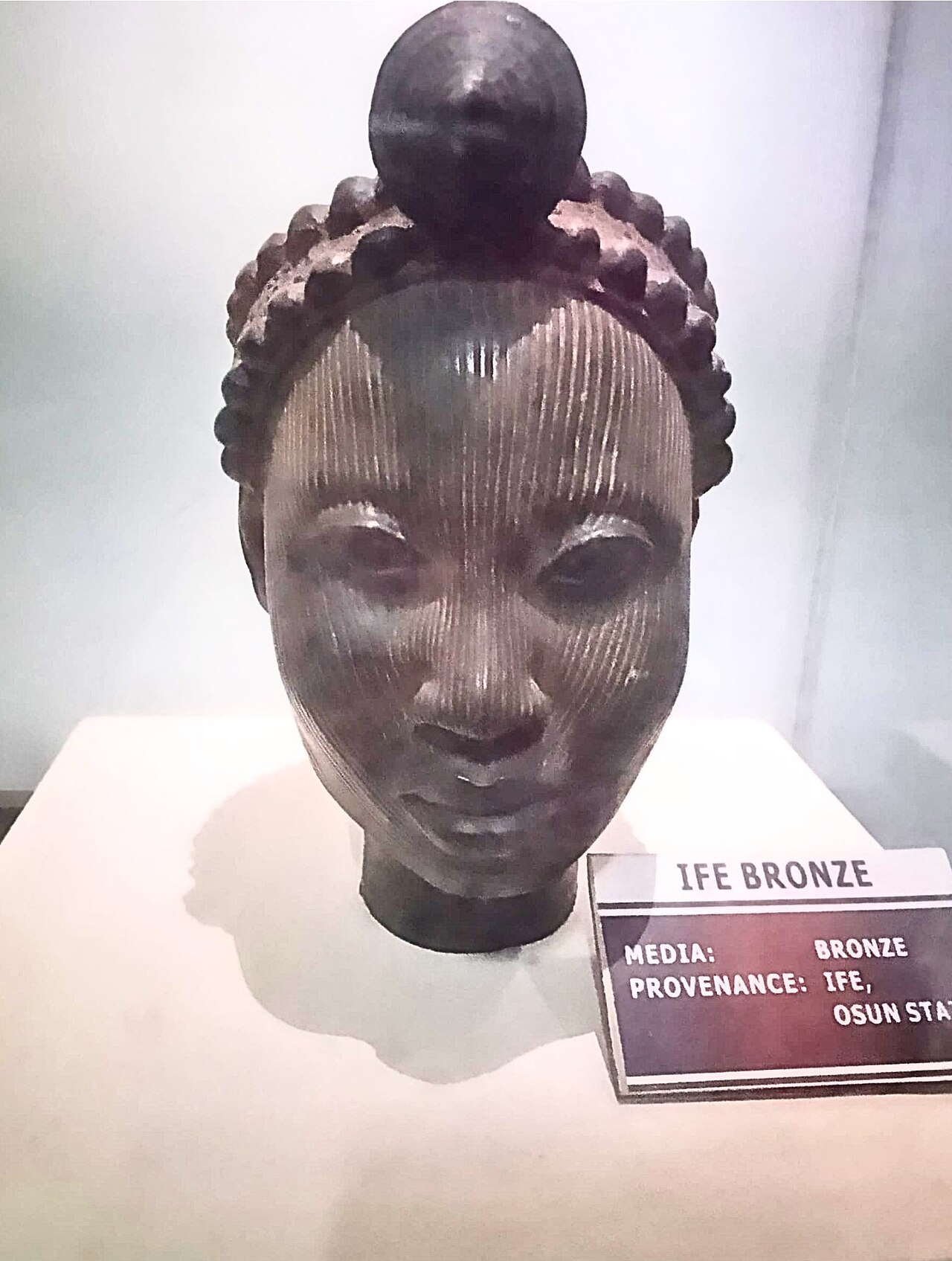
In 1910, the German explorer Leo Frobenius visited Ile-Ife and was shown a brass head so finely cast that he refused to believe it was African. He attributed it to the lost civilisation of Atlantis — a racist assumption that later scholars thoroughly dismantled. The truth was far more impressive: Ile-Ife had developed a sophisticated lost-wax casting tradition using brass and copper alloys, producing naturalistic heads, figures, and regalia that rival the famous Benin Bronzes in technical mastery.
Key archaeological finds include:
- The Olokun head, a brass head unearthed in 1910 at Wunmonije compound, now in the National Museum in Lagos.
- Lajuwa head, a terracotta head found at Ita Yemoo, dated to the 12th–14th century.
- Obalufon masks, named after the legendary king Obalufon II, cast in copper and used in coronation rituals.
- Life-sized terracotta heads from Ita Yemoo and Woye Asiri that show extraordinary attention to facial features, scarification, and royal regalia.
“These works are not primitive curiosities. They are the products of a mature, courtly artistic tradition that understood anatomy, proportion, and the symbolic language of kingship.” — Frank Willett, art historian and author of “Ife in the History of West African Sculpture”
Glass and Bead Production
Ile-Ife was also a centre of glass-making, one of the few in pre-colonial West Africa. Archaeologists have found glass beads and crucibles at sites like Igbo Olokun, suggesting the city produced high-value beads for trade and royal use. These beads — known as ìlèkè — remain essential to Yoruba royalty and religious practice today, worn by kings, priests, and initiates.
Key Dates and Landmarks: A Timeline of Ile-Ife
To appreciate the depth of Ile-Ife’s history, it helps to see it laid out chronologically. The table below summarises the city’s major milestones and the landmarks associated with them.
| Period / Date | Event or Development | Key Landmark or Figure |
|---|---|---|
| c. 500–800 CE | Early settlement and iron-working at Ile-Ife | Woye Asiri, Ita Yemoo |
| c. 8th–10th century | Urban expansion; Oduduwa tradition takes form | Oduduwa; Oke Ora |
| 11th–15th century | Golden age of Ife art and bronze casting | Olokun head; Obalufon masks |
| c. 1300–1500 | Oranmiyan dynasty links Ife to Oyo and Benin | Oranmiyan Staff (Opa Oranmiyan) |
| 1910 | Leo Frobenius’s controversial expedition | Wunmonije compound finds |
| 1960s–present | Systematic archaeology; UNESCO recognition | Frank Willett’s excavations; Osun-Osogbo nearby |
One landmark deserves special mention: the Opa Oranmiyan, a granite staff over 5 metres tall, said to mark the grave of Oranmiyan. It stands near the Ooni’s palace and is one of the city’s most recognisable monuments.
Ile-Ife’s Living Culture: Festivals, Deities, and Daily Life
Modern Ile-Ife is a bustling university town — home to Obafemi Awolowo University, one of Nigeria’s most prestigious institutions, founded in 1961. Its streets hum with okada motorcycles, students, traders, and pilgrims. But the old rhythms remain.
The Olojo Festival
Every year, the Olojo Festival draws thousands to Ile-Ife. It commemorates the creation of the world and honours Ogun, the god of iron and war. The Ooni appears in public wearing the sacred Are crown — a beaded crown with a veil that shields his face from the crowd, symbolising his role as a mediator between the human and divine realms. The festival features drumming, dancing, and the ritual cleansing of the city.
The Òrìṣà Pantheon
Ile-Ife is home to groves and shrines dedicated to major Òrìṣà, including:
- Ogun — god of iron, war, and technology, honoured at the Olojo festival.
- Osun — goddess of love, fertility, and water, whose main shrine is in nearby Osogbo but whose mythology ties to Ife.
- Obatala — deity of creation, peace, and the white cloth, credited with moulding human bodies.
- Oduduwa — the ancestral founder, honoured at the Ooni’s palace.
- Oramfe — the thunder deity, linked to the hill of the same name.
These deities did not stay in Nigeria. Through the transatlantic slave trade, Yoruba religion travelled to Cuba, Brazil, Trinidad, and the United States, where it evolved into Santería (Regla de Ocha), Candomblé, and Umbanda. Today, Cuban santeros and Brazilian pai-de-santo still make pilgrimages to Ile-Ife to reconnect with the source.
Ile-Ife and the Global Yoruba Diaspora
The African diaspora’s relationship with Ile-Ife is one of the most remarkable cultural reunifications of the modern era. For centuries, enslaved Yoruba people in the Americas preserved their language, music, and religion under brutal conditions. Names like Ṣàngó, Yemọja, and Ògún survived in Cuba and Brazil even as they were suppressed in Nigeria by colonial missionaries.
Since the late 20th century, a reverse pilgrimage has taken shape. Every year, thousands of diaspora Yoruba — from Cuba, Brazil, the US, and the UK — visit Ile-Ife. The Ooni’s palace receives delegations from casa de santo temples in Havana and terreiro communities in Salvador, Bahia. In 2016, the Ooni Oba Adeyeye Enitan Ogunwusi hosted a global Yoruba cultural festival that drew participants from over 30 countries.
This is not just tourism. It is a spiritual and political statement: that despite the Middle Passage, despite colonialism, despite centuries of erasure, the root remains. Ile-Ife is the proof.
Preserving the Legacy: Challenges and Opportunities
Ile-Ife faces the same pressures as many historic African cities: urbanisation, inadequate infrastructure, and the tension between development and heritage preservation. The city’s ancient groves and archaeological sites are not all well-protected. Looting of artefacts has been a persistent problem, and some bronzes and terracottas have ended up in European museums — a source of ongoing restitution debates.
Yet there is momentum. The National Commission for Museums and Monuments maintains the Ife Museum, and Obafemi Awolowo University’s archaeology department continues to excavate and publish. In 2023, the Nigerian government announced plans to develop a heritage tourism corridor linking Ile-Ife with Osogbo, Oyo, and Benin City.
Local initiatives matter too. The Ooni’s palace has invested in cultural education, and young Ife residents are using social media to document festivals, oral histories, and traditional crafts. The city is not frozen in time — it is adapting, as it always has.
Conclusion: Why Ile-Ife Still Matters
Ile-Ife is more than a historical footnote. It is a living argument against the idea that Africa’s past is shallow or derivative. Here, over a thousand years ago, artists cast metal with a precision that Europeans would not match until the Renaissance. Here, a political and spiritual system developed that linked dozens of kingdoms across hundreds of kilometres. Here, a cosmology took shape that would survive slavery, colonialism, and globalisation, and still draw pilgrims from three continents.
For the Yoruba, Ile-Ife is home — ilé in the deepest sense. For everyone else, it is a reminder that African history is not a prologue to European arrival. It is its own story, with its own heroes, its own genius, and its own dawn. If you ever stand at the Opa Oranmiyan or watch the Ooni emerge in the Are crown, you are standing at the source of a river that has flowed for a millennium. That is worth knowing. That is worth protecting.