📅 Last updated: 27.08.2026
The Kuba Kingdom art of Central Africa represents one of the most sophisticated and visually breathtaking artistic traditions on the continent, a royal legacy that flourished for centuries in the dense forests of what is now the Democratic Republic of Congo. This remarkable kingdom, which reached its zenith under the legendary ruler Shyaam aMbul aNgoong in the early 17th century, produced an astonishing array of objects—from intricately woven raffia textiles to portrait sculptures of its kings—that combined geometric precision with profound spiritual meaning. To understand Kuba art is to understand a civilization that elevated aesthetics to a form of governance, where every pattern, material, and motif spoke to the divine authority of the nyim (king) and the sophisticated cosmology of the Bushoong people.
- The Origins and Expansion of a Forest Kingdom
- Raffia Velvet: The Crown Jewel of Kuba Kingdom Art
- Portrait Sculptures: The Faces of Royal Power
- Masks, Ceremony, and the Spirit World
- The Golden Age of Kuba Art in the 19th Century
- Discovery, Collection, and Global Recognition
- Symbolism and Cosmology in Kuba Art
- Contemporary Kuba Art: Tradition and Innovation
- Preserving a Legacy: Museums, Ethics, and Repatriation
- The Enduring Power of Royal Splendor
The Origins and Expansion of a Forest Kingdom
The Kuba Kingdom, known to its people as the “Bushoong Kingdom,” emerged through a remarkable process of political consolidation that began around 1600. Unlike many African states that grew through military conquest alone, the Kuba federation formed through a combination of marriage alliances, diplomatic negotiation, and cultural assimilation. The founding figure, Shyaam aMbul aNgoong, was himself a fascinating character—according to oral tradition, he was the son of a Bushoong princess and a Tetela hunter, raised partially among the neighboring Pende people before returning to unite eighteen distinct ethnic groups under one royal umbrella.
These groups—including the Bushoong, Ngeende, Shoowa, Kete, and Binji—each maintained their own languages and customs while acknowledging the supreme authority of the Bushoong king. This federal structure had profound implications for artistic production. Rather than a single court style, Kuba Kingdom art encompassed a dazzling diversity of regional variations, each with its own preferred motifs, materials, and techniques. The Shoowa people, for instance, became renowned for their exceptionally fine pile cloths, while the Kete developed distinctive geometric patterns that differed markedly from the more representational styles of the central court.
The kingdom’s location in the Kasai River basin proved advantageous for artistic development. The region’s abundant raffia palms provided the primary material for the kingdom’s most celebrated art form—woven textiles that European visitors would later describe as “velvet” for their extraordinary softness and depth. The forest also yielded the hardwoods used for sculpture, the pigments for dyes, and the cowrie shells and beads that adorned royal regalia. By the 19th century, the Kuba Kingdom had become one of the wealthiest and most stable states in Central Africa, with a population estimated at 150,000 and a court that attracted artisans from across the region.
The Mythic Origins of Kuba Art
Kuba oral tradition traces the origins of their artistic practices to Woot, the mythical ancestor of the Bushoong people. According to one widely told version, Woot was a culture hero who brought civilization to the forest peoples, teaching them the arts of weaving, carving, and music. Another version of the myth involves a dramatic episode in which Woot committed a great transgression, causing a period of chaos that was only resolved through elaborate rituals—rituals that themselves became the basis for the kingdom’s artistic traditions. These foundation myths continue to inform how contemporary Kuba artists understand their craft, linking modern production to an ancient, sacred lineage.
Raffia Velvet: The Crown Jewel of Kuba Kingdom Art
If any single object type defines Kuba Kingdom art in the global imagination, it is undoubtedly the kasai velvet—the dense, richly patterned raffia cloth that European collectors first encountered with astonishment in the late 19th century. These textiles, known locally as mbal, were not merely decorative items but served as currency, gifts, markers of status, and ceremonial regalia. The process of creating them was extraordinarily labor-intensive, requiring weeks or even months of work by skilled artisans, and the finest examples were reserved exclusively for the royal court.
The production of kasai velvet involves a complex double-cloth technique that is technically demanding even by modern standards. The weaver begins by creating two separate layers of raffia cloth on a single loom, then uses a needle to embroider patterns through both layers, cutting the threads of the upper layer to create a luxurious pile. The result is a fabric that resembles velvet but is entirely plant-based, with geometric patterns that emerge in high relief against a smooth background. The most common motifs include interlocking triangles, checkerboard patterns, and stylized representations of animals and humans—each with specific meanings that would have been immediately legible to Kuba viewers.
Color played a crucial role in the symbolic language of these textiles. Natural raffia fibers range from pale cream to golden brown, and artisans achieved additional hues through the use of natural dyes. The deep reddish-brown color so characteristic of royal cloths came from the bark of the mukula tree, while black was obtained from iron-rich mud and white from kaolin clay. In Kuba aesthetics, the contrast between these colors was not merely decorative but carried cosmological significance—the alternation of light and dark represented the fundamental duality of existence, the interplay of life and death, male and female, order and chaos.
The Royal Textile Workshops
The most prestigious textiles were produced in dedicated workshops attached to the royal court. These workshops operated under the direct patronage of the nyim, and the artisans who worked there enjoyed elevated status in Kuba society. According to the Swiss ethnographer Emil Torday, who visited the Kuba Kingdom in 1908 and collected over 3,000 objects for European museums, the royal workshops employed both men and women in strictly segregated roles. Men typically wove the base cloth, while women performed the embroidery and pile-cutting that gave the textiles their distinctive texture. This division of labor reflected broader Kuba gender ideologies while also ensuring a consistent standard of quality.
Portrait Sculptures: The Faces of Royal Power
Among the most iconic works of Kuba Kingdom art are the ndop—portrait sculptures of individual kings that served as more than mere likenesses. Each ndop was created during the reign of the king it depicted and was designed to capture not only his physical features but also his essential character and achievements. The sculptures, carved from hardwood and typically measuring 40 to 55 centimeters in height, show the king seated cross-legged in a posture of meditation and authority. The hands rest on the knees, and the gaze is directed slightly upward, conveying a sense of calm, omniscient power.
Every element of the ndop carries specific meaning. The ibol, or personal emblem, carved on the base of each figure, functions as a visual signature that identifies the specific king. Shyaam aMbul aNgoong’s ndop, for example, features a drum—a reference to his legendary skill as a drummer and the role of music in his political strategy. Other kings are identified by objects such as a game board, a bellows, or a hunting knife, each alluding to a defining aspect of their reign. The kings are also depicted wearing the elaborate regalia of office, including the lukaku (a woven headdress decorated with cowrie shells) and the mukyeen (a belt of leopard skin), both of which reinforced their status as rulers of extraordinary power.
The ndop served multiple functions in Kuba society. At the most basic level, they were historical records, preserving the memory of past kings for future generations. They also functioned as spiritual vessels—sites where the ngesh (vital force) of the deceased king could reside and be accessed through ritual. When a new king was installed, he would participate in ceremonies at the tombs of his predecessors, where the ndop were kept in specially constructed shrines. The sculptures thus linked the current ruler to the entire lineage of Kuba kingship, legitimizing his authority through visible connection to the past.
Remembering a King: The Ndop of Mishe miShyaang
One of the most celebrated ndop in museum collections depicts King Mishe miShyaang, who ruled in the late 18th century. His emblem, a knife, refers to his reputation as a warrior and his consolidation of Kuba power through military campaigns. The sculpture, now in the British Museum, exemplifies the refined naturalism of the finest Kuba carvers, with the king’s facial features rendered in careful detail—high cheekbones, a broad nose, and an expression of quiet authority. The treatment of the body is more stylized, with the crossed legs and symmetrical posture conveying ideal kingship rather than individual anatomy. This combination of naturalism and abstraction is characteristic of Kuba royal portraiture and distinguishes it from the more purely stylized traditions of many neighboring peoples.
Masks, Ceremony, and the Spirit World
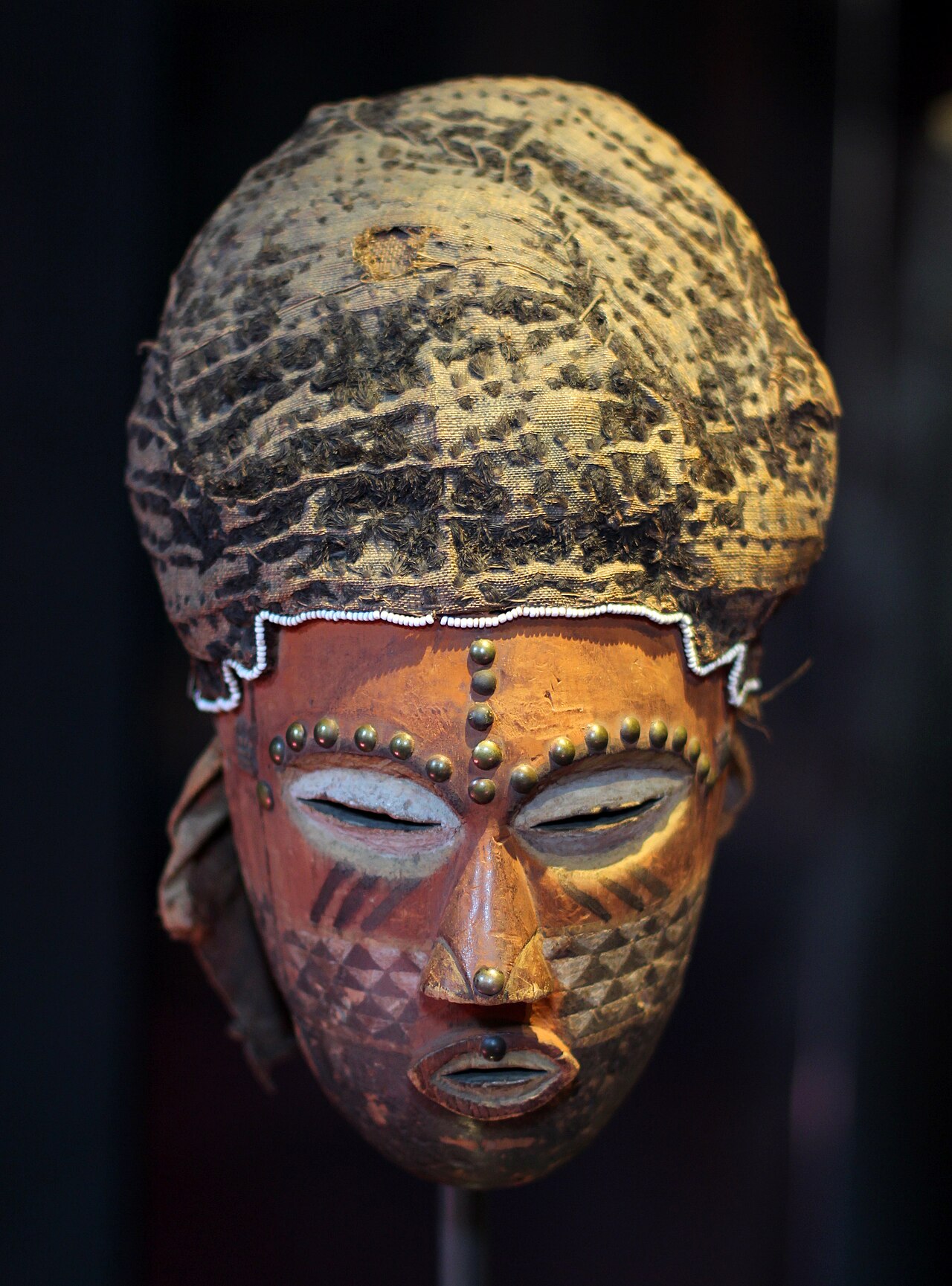
While the ndop represented the permanent, ancestral face of Kuba kingship, masks embodied the dynamic, transformative power of the court. Kuba masking traditions were numerous and varied, with different mask types serving distinct ceremonial functions. The most famous is the mukinka, a mask associated with the initiation of young men and the celebration of royal authority. Mukinka masks are characterized by their use of appliquéd geometric patterns in contrasting colors, often incorporating beads, cowrie shells, and pieces of imported trade cloth. The patterns reference the embroidery of royal textiles, creating a visual link between masking and the other great traditions of Kuba art.
Another significant mask type is the mwashamboy, a massive helmet mask that represents the spirit of the king himself. Unlike the relatively small mukinka, mwashamboy masks are large and imposing, covering the entire head of the wearer. They are decorated with an elaborate superstructure that may include carved figures, feathers, and other materials, and they appear only on the most important ceremonial occasions. The mwashamboy’s appearance is said to cause women and uninitiated men to flee, as it represents the most sacred and dangerous manifestation of royal power.
The pwoom itok mask, with its distinctive conical shape and painted geometric designs, is associated with the royal ancestors and appears at funerals and investiture ceremonies. Unlike the mukinka, which is worn by men, the pwoom itok is danced by a man wearing women’s clothing—a deliberate reversal of gender norms that highlights the mask’s liminal, transformative nature. These masks serve as reminders that Kuba Kingdom art was never static or purely decorative; it was actively deployed in ceremonies that maintained the social and cosmic order.
The Golden Age of Kuba Art in the 19th Century
The 19th century witnessed an extraordinary flourishing of Kuba artistic production, driven by a combination of political stability, economic prosperity, and royal patronage. This period, which corresponds to the reigns of Kings Kat Mbwamb (c. 1830–1850), Miko miMbul (c. 1850–1885), and the remarkable Kot aPe (c. 1885–1895), saw the creation of some of the most technically accomplished works in the kingdom’s history. The population of the capital, Nsheng, grew to perhaps 10,000 inhabitants, and the court attracted artisans from throughout the federation and beyond.
This golden age was also a period of intensified exchange with the wider world. Arab-Swahili traders from the east coast began reaching the Kuba Kingdom in the 1860s, bringing with them glass beads, brass wire, and cotton cloth. These imported materials were rapidly incorporated into Kuba artistic production, appearing in the beadwork of masks and the decoration of prestige objects. The Kuba were selective in their adoption of foreign goods, however, integrating imported materials into established artistic traditions rather than abandoning them. This cultural confidence is one of the hallmarks of Kuba Kingdom art and helps explain its remarkable coherence despite centuries of external contact.
The kingdom faced its first serious external threat in the 1890s, when representatives of King Leopold II of Belgium’s Congo Free State began penetrating the Kasai region. The Kuba initially resisted European encroachment, and King Kot aPe famously refused to sign a treaty with the Belgians, stating that his kingdom had no need of foreign protectors. This resistance was ultimately futile—the Congo Free State, and later the Belgian Congo, gradually extended its control over the region—but the Kuba maintained a remarkable degree of cultural autonomy well into the colonial period.
| Period | Key Ruler | Major Artistic Developments |
|---|---|---|
| c. 1600–1650 | Shyaam aMbul aNgoong | Foundation of the kingdom; establishment of court workshops; development of ndop tradition |
| c. 1650–1800 | Successive Bushoong kings | Refinement of kasai velvet technique; expansion of masking traditions; consolidation of royal symbolism |
| c. 1800–1885 | Kat Mbwamb, Miko miMbul | Golden age of artistic production; incorporation of imported materials; growth of Nsheng as artistic center |
| c. 1885–1910 | Kot aPe | Resistance to colonial encroachment; continuation of royal patronage despite external pressure |
| 1910–1960 | Various kings | Adaptation to colonial rule; continued production for local use and growing European market |
Discovery, Collection, and Global Recognition
The world beyond Central Africa first became aware of Kuba Kingdom art through the expeditions of European explorers and ethnographers in the late 19th and early 20th centuries. The most significant of these was the 1908–1909 expedition of Emil Torday, a Hungarian-born ethnographer working for the British Museum, who spent eight months among the Kuba and amassed a collection of extraordinary depth and quality. Torday’s precise documentation of the objects he collected, including his careful recording of their names, functions, and meanings, provided the foundation for all subsequent scholarship on Kuba art.
Torday was deeply impressed by what he found. In his book On the Trail of the Bushongo, published in 1925, he described the Kuba as “the most intelligent and industrious” people he had encountered in Africa, praising their artistic sophistication and the orderliness of their society. This admiration was shared by other collectors and scholars, and Kuba objects quickly became prized acquisitions for European and American museums. The British Museum’s Kuba collection, built largely on Torday’s fieldwork, remains one of the most comprehensive anywhere, containing more than 500 objects including ndop, masks, textiles, and everyday items of exceptional craftsmanship.
The influence of Kuba Kingdom art extended beyond museum collections into the world of modern art. In 1935, the Museum of Modern Art in New York mounted an exhibition of African art that included several Kuba textiles, and these works made a profound impression on abstract painters and textile designers. The geometric precision and bold patterning of kasai velvet seemed to anticipate the concerns of mid-century modernism, and Kuba textiles were reproduced in design journals and used as inspiration for everything from wallpaper to haute couture. This reception, while sometimes flattening the cultural specificity of the objects, nonetheless confirmed the universal appeal of Kuba aesthetics.
Symbolism and Cosmology in Kuba Art
To appreciate Kuba Kingdom art fully, one must understand the cosmological framework that gives it meaning. The Kuba conceive of the world as governed by the complementary forces of order and chaos, represented by the king and the forces of untamed nature respectively. The king’s role is to maintain the delicate balance between these forces, and his artistic regalia—the textiles, masks, and sculptures that surround him—are instruments in this cosmic project. Every pattern, every material, every color in Kuba art participates in this symbolic system.
The imbol (also spelled ibol), the geometric patterns that appear on textiles, masks, and body ornamentation, are particularly rich in meaning. Some of the most common include the mbol (a four-pointed star representing the king), the ngok (a spiral representing the continuity of life), and the mbut (a checkerboard symbolizing the alternation of power between the king and his subjects). These patterns are not merely decorative—they are a visual language through which the Kuba express their understanding of the world and their place within it. The ability to read and interpret this language was traditionally a mark of cultural sophistication, and elders would spend hours explaining the meanings of different motifs to younger generations.
The materials used in Kuba art also carry symbolic weight. Raffia, the fiber of the raffia palm, is associated with life and fertility, and its use in royal textiles links the king to the sustaining power of the earth. Cowrie shells, which came from the Indian Ocean trade, symbolize wealth and connection to the wider world. Leopard skin, reserved for the king alone, evokes the leopard’s status as the most powerful predator of the forest. The combination of these materials in a single object creates a dense web of associations that would have been immediately apparent to a Kuba viewer.
Contemporary Kuba Art: Tradition and Innovation
Far from being a relic of the past, Kuba Kingdom art remains a living tradition in the 21st century. The kingdom continues to exist as a cultural entity within the Democratic Republic of Congo, and the current nyim, Kot aNkwey (who ascended to the throne in 2008), maintains a court that supports artists working in traditional media. Contemporary Kuba artisans continue to weave raffia textiles, carve ndop, and produce masks for use in ceremonies, adapting ancient techniques to contemporary circumstances.
At the same time, Kuba artists are engaging with the global art world in new ways. The international market for African art has grown dramatically in recent decades, and Kuba pieces command high prices at auction—a fine kasai velvet can sell for tens of thousands of dollars. This economic value has created both opportunities and challenges for Kuba communities. On one hand, the art trade provides income and international recognition. On the other, it can lead to the removal of culturally significant objects from their original contexts and the commodification of sacred traditions.
There are also encouraging signs of cultural revitalization. In the city of Kananga, the capital of Kasai-Central province, a new generation of young Kuba is learning traditional weaving and carving techniques from elder masters. Some of these artists are experimenting with new forms, creating works that draw on Kuba aesthetics while addressing contemporary themes such as environmental conservation, political identity, and the legacy of colonialism. These efforts suggest that Kuba Kingdom art will continue to evolve, remaining a vital and dynamic tradition rather than a static museum piece.
Preserving a Legacy: Museums, Ethics, and Repatriation
The vast majority of the finest Kuba Kingdom art objects are today held in museum collections outside Africa, primarily in Europe and North America. The British Museum, the Royal Museum for Central Africa in Tervuren, Belgium, the Ethnologisches Museum in Berlin, and the Musée du Quai Branly in Paris each hold significant collections, and many other institutions have smaller holdings. These collections have made Kuba art accessible to a global audience and have been essential for scholarly research. At the same time, they raise complex ethical questions about cultural ownership, colonial history, and the future of these objects.
In recent years, the debate over the repatriation of African cultural heritage has intensified, driven by the 2017 call by French President Emmanuel Macron for the return of African objects held in French museums and the subsequent release of the Sarr-Savoy report. While no major Kuba objects have yet been formally repatriated, discussions are ongoing, and several institutions have begun developing collaborative programs with Congolese museums and communities. These initiatives aim to create more equitable relationships between source communities and Western institutions, recognizing the Kuba as the rightful heirs of their cultural heritage.
There are also significant efforts underway to preserve and document the intangible cultural heritage associated with Kuba art. The Kuba people themselves have been active in this work, recording oral histories, documenting ceremonial practices, and passing on technical knowledge to younger generations. These efforts are crucial because the meaning of Kuba art is not contained solely in the objects themselves but in the knowledge, skills, and beliefs that surround them. A kasai velvet without an understanding of its symbolism is like a page torn from a book—beautiful, perhaps, but lacking context and meaning.
The Enduring Power of Royal Splendor
Kuba Kingdom art stands as a testament to the extraordinary creativity and sophistication of Central African civilization. For more than four centuries, the Kuba people created works of breathtaking beauty and profound meaning—textiles that rival the finest velvets of Europe, sculptures that convey the dignity and authority of kingship, masks that connect the living to the spirit world. These objects are not merely artifacts of a lost past but living expressions of a culture that continues to evolve and adapt.
The legacy of Kuba art extends far beyond the borders of the kingdom itself. It has influenced modern artists, enriched museum collections, and challenged Western assumptions about the nature of African art. It reminds us that Africa’s cultural heritage is not monolithic but astonishingly diverse, reflecting the unique histories and worldviews of hundreds of distinct peoples. The geometric brilliance of a Kuba textile, the serene authority of a ndop portrait, the dramatic presence of a mwashamboy mask—these works speak to universal human concerns of power, beauty, and meaning while remaining deeply, unmistakably Kuba.
As we look to the future, the preservation and continuation of Kuba Kingdom art depend on a delicate balance—between honoring tradition and embracing innovation, between the global circulation of objects and the rights of source communities, between the aesthetic appreciation of form and the understanding of meaning. The Kuba people themselves remain the primary custodians of this heritage, and their ongoing creativity ensures that the tradition is not frozen in time but continues to grow. In an age of rapid change and cultural homogenization, the persistence of Kuba art is a powerful reminder of the resilience of African cultures and the enduring power of human creativity to express the deepest truths of existence.