📅 Last updated: 16.11.2026
The Loango Kingdom was one of the most sophisticated trading states on Africa’s Atlantic coast, a realm of coastal lagoons and forested hinterlands that flourished from roughly the 15th to the 19th century in what is now the Republic of the Congo. Long overshadowed in popular memory by its neighbours Kongo and Ndongo, Loango minted its own cloth currency, fielded a navy of canoes, and projected commercial influence from the Congo River mouth to the Loango Coast’s far northern reaches. Its merchants negotiated with Dutch, French, Portuguese, and English captains on terms shaped by African law and African demand, while its kings governed through a layered council of titled nobles whose authority predated any European arrival.
The Loango Kingdom was a coastal West-Central African state centred at present-day Loango in the Republic of the Congo, active from about the 15th to the 19th century. It grew wealthy through trade in salt, copper, ivory, and textiles, and later through Atlantic commerce, governed by a king (the Ma Loango) advised by powerful provincial lords and a female-led council. Its sophisticated political system and far-reaching trade networks made it a major regional power long before and after European contact.
- Where Was the Loango Kingdom, and Why Did It Matter?
- How Did the Loango Kingdom Govern Itself?
- What Did the Loango Kingdom Trade, and With Whom?
- The Loango Kingdom and the Atlantic Slave Trade
- Loango Kingdom Timeline: Key Dates and Turning Points
- Who Were the Neighbours of the Loango Kingdom?
- What Did Loango Culture and Society Look Like?
- Why Was the Loango Kingdom Forgotten — and Why Does It Matter Now?
- What Remains of the Loango Kingdom Today?
- The Loango Kingdom's Enduring Lesson
Where Was the Loango Kingdom, and Why Did It Matter?
Loango occupied the Atlantic seaboard north of the Congo River’s mouth, a strip of lagoon-fringed lowland running from roughly Pointe-Noire in the south toward the modern border with Gabon. The capital, also called Loango (near today’s village of Loango, about 20 kilometres north of Pointe-Noire), sat a short distance inland from the sea, connected to the coast by a navigable lagoon system. That geography was the kingdom’s fortune: it gave Loango a sheltered harbour, control of salt pans, and access to the forested interior where copper, ivory, and palm products originated.
The state’s importance rested on three pillars. First, it commanded the trade routes linking the interior of the modern Republic of the Congo and Gabon to the Atlantic. Second, it produced and controlled salt — a vital commodity in a region where preservation and cooking depended on it. Third, it developed the celebrated Loango cloth, a raffia and later cotton textile that functioned as money across a wide swathe of Central Africa. When European ships began arriving in the 16th century, they found not a passive supplier of captives but a commercial power with established rules, tariffs, and monopolies.
Early European visitors were struck by the kingdom’s order. The Dutch merchant Pieter van den Broecke, trading on the Loango Coast in the early 1600s, recorded a well-regulated market in which local brokers controlled access to the king and prices were set by custom. Later French and English accounts describe a capital of several thousand inhabitants, with broad streets, royal compounds, and a court that received foreign envoys with elaborate protocol.
How Did the Loango Kingdom Govern Itself?
Loango’s political system was one of the most distinctive in West-Central Africa. At its apex stood the king, the Ma Loango (also rendered Maloango), whose person was considered sacred and whose feet, by some accounts, were never allowed to touch the ground in public. He governed not as an absolute monarch but through a complex balance of councils and provincial lords, a structure that distributed power and checked royal overreach.
The King, the Council, and the Provincial Lords
Beneath the king were the Mafouk and other great titleholders — provincial governors and court officials who controlled districts, taxation, and trade. A council of elders and titled women, sometimes described in European sources as the “queen” or “princess” of Loango, held real influence over succession and policy. The king’s authority depended on managing these nobles, and succession disputes were common, occasionally resolved by civil conflict or by the intervention of the neighbouring Kingdom of Kakongo to the north.
This layered system had practical consequences for commerce. Foreign traders could not simply deal with the king directly; they negotiated through designated brokers and officials who collected customs duties and regulated access. The kingdom maintained a standing force of canoe-borne warriors and a corps of officials who inspected incoming goods. In this, Loango resembled the coastal city-states of the Swahili seaboard more than the large territorial empires of the Sahel — a maritime commercial power governed by law and custom rather than by conquest alone.
Law, Religion, and the Sacred King
Loango’s rulers drew legitimacy from spiritual authority. The king was associated with rain, fertility, and the well-being of the land, and royal rituals marked the agricultural and trading calendar. The kingdom’s religion centred on ancestor veneration and territorial spirits, later overlaid — but never replaced — by Christianity as Portuguese and French missionaries arrived. An important feature of Loango’s political culture was the role of women in the royal court; European accounts note titled female officials who participated in councils and whose consent mattered in major decisions.
What Did the Loango Kingdom Trade, and With Whom?
Trade was the lifeblood of the Loango Kingdom, and its merchants were remarkably adaptable. Before the Atlantic era, Loango’s economy rested on regional exchange: salt from coastal lagoons moved inland, copper from mines in the Mayombe region and beyond moved toward the coast, and raffia cloth woven in the kingdom travelled hundreds of kilometres into the interior. The famous Loango cloth — called mbongo in some sources — became a standard of value, used as currency in markets as far away as the Pool Malebo region near modern Kinshasa.
From the late 16th century, European ships — Portuguese, Dutch, English, and French — began calling at Loango and the neighbouring ports of Kakongo and Ngoyo. The kingdom’s rulers moved quickly to regulate this trade. They imposed duties, restricted certain goods to royal monopoly, and insisted that Europeans trade through approved intermediaries. Dutch records from the 17th century show Loango as a major source of ivory, copper, and redwood (a dye wood prized in European textile industries), exchanged for iron bars, textiles, alcohol, and firearms.
- Salt: Produced in coastal lagoons and traded inland, a foundational commodity of the regional economy.
- Copper: Mined in the Mayombe hills and traded as ingots and ornaments, highly valued across Central Africa.
- Ivory and redwood: Key exports to European markets from the 16th century onward.
- Loango cloth: Raffia and cotton textiles that served as currency and a major export to the interior.
- Enslaved people: Loango became a significant source of captives for the Atlantic trade, particularly from the 17th to the 19th century, a grim dimension that reshaped the region’s societies.
The Loango Kingdom and the Atlantic Slave Trade
No honest account of Loango can avoid the Atlantic slave trade. From the mid-17th century, the Loango Coast — including Loango, Kakongo, and Ngoyo — became one of the most active slaving regions in West-Central Africa. Captives were drawn from the interior and from warfare and raids, and European ships from France, Britain, the Netherlands, and Portugal competed for cargoes at the coast’s anchorages.
The trade distorted Loango’s economy and politics. Kings and nobles who controlled the sale of captives gained wealth and firearms, which in turn fuelled further conflict and capture. Some historians argue that the kingdom’s rulers attempted to regulate and limit the trade at times, but the commercial pressures were immense. The demographic and social costs were severe: communities were depopulated, and the region’s development was warped for generations. By the 19th century, as Britain and other powers suppressed the trade, Loango’s rulers and merchants shifted toward legitimate commerce — palm oil, rubber, and ivory — but the kingdom’s autonomy was already eroding.
Loango Kingdom Timeline: Key Dates and Turning Points
| Period | Event | Significance |
|---|---|---|
| c. 15th century | Loango emerges as a distinct coastal state | Consolidation of royal authority and regional trade networks |
| Late 16th–17th century | European ships begin regular trade at Loango Coast | Dutch, Portuguese, and English merchants exchange goods for ivory, copper, and redwood |
| 17th–18th century | Peak of Atlantic slave trade on the Loango Coast | Loango, Kakongo, and Ngoyo become major slaving ports; political and social upheaval |
| 19th century | Decline of the slave trade; shift to palm oil and rubber | Economic transition and growing European pressure |
| 1883–1885 | French treaties and the Berlin Conference | Loango’s territory absorbed into French Congo; kingdom loses sovereignty |
Who Were the Neighbours of the Loango Kingdom?
Loango did not exist in isolation. To the south lay the Kingdom of Kongo, the great Central African state whose capital at Mbanza Kongo had converted to Christianity in the late 15th century and whose influence radiated across the region. To the north, along the coast, were the smaller kingdoms of Kakongo and Ngoyo, closely related to Loango in culture and language and often allied or in competition with it. Inland, the kingdom’s trade networks reached the Teke and other peoples of the interior, and beyond them the vast Congo River basin.
The relationship with Kongo was complex. Loango’s rulers shared linguistic and cultural roots with the Kongo world — the Kikongo language and its dialects were spoken across the region — but Loango maintained its independence and developed its own political traditions. European observers sometimes treated Loango, Kakongo, and Ngoyo as a single “Loango Coast” entity, but they were distinct kingdoms with their own dynasties and interests. The Loango Kingdom’s ability to balance between Kongo, its coastal neighbours, and European traders was a mark of its diplomatic skill.
What Did Loango Culture and Society Look Like?
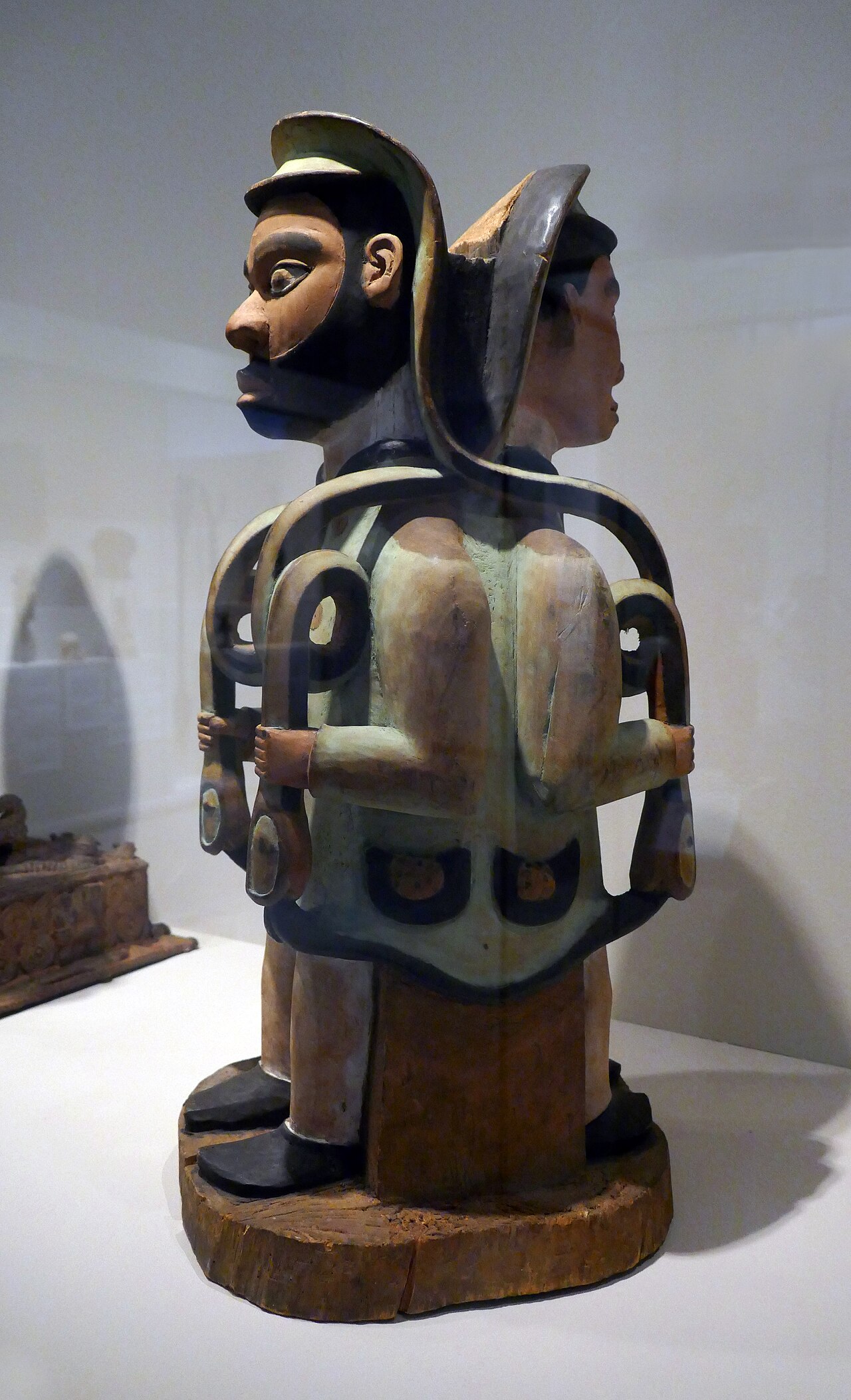
Loango’s society was organised around extended families, lineages, and territorial communities, with a powerful nobility and a large population of farmers, fishermen, salt-makers, and artisans. The kingdom’s artists produced some of Central Africa’s most striking works: carved wooden figures, raffia textiles with geometric patterns, and copper ornaments. Music and dance were central to court ritual and community life, and the kingdom’s traditions fed into the broader Kongo cultural sphere that would later shape the music and spirituality of the African diaspora in the Americas and the Caribbean.
Daily life revolved around the lagoons and the forest. Fishermen worked the coastal waters and lagoons; farmers cultivated cassava, plantains, and other crops; salt-makers harvested and processed salt in the coastal pans; weavers produced the raffia cloth that served as currency. The capital’s markets drew traders from across the region, and the king’s court supported specialists — smiths, weavers, drummers, and ritual experts — whose skills reinforced the kingdom’s prestige.
Why Was the Loango Kingdom Forgotten — and Why Does It Matter Now?
The Loango Kingdom’s relative obscurity is partly a matter of historical accident. Its neighbours Kongo and Ndongo produced famous kings — Afonso I, Nzinga — whose stories entered global history through dramatic encounters with Portugal. Loango’s rulers left fewer written traces, and its capital was never excavated on the scale of some other African sites. Colonial historiography, focused on the French Congo and its administrative centres, paid little attention to the pre-colonial kingdom. The result is a gap in public knowledge that recent scholarship — including archaeological work and studies of Dutch and French trading records — has begun to fill.
That recovery matters for several reasons. Loango is a case study in African political sophistication: a state that regulated foreign trade on its own terms, maintained a complex balance of power between king and nobles, and projected influence across a wide region. Its story also complicates popular narratives of African history as a simple tale of victimhood or of pre-colonial isolation. Loango was connected — to Europe, to the Americas, to the interior of Central Africa — and its people shaped those connections as much as they were shaped by them.
- Political innovation: A layered system of royal and noble authority with meaningful checks on the king’s power.
- Economic agency: African-set terms of trade, royal monopolies, and locally produced currency in the form of cloth.
- Cultural continuity: Kongo-world traditions that survive today in language, music, and religious practice on both sides of the Atlantic.
- Historical caution: A reminder that the slave trade’s damage was inflicted on functioning states, not on “stateless” societies.
What Remains of the Loango Kingdom Today?
In the Republic of the Congo, the Loango name persists in geography and memory. The coastal town of Loango, the Loango National Park in neighbouring Gabon (named for the broader region), and local traditions of royal lineage all carry the kingdom’s legacy. The Vili people, who inhabit the Loango Coast and are among the kingdom’s principal descendants, maintain cultural practices — including music, dance, and oral history — that recall the kingdom’s past. Museums in Brazzaville and abroad hold artefacts attributed to the Loango Coast, and historians continue to mine European archives for the kingdom’s commercial and political records.
The kingdom’s story also lives in the diaspora. The Kongo cultural sphere, of which Loango was a part, influenced religious traditions such as Palo Mayombe and Kumina, and the memory of Central African origins persists in communities across Brazil, Cuba, Haiti, and the United States. For a global audience, Loango offers a counter-narrative to the idea that African history before colonialism was static or marginal: here was a coastal empire that negotiated with Europe, controlled its own commerce, and governed through institutions of real complexity.
The Loango Kingdom’s Enduring Lesson
The Loango Kingdom deserves a place alongside the better-known states of African history — not as a curiosity, but as a fully realised political and commercial power. Its kings governed through councils and custom, its merchants set the terms of trade with European captains, and its weavers produced currency that circulated across Central Africa. Its decline, accelerated by the slave trade and completed by French colonial conquest in the 1880s, was not the result of internal weakness alone but of a global system that stripped African states of their autonomy.
To remember Loango is to insist on a fuller account of Africa’s past: one that includes sophisticated governance, long-distance commerce, and cultural achievement alongside the traumas of the Atlantic era. The kingdom’s lagoons and forested coast still shape life in the Republic of the Congo, and its history still speaks to anyone interested in how African societies met the wider world on their own terms. That is a legacy worth reclaiming — and a story that belongs to the continent and its diaspora alike.