📅 Last updated: 18.08.2026
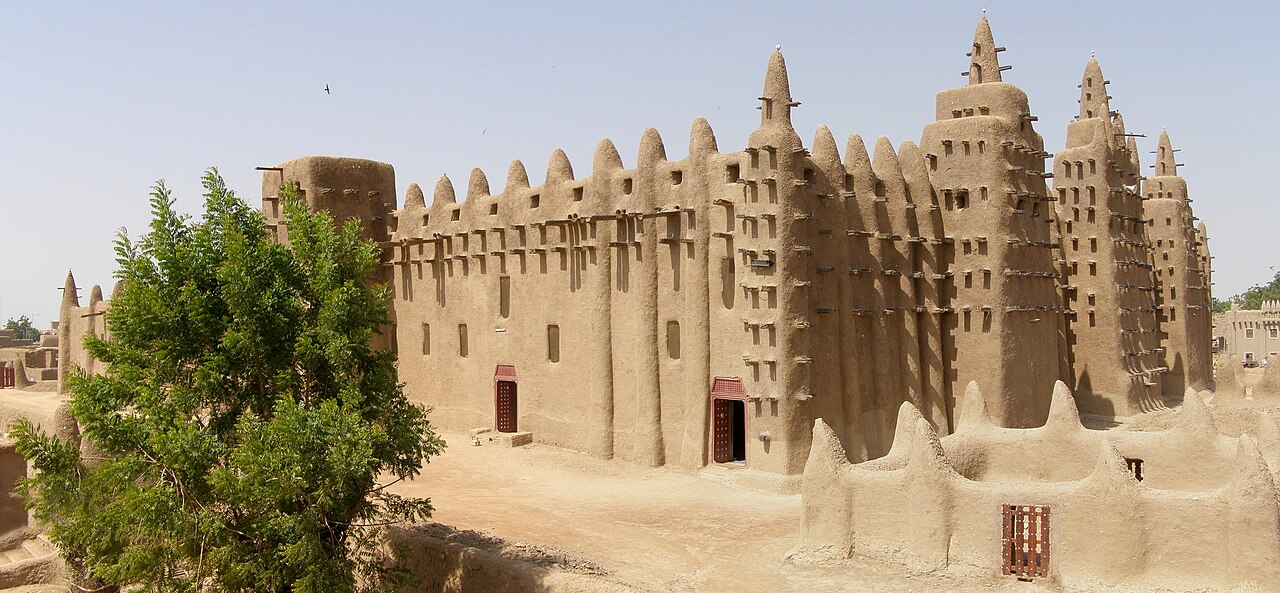
From the moment the first rays of the Saharan sun crest the horizon, the skyline of Djenne is defined by one monumental silhouette—a colossal, earthen citadel that embodies the pinnacle of Djenne mud architecture. This is the Great Mosque, the largest mud-brick building in the world, a structure that does not merely occupy space but commands the very landscape, rising like a sculpted dune from the flat expanse of the Bani River floodplain. It is a testament to the ingenuity of the Sonrai and Bozo peoples, a living monument whose walls breathe, shift, and are reborn with each passing season, challenging our very definition of permanence.
- The Architectural Genius of Djenne Mud Architecture
- A Living Festival: The Crepissage de la Grande Mosquée
- Djenne: More Than a Mosque
- Historical Echoes and Colonial Complexities
- Preservation in a Modern World
- Beyond the Mosque: The Broader Legacy of Earthen Architecture
- Visiting Djenne: A Journey Through Time
- The Enduring Power of Mud and Faith
To approach the mosque is to witness a paradox: a building of immense scale and solidity that is, in truth, perpetually in flux. Its towering minarets, shaped like terracotta spearheads, are not ancient stone but packed earth, smoothed by hand and crowned with ostrich eggs—symbols of fertility and purity. The walls, thick and tapering, are studded with bundles of toron, wooden palm sticks that jut out like a hedgehog’s quills, serving as both scaffolding for annual repairs and a striking aesthetic signature. This is not a relic of a bygone era, but a vibrant, functioning heart of a community, a place where faith, history, and collective labor converge in a spectacle of mud and water.
The Architectural Genius of Djenne Mud Architecture
The brilliance of the Great Mosque lies not in complex engineering formulas, but in a profound, empirical understanding of local materials and climate. The building is a masterpiece of bioclimatic design, a passive cooling system that predates modern air conditioning by centuries. The thick, earthen walls act as a thermal mass, absorbing the intense heat of the Malian day and releasing it slowly throughout the cooler night, creating an internal temperature that is remarkably stable. The interior, a serene forest of ninety-nine massive pillars, supports a ceiling of palm wood and mud, while small, funnel-shaped openings in the roof allow hot air to rise and escape, drawing cooler air in from the main entrances.
This architectural language was perfected over generations, but its most iconic expression is a relatively recent creation. The original mosque, a smaller structure dating back to the 13th century, was commissioned by Sultan Koi Kunboro after he embraced Islam. Over the centuries, it fell into disrepair and was rebuilt. The structure we see today was completed in 1907, under the direction of the French colonial administration, a fact that adds a complex layer to its history. While the French oversaw the construction, the actual building was a monumental feat of local labor and traditional technique, led by the guild of masons from Djenne, who used banco—a mixture of clay, straw, and cow dung—to create the durable, plaster-like surface. The result was a grand, imposing structure that seamlessly wove French colonial ambition with centuries-old Sudanese architectural traditions.
The Significance of the Toron
One of the most distinctive features of the mosque—and of Djenne mud architecture as a whole—is the ubiquitous toron. These protruding sticks are far more than decorative elements. In a building that must be constantly maintained, they are the essential infrastructure for its survival. Embedded deep within the wall’s core, the toron provide a permanent, built-in scaffolding system. During the annual re-plastering festival, the Crepissage, hundreds of men scale these wooden pegs, using them as footholds and handholds to reach every inch of the facade. They are the veins of the structure, allowing the lifeblood of fresh mud to be applied to its skin, ensuring its integrity against the erosive forces of the rainy season.
A Living Festival: The Crepissage de la Grande Mosquée
The true soul of Djenne mud architecture is not found in its static form, but in the vibrant, chaotic, and deeply spiritual festival that brings it to life each year. The Crepissage, or the Festival of Plastering, is a UNESCO-listed intangible cultural heritage event that transforms the entire town into a hive of coordinated activity. It is not merely a maintenance task; it is a profound communal ritual, a reaffirmation of faith, identity, and social cohesion that binds the diverse communities of Djenne together.
The festival begins with a preparatory phase known as Biannu, where young men venture out to the riverbanks to collect the fine, silty clay needed for the plaster. This clay is then mixed with water and rice chaff to create the perfect banco mixture. The atmosphere is electric with anticipation. As the date approaches, the town swells with visitors, and the air fills with the rhythmic beat of tam-tam drums and the chanting of traditional songs.
On the day of the festival, the Great Mosque becomes the stage for a breathtaking display of collective effort. Under the watchful eyes of the master masons, hundreds of men and boys swarm the exterior, climbing the toron with astonishing agility. They work in a synchronized ballet, passing buckets of mud from hand to hand, slapping, smoothing, and polishing the walls until they gleam under the harsh sun. It is a race against time, as the entire facade must be finished before the first rains arrive. The event is a powerful symbol of the community’s ownership of its heritage—a living proof that the mosque is not a museum piece, but a structure dependent on the active, loving hands of its people for its continued existence.
Djenne: More Than a Mosque
To understand the Great Mosque, one must understand its context: the remarkable city of Djenne itself. Located on an island in the inland Niger Delta, Djenne was, from its founding around 800 AD, a linchpin in the trans-Saharan trade routes. It was a bustling entrepôt where gold from the south, salt from the Sahara, and books and textiles from North Africa were exchanged. Its merchants grew wealthy, and its scholars became renowned across the Islamic world. The city was, and remains, a center of Islamic learning and commerce, with a population that prides itself on its cosmopolitan history.
The Great Mosque is the spiritual and geographical anchor of this historic city, but it is surrounded by a vibrant urban fabric. The old town of Djenne is a maze of narrow, winding alleyways and distinctive two-story houses, also built of banco. These homes, with their intricate facades and cool, shaded interiors, are marvels of vernacular architecture in their own right. The weekly Monday market, held in the vast square in front of the mosque, is one of West Africa’s most spectacular gatherings, drawing thousands of traders from the surrounding region who sell everything from Tuareg jewelry and Fulani blankets to fresh vegetables and livestock. It is a sensory overload of color, sound, and commerce, a living testament to the city’s enduring role as a regional hub.
Historical Echoes and Colonial Complexities
The history of the Great Mosque is layered with narratives that reflect the broader story of the Sahel. The original mosque was built on the site of an earlier palace, signifying the triumph of the new faith of Islam over the old order. For centuries, it was the center of religious life, and its imams were influential figures with authority spanning the entire Niger bend. However, the 19th century brought turbulent times. The Fulani leader Seku Amadu, during his jihad to purify Islam, viewed the mosque’s ornate design as extravagant and un-Islamic. In a fit of iconoclasm, he ordered its demolition around 1834, leaving only the tomb of the city’s Muslim patron saint, Al-Hajj Muhammad, standing. A simpler, less ornate mosque was built in its place.
The current structure is a product of a different era, born from a complex interplay of local tradition and colonial power. In 1906, the French administrator in Djenne, William Ponty, proposed rebuilding the mosque to its former glory. The motives were mixed: a desire to create an impressive monument to French colonial achievement, a romantic interest in the “exotic” architecture of the Sudan, and a pragmatic need to provide a suitably grand place of worship for the local elite. The project was presented to the town’s head mason, Ismaila Traoré, who was given the task of recreating the grand design from memory and oral tradition. The result was a building that was both a continuation of a local tradition and a product of colonial power dynamics, a monument that has since been adopted as a powerful symbol of Malian national identity, transcending its contested origins.
Key Dates in the Mosque’s History
| Year | Event | Significance |
|---|---|---|
| c. 1240 | First Great Mosque built by Sultan Koi Kunboro | Established Djenne as a major center of Islam in West Africa. |
| c. 1834 | Mosque demolished by Seku Amadu | Reflected a reformist Islamic movement that rejected ornate architecture. |
| 1906-1907 | Current structure constructed under French administration | Blended local building traditions with colonial-era grand design. |
| 1988 | Inscribed as a UNESCO World Heritage Site | Recognized the mosque and old town as having outstanding universal value. |
| 2012 | Malian conflict threatens the site | Raised global awareness of the need for heritage preservation in conflict zones. |
Preservation in a Modern World
In 1988, UNESCO recognized the profound cultural significance of Djenne and its mosque, inscribing both the Great Mosque and the old town on its list of World Heritage Sites. While this brought international acclaim and some financial support, it also introduced a new set of challenges. The preservation of earthen architecture is a delicate art, and the interventions of international experts have not always aligned with local traditions. The use of modern materials like cement for repairs, which seems logical to outsiders, has been proven disastrous for banco structures, as it creates impermeable layers that trap moisture and cause the traditional mud to crumble from within. The push to conserve the mosque in a pristine, “authentic” state can also clash with the living, evolving nature of the building, which has always been subject to modification and repair by the local community.
The threat of conflict has also cast a long shadow over Djenne. In 2012, as Islamist militants swept through northern Mali, they systematically destroyed Sufi shrines and monuments in cities like Timbuktu, viewing them as idolatrous. While Djenne was not physically damaged, the fear was palpable. The Great Mosque, with its elaborate design, could have been a prime target. The global community, including organizations like the Aga Khan Trust for Culture, has since worked to reinforce the site’s protection and empower local masons, recognizing that the ultimate guardians of the mosque are the people of Djenne themselves. The resilience of the community and their continued dedication to the annual Crepissage is the most powerful form of preservation—a living, breathing tradition that no amount of external funding can replicate.
Beyond the Mosque: The Broader Legacy of Earthen Architecture
The Great Mosque of Djenne is the undisputed monarch of the world of earthen architecture, but it is not alone. It is part of a vast and rich heritage found across the Sahel and beyond. The adobe skyscrapers of Shibam in Yemen, the ancient cliff dwellings of the Pueblo people in the American Southwest, and the ksour of the Maghreb all speak to a universal human ingenuity in building with the earth beneath our feet. In West Africa, this tradition is particularly vibrant, with a shared architectural language that stretches from the Hausa cities of northern Nigeria to the riverine towns of Mali.
This tradition is not static; it is being reimagined by a new generation of African architects who are looking to the past for sustainable solutions for the future. In an era of climate change and a global push for sustainable building practices, the principles of mud architecture—low energy consumption, use of local materials, and minimal carbon footprint—are more relevant than ever. Architects like Diébédo Francis Kéré, a Pritzker Prize winner from Burkina Faso, have gained international acclaim by reinterpreting earthen and local building techniques in a contemporary context, proving that this ancient wisdom is not a relic, but a viable blueprint for a more sustainable future.
The Great Mosque of Djenne is a powerful reminder that architecture is not just about shelter; it is about identity, community, and the relationship between a people and their environment.
Visiting Djenne: A Journey Through Time
For the traveler, a visit to Djenne is an unforgettable, immersive experience. Reaching the town is an adventure in itself, often involving a journey by four-wheel-drive vehicle or a scenic boat ride along the Bani River, especially during the rainy season when the floodplains are full. The best time to visit is during the cooler months from November to February, and if you can time your trip to coincide with the Crepissage in late spring or early summer, you will witness the mosque in its most dynamic and spectacular state.
When you arrive, the sheer scale of the mosque is overwhelming. As you stand in the vast market square, you can feel the weight of its history. To truly appreciate the site, consider a few key points:
- Respect the Sacred Space: The Great Mosque is an active place of worship. Non-Muslims are generally permitted to enter but must do so with the utmost respect, wearing modest clothing and being accompanied by a guide. It is always best to ask permission before taking photographs.
- Explore the Old Town: Wander through the labyrinthine streets and admire the traditional two-story houses with their beautifully carved wooden doors. The Djenne Museum, located nearby, houses a collection of ancient terracotta figurines from the Djenne-Djeno archaeological site, offering a glimpse into the region’s pre-Islamic past.
- Visit Djenne-Djeno: Just a short distance from the modern town lies the ancient city of Djenne-Djeno, one of the oldest known urban settlements in sub-Saharan Africa, dating back to 250 BC. This massive archaeological site, now a grassy expanse dotted with mounds, is a humbling reminder of the deep history of this region.
- Hire a Local Guide: To truly understand the nuances of the mosque’s design, the history of the town, and the significance of the annual festival, a knowledgeable local guide is invaluable. They can share stories and details that are not found in any guidebook.
Experiencing Djenne is to witness a living culture, not a static monument. The sounds of children playing, the calls to prayer echoing from the minarets, and the earthy smell of the banco walls all combine to create a place that feels profoundly alive and connected to a deep, enduring past.
The Enduring Power of Mud and Faith
In an age of glass, steel, and concrete, the Great Mosque of Djenne stands as a magnificent, defiant counterpoint. It is a testament to the fact that some of humanity’s most profound architectural achievements are not built to last forever, but are instead created to be renewed, loved, and rebuilt by the hands of the community. The mosque’s fragility is its greatest strength; its impermanence is what ensures its survival. The annual Crepissage is more than a repair job; it is a ceremony of love, a transfer of knowledge from one generation to the next, and a declaration that this sacred space, and the culture it represents, will endure.
As the sun sets, casting long shadows across the square, the Great Mosque glows with a warm, amber light. It is a breathtaking sight, a moment of profound peace. The monument’s power lies not just in its impressive scale, but in its embodiment of collective memory and shared purpose. It is a reminder that true sustainability is not just about technology, but about culture, community, and a profound respect for the natural world. Djenne’s Great Mosque, a pinnacle of Djenne mud architecture, is more than just a building; it is a living soul of a people, a prayer written in the very earth of Africa, and a beacon of human creativity that will continue to inspire for generations to come. The lesson it offers is timeless: the most enduring structures are not those built to withstand time, but those that are embraced by the hands and hearts of the people, generation after generation.