📅 Last updated: 05.07.2026
- The Crucible of the Danakil Depression
- The Ancient Economy of Salt: From Currency to Commodity
- The Rhythm of the Harvest: A Day in the Life
- The Human Cost: Danger, Thirst, and the Search for Water
- Geology, Climate, and the Future of the Salt
- Afar Salt Miners in a Changing Ethiopia
- Preserving a Tradition: Can the Salt Miners Survive?
- The Enduring Legacy: More Than Just Salt
The Afar salt miners, a community whose existence is etched into one of the most inhospitable landscapes on Earth, have been carving a living from the ancient seabed of the Danakil Depression for centuries, a tradition that is both a testament to human endurance and a window into Ethiopia’s deep history.
The Crucible of the Danakil Depression
To understand the Afar salt miners, one must first understand their world. The Danakil Depression, a geological wonder straddling Ethiopia and Eritrea, is a place of extremes. It is one of the hottest places on Earth, with average daily temperatures often exceeding 45°C (113°F) and occasionally spiking well above 50°C (122°F). It lies more than 100 meters (330 feet) below sea level, a vast, cracked, and shimmering plain of salt, sulfur, and volcanic rock. This is the Afar Triangle, a tectonic triple junction where three continental plates are pulling apart, slowly tearing Africa in two. The ground here hisses with steam, the air smells of sulfur, and the colors—acidic yellows, emerald greens, rusty reds, and blinding whites—seem alien, more suited to a distant planet.
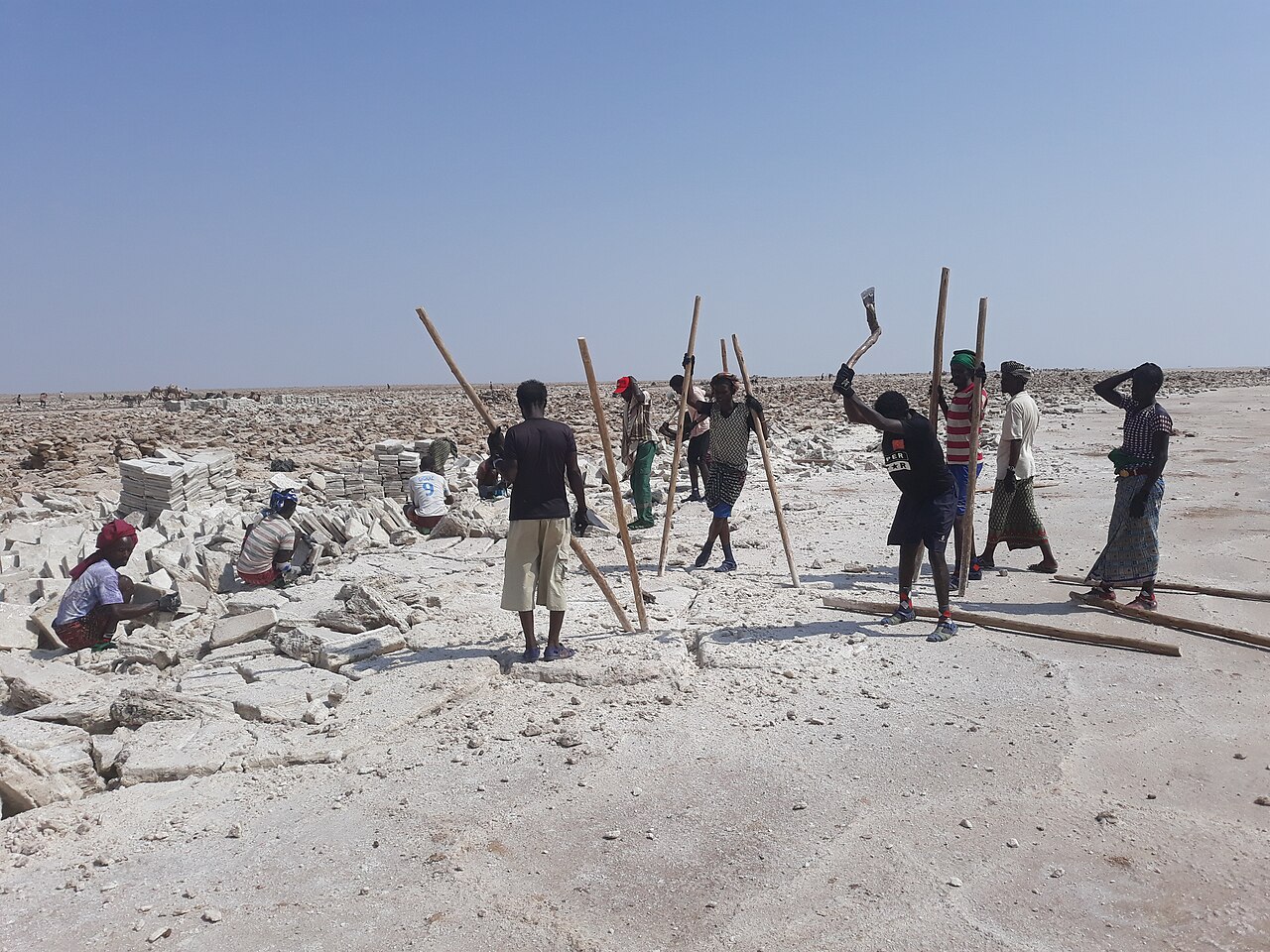
Yet, for the Afar people, this is not a wasteland. It is their homeland and their livelihood. The salt, or amole as it is traditionally known, is not a mineral to be mined; it is a crop to be harvested. The miners do not blast or drill; they cut. Using a simple set of tools that have changed little in generations—a long iron bar called a doma, a short-handled pickaxe, and a wooden mallet—they work in teams, rhythmically slicing the salt crust into rectangular slabs. Each slab, weighing between 4 and 8 kilograms (9 to 18 pounds), is a unit of currency, a building block of life.
The Ancient Economy of Salt: From Currency to Commodity
The tradition of the Afar salt miners is not merely a quaint cultural practice; it was once the backbone of a vast regional economy. Before the introduction of modern currency, salt slabs from the Danakil were a standard medium of exchange across the Ethiopian highlands. Historical records from the 16th century, including accounts from Portuguese Jesuit missionaries, describe caravans of hundreds of camels carrying salt bars to the markets of Axum, Gondar, and Harar. The value was standardized: a certain number of bars could buy a goat, a cow, or a wife’s dowry.
Today, the economic reality is more complex. While salt is no longer used as currency, it remains a vital commodity. The miners sell their slabs to middlemen, who transport them by truck or camel to markets in Mekelle, the capital of Tigray, or further afield. A single slab might sell for 20 to 50 Ethiopian birr (roughly $0.35 to $0.90 USD), a price that has remained stubbornly low for decades, squeezed by inflation, fuel costs for transport, and the sheer danger of the work.
The table below illustrates the key distinctions between the traditional and modern phases of this trade:
| Aspect | Traditional Era (Pre-1900) | Modern Era (2000-Present) |
|---|---|---|
| Primary Use | Currency, dietary salt, animal feed | Dietary salt, industrial uses (tanning), animal feed |
| Transport | Camel caravans, human porters | Trucks, camels, occasional light aircraft |
| Market Reach | Ethiopian highlands, Sudan | All of Ethiopia, parts of Somalia, Djibouti |
| Unit Value | High (direct medium of exchange) | Low (commodity, vulnerable to price fluctuations) |
| Labor | Clan-based, seasonal | Clan-based, year-round, increasingly cash-dependent |
This shift from currency to commodity has had profound consequences. The miners, once the bankers of the region, are now among its poorest laborers. Yet, the work continues, driven by a combination of tradition, lack of alternative employment, and the relentless demand for salt in a country of over 120 million people.
The Rhythm of the Harvest: A Day in the Life
The work of the Afar salt miners begins before dawn. The sun, even at 5:00 AM, is a pale threat. The miners, usually men from the same clan or village, gather at the edge of the salt pan. They are lean, their skin weathered to a deep leathery brown, their eyes shielded by sunglasses or simple cloth wrappers. Some wear flip-flops or sandals, despite the razor-sharp edges of the salt crust.
Cutting the Slabs
The process is methodical and brutal. First, the doma—a heavy iron rod about 1.5 meters long—is used to probe the crust, testing its thickness. The salt bed is not uniform; some layers are thin and brittle, others are thick and crystalline. The ideal slab is about 4 centimeters thick. The miner then swings the doma in a precise arc, driving it into the salt to create a grid of deep grooves. This is the most dangerous part: a slip can crush a foot, and the flying salt shards can blind.
Once the grid is cut, the doma is used as a lever to pry the slab loose. The miner then uses a short-handled pickaxe to trim the edges, shaping the slab into a rough rectangle. The final product, called a gela, is smooth and heavy, often with a faint pinkish or grayish hue due to trace minerals. A skilled team of three men can cut and shape between 100 and 150 slabs in a single morning.
The Caravan: Camels and Trucks
For centuries, the only way out was by camel. The Afar are renowned camel herders, and their dromedaries are perfectly adapted to the heat and lack of water. A single camel can carry 30 to 40 slabs, loaded onto a wooden saddle frame. The caravans, sometimes stretching for hundreds of animals, are a sight that has become iconic—a line of camels, swaying under their white loads, crossing a landscape of black lava and white salt.
Today, the camel is being slowly replaced by the Toyota Hilux and the Isuzu lorry. Trucks can carry far more salt, and they are faster. But they also require fuel, which must be brought into the depression, and they break down on the rough, salt-crusted tracks. The Afar miners have adapted, often using a hybrid system: camels bring the salt from the deepest pans to a central road, where trucks take over for the long haul to the highlands. This marriage of ancient and modern is a theme that runs through much of contemporary Africa.
The Human Cost: Danger, Thirst, and the Search for Water
The romance of the Afar salt miners is quickly tempered by the reality of the work. The Danakil Depression is a deathtrap. The heat is the most obvious threat. Without adequate water, a person can succumb to heatstroke in hours. The miners drink enormous quantities of water—often 10 to 15 liters a day—but the water they have access to is often brackish, warm, and carried in from distant wells.
Dehydration is a constant companion. It causes headaches, dizziness, and a deep, bone-weary fatigue. The salt itself is an enemy. The fine, white dust gets into everything: eyes, lungs, cuts, and sores. Respiratory infections are common. The miners rarely wear masks. The salt also corrodes the skin, causing painful cracks and fissures on hands and feet. A minor cut can quickly become infected.
The Afar Women: The Unseen Backbone
While the men are most visible in the salt pans, the women of the Afar community play a critical, often invisible role. They are responsible for the logistics of survival. They walk long distances to fetch water from brackish wells, often carrying heavy jerrycans on their backs. They prepare food—usually a simple porridge of sorghum or maize, sometimes with goat meat—and they maintain the temporary camps where the miners sleep.
These camps are clusters of low, dome-shaped huts made from curved branches and covered with plastic sheeting or woven mats. There is no electricity, no sanitation, and no medical care. The women also manage the small herds of goats and sheep that provide milk and meat. Their resilience is as formidable as that of the miners themselves, but they are rarely mentioned in the travelogues and documentaries that celebrate the salt trade.
Geology, Climate, and the Future of the Salt
The salt of the Danakil is not infinite, though it seems so. The depression was once part of the Red Sea, cut off from the ocean millions of years ago by tectonic uplift. The water that remained evaporated, leaving behind layer upon layer of salt, gypsum, and other evaporite minerals. The current salt crust is estimated to be between 800 meters and 1.5 kilometers thick in places. Geologically, the supply is immense.
However, the quality and accessibility of the salt are changing. Climate change is having a paradoxical effect. The region is becoming even hotter and drier, which means evaporation rates are increasing. This could, in theory, lead to more salt deposition. But it also means that the water table, which lies just below the salt crust, is dropping. In some areas, the miners have to dig deeper to reach the clean, thick salt layers. In others, the salt has become contaminated with gypsum or clay, making it less valuable.
The Threat of Industrial Mining
A more immediate threat to the traditional Afar salt miners is the arrival of industrial-scale salt extraction. In 2017, a large Ethiopian company, with investment from a Saudi firm, began constructing a massive salt processing plant near the town of Berhale, on the edge of the depression. This plant uses heavy machinery—excavators, graders, and crushers—to harvest salt at a rate that dwarfs the output of thousands of hand-cutters.
The industrial salt is cheaper, more uniform, and easier to transport. It is already finding its way into the same markets that the traditional miners have served for centuries. The Afar community is caught in a familiar dilemma: progress versus preservation. Some younger Afar have found work at the industrial plant, earning a regular wage. But for the majority, the plant represents an existential threat. They cannot compete on price or volume. Their only advantage is the perception of purity and tradition, a niche that may not be enough to sustain them.
Afar Salt Miners in a Changing Ethiopia
The Afar salt miners are not a relic of the past; they are participants in a rapidly modernizing Ethiopia. The country has seen dramatic economic growth over the past two decades, with new roads, railways, and industrial parks. The government has ambitious plans to expand the mining sector, including salt. Yet, the Afar people, who are predominantly pastoralist and semi-nomadic, have often been marginalized in these national development narratives.
The salt mines are located in the Afar Region, one of Ethiopia’s nine regional states. The region is sparsely populated, hot, and politically sensitive, bordering Eritrea and Djibouti. The Afar people have a strong sense of identity and a history of fierce independence. They have resisted both imperial domination and modern state control. The salt trade is not just an economic activity; it is a cultural anchor, a source of pride, and a link to their ancestors.
The Role of Technology and Tourism
In a surprising twist, technology is beginning to help the Afar salt miners. Mobile phones, even in the remote reaches of the depression, have become common. Miners use them to check salt prices in distant markets, to coordinate with truck drivers, and to call for help in emergencies. Solar-powered phone chargers are a prized possession.
Tourism has also grown. The Danakil Depression, with its otherworldly landscapes—the sulfur springs of Dallol, the lava lake of Erta Ale—has become a destination for adventure travelers. Many tourists want to see the salt miners at work. This has created a small but meaningful source of additional income. A miner can earn a few hundred birr by posing for photos or by giving a short tour of the cutting process. It is not a solution to the deeper economic challenges, but it is a connection to the wider world.
Preserving a Tradition: Can the Salt Miners Survive?
The question that hangs over the Danakil is whether the tradition of the Afar salt miners can survive the 21st century. The pressures are immense: industrial competition, climate change, a changing economy, and the pull of urban migration. Many young Afar are leaving the salt pans for the cities of Mekelle, Semera, or even Addis Ababa. They seek education, employment, and a life that does not involve 50°C heat and blinding salt dust.
Yet, there are also signs of resilience. The Afar have adapted to change before. They have survived drought, war, and displacement. The salt trade is woven into their social fabric. It is a source of cash, but it is also a marker of identity. To be an Afar salt miner is to be a man of the desert, a keeper of an ancient skill.
Initiatives for a Sustainable Future
Some non-governmental organizations and academic researchers are working with the Afar communities to find a sustainable path forward. Ideas include:
- Fair Trade Certification: Creating a premium market for hand-cut salt, similar to fair-trade coffee or chocolate. Tourists and specialty food markets in the West might pay more for a product with a human story.
- Improving Safety and Health: Providing simple protective equipment—goggles, gloves, dust masks—and training in basic first aid. Digging better, deeper wells for clean drinking water.
- Diversification: Encouraging the miners to also engage in small-scale tourism, guiding, or craft production using salt (e.g., salt lamps, decorative items).
- Cooperative Ownership: Helping the miners form cooperatives to gain more bargaining power against middlemen and industrial buyers.
These initiatives are small, but they offer a glimmer of hope. The goal is not to freeze the Afar in time, as a living museum exhibit. It is to allow them to choose their own future, to adapt the tradition on their own terms.
The Enduring Legacy: More Than Just Salt
The story of the Afar salt miners is a story of human ingenuity and endurance in the face of a hostile environment. It is a story that resonates far beyond Ethiopia. It reminds us that the world’s most ancient traditions are not static; they are dynamic, constantly negotiating between the past and the present. The miners are not victims, nor are they heroes. They are people, working to feed their families in one of the hardest places on Earth.
As you stand on the salt pan, the heat radiating up through the soles of your shoes, the silence broken only by the rhythmic thwack of a wooden mallet on an iron bar, you feel the weight of centuries. The Afar salt miners are not just mining salt. They are mining history, one slab at a time. And in that simple, brutal act, they are keeping alive a tradition that is as old as civilization itself. Whether this tradition will be carried forward by their children, or whether it will finally succumb to the relentless forces of modernity, remains to be seen. But for now, the camels still sway, the slabs still stack, and the miners still rise before dawn, to harvest the white gold of the Danakil.