📅 Last updated: 01.09.2026
In the heart of Ahmedabad’s old city, the Sidi Saiyyed Mosque stands as a breathtaking testament to the synthesis of Indo-Islamic artistry and African heritage, its world-famous stone lattice windows—the jali—capturing both the morning sun and the imagination of every visitor who passes beneath its arches. Built in 1573, the mosque is not merely a place of worship; it is a sculptural poem carved from white marble and yellow sandstone, a monument that bridges the mercantile ambition of the Gujarat Sultanate with the profound skills of African-descended artisans and administrators who shaped the region’s history.
- The African Hand in Gujarat’s History: The Sidi Legacy
- Anatomy of a Masterpiece: The Jali Work of the Sidi Saiyyed Mosque
- The Craft: A Tradition of Stone Carving and African Artisanship
- Ahmedabad: The City that Embraces the Sidi Saiyyed Mosque
- Modern Connections: The Sidi Community Today
- Preservation and the Future of a Masterpiece
- The Sidi Saiyyed Mosque as a Global Icon
- Practical Guide for the Visitor
- Conclusion: More Than Stone and Light
To walk into the mosque’s courtyard is to step into a quiet, shaded sanctuary where the chaos of the bustling city outside fades into a murmur. Yet, the true spectacle is not in the prayer hall’s simple, elegant interior, but in the ten exquisite stone screens that line its walls. These are not just windows; they are intricate, petrified forests of interwoven branches, leaves, and palm fronds, so delicately carved that they appear to have been spun from lace rather than chiseled from rock. This article delves deep into the history, artistry, and enduring legacy of this iconic structure, exploring its African connections and its place in the vibrant tapestry of Ahmedabad, a city recently designated as a World Heritage City by UNESCO.
The African Hand in Gujarat’s History: The Sidi Legacy
The story of the Sidi Saiyyed Mosque is inextricably linked to the story of the Sidis, a community of African origin—primarily from the Swahili Coast, Ethiopia, and Sudan—who have called India home for over 700 years. The name “Sidi” (also spelled Siddi, Sheedi, or Siddhi) is derived from the Arabic term Sayyidi, meaning “My Master,” a title of respect given to high-ranking officials and religious leaders. These were not a monolithic group; they arrived in the Indian subcontinent through various waves of migration, including as traders, mercenaries, and enslaved soldiers, often rising to positions of immense power and influence.
During the 15th and 16th centuries, the Gujarat Sultanate was a wealthy and cosmopolitan state, its ports at Cambay (Khambhat) and Surat bustling with trade from the Red Sea, the Persian Gulf, and East Africa. It was within this context that African soldiers and administrators, known for their loyalty, martial prowess, and administrative acumen, were recruited into the sultanate’s service. They were integrated into the highest echelons of society, not as marginal figures, but as powerful generals and provincial governors.
Sidi Saiyyed: The Man Behind the Mosque
The man who commissioned this architectural marvel, Sidi Saiyyed, was one such figure. A general in the army of the last Gujarat Sultan, Muzaffar Shah III, Sidi Saiyyed was a man of considerable standing. Historical records suggest he was a Habshi, a term used at the time for people of Abyssinian (Ethiopian) descent. He was not merely a soldier; he was a nobleman with the wealth and cultural patronage to commission a public monument that would outlive the sultanate itself.
Interestingly, the mosque was built in the very year the Gujarat Sultanate fell to the Mughal Emperor Akbar (1573). This timing is significant. It suggests that Sidi Saiyyed was a figure powerful and respected enough to complete a significant public work during a period of political transition. The mosque, therefore, stands not as a symbol of a dying dynasty, but as a marker of the enduring influence of the Sidi community in Gujarat, a community that would continue to serve the Mughals and later the British, with several Sidi families becoming hereditary rulers of small princely states like Sachin and Janjira.
Anatomy of a Masterpiece: The Jali Work of the Sidi Saiyyed Mosque
The architectural plan of the mosque is relatively simple: a rectangular prayer hall, about 30 meters long, with a beautifully carved central mihrab (prayer niche). The facade is a series of wide, pointed arches, which are typical of the Tughlaq and early Gujarat Sultanate styles. But the mosque’s true genius lies in its ten side screens, or jalis. These are not merely decorative; they are the defining feature of the monument, transforming what could be a stark, shadowy interior into a space drenched in dappled, ethereal light.
The jali technique involves carving a single slab of stone so that the background is cut away, leaving a pattern that is completely integrated into the frame. At Sidi Saiyyed, this is done with such virtuosity that the stone loses its weight and appears to float. The patterns are primarily floral and arboreal, a departure from the more geometric patterns common in many Islamic monuments. This choice reflects a local Gujarati aesthetic, a love for the natural world that permeates much of the region’s art and craft.
The “Tree of Life”: The Central Panel
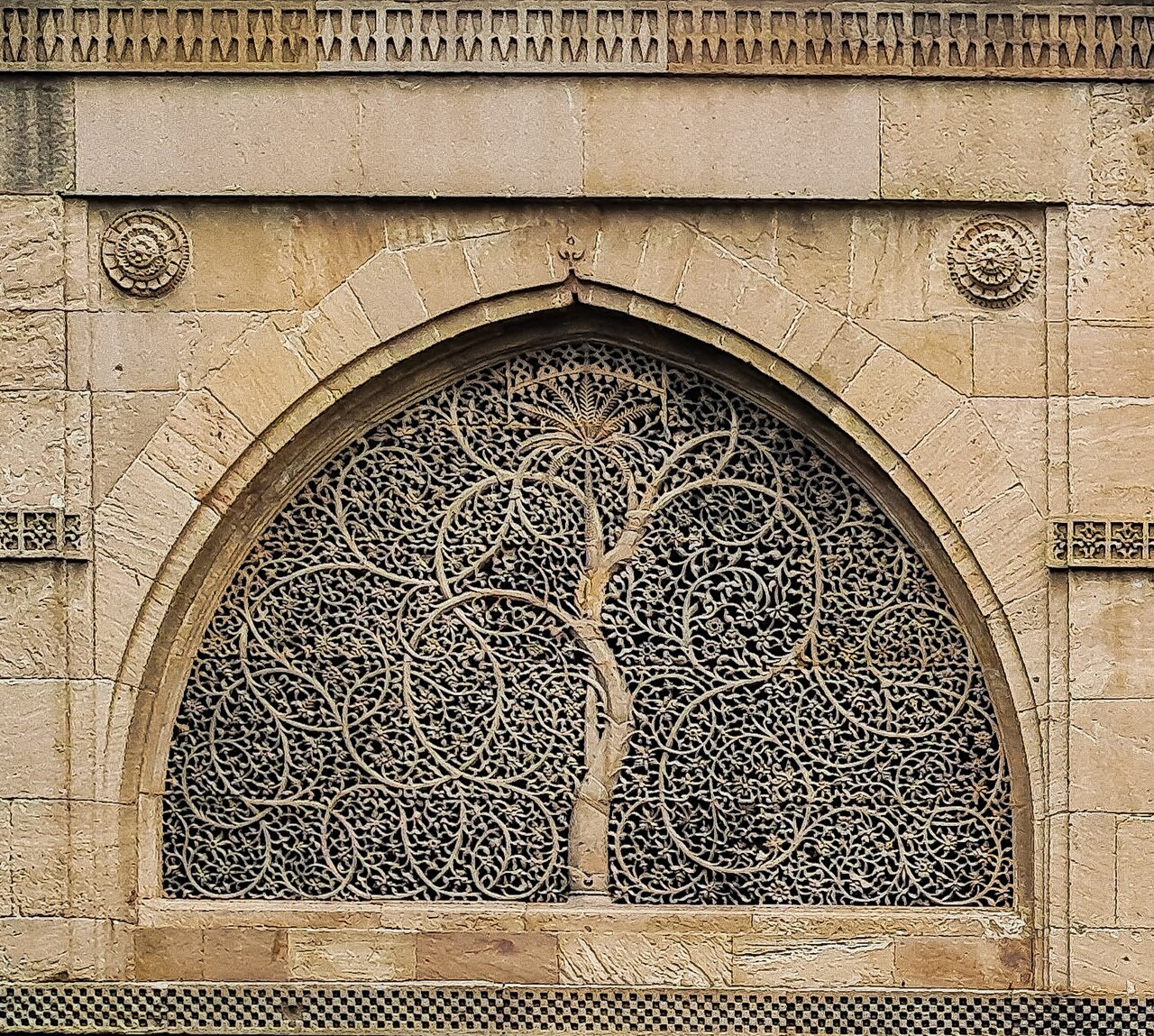
The most famous of these panels is the central one on the western wall, often referred to as the “Tree of Life” or the “Sidi Saiyyed Jali.” This masterpiece is a dense, intricate composition of intertwining branches and foliage that form a stylized, symmetrical tree. It is not a literal depiction of a specific tree, but rather a symbolic representation of abundance, life, and the interconnectedness of all things. The carving is so deep and the undercutting so fine that the branches appear to have been grown, not carved.
Visitors often spend hours trying to trace the path of a single branch through the tangle, only to find it looping back on itself in a hypnotic, endlessly complex pattern. The precision is mind-boggling. It is said that the carving was so delicate that the artisans had to work on the stone slabs before they were installed, and that the task was so intense it took several years to complete. This central panel has become the de facto icon of Ahmedabad, appearing on the city’s official letterhead and being the subject of countless photographs, paintings, and even textile designs.
“It is the most beautiful carving I have ever seen,” wrote a British traveler in the 19th century. “The stone is so thin and the work so fine that one could believe it was the work of fairies rather than of men.”
Comparison of the Ten Screens
While the Tree of Life is the most famous, the other nine jalis are equally worthy of study. Each is unique, though they share a common vocabulary of swirling arabesques, curling tendrils, and stylized lotus buds. Some are more geometric, with a central medallion surrounded by radiating stars. Others are pure, abstract representations of foliage. This variety suggests a workshop of highly skilled artisans, each with their own specialty, working under a master designer.
Here is a brief breakdown of the various panels:
| Panel Location | Primary Motif | Artistic Characteristics |
|---|---|---|
| Central (Western Wall) | Tree of Life | Complex, interwoven branches; deep undercutting; symbolizes abundance and eternity. |
| Northern Wall (Left) | Floral Medallions | Geometric star patterns within a circular frame, interspersed with small, delicate flowers. |
| Northern Wall (Center) | Palm Fronds | Arching, curved lines resembling palm leaves, creating a sense of graceful movement. |
| Southern Wall (Right) | Interlocking Vines | A dense network of thin, flowing vines that form a repetitive, rhythmic pattern. |
| Southern Wall (Center) | Lotus & Swirl | A stylized lotus flower at the center, surrounded by swirling, abstract foliage. |
This table only scratches the surface. The skill required to carve a single, continuous line of vine through a slab of stone, without breaking it, is a feat of near-superhuman patience and control. The artisans who created these screens were not just laborers; they were masters of their craft, inheritors of a tradition of stone carving that had flourished in Gujarat for centuries.
The Craft: A Tradition of Stone Carving and African Artisanship
The creation of the Sidi Saiyyed Mosque was a collaborative effort, reflecting the diverse society of 16th-century Gujarat. While the patron was of African descent, the architects and masons were likely local Gujaratis, members of the Salat or Sompura communities who were renowned for their stone-working abilities. This cross-cultural collaboration is a vital part of the mosque’s story. It was not an “African” style imposed on an Indian landscape, but a fusion—using local materials, local techniques, and local motifs, to express the faith and status of an African patron.
This period in Gujarat was a golden age for construction. The Sultanate had developed a unique architectural style that blended elements of Indo-Aryan temple architecture with Islamic forms. The use of carved stone screens, or jalis, became a hallmark of this style, used in palaces and tombs to provide privacy, light, and ventilation. The Sidi Saiyyed Mosque represents the absolute pinnacle of this jali tradition. No other monument in Gujarat, or perhaps in all of India, achieved such a level of intricacy and artistic expression in this medium.
The Material: Sandstone and Light
The mosque is built primarily from a warm, honey-colored sandstone, quarried locally. This stone is relatively soft when first extracted, allowing for intricate carving, but hardens upon exposure to air. This property was essential for the creation of the jalis. The artisans had to work quickly, but with immense precision, knowing that any mistake could not be easily corrected. The choice of sandstone also has an aesthetic effect: it glows in the afternoon sun, turning the mosque into a lantern of warm light.
The interplay of light and shadow is the true magic of the jali. As the sun moves across the sky, the patterns of light cast on the floor and walls of the prayer hall change constantly. At dawn, long, sharp shadows stretch across the floor. At midday, the light is bright and dappled, creating a sense of being inside a forest canopy. In the late afternoon, the light turns golden, illuminating the intricate details of the carving. This is not just a building; it is a solar clock, a living artwork that changes with every passing hour.
Ahmedabad: The City that Embraces the Sidi Saiyyed Mosque
The Sidi Saiyyed Mosque is not a relic isolated from the life of the city; it is the beating heart of old Ahmedabad. Located on the busy Lal Darwaja (Red Gate) thoroughfare, it sits at a major crossroads, with auto-rickshaws honking, vendors selling roasted corn and spicy chai, and a constant stream of people passing by. The contrast between the frantic, modern energy of the street and the serene, timeless beauty of the mosque is one of the most compelling aspects of visiting it.
For the people of Ahmedabad, the mosque is a source of immense pride. It is featured on the city’s official logo, a symbol of their heritage and artistry. It is also a popular spot for locals to relax, read a book, or simply sit in the shade and watch the world go by. It is a living monument, used for prayers five times a day, yet also open to tourists and photographers from around the world.
UNESCO World Heritage Status
In 2017, Ahmedabad was declared India’s first UNESCO World Heritage City, and the Sidi Saiyyed Mosque was cited as one of the key monuments justifying this status. This recognition has brought increased attention and conservation efforts to the old city. The mosque, managed by the Archaeological Survey of India (ASI), has undergone careful restoration to ensure that the delicate jalis are preserved for future generations. The UNESCO citation specifically praised the city’s “exceptional example of Indo-Islamic architecture,” with the mosque being a prime exhibit.
This global recognition has also helped to reframe the narrative around the Sidi community. For years, the story of the mosque was told primarily as a tale of Mughal or Sultanate architecture, with the African connection often glossed over. Today, there is a growing interest in the Sidi heritage, both in India and abroad. The mosque is increasingly recognized as a powerful symbol of the African diaspora’s contributions to global culture—a tangible, magnificent proof that African people were not just passive subjects of history, but active shapers of the societies they lived in.
Modern Connections: The Sidi Community Today
Who are the descendants of Sidi Saiyyed and his contemporaries today? They are a vibrant, if small, community scattered across Gujarat, Karnataka, and Hyderabad, as well as in Pakistan. In Gujarat, the Sidi community is primarily concentrated in the regions of Saurashtra and Kutch. Over the centuries, they have integrated deeply into Indian society, adopting the Gujarati language and local customs, while maintaining a distinct cultural identity through music, dance, and religious practices.
One of the most visible expressions of this living heritage is the Sidi Goma music and dance tradition. This is a powerful, trance-inducing performance featuring the damam (a large kettledrum), the mugarman (a bow instrument), and energetic, acrobatic dancing. The music has African roots, with rhythms and call-and-response patterns that would be familiar to audiences in East Africa. The Sidi Goma troupe has performed internationally, bringing this unique cultural treasure to global audiences.
Here are some key aspects of the Sidi community’s contemporary identity:
- Religious Syncretism: Many Sidis are Sunni Muslims, but their practice is often infused with Sufi traditions and veneration of saints, including African Sufi saints like Bava Gor, whose shrine in Ratanpur, Gujarat, is a major pilgrimage site for both Sidis and other Muslims.
- Cultural Preservation: Organizations like the Sidi Heritage and Cultural Centre in Talala, Gujarat, are working to document and preserve their history, language, and performing arts.
- Modern Identity: Many Sidis now use the term “Afro-Indian” to describe themselves, forging a connection with the wider African diaspora while asserting their rightful place as an integral part of India’s multicultural fabric.
- Economic Status: Historically, many Sidis were landless laborers or engaged in traditional occupations. In recent decades, government affirmative action programs and increased educational opportunities have helped improve their socio-economic standing.
The Sidi Saiyyed Mosque is thus not a monument to a vanished people, but a living link to a community that continues to thrive, adapt, and contribute to the nation. It is a beacon of their history, a reminder of their ancestors’ achievements, and a source of inspiration for their future.
Preservation and the Future of a Masterpiece
The very delicacy that makes the jalis of the Sidi Saiyyed Mosque so breathtaking also makes them profoundly vulnerable. The sandstone is susceptible to weathering, pollution, and the vibrations caused by the heavy traffic that throngs the surrounding roads. The constant exposure to vehicle exhaust has led to a darkening of the stone and a weakening of the thin, carved sections.
The Archaeological Survey of India (ASI) has undertaken significant conservation work in recent years. This has involved careful cleaning of the stone, the application of consolidants to strengthen the fragile lattice, and the installation of protective barriers to prevent visitors from touching the delicate carvings. There is a delicate balance to be struck between preserving the monument and keeping it accessible to the public who love it.
Furthermore, there is a growing movement to document the mosque using cutting-edge technology. 3D scanning and photogrammetry have been used to create highly detailed digital models of the jalis. This serves two purposes: it provides a permanent record of the monument in its current state, invaluable for future restoration efforts, and it allows people from around the world to experience the intricate details of the carving in a virtual format, without putting pressure on the fragile original structure.
The Sidi Saiyyed Mosque as a Global Icon
The influence of the Sidi Saiyyed Mosque extends far beyond the boundaries of Ahmedabad. Its image is a staple of coffee table books on Indian architecture, and its design has inspired countless replicas and adaptations. Perhaps the most famous of these is the “Tree of Life” pattern, which has been reproduced in everything from furniture screens and laser-cut metal panels to jewelry and fabric prints. The design has become a shorthand for “Indian craftsmanship” around the world.
This global recognition is a double-edged sword. On one hand, it cements the mosque’s status as a masterpiece of world heritage. On the other, it can sometimes obscure the specific, local, and deeply African-influenced context of its creation. When we see the “Tree of Life” on a modern product, we rarely think of the Sidi general who commissioned it, or the African soldiers and merchants who were such an integral part of the society that produced it.
This is why telling the full story of the Sidi Saiyyed Mosque is so crucial. It is a story that challenges simplistic narratives of a monolithic “Islamic” or “Indian” art. It highlights the complex, fluid, and often surprising ways in which cultures interact, blend, and create something entirely new. It is a story of migration, power, faith, and art—a story that resonates as much in the 21st century as it did in the 16th.
Practical Guide for the Visitor
For those planning a trip to Ahmedabad, a visit to the Sidi Saiyyed Mosque is an absolute essential. It is not a large monument, and it can be seen in an hour, but it is an hour that will stay with you for a lifetime.
Here is a quick guide to planning your visit:
- Location: The mosque is located at Lal Darwaja, in the heart of the old city. It is easily accessible by auto-rickshaw or taxi. The nearest major landmark is the Bhadra Fort.
- Timings: The mosque is generally open from early morning to sunset. It is closed to tourists during the main prayer times (Zuhar and Jumu’ah on Fridays).
- Entry Fee: There is a nominal entry fee for foreign tourists, while Indian nationals may enter for a very small fee or free of charge, as per the ASI rules.
- Best Time to Visit: The light is most dramatic in the late afternoon (around 4 PM to 5:30 PM) when the sun is low and the jalis cast long, beautiful shadows. The winter months (November to February) are the most pleasant for exploring the city.
- Etiquette: As this is a functioning mosque, visitors should dress modestly (cover shoulders and knees). It is customary to remove shoes before entering the prayer hall.
After visiting the mosque, take some time to explore the surrounding streets. The nearby Manek Chowk is a vibrant market square that transforms from a vegetable market in the morning to a bustling food market at night. The chaotic energy of the old city is the perfect counterpoint to the serene beauty of the mosque, offering a complete sensory experience of Ahmedabad.
Conclusion: More Than Stone and Light
The Sidi Saiyyed Mosque is more than just an architectural wonder; it is a profound symbol of the African diaspora’s global impact. For too long, the history of Africa has been told from the perspective of its colonizers, focusing on what was taken from it. But the story of Sidi Saiyyed and the Sidi community of India offers a different narrative—one of agency, skill, and cultural fusion. It stands as a testament to the fact that African people, even when far from their ancestral homelands, were not merely laborers or victims, but were often leaders, patrons of the arts, and architects of civilization.
Standing before the Tree of Life, one is not just looking at a beautiful carving. One is looking at the legacy of a general who served his adopted land with distinction. One is looking at the hands of nameless artisans who poured their soul into stone. One is looking at centuries of history—of trade winds connecting Gujarat and East Africa, of faith, of power, and of the enduring human desire to create beauty. The Sidi Saiyyed Mosque is a masterpiece, yes, but it is also a bridge—connecting Africa to India, the past to the present, and the sacred to the everyday. It is a reminder that the world’s heritage is a shared, interconnected tapestry, and that the threads of African history are woven into the very fabric of our global civilization.