📅 Last updated: 01.09.2026
In the highlands of northern Ethiopia, where the sun-scorched earth gives way to dramatic plateaus and ancient rock-hewn churches, lies the legacy of the Kingdom of Aksum, one of the most powerful and sophisticated civilizations of the ancient world. From roughly the 1st century CE to the 8th century, this empire commanded trade routes that connected the Roman world to India, minted its own currency, and forged a unique civilization that would shape the destiny of the Horn of Africa for millennia. Yet today, its story remains one of Africa’s best-kept secrets—a monumental chapter in human history that deserves far more recognition than it typically receives.
- The Rise of the Kingdom of Aksum: A Commercial Empire
- The Kingdom of Aksum and the Adoption of Christianity
- Monuments of Stone: The Stele Field and Aksumite Architecture
- The Kingdom of Aksum's Golden Age: Ezana, Kaleb, and Beyond
- The Decline of the Kingdom of Aksum: Causes and Consequences
- Key Dates and Milestones in the History of the Kingdom of Aksum
- Rediscovering the Kingdom of Aksum: Archaeology and Heritage
- Living Legacy: The Kingdom of Aksum in Ethiopian Identity Today
- Aksum's Enduring Lessons
The Kingdom of Aksum did not emerge from a vacuum. It rose from the fertile soils of the Tigray region, building upon earlier proto-Ethiopian cultures like D’mt, which flourished as early as the 10th century BCE. But what made Aksum extraordinary was its ability to synthesize influences from across the ancient world—South Arabian script, Egyptian trade networks, Greek artistic conventions, and indigenous African traditions—into something entirely new and distinctly powerful. By the third century CE, the Persian prophet Mani would list Aksum as one of the four great powers of the world, alongside Rome, Persia, and China. This was no peripheral kingdom; it was a global superpower.
The Rise of the Kingdom of Aksum: A Commercial Empire
The city of Aksum, the empire’s capital, was strategically positioned on the edge of the Ethiopian highlands, a natural fortress that guarded its inhabitants while offering access to the Red Sea. The nearby port of Adulis, located on the Gulf of Zula in modern-day Eritrea, served as the empire’s commercial lifeline. It was through Adulis that the Kingdom of Aksum plugged into an intricate web of Indian Ocean trade, exporting ivory, frankincense, myrrh, gold, and exotic animal skins to markets as far away as Alexandria, Rome, and the western coast of India.
In return, Aksum imported silk, spices, glassware, and wine, creating a vibrant cosmopolitan culture that blended African, Arabian, and Mediterranean influences. The Roman historian Pliny the Elder described Adulis as a bustling emporium, and by the second century CE, the anonymous author of the Periplus of the Erythraean Sea—a Greek sailing manual—singled out Adulis as a major hub of commerce. The wealth generated by this trade funded monumental building projects, supported a powerful military, and attracted the attention of rivals and allies alike.
What set the Kingdom of Aksum apart from other trading states was its mastery of technology and administration. Aksumite engineers developed sophisticated irrigation systems, including terraced farming and reservoirs that allowed the empire to feed its growing population. The kingdom’s rulers, known as negus or negusa nagast (king of kings), maintained a centralized bureaucracy that could mobilize labor for massive construction projects, levy taxes, and administer justice across a vast territory. They also introduced a unique system of coinage—the first in sub-Saharan Africa—which not only facilitated trade but also projected royal authority through images of the king, often accompanied by symbols of the sun and moon or, later, the cross.
The Aksumite Navy and Regional Dominance
The Aksumite navy was the most formidable naval force in the region, allowing the empire to project power across the Red Sea. In the fourth century CE, King Sembrouthes conducted military campaigns in Arabia, and his successor, the legendary King Ezana, expanded Aksumite control over parts of the Arabian Peninsula, including the kingdom of Himyar in modern-day Yemen. This trans-Red Sea empire was not merely a colonial venture; it was a strategic move to secure trade routes and ensure the free flow of goods between Africa and Asia.
The Aksumite military was equally formidable on land. Ezana’s campaigns against the Nuba and the Beja peoples, recorded in Greek and Ge’ez inscriptions, demonstrate a disciplined army capable of long-range operations. But unlike many ancient empires, Aksum’s expansion was not purely predatory. The kingdom established diplomatic relationships with its neighbors, exchanged ambassadors with the Byzantine Empire, and even offered refuge to early Muslims fleeing persecution in Mecca in 615 CE—a gesture that earned the empire lasting goodwill in the Islamic world.
The Kingdom of Aksum and the Adoption of Christianity
Perhaps the most transformative moment in the history of the Kingdom of Aksum came in the early fourth century CE, when King Ezana converted to Christianity. The exact circumstances remain shrouded in legend, but the historical record is clear: by around 330 CE, Ezana had abandoned the traditional polytheistic worship of the Aksumite pantheon—which included the gods Astar, Mahrem, and Beher—and embraced the new faith. His coins, once bearing the sun-and-moon disc, now displayed the cross, and his inscriptions invoked the Father, Son, and Holy Spirit.
The conversion of Aksum was not an isolated event. It occurred against the backdrop of the Roman Empire’s own Christianization under Constantine, and the two powers maintained close diplomatic and religious ties. The Aksumite church was initially under the authority of the Patriarchate of Alexandria, and the bishop of Aksum was traditionally appointed from Egypt—a practice that continued for centuries. This connection to the Coptic Church would have profound implications for Ethiopian Christianity, shaping its liturgy, theology, and monastic traditions.
Christianity did not replace indigenous beliefs overnight. Instead, it coexisted with older traditions, absorbing and transforming them. The Ark of the Covenant, which Ethiopian tradition claims was brought to Aksum by Menelik I—the legendary son of the Queen of Sheba and King Solomon—became the centerpiece of a new national mythology. The church of St. Mary of Zion in Aksum, built in the fourth century and rebuilt several times since, is believed to house the Ark to this day. Whether or not one accepts the historical veracity of this claim, it speaks to the profound spiritual significance of Aksum in Ethiopian identity.
Monuments of Stone: The Stele Field and Aksumite Architecture
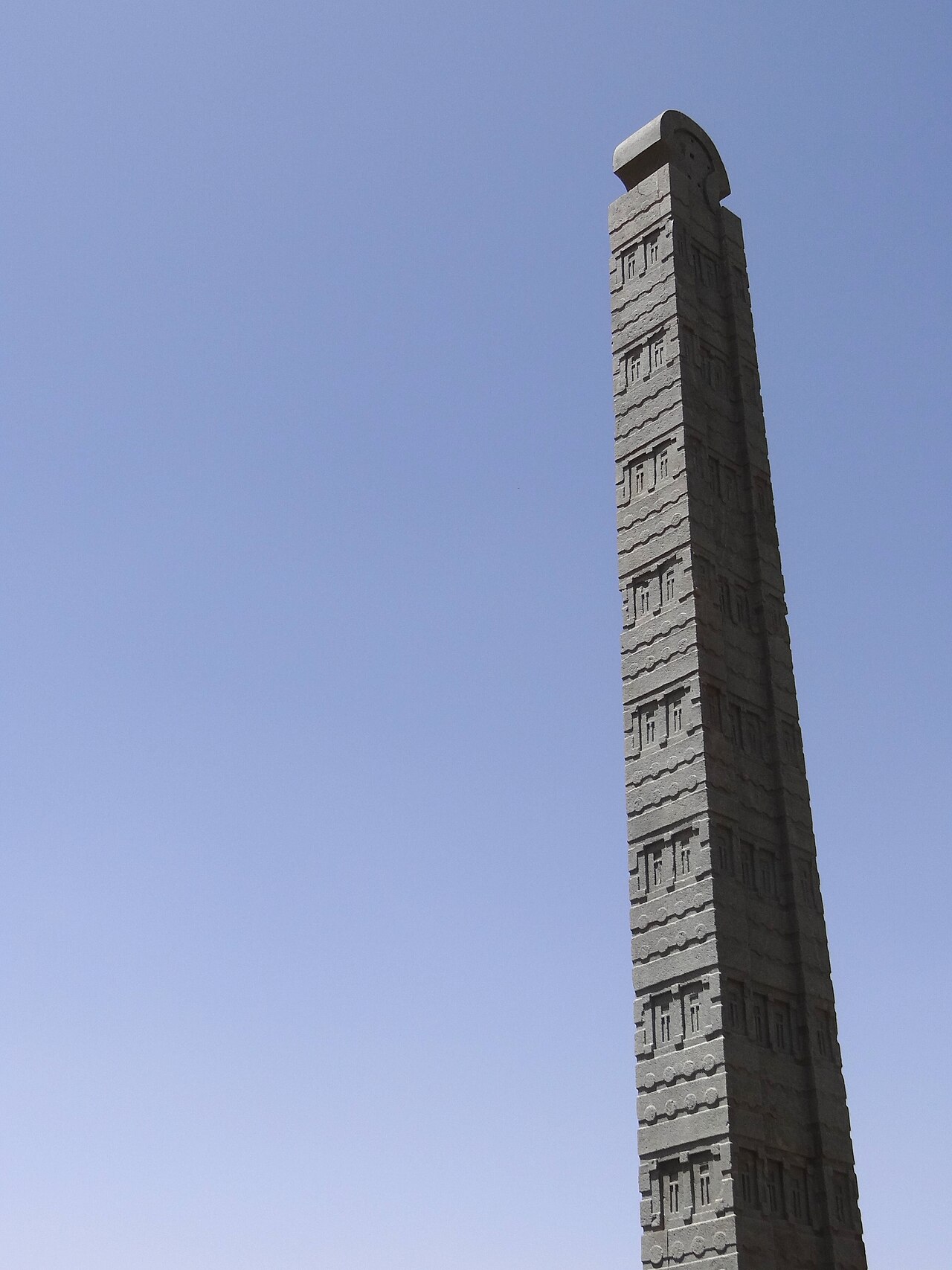
No visit to Aksum is complete without standing in the shadow of its famous stelae—towering granite obelisks that served as markers for royal tombs. The largest of these, the Great Stele, once stood over 33 meters tall and weighed an estimated 500 tons, making it the largest single piece of stone ever quarried in the ancient world. Although it now lies broken on the ground, its sheer scale is a testament to the engineering prowess of Aksumite stonemasons.
The stelae are more than mere monuments; they are architectural models in stone. Carved with intricate details that mimic multi-story buildings, complete with doors, windows, and beam ends, they offer a glimpse into the lost wooden architecture of Aksum. The tallest standing obelisk, the Obelisk of Aksum, measures 24 meters and was carved in the fourth century CE. It was looted by Italian forces in 1937 and returned to Ethiopia in 2005 after a long diplomatic campaign—a symbol of the enduring significance of these ancient monuments.
Beneath the stelae lie elaborate underground tombs, some with multiple chambers, carved directly into the bedrock. The Tomb of the Brick Arches and the Tomb of the False Door reveal sophisticated construction techniques, including corbelled arches and precisely fitted stonework. These tombs were not merely burial chambers; they were statements of royal power, designed to ensure the safe passage of the king into the afterlife and to cement his legacy in the memory of his people.
The Palace of Dungur and Daily Life
Beyond the royal monuments, the ruins of Dungur—often called the Palace of the Queen of Sheba—offer a glimpse into the lives of Aksum’s elite. This sprawling complex, dating to the sixth or seventh century CE, includes a central courtyard, multiple rooms, and a sophisticated drainage system. The palace walls, built of granite blocks without mortar, demonstrate the characteristic Aksumite building technique known as dry-stone masonry, which required immense skill and precision.
Ordinary Aksumites lived in simpler dwellings, typically round houses with stone foundations and thatched roofs, but they shared in the prosperity of the empire. Agricultural surpluses, generated by the fertile highland soils, supported a dense population. Inscriptions and archaeological evidence reveal a society with distinct social classes, including nobles, priests, merchants, artisans, and farmers. Women could hold significant property rights and even wield political influence, as evidenced by the prominent role of the queen mother in Aksumite court life.
The Kingdom of Aksum’s Golden Age: Ezana, Kaleb, and Beyond
The reign of King Ezana in the fourth century marked the apex of Aksumite power. His inscriptions, written in Ge’ez, Sabaean, and Greek, boast of military victories, territorial expansion, and the establishment of a Christian empire. Ezana’s armies pushed south into the Ethiopian highlands, incorporating the Agaw and other peoples into the Aksumite sphere, and east across the Red Sea into Arabia. His reign saw the consolidation of a unified state that stretched from the Nile Valley to the Arabian coast.
Two centuries later, King Kaleb (reigned c. 520–540 CE) launched one of the most ambitious military campaigns of the ancient world. At the request of the Byzantine Emperor Justin I, Kaleb invaded Himyar in southern Arabia to end the persecution of Christians by the Jewish king Dhu Nuwas. The campaign was successful, and Kaleb established a protectorate over the region, installing a Christian ruler and securing Aksum’s dominance over the Red Sea trade. This intervention, recorded in the Book of the Himyarites and in contemporary Greek sources, demonstrates the global reach of the Kingdom of Aksum at its zenith.
Kaleb’s reign also saw a flowering of Aksumite culture. The church of St. Mary of Zion was expanded, monasteries were founded, and the production of illuminated manuscripts flourished. The Ge’ez language, which had developed a written script from South Arabian origins, became the literary language of the empire, used for royal inscriptions, religious texts, and historical chronicles. The translation of the Bible into Ge’ez, known as the Garima Gospels, is one of the oldest surviving illuminated manuscripts in the world, dating to the fifth or sixth century CE.
The Decline of the Kingdom of Aksum: Causes and Consequences
The decline of the Kingdom of Aksum was a gradual process, unfolding over several centuries. By the seventh century, the rise of Islam had transformed the geopolitical landscape of the Red Sea. The new Arab empires, first the Umayyads and then the Abbasids, controlled the major trade routes, and Aksum’s access to the sea was increasingly challenged. The port of Adulis, once the empire’s lifeline, declined in importance as trade shifted to Muslim-controlled ports along the Arabian coast.
Environmental factors also played a role. Archaeological evidence suggests that deforestation, soil erosion, and overgrazing, exacerbated by centuries of intensive agriculture, led to declining agricultural yields. The Aksumite heartland, once capable of supporting a large population, could no longer sustain the empire’s urban centers. Political fragmentation followed, as regional governors asserted their autonomy and new powers, such as the Zagwe dynasty, rose to prominence in the south.
Yet the legacy of the Kingdom of Aksum did not disappear. Its language, Ge’ez, evolved into the liturgical language of the Ethiopian Orthodox Church. Its architectural traditions influenced the rock-hewn churches of Lalibela, carved in the 12th and 13th centuries. Its coinage, administrative structures, and religious institutions provided the foundation for subsequent Ethiopian states. Most importantly, the Aksumite identity—rooted in Christianity, monarchy, and a unique cultural heritage—became the bedrock of Ethiopian national consciousness.
Key Dates and Milestones in the History of the Kingdom of Aksum
For readers seeking a quick overview, the following table summarizes the most significant milestones in Aksumite history:
| Date (approx.) | Event | Significance |
|---|---|---|
| 1st century CE | Rise of Aksum as a regional power | Consolidation of trade networks and urbanization of the capital |
| c. 330 CE | Conversion of King Ezana to Christianity | Establishment of the first Christian state in sub-Saharan Africa |
| c. 350 CE | Ezana’s campaigns against the Nuba | Expansion of Aksumite territory into the Nile Valley |
| c. 520–540 CE | King Kaleb’s invasion of Himyar | Peak of Aksumite military power and influence in Arabia |
| 7th century CE | Rise of Islam and decline of Adulis | Economic decline and increasing isolation |
| c. 8th century CE | Political fragmentation and rise of the Zagwe dynasty | End of Aksumite imperial authority |
Rediscovering the Kingdom of Aksum: Archaeology and Heritage
The modern rediscovery of the Kingdom of Aksum is a story of scientific inquiry, national pride, and international cooperation. The first systematic archaeological investigations began in the early 20th century, led by German and French expeditions. The Italian occupation of Ethiopia (1936–1941) was marked by the looting of the Obelisk of Aksum, which was erected in Rome as a symbol of fascist imperial ambition. Its return in 2005, after years of diplomatic pressure, was a powerful moment of restitution and a testament to the enduring significance of Aksumite heritage.
Today, the Aksum Archaeological Site is a UNESCO World Heritage Site, recognized for its outstanding universal value. Ongoing excavations continue to reveal new insights into Aksumite urbanism, trade, and daily life. Recent discoveries, including a fourth-century church at the site of Beta Giyorgis and a large-scale residential complex at the nearby site of Gobedra, have expanded our understanding of the empire’s complexity and sophistication.
Ethiopian archaeologists, many of them trained at the University of Aksum and other national institutions, are leading these efforts, often in collaboration with international teams. Their work is not merely academic; it is a project of national identity, reclaiming a proud heritage that connects modern Ethiopia to its ancient roots. The Aksum Museum, opened in 2019, showcases artifacts from the site, including pottery, jewelry, coins, and inscriptions, offering visitors a tangible connection to this remarkable civilization.
Living Legacy: The Kingdom of Aksum in Ethiopian Identity Today
The Kingdom of Aksum is not a relic of the distant past; it is a living presence in Ethiopian life. The Ethiopian Orthodox Church, with its ancient liturgy, monastic traditions, and deep reverence for the Ark of the Covenant, traces its origins directly to Aksum. The annual festival of Timkat, which celebrates the Epiphany, draws thousands of pilgrims to Aksum, where they reenact the baptism of Christ in a ceremony that echoes ancient Aksumite rituals.
The Rastafari movement, which emerged in Jamaica in the 1930s, also claims a spiritual connection to Aksum. Rastafarians regard Ethiopia as the promised land and Emperor Haile Selassie I, who claimed descent from the Solomonic line that traces back to Menelik I, as a divine figure. For Rastafarians, the Kingdom of Aksum represents the golden age of African civilization, a source of pride and inspiration in the face of colonial oppression.
Modern Ethiopia also looks to Aksum for symbols of national unity and resilience. The national airline, Ethiopian Airlines, features an obelisk in its logo. The flag of Ethiopia incorporates the colors green, yellow, and red, which are said to derive from the Aksumite banner. And the very name “Ethiopia,” derived from the Greek Aithiopia (land of burnt faces), was used to describe the Aksumite kingdom and has been adopted as the official name of the modern state.
As the continent of Africa continues to rise, the legacy of the Kingdom of Aksum offers a powerful reminder of what African civilizations achieved long before the colonial era. It was a society that built monumental architecture, created a written language, minted its own currency, and engaged with the wider world as an equal partner. Its story challenges the outdated narrative that Africa was a passive recipient of outside influences, and instead reveals a dynamic, innovative, and globally connected civilization.
Aksum’s Enduring Lessons
The Kingdom of Aksum was not a lost empire in the sense of being forgotten; it lives on in the faith, culture, and identity of millions of Ethiopians and in the broader African diaspora. But it is lost to the world’s general historical consciousness, often overshadowed by the narratives of Rome, Greece, and Egypt. This article has sought to restore some of that lost visibility, to bring the Kingdom of Aksum out of the shadows and into the light it deserves.
What lessons can we draw from Aksum? First, that African civilizations were not peripheral to world history but central to it. The Kingdom of Aksum was a major player in the ancient global economy, a diplomatic power, and a cultural innovator. Second, that resilience is built into the fabric of Ethiopian society. Despite environmental challenges, political upheavals, and changing global circumstances, the cultural DNA of Aksum has endured for nearly two thousand years. Third, that heritage is not a static thing to be preserved in museums but a living force that shapes identity and inspires future generations.
As travelers walk among the stelae, as scholars decipher the ancient inscriptions, and as pilgrims sing their ancient hymns in the church of St. Mary of Zion, the Kingdom of Aksum continues to speak. Its voice is a reminder that greatness is not measured only by the size of empires or the duration of their power, but by the depth of their cultural contributions and the enduring legacy they leave behind. In the highlands of Ethiopia, that legacy stands tall, carved in stone and etched in memory, waiting to be discovered by all who are willing to listen.