📅 Last updated: 18.08.2026
Deep in the highlands of northern Ethiopia, the Lalibela rock churches are not merely monuments carved from the earth; they are a testament to human faith, engineering audacity, and a living, breathing spiritual tradition that has endured for over eight centuries. Hewn top-down into the volcanic tuff of the Lasta mountains, this complex of eleven medieval churches is often called the ‘New Jerusalem’, a sacred pilgrimage site that continues to draw the faithful and the curious into its labyrinthine trenches. To walk through Lalibela is to step into a world where geology and divinity are inextricably fused, a place where the stone itself seems to pulse with the rhythm of ancient chants and the quiet shuffle of bare feet on worn pilgrim paths.
- The Vision of a King: Gebre Mesqel Lalibela
- Deciphering the Layout: A Terrestrial Jerusalem
- A Living Heritage: Faith and Festivals in the Present
- Key Dates and Structures: A Quick Reference
- Beyond the Rock: The Art and Iconography
- Challenges and Preservation: Safeguarding a World Heritage
- The Pilgrim's Journey: A Modern Odyssey
- The Enduring Allure of the Sacred Marvel
But to understand Lalibela is to move beyond the breathtaking visual spectacle of its monolithic architecture. It is to delve into the reign of a visionary king, the complex geopolitics of the medieval Horn of Africa, and the living traditions of the Ethiopian Orthodox Tewahedo Church that still animate these sacred spaces today. This is not a story of a lost civilization, but of a vibrant, continuous culture that has made this highland citadel a focal point of African and Christian history. It is a journey into the heart of a nation’s soul, where every chisel mark and every faded fresco tells a story of devotion, resilience, and the enduring human desire to create heaven on earth.
The Vision of a King: Gebre Mesqel Lalibela
The genesis of the Lalibela rock churches is shrouded in legend, yet anchored in a specific historical context. The complex is attributed to King Gebre Mesqel Lalibela, who ruled the Zagwe dynasty from approximately 1181 to 1221 AD. The Zagwe dynasty, which had its capital at nearby Roha (later renamed Lalibela in the king’s honor), was a powerful force in the Ethiopian highlands, succeeding the Aksumite Empire. While Aksum’s legacy was one of monumental stelae and the early adoption of Christianity, the Zagwe dynasty carved its own unique identity into the very bedrock of the earth.
The most enduring legend surrounding the king is his divine vision. According to the hagiography, The Life of Lalibela, the king was poisoned by his brother in his youth, and fell into a three-day trance. During this time, he was transported to heaven, where God instructed him to build a new Jerusalem on Earth, a place of pilgrimage for those who could not make the perilous journey to the Holy Land. This was a time when Jerusalem itself was under the control of Muslim forces, making Christian pilgrimages increasingly difficult and dangerous. Lalibela’s mission was thus profoundly political and spiritual: to create a symbolic sanctuary that would serve as the spiritual heart of the Christian world in Africa.
The scale of the undertaking was staggering. The churches were not built by stacking stones, but rather by excavating vast trenches around massive, isolated blocks of rock and then meticulously carving the interior and exterior to create columns, arches, windows, and intricate reliefs. This ‘top-down’ construction method required immense planning and a precise understanding of the geology of the tuff. It was, in essence, a process of sculpting a cathedral from a single piece of stone, a feat that modern engineers still marvel at. The sheer labor involved, estimated to have taken 25 years with thousands of workers, suggests a highly organized state with a powerful central authority capable of mobilizing vast resources and skilled artisans.
Deciphering the Layout: A Terrestrial Jerusalem
The eleven churches of Lalibela are not scattered randomly; they are deliberately arranged within two main clusters, connected by a network of trenches, tunnels, and passages. This layout is a deliberate symbolic recreation of the Holy Land, with a river (the Jordan) and a Hill of Golgotha. The arrangement is designed to guide the pilgrim on a spiritual journey, mirroring the sacred geography of Jerusalem itself.
The northern group, which is often considered the older of the two, contains the most iconic and technically impressive structures, including the famous Church of St. George (Bete Giyorgis), which stands isolated in a deep pit, its cruciform shape visible from above. The other churches in this group include Bete Medhane Alem (House of the Redeemer of the World), which is the largest of all the churches, and Bete Maryam (House of Mary), which is the oldest and considered the most holy. The southern group is home to Bete Amanuel, Bete Abba Libanos, Bete Lehem, and Bete Gabriel-Rufael, which are connected to a series of caves and a hermit’s cell.
Beyond the two main clusters, the church of Bete Giyorgis stands alone, connected by a trench to the rest of the site. The entire complex was designed as a cohesive whole, a veritable city of faith carved into the earth. This was not just a collection of isolated churches but a complete liturgical landscape, complete with baptismal pools, open-air sanctuaries, and ceremonial pathways. The symbolism is pervasive: the water in the baptismal pool at Bete Maryam represents the Jordan River, and the steps and passages are designed to evoke the stations of the cross.
- Bete Medhane Alem (House of the Redeemer of the World): The largest church, supported by 68 rectangular pillars. It is a colossal space that feels more like a vast hall than a typical church.
- Bete Maryam (House of Mary): The oldest and most sacred, with a beautifully decorated interior, including carved and painted geometric motifs and friezes depicting saints and biblical scenes.
- Bete Giyorgis (House of St. George): The most iconic, carved in the shape of a perfect Greek cross, standing in a 15-meter deep pit. It is a masterpiece of design and proportion.
- Bete Amanuel (House of Emmanuel): Possibly a former royal chapel, its exterior is carved with Aksumite-style architectural elements, hinting at a connection to the older empire.
- Bete Abba Libanos (House of the Abbot Libanos): A smaller, more intimate church, connected to a cave, likely used for private prayer and retreat.
The Engineering of Faith: How It Was Done
The construction process was a marvel of pre-industrial engineering. The builders first had to remove the massive overburden of soil and rock to expose the desired block. Then, they began carving from the top down, creating the roof and the exterior facade before hollowing out the interior. This method allowed them to create a structure that appeared to be a building, yet was part of the earth itself. The process was likely aided by simple tools—iron chisels, hammers, and levers—and a profound understanding of the rock’s natural fracture lines.
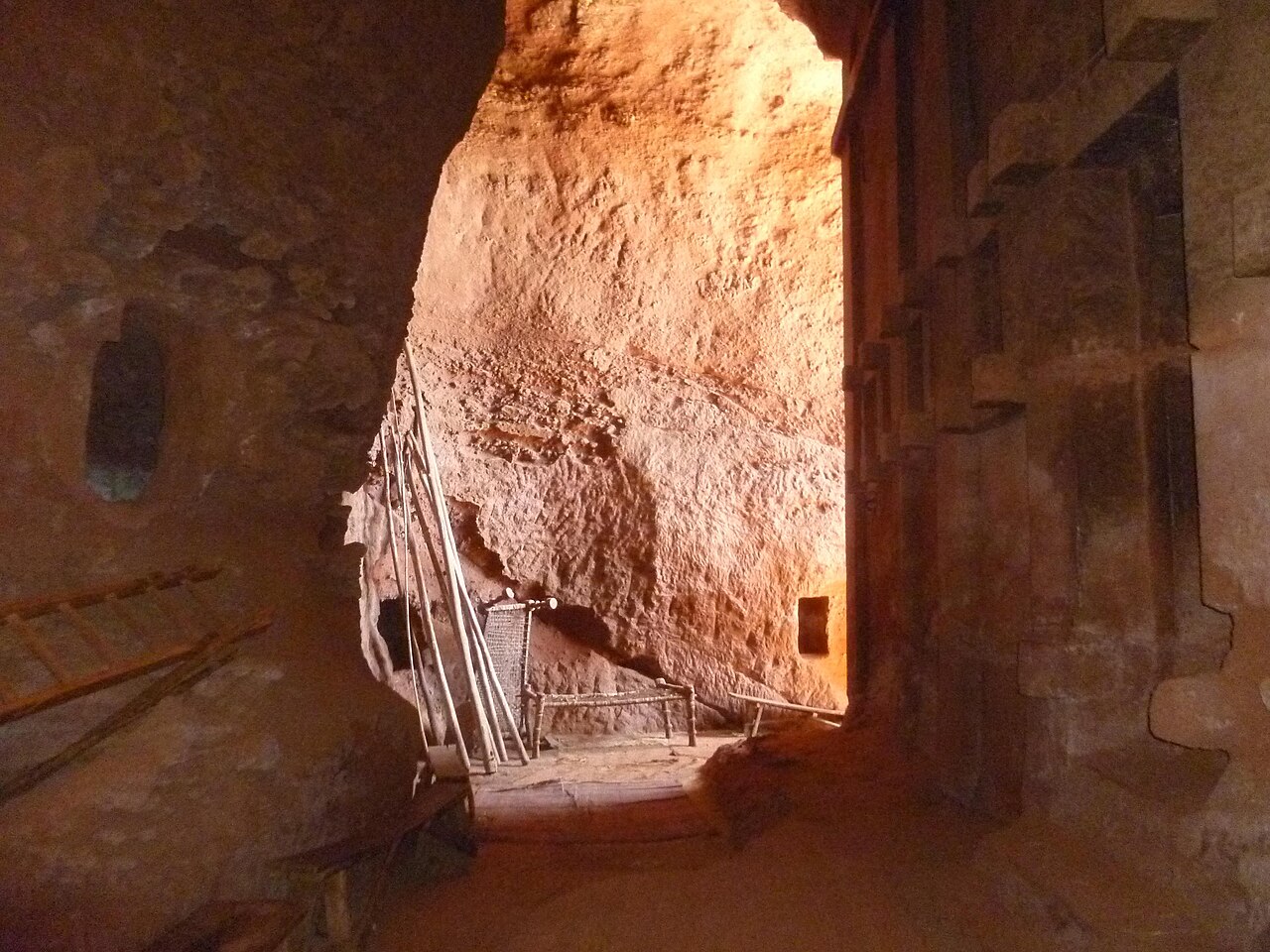
The work was not just about brute force; it required incredible precision. The windows, arches, and columns within the churches are perfectly proportioned, and the walls are often polished to a smooth finish. The artisans clearly had a deep knowledge of both architecture and sculpture. They were able to create the illusion of a freestanding building with sophisticated drainage systems, which were crucial to prevent water damage in the rainy season. The churches are also connected by a network of underground tunnels and passages, some of which are large enough to walk through, while others are small crawl spaces, which may have been used for secretive rituals or as escape routes.
A Living Heritage: Faith and Festivals in the Present
Lalibela is not a museum piece; it is a vibrant, functioning religious center. The Ethiopian Orthodox Tewahedo Church, which has its roots in the ancient Kingdom of Aksum, has maintained an unbroken presence here for centuries. Every day, priests and deacons in white robes and colorful turbans conduct services within the dark, incense-filled interiors of the churches, their liturgy a mix of ancient Ge’ez and modern Amharic. The chants, the rhythmic beating of the kebero drums, and the sistrum (a sacred rattle) create an atmosphere that is both deeply ancient and alive.
The most significant time to witness this living faith is during Genna (Ethiopian Christmas), celebrated on January 7th, and Timkat (Epiphany), on January 19th. During these festivals, tens of thousands of pilgrims from across Ethiopia converge on Lalibela. They come in a sea of white cotton shawls, walking for days or weeks to participate in the ceremonies. The atmosphere is electric, a powerful combination of deep piety, communal celebration, and the sheer physicality of thousands of people moving through the narrow trenches and tunnels. The clergy, in their ornate vestments, carry processional crosses and elaborate umbrellas, and the air is thick with the smoke of frankincense and myrrh.
“When you see Lalibela, you are not seeing a relic of the past. You are seeing the beating heart of a living faith. The stones are not dead; they are alive with the prayers of a thousand years.” — A reflection common among pilgrims and visitors alike.
This living tradition extends beyond the festivals. Throughout the year, the churches are used for daily prayers, baptisms, and other sacraments. The priests are the custodians of this heritage, holding keys to the churches and guarding the ancient manuscripts, crosses, and ceremonial robes that are treasured within. They are not just historical caretakers but active participants in a faith that defines their lives and the identity of the community. The town of Lalibela itself is a dynamic place, with a growing population of priests, monks, and artisans who make their living from the pilgrimage trade, crafting crosses, paintings, and other religious artifacts.
Key Dates and Structures: A Quick Reference
To appreciate the full scope of Lalibela, it is helpful to have a quick reference for its key dates and architectural highlights. The following table provides a concise overview of the most important elements of this sacred site.
| Structure / Event | Date / Period | Key Characteristics & Significance |
|---|---|---|
| King Lalibela’s Reign | c. 1181 – 1221 AD | Zagwe dynasty king who commissioned the churches as a ‘New Jerusalem’. |
| Bete Medhane Alem | Late 12th / Early 13th C. | Largest of the churches, with 68 pillars. Represents the ‘House of the Redeemer of the World’. |
| Bete Giyorgis (St. George) | Late 12th / Early 13th C. | The most iconic, a perfect Greek cross carved 15 meters down into the rock. |
| UNESCO World Heritage Listing | 1978 | Recognized as a masterpiece of human creative genius and a unique artistic achievement. |
| Major Festivals | Annually (Jan 7 & 19) | Genna (Christmas) and Timkat (Epiphany) see tens of thousands of pilgrims. |
Beyond the Rock: The Art and Iconography
The interiors of the Lalibela rock churches are a treasure trove of religious art, much of it dating back centuries. The walls are adorned with vivid frescoes depicting biblical scenes, the lives of saints, and the Virgin Mary, often painted in rich reds, blues, and golds. The style is distinctly Ethiopian, with a flat, two-dimensional quality and large, expressive eyes that are characteristic of the country’s unique artistic tradition. The paint, made from natural pigments, has survived remarkably well in the dry, cool climate.
Beyond the frescoes, the churches house a remarkable collection of sacred artifacts. The most significant of these are the processional crosses, often made of brass, silver, or gold, and intricately engraved with geometric patterns and Christian symbols. These crosses are not just decorative; they are used in blessings and processions, and they are carried by the clergy as symbols of their authority. Also on display are ancient manuscripts written in Ge’ez, the classical Ethiopian language, often beautifully illuminated with colorful miniatures. These manuscripts are not just texts; they are works of art, painstakingly copied and decorated by monks over the centuries. The most famous of these is the Lalibela Gospel, a beautifully illustrated manuscript that is a testament to the skill of Ethiopian calligraphers and illuminators.
The Role of the Bete Maryam Church
Bete Maryam is arguably the most sacred of all the churches. Its name, meaning ‘House of Mary’, points to the deep veneration of the Virgin in Ethiopian Orthodoxy. Its interior is a riot of carved and painted decoration, with a central, square sanctuary surrounded by a series of aisles and chapels. The ceiling is covered in a series of concentric rings of carved and painted crosses, creating a sense of celestial order. The church also features a famous carved pillar that is said to be a copy of the pillar upon which Christ was flagellated. It is a place of profound spiritual power, and the air is always thick with the smell of incense and the murmur of prayers.
The church is also connected to a series of smaller chapels and a sacred pool, which is used in the Timkat ceremony to re-enact the baptism of Jesus. The entire complex is a carefully orchestrated space designed to facilitate a deep and transformative spiritual experience. The architectural details are not arbitrary; they are all symbolic, guiding the worshipper from the outer world of the trenches into the inner sanctum of the divine.
Challenges and Preservation: Safeguarding a World Heritage
The Lalibela rock churches face significant challenges in the 21st century. The most pressing is the threat of structural damage due to water infiltration and erosion. The volcanic tuff is relatively soft, and centuries of rain and changing weather patterns have taken their toll. The roof of Bete Medhane Alem, for example, has been a particular concern, requiring structural support and complex drainage systems to prevent collapse. In 2021, UNESCO reported that the churches were on the verge of losing their World Heritage status due to a lack of adequate conservation efforts, a stark warning that this irreplaceable heritage is under threat.
However, there is also a powerful movement for preservation. The Ethiopian government, in partnership with international organizations like UNESCO and the World Monuments Fund, has been working on a range of conservation projects. These include installing protective shelters over some of the churches, improving drainage systems, and using advanced scanning technology to monitor the structural integrity of the rock. Local communities are also deeply involved in the preservation effort, understanding that their heritage is not only a spiritual treasure but also a vital economic resource for their town. The key is to find a balance between preserving the authenticity of the site and making it accessible to the millions of pilgrims and tourists who wish to experience its wonder. This is not a task for the faint of heart; it requires a long-term, multi-disciplinary approach that combines cutting-edge science with respect for ancient traditions.
The Pilgrim’s Journey: A Modern Odyssey
For the modern traveler, reaching Lalibela is an adventure in itself. The most common route is to fly from Addis Ababa to the small airport near the town, a flight that offers stunning views of the Ethiopian Highlands, with their terraced fields and dramatic gorges. The town of Lalibela itself is a fascinating mix of the ancient and the modern. There are traditional tukul huts, with their distinctive conical roofs, alongside modern hotels and guesthouses. The streets are filled with the sounds of life—the bleating of goats, the chatter of pilgrims, the rhythmic hammering of artisans creating new crosses and paintings.
Once inside the complex, the experience is overwhelming. The descent into the trenches is like a journey back in time. The noise of the town fades away, replaced by the quiet hum of prayer and the echo of footsteps on stone. Visitors are advised to hire a local guide, who can explain the history and significance of each church, and to be respectful of the religious nature of the site. Dress code is important; shoulders and knees should be covered, and visitors are often asked to remove their shoes before entering the innermost sanctuaries. It is a place to be experienced with all the senses—to feel the cool, smooth stone under your fingers, to smell the fragrant incense, to hear the haunting melodies of the priests, and to see the flickering light of candles illuminating ancient frescoes.
The journey to Lalibela is more than just a sightseeing trip. It is a pilgrimage into the heart of African history and Christian faith. It is a reminder that Africa is not a monolith, but a continent of immense diversity, with a heritage that includes some of the most extraordinary architectural achievements in human history. The rock-hewn churches are a source of immense pride for Ethiopians, and they stand as a powerful symbol of the country’s unique identity and its profound connection to its past.
The Enduring Allure of the Sacred Marvel
In a world that is increasingly fast-paced and digital, the Lalibela rock churches offer a profound sense of permanence and connection to something larger than ourselves. They are a physical manifestation of faith, a testament to the power of human belief to move mountains—or in this case, to carve them. The story of Lalibela is not just a story of a king and his architectural vision; it is a story of a people, their resilience, and their unwavering devotion. It is a story that continues to be written every day by the priests who chant their ancient liturgy, by the pilgrims who walk for weeks to touch the sacred stone, and by the guardians who work to ensure this wonder endures for generations to come.
As you stand at the edge of the pit, looking down at Bete Giyorgis in the shape of a perfect cross, you understand that you are in the presence of something truly extraordinary. It is a place where the earth and the heavens seem to meet, where the past is not a distant memory but a living presence. The Lalibela rock churches are more than just a historical monument; they are a living, breathing testament to the enduring power of the human spirit. They are a call to slow down, to reflect, and to appreciate the beauty and depth of a culture that has managed to preserve its soul in the face of immense change. For anyone seeking to understand the true heart of Africa, a visit to this sacred marvel is an essential, transformative experience.