📅 Last updated: 21.09.2026
The Gedi Ruins rise out of the coastal forest like a secret the earth almost kept: coral-stone walls, a great mosque, a pillared tomb, and streets that once hummed with the trade of the Indian Ocean. Walk through them today, beneath the dappled shade of giant baobabs and tamarind trees near the town of Watamu in Kilifi County, Kenya, and you are walking through one of East Africa’s most complete and enigmatic medieval cities. Gedi was a Swahili town — prosperous, literate, cosmopolitan, and Muslim — that flourished between the thirteenth and seventeenth centuries, then was abandoned so completely that the forest swallowed it whole. Its rediscovery in the twentieth century opened a window onto a civilisation that linked the East African coast to Persia, Arabia, India, and China long before European ships rounded the Cape.
- What and Where Are the Gedi Ruins?
- A Swahili City on the Indian Ocean Rim
- Who Built Gedi? People, Power, and the Swahili Identity
- Architecture of the Gedi Ruins: Coral, Coral, and More Coral
- A Timeline of Gedi: Rise, Peak, and Silence
- Why Was Gedi Abandoned?
- Rediscovery and Archaeology: Bringing Gedi Back into History
- Visiting the Gedi Ruins Today
- The Gedi Ruins and the Future of African Heritage
- Why the Gedi Ruins Still Speak to Us
This is the story of that lost city: who built it, how it grew rich, why it was abandoned, and why its ruins still matter to Kenya and to the wider Swahili world.
What and Where Are the Gedi Ruins?
The Gedi Ruins lie about 90 kilometres north of Mombasa and roughly 16 kilometres south of Malindi, tucked just inland from the Indian Ocean beaches of Watamu. The site covers around 45 acres within a larger forest reserve, and it is protected today as a national monument managed by the National Museums of Kenya. The name is sometimes spelled “Gede” or “Gedi,” and its meaning is uncertain: some link it to the Galla (Oromo) word for “precious,” others to a Swahili term, but no interpretation is definitive. What is clear is that this was never a mere village. It was a planned, walled town with a distinct urban layout.
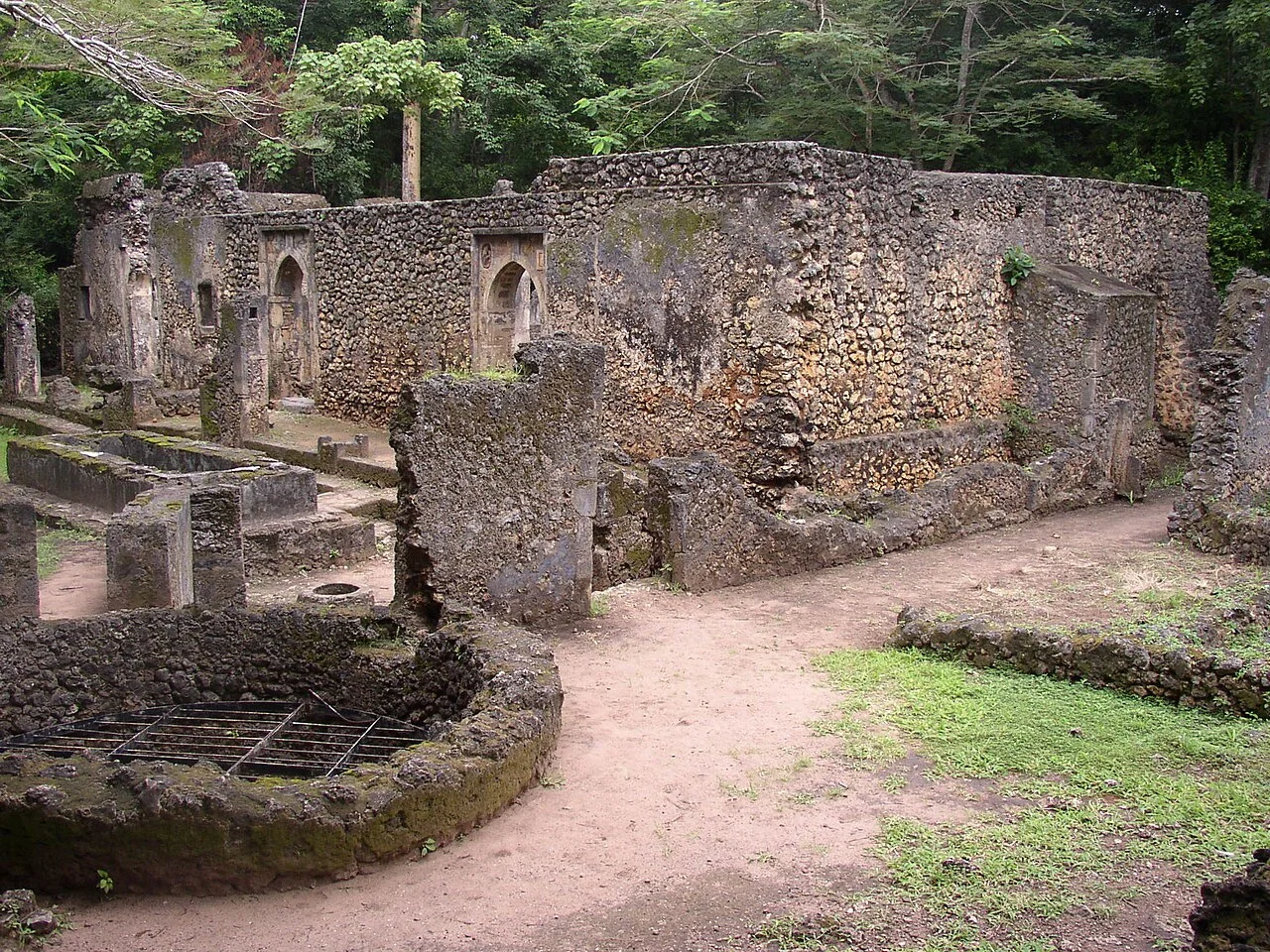
Visitors approach through the cool green of the Arabuko-Sokoke forest fringe, hearing sykes monkeys and hornbills before they see a single stone. Then the walls appear: low coral rag and lime-mortar structures, roofless now, but still legible as houses, mosques, wells, and tombs. The sense of a functioning city is immediate and uncanny.
A Swahili City on the Indian Ocean Rim
To understand Gedi is to understand the Swahili civilisation. For centuries, the East African coast was not a periphery but a hub. From Mogadishu in the north to Kilwa in the south, and on to the Comoros and Mozambique, Swahili towns grew wealthy on monsoon trade. Dhows — the wooden sailing vessels that still ply these waters — rode the northeast monsoon from Arabia and India between November and March, and returned on the southwest monsoon from April to August. That seasonal rhythm shaped everything: the calendar of commerce, the architecture, the food, the faith.
Swahili culture was and is urban, maritime, and deeply Muslim, with its own language — Kiswahili — whose earliest written forms appear in Arabic script on the coast. Gedi was one of dozens of such towns. Others included Mombasa, Malindi, Lamu, Pate, Kilwa Kisiwani, and Shanga. What makes Gedi exceptional is not its wealth alone but its preservation: because it was abandoned rather than continuously rebuilt, its medieval footprint survives more intact than almost any comparable site in the region.
The Indian Ocean World in One Town
Excavations at Gedi have yielded a material culture that reads like a map of the medieval Indian Ocean. Archaeologists have recovered:
- Chinese celadon and blue-and-white porcelain, some pieces dating to the Ming dynasty (fourteenth to seventeenth centuries);
- Persian and Arabian ceramics, including glazed wares from the Gulf;
- Indian beads and glass, and cowrie shells used as currency;
- Iron tools, slag, and evidence of local smithing and weaving;
- Imported glass vessels and metalwork suggesting a wealthy merchant class.
These finds confirm that Gedi was plugged into a transoceanic network stretching from the South China Sea to the Mediterranean. A merchant in Gedi might drink from a Chinese bowl, wear Indian cloth, and pray in a mosque built by local masons using coral cut from the reef. That fusion is the essence of Swahili urban life.
Who Built Gedi? People, Power, and the Swahili Identity
Gedi’s residents were Swahili: African people of the coast who spoke Kiswahili, practised Islam, and organised themselves into a stratified urban society. Nineteenth- and early twentieth-century colonial writers, encountering the ruins, sometimes credited them to “Arabs” or “Persians,” a racialised assumption that denied African agency. Modern archaeology has thoroughly dismantled that view. The town’s builders were indigenous coastal Africans whose culture had absorbed and transformed influences from across the ocean — not foreign colonists planting a city on African soil.
Who held power in Gedi? The evidence points to a local ruling elite, perhaps a sultan or a council of prominent families, whose authority rested on trade, land, and religious standing. The town’s large palace complex — the biggest structure on the site — suggests a resident ruler with the means to command labour and resources. Nearby, a series of wealthy houses with courtyards, wells, and private latrines indicate a merchant class of considerable comfort.
Daily Life in a Medieval Swahili Town
What did life look like inside these walls? Gedi’s houses were built of coral rag and lime mortar, with flat roofs of mangrove poles and thatch, and interiors divided into rooms around a central courtyard. Many had wells and washing areas. People ate rice, millet, sorghum, fish, shellfish, and meat; they drank from locally made and imported vessels; they wore cotton cloth, some of it woven locally, some imported. Children played in the lanes; women drew water; men sailed, fished, farmed, traded, and prayed.
The town also had a social geography. The elite lived near the Friday mosque and the palace; poorer residents and perhaps enslaved people lived on the periphery. Gedi, like other Swahili towns, was part of a wider economy that included the export of ivory, timber, slaves, and mangrove poles, and the import of luxury goods. That economy made some families rich — and made the town a target for rivalry and, eventually, for decline.
Architecture of the Gedi Ruins: Coral, Coral, and More Coral
The genius of Gedi’s builders lay in what they had at hand. The reef provided coral limestone, which they burned to make lime and cut into blocks. Mangrove forests provided poles for roofs and floors. The result is an architecture that is both monumental and biodegradable — which is precisely why the town vanished so thoroughly when it was abandoned.
Key structures a visitor should look for include:
- The Great Mosque — a large Friday mosque with a deep mihrab niche facing Mecca, a raised minbar platform, and a courtyard. Its scale signals a substantial Muslim congregation.
- The Palace — a sprawling complex of courtyards, audience halls, and private quarters, likely the seat of the town’s ruler.
- The Pillared Tomb — a striking funerary monument with tall coral pillars, associated with the town’s elite and possibly with a venerated figure.
- The Houses — numerous domestic compounds, some with wells, latrines, and evidence of two-storey construction.
- The City Walls — a perimeter wall with gates, indicating a concern with defence and with regulating movement in and out of the town.
- Wells and Water Systems — a reminder that a city of thousands needed reliable fresh water, managed through wells and possibly cisterns.
There are also smaller mosques — at least three or four in total — suggesting neighbourhood-level worship. The presence of multiple mosques, rather than one central congregation, hints at a town large enough to sustain several communities of worshippers.
A Timeline of Gedi: Rise, Peak, and Silence
Gedi’s history is reconstructed from archaeology, oral tradition, and comparison with better-documented Swahili towns. The broad arc is clear, even if exact dates remain debated.
| Period | What Was Happening at Gedi |
|---|---|
| c. 11th–12th century | Early settlement and growth; the town begins to take shape as a Swahili trading community. |
| c. 13th–14th century | Expansion and prosperity; construction of major stone buildings, including the Great Mosque and palace. |
| c. 15th–16th century | Peak of wealth and population; extensive Indian Ocean trade, including Chinese porcelain imports. |
| c. 16th–17th century | Decline; Portuguese disruption of Indian Ocean trade, regional warfare, and possibly water shortages or disease. |
| c. 17th century | Abandonment; the town is left to the forest, its stone buildings gradually covered by vegetation. |
That final row is the mystery at the heart of the Gedi Ruins. Why would a thriving city simply stop?
Why Was Gedi Abandoned?
No single cause explains Gedi’s end. Historians and archaeologists point to a combination of pressures, each plausible and together compelling.
Portuguese Disruption
When Vasco da Gama sailed up the East African coast in 1498 and Portuguese forces subsequently attacked and taxed Swahili ports, the old trading system was destabilised. Portuguese demands for tribute, their naval dominance, and their violent interventions — including the sack of Mombasa and the bombardment of other towns — disrupted the monsoon trade on which Gedi depended. A town whose wealth came from Indian Ocean commerce could not easily survive the collapse of that commerce.
Regional Rivalry and Warfare
Swahili towns competed fiercely. Malindi, Mombasa, and others vied for dominance, sometimes allying with the Portuguese against each other. Gedi, smaller than these giants, may have been caught in the crossfire or lost access to trade routes. Oral traditions in the region speak of conflicts and migrations, though they are hard to date precisely.
Environmental and Water Stress
Gedi’s wells were its lifeline. Over centuries, a growing population could have strained local water supplies, especially if the water table shifted or wells silted. Some scholars have suggested that salinisation or drought played a role. The town’s abandonment of a site with so many wells hints that water — or the lack of it — may have been decisive.
Disease and Demographic Collapse
Plague, malaria, or other epidemics could have emptied a city quickly. The coast was connected to global trade networks, and with trade came pathogens. A severe outbreak could have killed or driven away enough people to make the town unsustainable.
The Galla (Oromo) Invasions
Some traditions attribute Gedi’s end to attacks by Oromo (historically called Galla) pastoralists moving south in the sixteenth and seventeenth centuries. Whether these incursions directly destroyed Gedi or simply made the surrounding countryside unsafe is debated. What is likely is that insecurity, combined with economic decline, made staying untenable.
The most honest answer is that Gedi was abandoned for a mix of reasons — economic, political, environmental, and possibly epidemiological — that reinforced one another. Cities rarely die of a single blow.
Rediscovery and Archaeology: Bringing Gedi Back into History
For roughly two centuries, Gedi was a ruin in the forest, known to local communities but largely ignored by the wider world. That changed in the twentieth century. British colonial administrators and archaeologists began to take notice, and systematic excavation began in earnest in the late 1930s and continued in the post-independence era. The site was declared a protected monument, and the National Museums of Kenya took responsibility for its conservation and interpretation.
Excavations by researchers including James Kirkman and later teams revealed the town’s plan, its mosques, its palace, and its rich assemblage of imports. The work helped establish Gedi as a key site for understanding Swahili urbanism — not a footnote to Arab or Persian history, but a central chapter in African history. Today, the Gedi Ruins are also part of a broader push to have Swahili coastal sites recognised for their global significance, alongside Kilwa Kisiwani and other World Heritage properties.
“The Swahili coast was never isolated. It was one of the great meeting places of the medieval world — and Gedi is one of its best-preserved witnesses.”
That reframing matters. For generations, the story of Africa’s global connections was told as a story of European arrival. Gedi tells a different story: of African merchants, sailors, masons, and scholars who were already global long before da Gama.
Visiting the Gedi Ruins Today
A visit to the Gedi Ruins is one of Kenya’s most rewarding heritage experiences, and it pairs beautifully with the beaches and marine park of Watamu. The site is open to the public, with guides available at the entrance who bring the stones to life with stories of the mosque, the palace, and the people who lived here.
Practical Tips
- Getting there: Gedi is about a 90-minute drive from Mombasa and roughly 20 minutes from Watamu or Malindi. Taxis, matatus, and tour vans all serve the site.
- Best time to go: Early morning or late afternoon, when the light is soft, the heat is manageable, and the forest birds and monkeys are most active.
- What to bring: Comfortable shoes for uneven coral paths, water, sun protection, and a camera. Insect repellent is wise in the green season.
- Respect the site: It is a historical and religious heritage site; dress modestly and follow your guide’s instructions, especially around the mosque and tombs.
- Combine with: The Watamu Marine National Park, the Arabuko-Sokoke Forest (home to rare birds and the golden-rumped elephant shrew), and the beaches of the north coast.
The nearby town of Gede and the wider Kilifi County are also worth exploring. Kilifi town, with its old ferry and growing arts scene, and Malindi, with its Swahili and Portuguese heritage, add context to the ruins. The coast is not a museum: it is a living place where fishing dhows still sail, where Kiswahili is spoken in homes and markets, and where the descendants of Gedi’s world continue to shape Kenyan life.
The Gedi Ruins and the Future of African Heritage
Gedi’s significance today goes beyond tourism. It is a case study in how Africa’s past is researched, protected, and told. The site faces familiar challenges: coastal erosion, vegetation encroachment, visitor pressure, and the constant need for funding and skilled conservation. Climate change adds new risks, from rising seas to stronger storms. At the same time, digital documentation, community engagement, and partnerships between the National Museums of Kenya, universities, and international bodies are opening new ways to study and share the site.
There is also a deeper cultural project at work. For Kenyans and for the African diaspora, Gedi is a reminder that urbanism, literacy, trade, and faith flourished on the continent centuries before colonialism. It challenges the stereotype of Africa as a place outside history. A schoolchild in Mombasa or Nairobi, or a visitor from Brazil, Britain, or the United States, can stand in Gedi’s mosque and feel connected to a world that was sophisticated, connected, and African.
Gedi in the Swahili Imagination
Swahili culture has always been a culture of memory and story. Coastal communities carry traditions of migrations, founders, and lost cities. Gedi belongs to that landscape of memory, alongside other abandoned or partially abandoned towns such as Takwa on Manda Island and the older layers of Kilwa. These places are not dead; they are ancestors, and they are increasingly recognised as part of a shared Indian Ocean heritage that links East Africa to the Gulf, India, and Southeast Asia.
Why the Gedi Ruins Still Speak to Us
The Gedi Ruins are more than a picturesque stop on Kenya’s north coast. They are evidence of a civilisation that was urban, literate, Muslim, and globally connected at a time when much of Europe was still recovering from the collapse of Rome. They are a testament to African agency in the Indian Ocean world, and a reminder that the continent’s history is one of movement, exchange, and innovation.
Standing in the roofless Great Mosque, with the forest pressing in and the sea a few kilometres away, you can almost hear the call to prayer and the creak of dhow rigging. Gedi was not lost because it was unimportant. It was lost because it was abandoned — and it was abandoned because the world around it changed. Its stones survive to tell us that the Swahili coast was never a backwater, and that Africa’s cities have always been part of the wider human story.
If you travel to Kenya’s coast, make time for Gedi. Walk slowly. Listen to the guide. Let the quiet do its work. The ruins are a reminder that history is not only written in books; sometimes it is written in coral, and sometimes it is waiting for us in the forest.