📅 Last updated: 02.10.2026
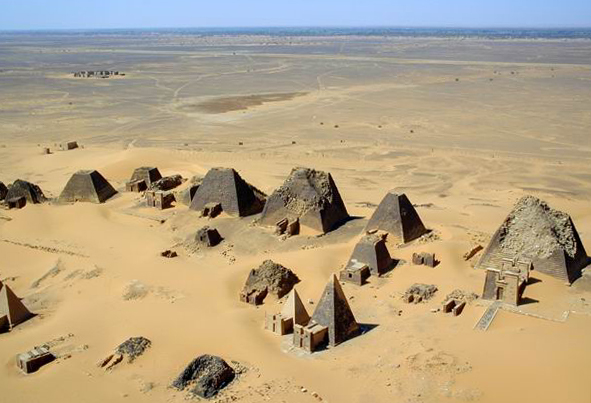
The Meroe Pyramids rise from the desert sands of northern Sudan like a field of stone sails, more than two hundred tombs clustered on a low ridge roughly 200 kilometres north-east of Khartoum. Most travellers have never heard of them; many who have assume, wrongly, that such monuments belong only to Egypt. Yet here in the ancient Kushite heartland stands one of the largest and most concentrated pyramid fields on Earth — the royal cemetery of a Nubian kingdom that ruled Egypt as pharaohs, traded with Rome, and produced a script that scholars still cannot fully read.
- A Nubian Kingdom That Ruled Egypt
- What You Actually See at the Meroe Pyramids
- Meroitic Script: A Language Still Waiting to Be Read
- Daily Life, Gods, and Architecture Beyond the Pyramids
- Rediscovery, Damage, and the Fight to Protect the Meroe Pyramids
- Visiting the Meroe Pyramids Today
- Why Meroe Matters — and Why It's Still Overlooked
- Planning Your Journey — and Your Perspective
A Nubian Kingdom That Ruled Egypt
To understand why the Meroe Pyramids exist at all, you have to go back to the kingdom of Kush, the civilisation that flourished along the Nile in what is now Sudan. Kush was not a poor cousin of Egypt. It was a rival, a trading partner, an occupier, and at times a teacher. Its people built cities at Kerma as early as 2500 BCE, and its elites adopted and adapted Egyptian religion, art, and architecture without ever ceasing to be Nubian.
The most dramatic chapter came in the eighth century BCE, when a Kushite king named Kashta pushed north and his son Piye (also written Piankhy) conquered Egypt around 727 BCE, founding what historians call the Twenty-Fifth Dynasty. For roughly a century, pharaohs with Nubian names — Piye, Shabaka, Taharqa, Tantamani — ruled from Memphis and Thebes. Taharqa, perhaps the most famous of them, is named in the Hebrew Bible and built extensively at Karnak and in Nubia itself.
The dynasty ended when Assyrian armies under Esarhaddon and then Ashurbanipal pushed the Kushites back south in the 660s BCE. But the retreat was not a collapse. The kings returned to Nubia and re-established themselves, first at Napata near the Fourth Cataract, and later further south at Meroe, between the Fifth and Sixth Cataracts of the Nile. From around 270 BCE, Meroe became the political and cultural capital of a kingdom that would endure for centuries.
Why the Capital Moved South
The move to Meroe was strategic. Napata sat dangerously close to Egypt and to the shifting frontier of foreign power. Meroe, by contrast, lay in a region with reliable summer rains, closer to the savannas and to the Red Sea trade routes. It was also near iron ore deposits, and Meroitic craftspeople became skilled ironworkers — a fact that led early scholars to dub Meroe “the Birmingham of Africa,” a label modern archaeologists consider overstated but which reflects the kingdom’s genuine industrial energy.
Meroe also sat at a crossroads. Goods moved north to Egypt, east to the Red Sea port of Adulis and onward to Arabia and India, and south into the African interior. Ivory, ebony, gold, ostrich feathers, slaves, and exotic animals travelled these routes. In return came Mediterranean wine, Roman glass, and Indian textiles.
What You Actually See at the Meroe Pyramids
The royal cemetery at Meroe is divided into three main groups, spread across the desert at Begrawiya:
- The South Cemetery — the oldest section, with burials dating from roughly 720 to 300 BCE. Many of its tombs are marked by small pyramids, and some of its earliest rulers were probably buried here before the capital fully shifted south.
- The North Cemetery — the largest and most impressive group, containing the tombs of the later kings and queens, from around 300 BCE to 350 CE. This is where visitors see the tallest and best-preserved pyramids.
- The West Cemetery — a smaller group of tombs, including some of the finest examples of Meroitic pyramid architecture.
The pyramids themselves are smaller than their Egyptian counterparts — typically between 10 and 30 metres tall — but they are steeper, with a sharper angle that gives them a distinctive, almost needle-like profile. Each pyramid marked a tomb, usually with a chapel attached to the eastern face and a burial chamber cut deep into the bedrock below. The chapels were decorated with reliefs showing the deceased king or queen before the gods, and with rows of hieroglyph-like symbols in the Meroitic script.
Many pyramids once had a stone offering table and a stela at the entrance, inscribed with the ruler’s name and titles. Over the centuries, wind, sand, and treasure hunters have stripped away much of the decoration. Yet enough remains to make the site powerfully evocative, especially at sunrise, when the pyramids cast long shadows across the dunes.
The Kandakes: Queens Who Fought Rome
One of the most remarkable features of Meroitic society was the prominence of women. Several rulers were queens, known as kandakes (often rendered “Candace” in classical sources, though it appears to have been a title rather than a personal name). They ruled in their own right, led armies, and were buried with full royal honours at Meroe.
The most famous is Amanirenas, who ruled around 40–10 BCE. When the Roman prefect of Egypt, Gaius Petronius, campaigned south into Nubia around 25 BCE, the Kushites fought back. According to the Greek geographer Strabo, a kandake led the resistance and even raided Roman positions in southern Egypt. The conflict ended with a negotiated peace that was unusually favourable to Kush: the Romans withdrew, and Meroe kept its independence. It was one of the few ancient states to force Rome to compromise rather than dictate terms.
“The Meroitic kingdom was not a footnote to Egypt. It was a major power in its own right, with its own language, its own gods, and its own imperial ambitions.” — a view now standard among archaeologists of the Middle Nile.
Meroitic Script: A Language Still Waiting to Be Read
Perhaps the most tantalising aspect of Meroe is its writing system. The Meroitic script has two forms — a hieroglyphic version used in monumental inscriptions, and a cursive version used in everyday documents. Both were deciphered phonetically in the early twentieth century by the British scholar Francis Llewellyn Griffith, who worked out the sound values of the signs.
But here is the catch: we can read Meroitic aloud without fully understanding it. The language itself is not closely related to Egyptian, and no bilingual text of sufficient length has been found to crack its grammar and vocabulary. Scholars can identify names, titles, and a handful of common words, but the bulk of Meroitic literature — royal decrees, religious texts, personal letters — remains opaque.
That gap is one of the great unsolved puzzles of African archaeology. Every new inscription found at Meroe, Musawwarat es-Sufra, or Naqa adds a few more pieces to the puzzle, but a full decipherment may still be decades away.
| Period | Key Development | Notable Figures or Sites |
|---|---|---|
| c. 2500–1500 BCE | Kingdom of Kerma flourishes in Upper Nubia | Kerma, the Western Deffufa |
| c. 727–656 BCE | Kushite kings rule Egypt as the Twenty-Fifth Dynasty | Piye, Shabaka, Taharqa |
| c. 270 BCE | Meroe becomes the royal capital of Kush | Begrawiya royal cemeteries |
| c. 25 BCE | Kushite–Roman war ends in negotiated peace | Kandake Amanirenas, Petronius |
| c. 350 CE | Kingdom of Kush declines and collapses | Rise of Aksum, internal pressures |
Daily Life, Gods, and Architecture Beyond the Pyramids
The Meroe Pyramids are the most famous monument of the kingdom, but they are not the whole story. Meroitic civilisation produced a rich architectural and religious landscape that stretched across the Butana plain and along the Nile.
At Musawwarat es-Sufra, about 180 kilometres south-west of Meroe, stands the Great Enclosure — a sprawling complex of temples, corridors, and ramps whose exact purpose remains debated. Some scholars see it as a pilgrimage centre, others as a royal training ground or a ceremonial site. Its walls are covered with reliefs of elephants, lions, and gods, and its layout is unlike anything else in the Nile Valley.
At Naqa, two major temples survive. The Temple of Amun, begun in the first century BCE, and the Temple of Apedemak, the lion-headed Nubian god of war, whose reliefs show the god with a lion’s head and a human body, sometimes with serpents emerging from his body. Apedemak was a distinctly Nubian deity, and his prominence at Naqa and elsewhere shows how Meroitic religion blended Egyptian and indigenous traditions.
Everyday life in Meroe was shaped by the Nile. Farmers grew sorghum, millet, and barley; herders kept cattle, sheep, and goats. The kingdom’s wealth came from agriculture, gold, and trade. Meroitic pottery — especially the fine, painted wares found in tombs — is among the most beautiful produced anywhere in the ancient world, with geometric and floral designs in red, black, and cream.
The Collapse of Kush
No kingdom lasts forever. By the third and fourth centuries CE, Kush was under pressure from multiple directions. The rise of the Kingdom of Aksum in the Ethiopian highlands posed a growing threat; Aksumite inscriptions from the fourth century claim victories over the Kushites. Climate change, shifting trade routes, and internal political fragmentation all played a role. By around 350 CE, Meroe had been abandoned as a royal capital, and the kingdom dissolved into a series of smaller successor states.
What replaced Kush was not a void. The region became home to the Christian kingdoms of Nobatia, Makuria, and Alwa, which flourished in the medieval period and left their own remarkable monuments — including the frescoes of Faras and the cathedral at Dongola. The Nubian story continued, just in a different key.
Rediscovery, Damage, and the Fight to Protect the Meroe Pyramids
For centuries after the fall of Kush, the Meroe Pyramids were largely forgotten outside Sudan. European travellers began to visit in the early nineteenth century, and their accounts helped spark scholarly interest. But the same period brought catastrophe. In 1834, the Italian treasure hunter Giuseppe Ferlini dynamited the tops of several pyramids at Meroe in search of gold. He found a small amount of jewellery — which he sold — but destroyed some of the finest tombs in the process. The scars are still visible today.
Proper archaeological investigation began in the early twentieth century. The American archaeologist George Reisner excavated extensively at Meroe and other Nubian sites between 1916 and 1923, producing a chronology of Kushite rulers that, despite later revisions, still underpins much of our understanding. Since the 1960s, teams from Sudan, Britain, Germany, France, and elsewhere have continued the work, often under difficult conditions.
Today the Meroe Pyramids face new threats. Desertification is creeping southward, and shifting sands bury monuments. Flash floods occasionally damage structures. Tourism, though still modest compared to Egypt, brings both income and pressure. And Sudan’s political instability — including the 2019 revolution and the conflict that erupted in 2023 — has made it harder to protect and manage heritage sites.
In 2011, the archaeological sites of the Island of Meroe — including the royal cemeteries at Begrawiya, Musawwarat es-Sufra, and Naqa — were inscribed on the UNESCO World Heritage List. That recognition has helped attract international attention and funding, but the challenges remain formidable.
Visiting the Meroe Pyramids Today
For travellers who make it to Sudan, the Meroe Pyramids are an unforgettable experience. The site is usually reached by road from Khartoum, a drive of about three to four hours, often via the town of Shendi. There is no large-scale tourist infrastructure — no crowds, no queues, no souvenir stalls lining the approach. You may have the pyramids almost to yourself.
That solitude is part of the magic, but it also means visitors should plan carefully:
- Best time to go: November to February, when daytime temperatures are more bearable. Summer heat can exceed 45°C.
- Permits and logistics: Foreign visitors typically need a Sudanese visa and, in some periods, travel permits for areas outside Khartoum. Check current requirements well in advance.
- Guides: Local guides and Sudan-based tour operators can arrange transport, permits, and knowledgeable commentary. Their expertise makes a huge difference.
- Respect: The site is a cemetery, not just a photo opportunity. Follow guide instructions, stay on designated paths, and avoid climbing on the pyramids.
- Combine with: The temples at Naqa and Musawwarat es-Sufra, the ancient city of Meroe itself, and the Nile-side town of Shendi.
Sudan’s tourism sector has been buffeted by conflict in recent years, and travel advice changes frequently. But for those able to go, the experience is unlike any other. Standing among the royal tombs of Kush, with the desert stretching to the horizon, you are standing at the heart of a civilisation that once ruled Egypt, traded with Rome, and wrote in a script we still cannot read.
Why Meroe Matters — and Why It’s Still Overlooked
The relative obscurity of the Meroe Pyramids is not an accident of history. It is the product of centuries of scholarship that centred Egypt and treated Nubia as a peripheral shadow. Nineteenth-century racial theories, colonial-era archaeology, and the sheer difficulty of working in Sudan all contributed to the neglect. Even today, many world history curricula mention Kush only in passing, if at all.
That is beginning to change. Sudanese archaeologists such as the late Ahmed Mohamed Ali Hakem and the pioneering scholar Ali Osman Mohamed Salih helped build a national tradition of research. Museums in Khartoum, including the National Museum of Sudan, hold extraordinary collections of Meroitic art and artefacts. International collaborations are producing new discoveries every year, from unpublished inscriptions to geophysical surveys that reveal buried structures without excavation.
And the diaspora is paying attention. Sudanese artists, writers, and musicians — from the poet Mohamed el-Makki Ibrahim to contemporary musicians blending Nubian rhythms with jazz and hip-hop — are reconnecting with this heritage on their own terms. In doing so, they are helping to shift the narrative from “forgotten” to “reclaimed.”
A Kingdom Worth Remembering
The Meroe Pyramids are not a lesser version of Egypt’s monuments. They are the signature of a distinct African civilisation — one that produced its own gods, its own script, its own queens, and its own way of building for eternity. They stand as a reminder that the Nile Valley’s history is not a single story but many, and that some of its most remarkable chapters are still waiting to be fully told.
Planning Your Journey — and Your Perspective
If you ever find yourself standing before the Meroe Pyramids, take a moment to look beyond the stones. Think of Piye and Taharqa, who ruled from the Nile Delta to the Sixth Cataract. Think of Amanirenas, who faced down Rome and won a peace on her own terms. Think of the scribes who carved words in a language we can pronounce but not yet understand, and of the archaeologists — Sudanese, European, American, and others — who have spent their lives trying to bring that world back into the light.
Sudan’s heritage is not a curiosity for specialists. It is part of the broader African story, and it belongs to everyone who cares about the deep roots of human achievement. The Meroe Pyramids may be less famous than Giza, but they are no less extraordinary. They are a testament to a kingdom that refused to be a footnote — and to a continent whose history is far richer, and far more interconnected, than the old textbooks ever admitted.