📅 Last updated: 30.09.2026
Yaa Asantewaa was in her sixties when she stood before the assembled chiefs of Asante and asked them a question that would echo through the centuries: “Is it true that the bravery of Asante is no more?” The year was 1900, the British had exiled the Asantehene to the Seychelles, and the men around her hesitated. Her answer — to lead a war against the most powerful empire on earth — turned a queen mother from Edweso into a symbol of resistance that still resonates across Ghana and the African diaspora today.
- Who Was Yaa Asantewaa?
- The Road to War: Colonial Pressure and Asante Resistance
- Yaa Asantewaa Takes Command
- Why the Asante Lost — and Why It Still Mattered
- Exile, Death, and the Making of an Icon
- The Queen Mother Institution: Power Behind and Beside the Throne
- Yaa Asantewaa's Legacy in Modern Ghana and Beyond
- A Legacy That Refuses to Be Forgotten
Her story is not simply one of defiance. It is a story about political power, about the specific role of women in Asante governance, about the machinations of colonial conquest, and about what happens when a society’s survival is placed in the hands of someone everyone underestimated. This is how it unfolded.
Who Was Yaa Asantewaa?
Yaa Asantewaa was born around 1840 in Besease, a town in the Ejisu-Juaben district of what is now Ghana’s Ashanti Region. She was the daughter of Kwaku Ampoma and Ata Po, and through her mother she belonged to the Asona clan — one of the royal clans of Asante. This lineage mattered enormously, because in Asante political culture, royal identity passed through the mother’s line. Her brother, Kwasi Afrane, became the ruler of Edweso, a prominent state within the Asante Confederacy, and when he died, Yaa Asantewaa used her influence to secure the position for her own grandson, Kwasi Afrane II. She became the Asantehemaa of Edweso — queen mother — a position of genuine political authority, not ceremonial decoration.
To understand why a queen mother could lead an army, you have to understand how Asante was governed. The Asante Empire, at its height in the eighteenth and nineteenth centuries, was a sophisticated confederation of states bound together under the Golden Stool, the sacred symbol of the Asante nation’s soul. Each state had a chief, and alongside each chief sat a queen mother — the ohemaa — who advised him, nominated successors, and held her own court. The queen mother was not a consort. She was a co-ruler. When Yaa Asantewaa spoke, she spoke with the weight of that institution behind her.
She was also, by all accounts, a formidable personality: sharp-tongued, politically astute, and utterly unimpressed by British pretensions. She had witnessed decades of Asante-British conflict, including the earlier Anglo-Asante wars and the gradual erosion of Asante sovereignty. By 1896, the British had arrested and exiled Asantehene Prempeh I, along with several senior chiefs, to the Seychelles. The empire was decapitated. The queen mother of Edweso watched it happen — and waited.
The Road to War: Colonial Pressure and Asante Resistance
The conflict that made Yaa Asantewaa famous did not erupt out of nowhere. It was the culmination of nearly a century of friction between the Asante Empire and British colonial interests on the Gold Coast.
From Trade Partners to Adversaries
In the early nineteenth century, Asante and Britain were trading partners, bound by commerce in gold, kola nuts, ivory, and enslaved people. But as British influence expanded along the coast, and as the Asante pushed southward toward the coastal Fante states, the relationship soured. A series of wars followed: the Anglo-Asante Wars of 1824, 1863, 1873–74, and 1895–96. The British burned Kumasi in 1874, forcing the Asante to sign treaties that chipped away at their sovereignty. Each peace deal was, in practice, a step toward colonization.
By the 1890s, the British had a new weapon: the demand for the Golden Stool. Governor Frederick Hodgson, a man whose arrogance would prove catastrophically counterproductive, believed the Asante would simply hand over their most sacred object if asked forcefully enough. He was wrong.
The Golden Stool and the Breaking Point
The Golden Stool — Sika Dwa Kofi — is not furniture. According to Asante tradition, it descended from the heavens in a cloud of white dust and landed on the lap of Osei Tutu I, the founder of the Asante Empire, in the late seventeenth century. It contains the sunsum — the soul or spirit — of the Asante nation. No one sits on it. It is never allowed to touch the ground. Its safety is bound up with the well-being of the entire Asante people.
When Governor Hodgson summoned the chiefs to Kumasi in March 1900 and demanded the Golden Stool, he might as well have demanded their souls. According to accounts preserved in Asante oral history and later documented by scholars, the chiefs were stunned into silence. Hodgson, frustrated, reportedly threatened to send the chiefs to the Seychelles to join Prempeh. The meeting ended in humiliation.
“Is it true that the bravery of Asante is no more? I cannot believe it. It cannot be! I must say this: If you, the men of Asante, will not go forward, then we will. I shall call upon my fellow women. We will fight the white men. We will fight till the last of us falls in the battlefields.”
That speech, as recorded in Asante tradition and repeated by generations of historians, is the moment Yaa Asantewaa crossed from political leader to war leader. The men had faltered. She did not.
Yaa Asantewaa Takes Command
What happened next was extraordinary by any standard. Yaa Asantewaa assumed the role of war leader — a position traditionally held by men — and rallied the Asante states to resist. She was joined by chiefs including Kwabena Anokye, the ruler of Mampong; Edusei of Offinso; and others who had initially hesitated. Together they raised an army of several thousand, drawn from across the Asante heartland: Edweso, Mampong, Offinso, Kumawu, Ejisu, and beyond.
Her strategy was clear. The British had established a fort in Kumasi — the seat of Asante power — and the governor and his wife were trapped inside. If the Asante could cut off supplies, disrupt communications, and prevent relief columns from reaching the fort, they might force the British out entirely. It was a siege, and it was audacious.
The Siege of Kumasi Fort
The war began in late March 1900 and lasted until September — roughly six months of sustained fighting. The Asante surrounded Kumasi and laid siege to the British fort, where Governor Hodgson, his wife Lady Hodgson, and a garrison of British soldiers and Hausa constables were holed up. The besieged lacked food, ammunition, and reliable communication with the coast. Relief expeditions were dispatched from the south, but the Asante ambushed them repeatedly, inflicting heavy casualties.
The fighting was brutal and the terrain punishing. Asante fighters used the forest to their advantage, employing guerrilla tactics that frustrated British columns. The British had superior firepower — Maxim guns, artillery, and modern rifles — but the Asante had numbers, local knowledge, and the desperation of people defending their homeland and their sacred heritage.
Yaa Asantewaa herself is said to have been present at the front, though the precise details of her battlefield role are debated. What is not debated is that she was the political and spiritual engine of the resistance. She coordinated, she inspired, and she refused every offer of negotiation that would have compromised Asante sovereignty.
Key Events of the War of the Golden Stool
| Date | Event |
|---|---|
| March 1900 | Governor Hodgson demands the Golden Stool at a meeting in Kumasi; Yaa Asantewaa delivers her famous speech rallying the chiefs. |
| Late March 1900 | Asante forces besiege Kumasi Fort; Governor Hodgson and Lady Hodgson trapped inside. |
| April–July 1900 | British relief columns ambushed; heavy casualties on both sides; the siege holds. |
| September 1900 | British relief force under Colonel Willcocks breaks the siege; Asante resistance collapses. |
| 1901 | Yaa Asantewaa captured; exiled to the Seychelles, where she dies in 1921. |
Why the Asante Lost — and Why It Still Mattered
The British eventually broke the siege in September 1900, when a relief column under Colonel James Willcocks fought its way into Kumasi. The Asante, exhausted and outgunned, scattered. Yaa Asantewaa and several other leaders fled into the bush, but they were captured one by one. By 1901, the war was over.
Why did they lose? The answer is not simply “superior British firepower,” though that certainly mattered. The Asante also suffered from internal divisions — some states had been reluctant to join the fight, and the British exploited these fractures. The exile of Prempeh I and other senior leaders in 1896 had decapitated the traditional command structure. And the British, unlike the Asante, could draw on reinforcements, supplies, and naval support from the coast.
But the war had consequences that went far beyond its immediate outcome. It was the last major armed resistance to British colonial rule in West Africa. It forced the British to abandon their demand for the Golden Stool — they never got it. And it demonstrated that colonial conquest was not a simple matter of “superior civilization” overcoming “primitive tribes.” It was a violent, contested, and often uncertain process, and the Asante made the British pay for every inch of ground.
The Golden Stool remained hidden throughout the war, and when it was eventually discovered by road workers in 1920 and desecrated by them, the Asante responded with such outrage that the British colonial administration hastily intervened to appease them. The stool was restored to its sacred role. It remains a symbol of Asante identity today.
Exile, Death, and the Making of an Icon
Yaa Asantewaa was captured in 1901 and exiled to the Seychelles, along with other Asante leaders including her grandson Kwasi Afrane II and chiefs from Mampong and Offinso. She spent the remaining two decades of her life on the islands, far from the forests and rivers of Edweso. She died in 1921 at around the age of 81.
Her body was eventually returned to Ghana. In 1924, Prempeh I — who had also been exiled to the Seychelles but was allowed to return in 1924 — arranged for the remains of Yaa Asantewaa and other exiled leaders to be brought home. She was buried with honor in Edweso, in a mausoleum that still stands today.
But her story did not end with her death. It was kept alive by Asante oral historians, by schoolteachers, by nationalists in the independence era, and eventually by the global diaspora. Today, Yaa Asantewaa is a household name in Ghana. Her image appears on currency, on stamps, and in textbooks. Schools and hospitals bear her name. In 2000, Ghana issued a commemorative coin marking the centenary of the War of the Golden Stool. In 2018, a statue of her was unveiled at the African Union headquarters in Addis Ababa — a recognition of her continental significance.
Yaa Asantewaa in Popular Culture and Memory
Her legacy extends well beyond Ghana. In the Caribbean, where many people of Asante descent were taken during the transatlantic slave trade, she is honored as a symbol of resistance to slavery and colonialism. In the United States, she is invoked in Pan-Africanist and Black feminist discourse. On social media, her quote — “If you, the men of Asante, will not go forward, then we will” — circulates regularly as a rallying cry for women’s leadership.
That quote, however, deserves scrutiny. It is a powerful statement, but it is also a reminder that Yaa Asantewaa was operating within a specific political context. She was not simply saying “women should lead.” She was shaming the men who had failed to defend their nation and asserting that the responsibility of leadership falls on whoever is willing to carry it. Her feminism, if we can call it that, was not abstract. It was rooted in the concrete realities of Asante governance, where queen mothers already held real power.
The Queen Mother Institution: Power Behind and Beside the Throne
One of the most misunderstood aspects of Yaa Asantewaa’s story is the institution she represented. In many Western accounts, she is described as a “queen” or “warrior queen” — labels that evoke European monarchies and obscure the specific nature of Asante political structure.
The ohemaa — queen mother — was not the wife of the chief. She was typically the chief’s mother, sister, or maternal aunt. Her authority derived from her membership in the royal lineage, and her role was fundamentally different from that of a European queen consort. She nominated the chief, she advised him, she adjudicated disputes, and she could — and did — depose him if he failed in his duties. In some cases, she led armies.
This was not unique to Asante. Across Akan societies — Fante, Akuapem, Akyem, and others — the queen mother occupied a parallel seat of power. Among the Yoruba, the Iyoba and Olori held comparable authority. Among the Igbo, women’s councils like the Omu exercised significant political influence. The idea that pre-colonial Africa was uniformly patriarchal is a colonial myth. Women held power, and they held it formally.
Yaa Asantewaa’s leadership, then, was not an aberration. It was an expression of an established political tradition. What was unusual was the scale of the crisis and the fact that she stepped into a military role when the men around her faltered. The institution gave her the authority; her character gave her the courage.
Yaa Asantewaa’s Legacy in Modern Ghana and Beyond
Today, Yaa Asantewaa is more than a historical figure. She is a brand, a symbol, and a touchstone for conversations about gender, leadership, and decolonization.
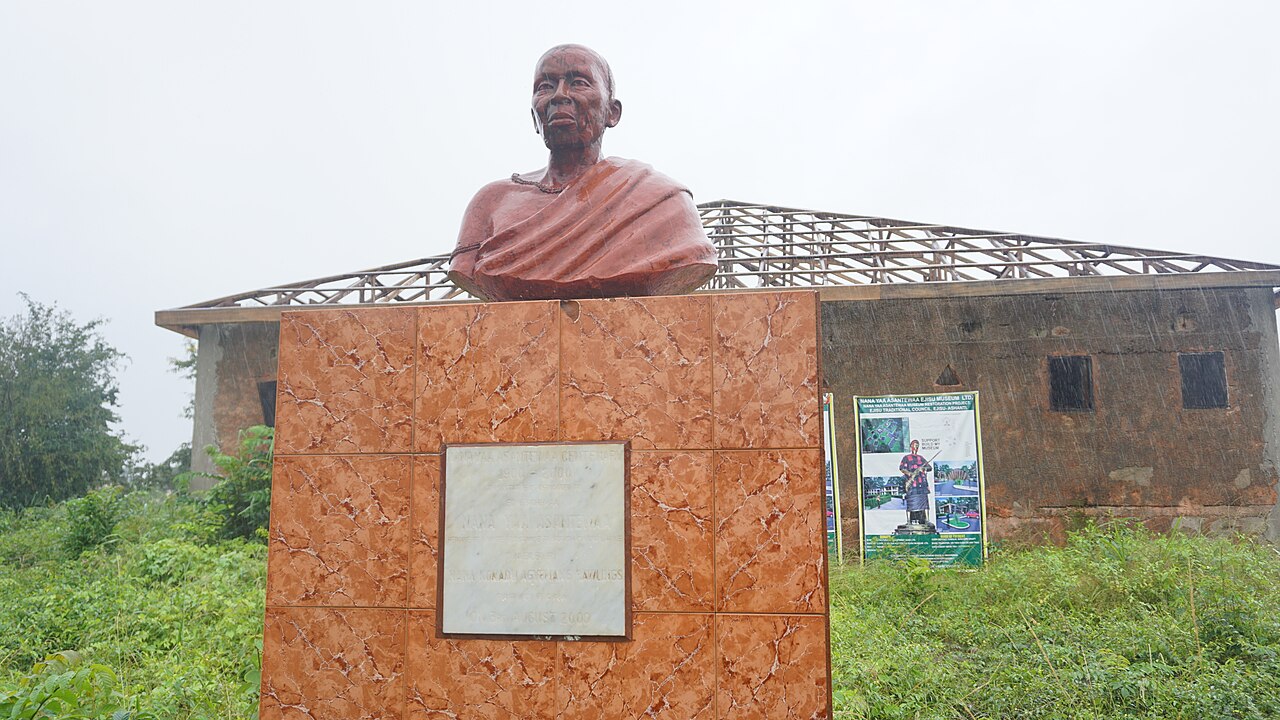
In Ghana, her name is invoked in political speeches, in women’s empowerment campaigns, and in debates about the role of traditional leaders in modern governance. The Yaa Asantewaa Girls’ Senior High School in Kumasi, founded in 1960, is one of the country’s most prestigious schools for girls. The Yaa Asantewaa Museum in Kwaso, near Ejisu, preserves her memory and the history of the Edweso state.
Beyond Ghana, she has become a global icon. In 2018, the African Union unveiled a statue of her at its headquarters in Addis Ababa, alongside other continental figures. In 2020, the Royal Mint in the United Kingdom issued a commemorative coin featuring her image as part of a series on British monarchs and their adversaries — an irony that was not lost on observers. In the diaspora, her name appears in the titles of books, documentaries, and academic studies.
Her story also resonates in contemporary debates about repatriation and reparations. The Golden Stool was never taken by the British, but many other Asante treasures were. The return of looted artifacts from European museums to Africa is now a live political issue, and Yaa Asantewaa’s war is often cited as evidence that Africans resisted colonial theft — and that the struggle for restitution is a continuation of that resistance.
What Yaa Asantewaa Teaches Us
There are several lessons that emerge from her life, and they are not the ones usually emphasized in simplified retellings.
- Leadership is contextual. Yaa Asantewaa did not seize power in a vacuum. She stepped into a role that already existed — the queen mother — and used it to meet a crisis. Her authority was legitimate, not usurped.
- Courage is not the absence of fear. She was in her sixties, facing the most powerful empire in the world, with no guarantee of success. She fought anyway.
- Colonial conquest was contested. The idea that Africans passively accepted colonization is a lie. The War of the Golden Stool is one of many examples of armed resistance that colonial histories often downplayed or ignored.
- Women’s leadership is not new. Yaa Asantewaa was not the first African woman to lead, and she was not the last. Her story is part of a long tradition that predates colonialism and continues today.
A Legacy That Refuses to Be Forgotten
Yaa Asantewaa died in exile, defeated in war, far from the land she loved. By the narrow logic of military outcomes, she lost. The British annexed Asante, and the Gold Coast became a colony. The empire she defended was dismantled.
But history is not written by the victors alone. It is also written by those who remember. And the Asante remembered. They remembered the queen mother who shamed the chiefs into fighting. They remembered the woman who refused to surrender the Golden Stool. They remembered the leader who, when everyone else hesitated, said: We will fight till the last of us falls.
That memory has outlasted the British Empire. It has outlasted the colonial administration that exiled her. It has outlasted the men who doubted her. Today, Yaa Asantewaa stands as one of the most recognizable figures in African history — not because she won a war, but because she refused to accept that her people’s sovereignty could be taken without a fight.
Her story is a reminder that resistance is never futile, even when it fails. It plants seeds that grow in unexpected places — in the independence movements of the 1950s and 1960s, in the Pan-Africanist dreams of the diaspora, in the ongoing struggle for gender equality, and in the quiet determination of every person who refuses to accept injustice as inevitable.
Yaa Asantewaa was not a myth. She was a woman, a mother, a queen, and a warrior. And her question — “Is it true that the bravery of Asante is no more?” — is still worth answering.