📅 Last updated: 08.09.2026
Kunta Kinteh Island, a tiny, parched speck of land huddled in the mouth of the River Gambia, is a place where the weight of history is so dense it feels like a physical presence, pressing down on the sunbaked earth. This island, once the epicentre of a human catastrophe that tore millions of lives from West Africa, is not merely a historical site; it is a stark, visceral monument to the transatlantic slave trade, a pilgrimage destination for those seeking to understand the brutal mechanics of human trafficking and the indomitable spirit of those who survived it. To stand on its shores is to confront a painful past, yet it is also to bear witness to the profound resilience of a people and a culture that refused to be erased.
- The Island’s Many Names: From St. Andrew to Kunta Kinteh
- The Saga of Kunta Kinteh and the Power of Roots
- Inside the Fort: The Architecture of Atrocity
- Life in the Dungeons: The Horrors of the Middle Passage’s Antechamber
- The Isle of No Return and the Symbolism of Memory
- Beyond the Ruins: The Living Culture of the Gambia
- A Unique Perspective: The Island’s Place in Global History
- Preserving the Past for Future Generations
- Kunta Kinteh Island: A Testament to Resilience and Remembrance
The Island’s Many Names: From St. Andrew to Kunta Kinteh
Before it became synonymous with the horrors of the slave trade, the island was known to the Portuguese, the first Europeans to sail up the Gambia River in the 15th century, as the isle of St. Andrew. Its strategic location, approximately 30 kilometres from the river’s mouth, made it a natural point for trade and, tragically, for human commodification. In 1651, the island was briefly colonised by Courlanders (from modern-day Latvia), who built a fort there, but it was the British who would ultimately leave the most enduring and infamous mark.
Following a series of Anglo-French conflicts, the island and its fort fell firmly under British control in the late 18th century. It was renamed James Island, after the Duke of York, later King James II. For over a century, Fort James, as it became known, operated as one of the most significant British slave-trading depots in West Africa. It was a place where captives were held in squalid, disease-ridden dungeons before being force-marched onto waiting ships for the horrific Middle Passage to the Americas.
The island’s most poignant name, however, is its newest. In 2011, the government of The Gambia, under the leadership of President Yahya Jammeh, officially renamed James Island to Kunta Kinteh Island, and the nearby town of Albreda to Jufureh. This was a powerful act of historical reclamation, honouring the fictionalised but deeply symbolic character from Alex Haley’s seminal 1976 novel, Roots: The Saga of an American Family. The name change was a deliberate move to shift the narrative focus from the European colonisers to the African victims and their descendants, forever cementing the island’s connection to one of the most famous stories of the African diaspora.
The Saga of Kunta Kinteh and the Power of Roots
No discussion of Kunta Kinteh Island is complete without acknowledging the immense cultural impact of Roots. The novel, and its record-breaking 1977 television miniseries, told the story of Kunta Kinteh, a young Mandinka man from the village of Jufureh, who was captured by slave raiders in 1767 while trying to chop wood for a drum. He was marched to the coast, held on the island, and shipped to Annapolis, Maryland, where he was sold into slavery and given the name Toby.
Haley’s work was a monumental achievement, tracing his own family lineage back to Kunta Kinteh through generations of oral history. While historians have debated the factual accuracy of certain details in Haley’s research, the emotional and cultural truth of Roots was undeniable. It awakened a global consciousness about the scale and brutality of the slave trade, and it gave millions of African Americans a powerful, tangible connection to a specific African heritage. For the first time, a place like Jufureh and an island like Kunta Kinteh Island became not just geographical locations on a map, but spiritual homelands.
Today, the island is a UNESCO World Heritage Site, recognised not only for its grim history but also for its potential to foster understanding and reconciliation. The site is a crucial part of the “Roots” heritage trail, drawing visitors from across the globe, particularly from the African diaspora, who come to walk in the footsteps of their ancestors and pay their respects. The island serves as a powerful reminder that the story of Africa is not solely one of tragedy, but also one of extraordinary endurance and the unbreakable bonds of memory that span oceans.
A Journey to the Island: From Banjul to Jufureh
Reaching Kunta Kinteh Island is an experience in itself, a journey that takes you from the vibrant, modern capital of Banjul deep into the heart of rural Gambia. The trip typically begins with a drive of about two hours along the North Bank Road, a dusty, lively thoroughfare that passes through bustling markets, peanut farms, and villages shaded by ancient kapok trees. The landscape is a vibrant tapestry of greens and ochres, a testament to the country’s nickname, “The Smiling Coast.”
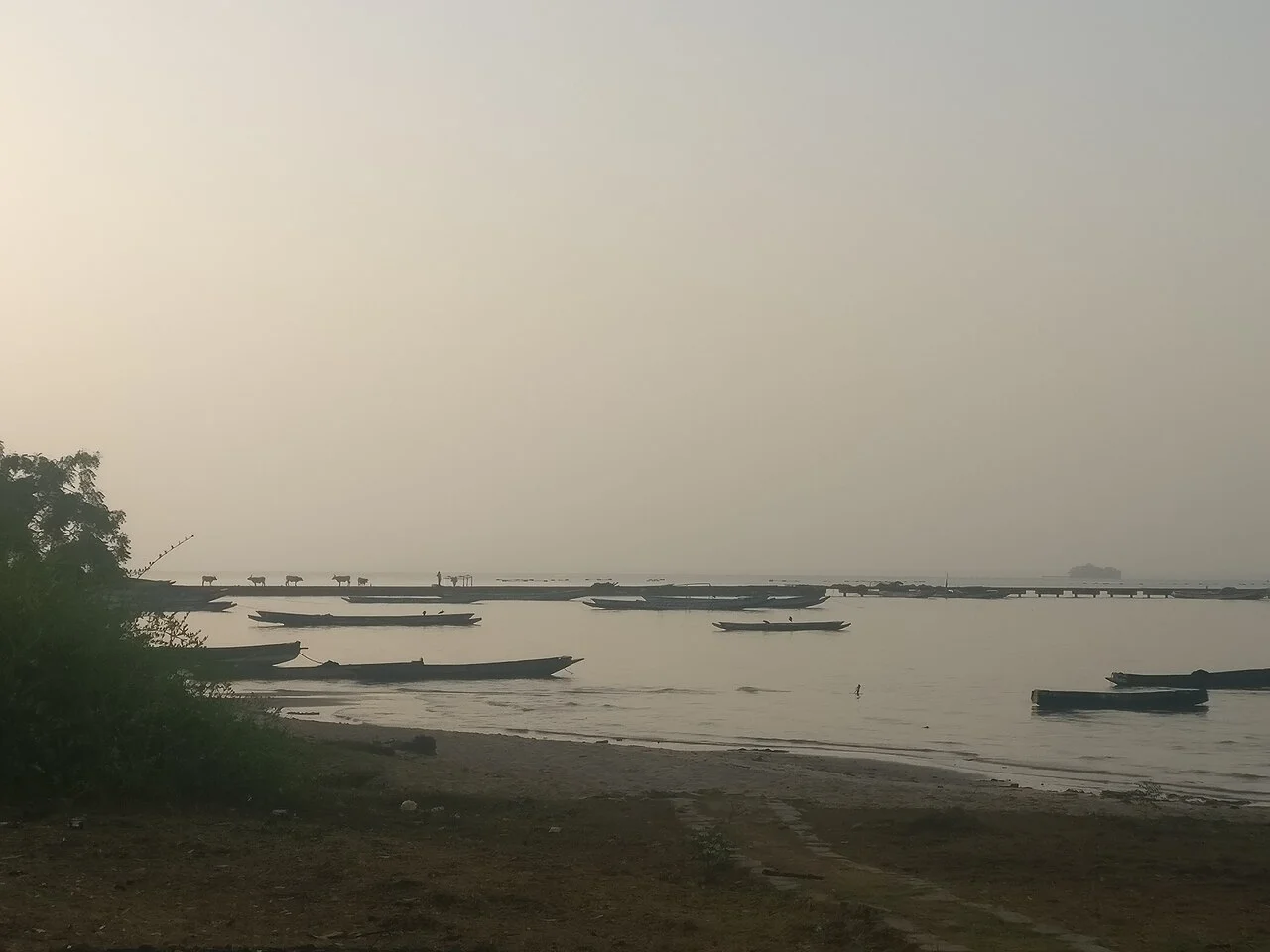
The journey culminates in the small town of Albreda, which sits directly opposite the island. Albreda was once a Portuguese trading post and later a French one, and its crumbling colonial buildings stand as silent witnesses to the European scramble for African resources. From Albreda, visitors take a short, motorised pirogue ride across the choppy, brown waters of the river. As the boat approaches the island, the skeletal ruins of Fort James emerge from the landscape, a stark and haunting silhouette against the bright African sky. It is a moment of profound anticipation, the reality of the place slowly sinking in with every metre closer you get.
Inside the Fort: The Architecture of Atrocity
Stepping ashore on Kunta Kinteh Island is a jarring sensory experience. The island is surprisingly small, only a few hundred metres long and wide, and it is now a silent, eerie place, overgrown with mangroves and scrub. The remnants of the British fort, built from red laterite bricks, stand crumbling and roofless, their walls eroded by centuries of tropical weather and neglect. Yet, despite its ruinous state, the layout of the fort is still discernible, and it tells a chilling story of calculated cruelty.
Visitors can explore the foundations of the officers’ quarters, the soldiers’ barracks, and, most harrowingly, the underground slave dungeons. These small, windowless cells, now open to the sky, could hold up to 150 people at a time in conditions of unimaginable filth and despair. Men, women, and children were packed together, chained and starving, for weeks or even months, awaiting the arrival of a slave ship. The air inside these stone pits is thick and heavy, and even today, it is not difficult to imagine the terror and anguish that permeated these walls. The lack of sanitation and the prevalence of disease meant that mortality rates were staggeringly high, and the island was not just a holding pen but a graveyard for countless nameless souls.
Near the fort’s remnants, visitors can also see a British cannon still pointing out over the river, a symbol of the military force that backed the trade. A British colonial house, once the residence of the fort’s commander, also stands in partial ruin. The entire island is a haunting testament to the brutal efficiency of the slave trade, a place where human life was systematically devalued and destroyed for profit. The silence here is not one of peace; it is the silence of a wound that has never fully healed.
“I do not know who I am, where I am going, or what will become of me. But I know that I am a man. I know that I am a Mandinka. I know that I will never stop fighting for my freedom.” — A sentiment echoing the spirit of countless captives.
Life in the Dungeons: The Horrors of the Middle Passage’s Antechamber
To truly understand the significance of Kunta Kinteh Island, one must grasp the dehumanising process that captives endured. The journey to the coast was often a brutal forced march, sometimes lasting hundreds of kilometres, with captives bound together by wooden yokes and ropes. Those who could not keep up were often killed or left to die. Upon arrival at the coast, they were examined like livestock by European surgeons and traders, their bodies scrutinised for signs of disease or weakness.
The captives who were deemed fit were then branded with hot irons and herded into the dungeons of Fort James. Here, they were stripped of their names, their languages, their families, and their identities. They were no longer people; they were cargo. The conditions were designed to break their spirits, to instil total submission and terror. The separation of families was a deliberate tactic, as was the deliberate mixing of different ethnic and linguistic groups to prevent communication and potential rebellion.
The psychological torment was as brutal as the physical abuse. The captives could hear the sounds of the fort’s activities above them, the laughter and shouts of the traders, the clinking of glasses, and the rhythmic pounding of the waves against the island’s shores. They knew they were being held for a purpose they could only fear. The voyage across the Atlantic, the infamous Middle Passage, is rightly remembered for its horrors, but the experience on the island was its own circle of hell—a prelude of suffering that lasted for weeks or months, a period of profound uncertainty and terror that is almost impossible for the modern mind to fully comprehend.
The Transatlantic Slave Trade: A Grim Statistical Overview
The scale of the tragedy that Kunta Kinteh Island represents is almost unimaginable. To provide a clearer picture, the table below outlines key, verifiable data points concerning the transatlantic slave trade, offering a sobering perspective on its magnitude and duration.
| Statistic | Figure / Period | Source / Note |
|---|---|---|
| Total Africans forcibly transported to the Americas | Estimated 12.5 million | Trans-Atlantic Slave Trade Database (TSTD); the largest forced migration in history. |
| Africans disembarked in North America | Approximately 388,000 | TSTD; this is less than 5% of the total, with the vast majority going to Brazil and the Caribbean. |
| Mortality rate during the Middle Passage | Estimated 12-15% (1.8 million deaths) | TSTD; this figure excludes the high death rate on land during capture and in holding pens like Fort James. |
| Primary European nations involved | Portugal, Britain, France, Spain, Netherlands | British ships carried over 3.4 million captives, more than any other nation. |
| Peak period of the trade | 1701-1810 | This century saw over 6 million people transported, the height of the trade when Fort James was at its busiest. |
| Abolition of the slave trade by Britain | 1807 | The British Parliament passed the Slave Trade Act, but the trade continued illegally for decades. |
These numbers are not just cold statistics; they represent individual human beings—mothers, fathers, children, artisans, healers, and warriors—whose potential was brutally extinguished or forcibly redirected to build wealth for others. The legacy of this forced migration is a complex tapestry woven into the very fabric of the Americas, from its music and food to its politics and social structures.
The Isle of No Return and the Symbolism of Memory
One of the most poignant spots on Kunta Kinteh Island is a small, gnarled baobab tree. It is known locally as the “Tree of Forgetfulness” or the “Tree of Return.” The lore surrounding the tree is heartbreakingly symbolic. It is said that female captives were forced to walk around the tree seven times before boarding the ships. This ritual was designed to make them forget their past, their homes, and their families, leaving them in a state of spiritual and mental confusion that would ensure their compliance. The tree is a powerful symbol of the attempt to erase memory, an act of cultural genocide that was as deliberate as the physical enslavement itself.
Yet, for the descendants of those who were taken, the island has become a place of remembrance and reclamation. For many African Americans and members of the diaspora, visiting the island is a deeply spiritual and emotional pilgrimage. It is a chance to honour their ancestors, to reclaim the names and histories that were stolen from them, and to connect with a homeland they have only ever known through stories and dreams. The act of walking on the same ground as their forebears, of touching the walls of the dungeons, is a powerful act of healing and a reassertion of identity in the face of a history that sought to erase it.
The Gambian people themselves have embraced this role as guardians of memory. The nearby village of Jufureh, the ancestral home of the Kinteh clan, is a vibrant community that has become a focal point for visitors. Here, tourists are welcomed by members of the Kinteh family, who proudly share their oral history and genealogy. The famous “Roots” ceremony, which takes place in Jufureh, involves a traditional welcoming and a retelling of the clan’s story, providing a living, breathing connection to the past that extends beyond the ruins of the island.
Beyond the Ruins: The Living Culture of the Gambia
It is crucial to remember that the story of The Gambia is not solely defined by its painful history. The country is a vibrant, modern, and deeply welcoming nation that is actively using its heritage to build a better future. Just a short distance from the solemnity of Kunta Kinteh Island, life continues with an infectious energy. The bustling markets of Banjul and Serrekunda are a cacophony of colour, sound, and commerce, where vendors sell everything from vibrant fanga fabrics and intricate silver jewellery to fresh produce and the latest mobile phones.
Gambian music is a joyous and powerful force, with genres like mbalax and afro-manding filling the air. The kora, a beautiful 21-stringed harp-lute, is the country’s national instrument, and its haunting melodies are a source of immense pride. The country is also renowned for its vibrant arts scene, with skilled woodcarvers, batik artists, and painters creating works that both reflect traditional techniques and engage with contemporary themes.
Furthermore, the Gambia is a pioneer in community-based ecotourism. The wetlands and national parks, such as Kiang West National Park and the River Gambia National Park (home to the famous chimpanzee sanctuary), are vital habitats for a stunning array of wildlife, including hippos, manatees, crocodiles, and over 500 species of birds. Local communities are increasingly involved in managing these natural treasures, ensuring that tourism benefits the population directly and fosters a sense of stewardship for the environment. This duality—honouring a tragic past while actively building a dynamic and hopeful present—is the true essence of modern Gambia.
A Unique Perspective: The Island’s Place in Global History
The history of Kunta Kinteh Island is not an isolated African story; it is an integral chapter in the intertwined histories of Europe, the Americas, and Africa. The wealth generated by the slave trade funded the industrial revolution in Britain and built many of the great fortunes of the American South and the Caribbean. The sugar, cotton, and tobacco produced by enslaved labour in the Americas were central to the global economy of the 18th and 19th centuries. To understand the world we live in today, from the racial dynamics of the United States to the economic disparities between the Global North and South, one must confront the legacy of places like this island.
The island also stands as a testament to the resilience of the human spirit. The fact that the descendants of those who were enslaved have not only survived but thrived, creating vibrant cultures and making immeasurable contributions to every field of human endeavour, is a powerful counter-narrative to the dehumanising story of the trade itself. Kunta Kinteh’s story, as popularised by Roots, is one of resistance and defiance, as he never stopped fighting for his freedom or yearning for his home. His spirit is a metaphor for the diaspora itself—a people who were torn from their roots but who have continued to grow, blossom, and enrich the world in countless ways.
Preserving the Past for Future Generations
The preservation of Kunta Kinteh Island and its associated sites is a complex and ongoing challenge. The ruined fort is subject to the relentless forces of erosion, saltwater, and tropical weather. The Gambian government, in partnership with UNESCO and various international organisations, has been working to stabilise the structures and protect the site from further decay. However, funding is often scarce, and the task is monumental.
There is also the challenge of managing the site’s emotional weight. The Gambia has adopted a thoughtful approach, aiming to educate visitors about the facts of the slave trade while also providing a space for reflection and remembrance. Local guides, many of whom are descendants of families who remained in the area, offer deeply personal and knowledgeable tours, sharing stories that have been passed down through generations. They speak not only of the horrors but also of the strength and dignity of their ancestors, ensuring that the site remains a place of learning and empowerment, not just a spectacle of suffering. This careful, human-centred approach to heritage management is crucial for ensuring that the memory of what happened here is never forgotten and that its lessons continue to resonate with future generations.
Kunta Kinteh Island: A Testament to Resilience and Remembrance
Standing on the windswept shore of Kunta Kinteh Island, looking out over the vast Atlantic, one is filled with a complex mix of emotions—sorrow, anger, awe, and ultimately, a profound sense of hope. The island is a scar on the face of the earth, a permanent reminder of humanity’s capacity for cruelty. But it is also a place of profound meaning, where the story of suffering is inseparable from the story of survival. The captives who passed through this place did not just endure; their descendants went on to build nations, create art, and fight for freedom and equality across the globe.
To visit Kunta Kinteh Island is to undertake a pilgrimage of understanding. It is to acknowledge the painful chapters of our shared history and to recognise the deep connections that bind all of humanity together. It is to listen to the whispers of the past and to hear in them not just a story of despair, but a powerful testament to the unyielding strength of the human spirit. The island is a call to remember, to learn, and to ensure that such atrocities are never again allowed to happen. It stands as a silent, enduring witness, not to the triumph of oppression, but to the enduring power of memory, resilience, and the unbreakable will to be free.