📅 Last updated: 03.09.2026
Lamu Old Town is not merely a destination; it is a living, breathing manuscript of Swahili civilization, its coral-stone walls and winding alleys inscribing over seven centuries of trade, faith, and cultural synthesis onto the edge of the Indian Ocean. To walk its streets is to step into a world where the call to prayer mingles with the sound of dhows creaking at anchor, and where time seems to move to the rhythm of the tides rather than the tick of a clock. This ancient port, a jewel on Kenya’s northern coast, offers more than just a glimpse into the past; it presents a profound, ongoing narrative of resilience and cultural fusion that continues to shape the identity of the Swahili people today.
- The Historical Cradle of the Swahili Coast
- The Architectural Poetry of Coral Stone and Mangrove
- Life on the Water: The Enduring Dhow Culture
- A Bastion of Islamic Scholarship and Cultural Celebrations
- Navigating the Timeless Lanes: A Journey Through the Present
- Preservation and Modernity: The Delicate Balance
- The Living Legacy of Lamu Old Town
The Historical Cradle of the Swahili Coast
The story of Lamu Old Town is inextricably linked to the rise of the Swahili civilization, a distinct culture born from the intermarriage and collaboration of Bantu-speaking coastal communities with Arab, Persian, and later Indian and Portuguese traders. While the archipelago has been inhabited for millennia, the town itself began to flourish as a major trading hub from around the 12th century. It was during this period that Lamu established itself as a pivotal node in the vast Indian Ocean trade network, exchanging ivory, timber, frankincense, and, tragically, slaves for porcelain, silk, spices, and glass from as far afield as China and the Middle East.
By the 19th century, Lamu had reached its zenith, becoming a centre of poetry, theology, and scholarship under the patronage of its influential merchant families. The town’s importance was such that in 1813, its residents, allied with the Mazrui Arabs of Mombasa, successfully repelled an invasion from the rival city-state of Pate in the decisive Battle of Shela. This victory cemented Lamu’s independence and marked the beginning of a golden era of prosperity and cultural achievement that is still celebrated today, most famously during the annual Maulidi Festival, which commemorates the birth of the Prophet Muhammad.
An Unbroken Urban Fabric
Unlike many historic coastal settlements that were dramatically reshaped by Portuguese or Omani colonial occupation, Lamu’s character remained remarkably intact. The Portuguese, who sacked Mombasa, found Lamu a less strategic prize and largely left its social fabric undisturbed. Later, while the Sultan of Zanzibar exerted nominal control in the 19th century, the town’s own council of elders and merchants continued to govern its daily affairs, fostering a unique sense of continuity. This historical autonomy is one of the key reasons why Lamu Old Town retains an architectural and cultural integrity that is almost unprecedented along the East African coast, a fact recognised by UNESCO when it was inscribed as a World Heritage Site in 2001.
The Architectural Poetry of Coral Stone and Mangrove
The physical layout and design of Lamu Old Town are its most immediate and striking marvels. The architecture is a masterclass in adaptation and aesthetics, an intricate fusion of Swahili, Arab, Persian, and Indian design principles that create a cool, shaded, and deeply private urban environment. The primary building material is coral stone, quarried from the nearby reef and left to cure before being cut into precise blocks. This is then bound with a lime mortar made from burnt coral, a technique that has proven remarkably durable for centuries.
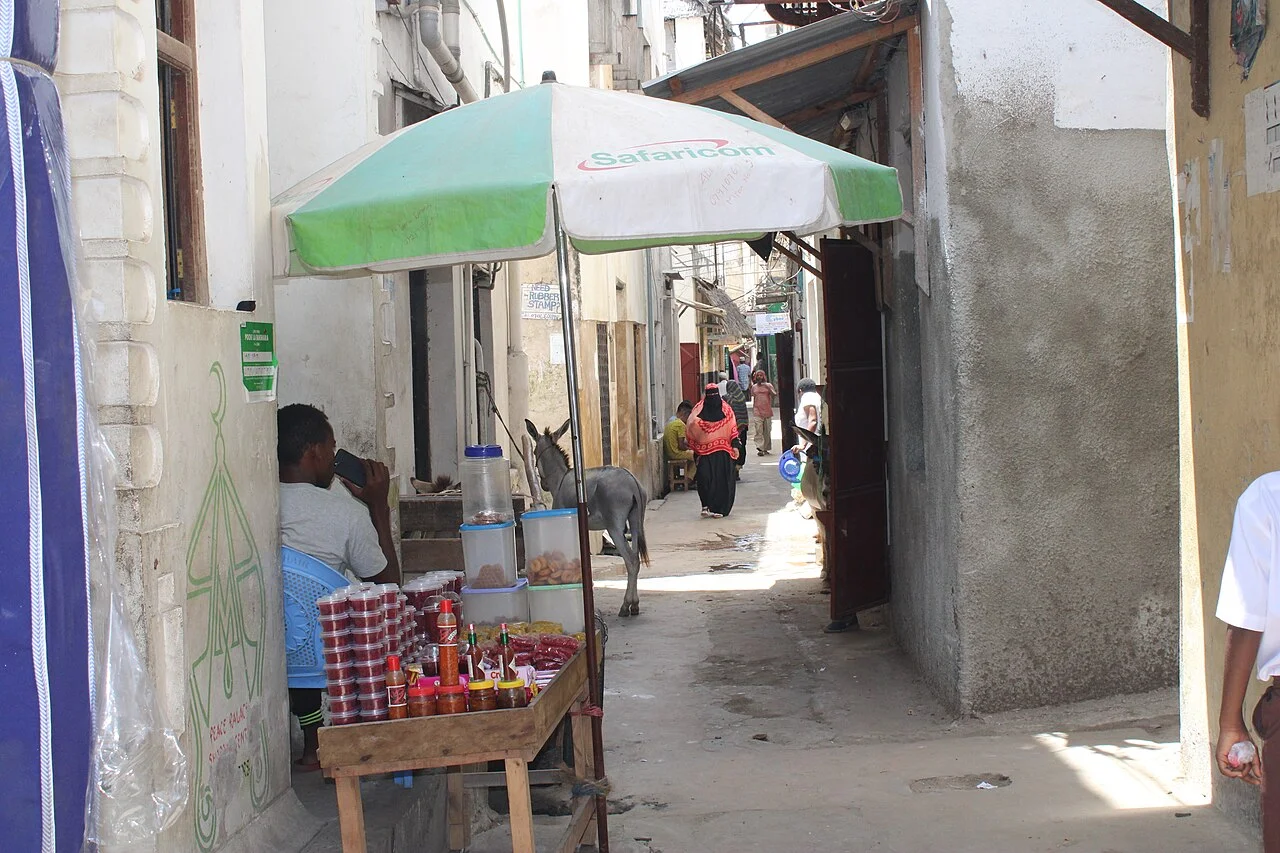
The famous, labyrinthine streets of the old town are deliberately narrow and often roofed with mangrove poles, providing essential shade from the equatorial sun. This was not a random design choice but a sophisticated response to the harsh climate. The dense urban planning also reflects a deeply ingrained social code based on Islamic principles of privacy and modesty. Elaborately carved wooden doors, often of teak or mangrove, are a hallmark of Lamu’s architecture. The style of carving—whether the floral motifs of the older Arabesque style or the geometric patterns of the later Indian style—often denoted the wealth and origins of the family that lived within.
The Iconic Swahili House
The quintessential Lamu dwelling, the Swahili house, is a masterpiece of vertical and horizontal planning designed around a central courtyard. This courtyard serves as the heart of the home, a private open-air space that allows light and air to penetrate while maintaining absolute seclusion from the street. The houses are typically two stories high with flat coral-rag roofs, featuring a distinct daka, or roof terrace, and a prominent baraza—a low, stone-built bench that runs along the exterior wall of many homes. The baraza is more than just a seat; it is a fundamental social institution where men gather in the cool of the evening to discuss politics, share news, and engage in storytelling, reinforcing the community’s strong social bonds.
- Ground Floor: Largely used for storage and service areas, with the daka (veranda) providing a transitional space.
- Upper Floor: Contains the main living quarters, including the ndani (inner room) and the taqsimi (a formal reception room), often lavishly decorated with carved plaster niches (vidaka) and Chinese porcelain plates set into the walls.
- Roof Terrace (Daka): Used for sleeping during hot nights, socialising, and offering panoramic views of the town and harbour.
This architectural form is not a static museum piece. Many homeowners today are actively engaged in restoration and conservation, supported by organisations like the Lamu Museum and the National Museums of Kenya, working to preserve traditional techniques while adapting homes for modern living, proving that heritage and progress can coexist.
Life on the Water: The Enduring Dhow Culture
To understand Lamu, one must look to the sea. The Indian Ocean is not a barrier but a highway, and the dhow is its most iconic vehicle. These elegant, lateen-rigged sailing vessels, traditionally built from mangrove and teak, are still handcrafted in Lamu’s boatyards using methods passed down from master craftsmen to apprentices over generations. The island of Lamu, and the nearby town of Matondoni, are famed for their skilled boat builders, who can spend months constructing a single vessel without any written plans, relying purely on memory and practiced skill.
While modern motorboats are increasingly common, the dhow remains central to the local economy and culture. They are used for fishing, for transporting goods and building materials between the island and the mainland, and for the traditional sport of dhow racing, a thrilling spectacle that draws huge crowds during festivals. The daily rhythm of the town is still set by the monsoon winds. For centuries, traders would set sail with the north-easterly Kaskazi winds (December to March) and return with the south-westerly Kusi winds (April to August), a cycle that dictated the very ebb and flow of commerce and culture.
“The sea is not just a job for us; it is in our blood. Every plank of a dhow, every knot in its rope, tells the story of our fathers and their fathers before them. To sail is to remember.” — A sentiment echoed by many veteran sailors and boatbuilders of Lamu.
This maritime culture also brings a cosmopolitan energy to the narrow streets. The town’s population is a rich mosaic of Swahili, Arab, Indian, and even European descent, all of whom have contributed to the unique social fabric. The air is often filled with a cacophony of languages and accents, from the lyrical Kiswahili to the lilting Portuguese-influenced dialect of some older residents, a testament to Lamu’s long history as a global crossroads.
A Bastion of Islamic Scholarship and Cultural Celebrations
For generations, Lamu Old Town has been a revered seat of Islamic learning and Swahili culture. The town is home to more than twenty mosques, some of which, like the Pwani Mosque, date back to the 14th century. Beyond their religious function, these mosques and the associated madrasas (religious schools) have been the primary engines of literacy and scholarship for centuries. They are the reason why Lamu became a centre for the composition and preservation of Swahili poetry, a rich and complex literary tradition that explores themes of love, faith, history, and philosophy. The works of renowned 19th-century poets like Mwana Kupona, whose poem “Utendi wa Mwana Kupona” is a cornerstone of Swahili literature, were composed and recited here.
This profound religious and intellectual heritage culminates in the town’s most famous annual event: the Maulidi Festival. Held every year during the third month of the Islamic lunar calendar, the festival transforms Lamu Old Town into a vibrant centre of pilgrimage and celebration. Thousands of pilgrims, scholars, and tourists flock to the island to honour the birth of the Prophet Muhammad. The festival is marked by days of religious recitations, prayers, and scholarly discussions, but it is most famous for its spectacular evening procession of Zarafa (a decorated model of a dhow) and the hypnotic, rhythmic chanting and drumming that fills the night air. It is a powerful, moving display of faith and communal identity that has put Lamu on the global religious tourism map.
Navigating the Timeless Lanes: A Journey Through the Present
Walking through Lamu Old Town today is a multi-sensory experience. There are no cars here—the streets are simply too narrow—so life moves at the pace of foot, donkey, and bicycle. This car-free environment is one of the town’s greatest charms, preserving a medieval atmosphere and a quieter, more human scale of life. The main street, Harambee Avenue, runs along the seafront, bustling with shops, hotels, and the historic Lamu Fort, a massive, hulking structure built by the Omani Arabs in the early 19th century. This fort, which now houses the Lamu Museum’s excellent collection on Swahili culture, was once a military garrison and a prison, its thick walls a silent witness to centuries of political shifts and power struggles.
Venturing deeper into the town, the main thoroughfares branch off into a network of even smaller, more intimate lanes. Here, you will find artisan workshops where craftsmen continue to produce the intricate silver jewellery, wood carvings, and woven kofia (embroidered caps) that Lamu is famous for. The scent of cardamom and cloves wafts from small spice shops, while women in brightly coloured khangas and buibui (black veils) move gracefully between homes and markets. It is a place where the past is not a distant relic but a living presence, woven into the daily commerce and social interactions of its residents.
| Aspect of Life | Historical Significance | Contemporary Reality |
|---|---|---|
| Transportation | Dhow and foot were the only modes of travel for centuries. | Streets remain car-free; donkeys and boats are still essential for daily life, but motorised boats are increasingly used for sea travel. |
| Economy | Historically based on trade in ivory, spices, and mangrove poles. | Fishing, tourism, and boat-building are now the mainstays, alongside a growing focus on heritage conservation. |
| Social Structure | Hierarchical, led by influential merchant and religious families. | A more egalitarian society, but traditional family lineage and respect for elders still carry significant weight. |
| Architecture | Coral stone and mangrove were the primary, functional building materials. | These same materials are used in restoration, but with modern techniques and cement for structural reinforcement. |
Preservation and Modernity: The Delicate Balance
In 2001, UNESCO’s designation of Lamu Old Town as a World Heritage Site was a double-edged sword. It brought international recognition and crucial funding for conservation, but it also placed the town under a global spotlight, increasing pressure from tourism and development. The challenge for Lamu today is to manage this modern attention without sacrificing the very authenticity that makes it so special. The balance between preserving the ancient fabric and providing for the needs of a modern population is a delicate one.
Significant efforts are underway to ensure this balance is maintained. The Lamu World Heritage Site Management Committee, in partnership with the National Museums of Kenya and international bodies like the Aga Khan Trust for Culture, has implemented a range of conservation projects. These include the meticulous restoration of historic houses, the training of local craftsmen in traditional building techniques, and the development of a comprehensive management plan that guides urban development and tourism. For instance, the Riyadha Mosque, a centre of learning built in the 1880s, has been a key focus of restoration, preserving its unique coral stone architecture and its role as a vibrant community hub. Furthermore, the focus is not only on physical structures but also on safeguarding the intangible heritage—the music, poetry, and oral traditions that give the town its soul.
Challenges on the Horizon
The recent development of the Lamu Port-South Sudan-Ethiopia Transport (LAPSSET) Corridor project, a massive infrastructure undertaking that includes a new port on the mainland at Manda Bay, represents the most significant challenge to the region’s traditional way of life. While the project promises economic development and job creation for the broader region, it also brings the risk of unplanned urbanisation, environmental damage, and social disruption to the fragile ecosystem of the Lamu archipelago. Balancing these large-scale national ambitions with the need to protect a site of outstanding universal value is a complex geopolitical and ethical question that the Kenyan government and local communities are still grappling with. The outcome will determine the future character of not just the old town, but the entire coastal region.
The Living Legacy of Lamu Old Town
Lamu Old Town is far more than a beautifully preserved relic or a postcard image of a bygone era. It is a powerful testament to the resilience, creativity, and cosmopolitan spirit of the Swahili people. It demonstrates that African history is not a singular narrative, but a complex tapestry of interactions, where diverse cultures have met, clashed, and ultimately blended to create something truly unique. The town’s survival for over seven centuries is a story of active adaptation, not passive preservation. Its residents have continuously renegotiated their identity and their place in the world, absorbing external influences while fiercely maintaining their core cultural values and their connection to the sea.
To walk its ancient streets is to hear the echoes of poets and scholars, to see the handiwork of master carpenters and masons, and to feel the pulse of a community deeply rooted in its past yet inextricably part of the present. As modern Kenya races forward, Lamu Old Town serves as an essential anchor, a reminder that progress is most meaningful when it is built on a foundation of deep cultural understanding and pride. It is a treasure not just for Kenya, but for the entire world, a place where the soul of a civilisation is etched into the very fabric of its urban landscape, and where the timeless call of the sea still beckons to all who are willing to listen. Its legacy is not a static one of preservation, but a dynamic, ongoing creation, ensuring that this Swahili treasure remains a vibrant and vital part of Africa’s future.