📅 Last updated: 31.08.2026
For centuries, the story of ancient Africa has been told through a single, dominant lens—the lens of Egypt, the land of the pharaohs. Yet, just a few hundred miles to the south, along the same life-giving waters of the Nile, a rival civilization flourished, traded, fought, and ultimately ruled over its northern neighbor. This was the Kingdom of Kush, a formidable empire whose history is one of the most compelling, complex, and often overlooked chapters in the story of the ancient world.
- The Land of the Bow: Origins and the Rise of Kerma
- The Egyptian Occupation and the Culture of Napata
- The Black Pharaohs: The 25th Dynasty of Egypt
- Return to the South: The Meroitic Kingdom
- The Iron Age Powerhouse and Its Global Trade
- A Lineage of Kings and Queens
- The Mystery of the Meroitic Script
- Decline and Legacy: The End of an Era
- A Civilization of Its Own
The Land of the Bow: Origins and the Rise of Kerma
Long before the pyramids of Giza were a distant memory to their builders, the foundations of Kush were being laid in the fertile savannas and rocky outcroppings of Nubia, a region that stretches from Aswan in southern Egypt to the confluence of the White and Blue Nile in modern-day Sudan. The earliest inhabitants were pastoralists and farmers, but by around 2500 BCE, a powerful urban center had emerged at Kerma, just south of the Third Cataract. This was not a mere village or a trading post; it was a bustling metropolis with massive mud-brick walls, sprawling residential districts, and a population that may have reached 10,000 people—making it one of the largest cities in Africa at the time.
The people of Kerma were masterful artisans. They crafted exquisite, finely polished black-topped red pottery that is considered some of the finest ceramic work of the ancient world. They worked gold, ivory, and semi-precious stones into jewelry of breathtaking beauty. Their wealth was built on a strategic monopoly of trade routes that funneled goods from the African interior—ebony, frankincense, leopard skins, and, crucially, gold from the deserts to the east—northward into Egypt.
This economic power translated into military and political strength. The Egyptians, who viewed the south with a mixture of disdain and fear, called this land Ta-Seti, “the Land of the Bow,” a testament to the legendary archery skills of the Nubian warriors. The relationship between Egypt and Kerma was one of constant tension, marked by cycles of trade, raid, and conquest. The Egyptians coveted Kerma’s gold and resources, while the Kushites fiercely defended their independence. This was not a relationship of simple domination; it was a dynamic, two-way street of cultural exchange and conflict that shaped both civilizations.
The Egyptian Occupation and the Culture of Napata
The balance of power shifted decisively in the 16th century BCE when the pharaohs of the New Kingdom, having expelled the Hyksos from the Delta, turned their military might southward. Pharaoh Thutmose I and his successors pushed deep into Nubia, eventually conquering Kerma and establishing a colonial administration. The Egyptians built fortress-towns like Amara West and, most importantly, the city of Napata, located at the foot of the sacred mountain of Jebel Barkal. This was not merely a military garrison; it was a center of Egyptian administration, religion, and culture.
For nearly five centuries, Nubia was effectively an Egyptian province, governed by a viceroy known as the “King’s Son of Kush.” The Egyptians built temples to Amun, the great god of Thebes, and imposed their language, writing, and religious practices on the local elite. However, the story of this period is not one of simple cultural erasure. The Nubian elites adopted Egyptian customs but infused them with their own local meanings and traditions. They were not passive recipients of Egyptian culture; they were active agents who selected, adapted, and reinterpreted it to suit their own needs.
This period of colonization, ironically, sowed the seeds for the next great chapter of the Kingdom of Kush. The city of Napata became a deeply sacred place, not just for the Egyptians, but for the Nubians themselves. The pyramid tombs of the New Kingdom pharaohs, built in the shadow of Jebel Barkal, became a template for the future. The local elite, educated in Egyptian ways and steeped in the cult of Amun, were preparing themselves for a role far greater than that of colonial subjects.
The Black Pharaohs: The 25th Dynasty of Egypt
As the New Kingdom of Egypt crumbled under internal strife and foreign invasions in the 11th century BCE, the power vacuum in the south was filled by the very people the Egyptians had once sought to control. The Kushite kings of Napata, who had long maintained their own independent kingdom while adopting Egyptian royal ideology, began to expand their influence northward. In the 8th century BCE, a charismatic and ambitious king named Kashta (“The Kushite”) asserted control over Upper Egypt, but it was his son, Piye (or Piankhi), who would achieve the ultimate triumph.
Piye launched a full-scale military campaign into Egypt, which was then a fractured landscape of competing petty kingdoms, all under the shadow of the Assyrian Empire to the east. Piye’s conquest was swift and decisive. He marched his army north, winning key victories and receiving the submission of the delta chiefs. Unlike many conquerors, Piye did not loot or destroy. He was a deeply religious man, and his primary goal was to restore the purity of the cult of Amun. He travelled to Thebes and participated in the Opet Festival, a grand religious ceremony that legitimized his rule. His famous Victory Stela, a massive slab of granite inscribed with the story of his campaign, is a masterpiece of royal propaganda, but it also reveals a king who saw himself as a pious restorer of order, not a mere plunderer.
Piye and his successors—most notably Shabaka, Shebitku, and Taharqa—became the founders of Egypt’s 25th Dynasty, often called the “Kushite” or “Ethiopian” Dynasty. For nearly a century (c. 747–656 BCE), these “Black Pharaohs” ruled over a united Nile Valley stretching from the Mediterranean Sea to the confluence of the Blue and White Nile. It was a golden age. They initiated a massive building program, restoring ancient temples and constructing new ones with a distinctive, archaizing style that harked back to the Old Kingdom. Taharqa, the most powerful of the dynasty, built more temples and monuments than many native Egyptian kings, including the magnificent colonnaded kiosk at Karnak. Under their rule, Egypt was prosperous, stable, and culturally vibrant.
“The Kushite kings did not see themselves as foreigners imposing a foreign culture. They saw themselves as the true inheritors of the ancient Egyptian tradition, the restorers of a golden age that had been lost.” — A perspective echoed by many modern historians of the period.
However, their power was not to last. The Assyrian Empire, having consolidated its hold on the Levant, turned its full force on Egypt. Despite the heroic resistance of Taharqa and his successor Tanutamani, the Kushite armies were eventually overwhelmed by the iron weapons and advanced siege tactics of the Assyrians. In 656 BCE, the Assyrians installed a native Egyptian vassal, Psamtik I, as ruler of the Delta, effectively ending the Kushite control of Lower Egypt. The Kushite kings retreated to their homeland, their dream of ruling a unified Nile Valley shattered, but their legacy as the legitimate pharaohs of Egypt remained a powerful memory.
Return to the South: The Meroitic Kingdom
The retreat from Egypt was not a collapse; it was a strategic withdrawal. The Kushite court moved its center of power southward, eventually settling at Meroe, located between the Fifth and Sixth Cataracts of the Nile. This move was profoundly significant. Meroe was further from the threats of the Mediterranean world, but it was also at the heart of a rich agricultural region and, crucially, it was closer to the iron ore and timber needed for iron smelting. Meroe would become the Birmingham of ancient Africa, a massive industrial center producing iron tools, weapons, and trade goods on an unprecedented scale.
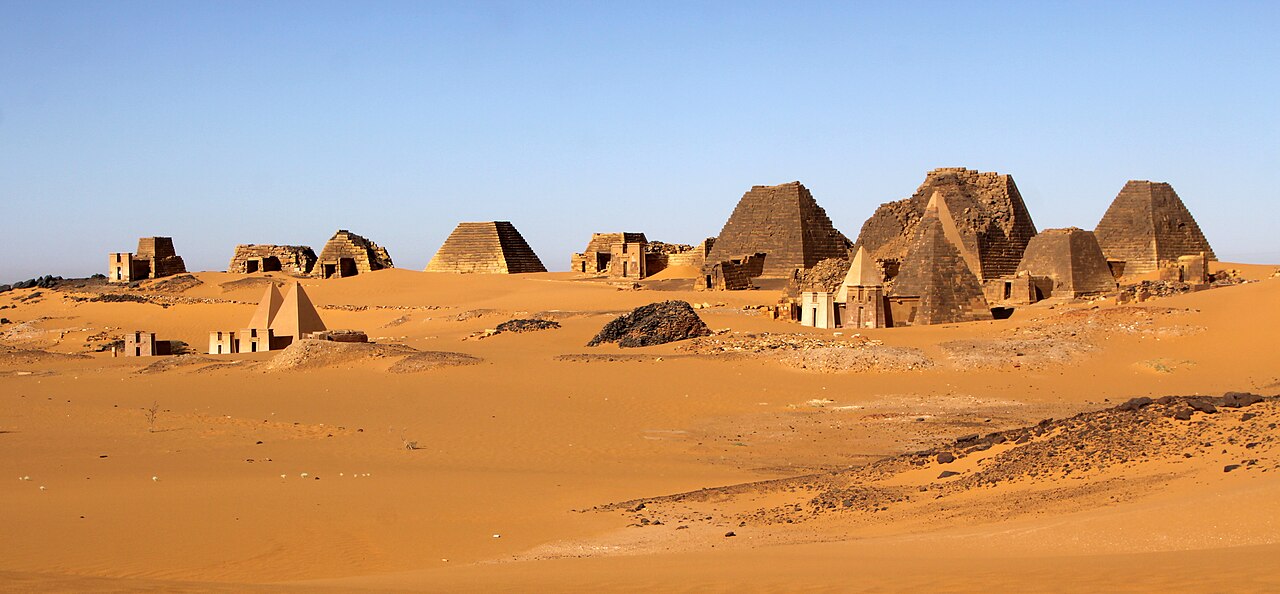
The Meroitic period (c. 590 BCE – 350 CE) saw the Kingdom of Kush reach a new zenith. The kings and queens of Meroe built dozens of steep-sided, narrow pyramids—smaller than their Egyptian counterparts but just as striking—that still stand today at sites like Meroe, Nuri, and el-Kurru. They developed their own unique writing system, the Meroitic script, which remains only partially deciphered to this day, a tantalizing mystery that represents a unique and independent cultural achievement.
The culture of Meroe was a fascinating blend of Egyptian traditions and indigenous African innovations. The rulers continued to style themselves as pharaohs and worshipped gods like Amun and Isis, but they also elevated native gods like Apedemak, a lion-headed deity of war and kingship. Perhaps most remarkably, the Kushites of Meroe were known for their powerful queens, known as Kandakes (or Candaces). Unlike most of their Egyptian counterparts, these ruling queens were not simply consorts or regents; they were independent sovereigns who led armies, built monuments, and negotiated with foreign powers. The famous Kandake Amanirenas is a prime example. After the Roman Empire conquered Egypt in 30 BCE, she led a daring military campaign against Roman forces in southern Egypt, raiding Roman garrisons and even carrying off bronze statues of Augustus to bury beneath the steps of her palace—a symbolic act of defiance that is one of the most iconic moments in ancient African history.
The Iron Age Powerhouse and Its Global Trade
The wealth of Meroe was not based solely on agriculture. It was an industrial and commercial powerhouse. The vast slag heaps found at Meroe are evidence of one of the largest iron-smelting industries in the ancient world. This iron was not just for local use; it was a major export. The Kingdom of Kush sat at a vital crossroads of trade routes that connected the Mediterranean world, the Arabian Peninsula, and the deep interior of Africa. From Meroe, caravans travelled east to the Red Sea ports of Adulis and Berenike, where goods were shipped to India and the Roman Empire. They also travelled south and west into the African interior, exchanging iron, textiles, and manufactured goods for gold, ivory, ebony, and exotic animals.
This trade brought immense prosperity and also connected Kush to a wider world. Greek and Roman writers, from Herodotus to Strabo, wrote about the “Ethiopians” of Meroe with a mixture of admiration and curiosity. The kingdom was not isolated; it was a sophisticated, cosmopolitan state that engaged with the great powers of the day. The artistic style of Meroitic pottery and jewelry shows influences from Greece, Rome, and even India, while their own unique artistic traditions remained unmistakable. The famous royal baths at Meroe, a large water sanctuary with a complex hydraulic system, are a testament to the engineering skill and sophisticated aesthetic of the Meroitic people.
One of the most impressive aspects of the Meroitic state was its political stability. The system of succession, which involved both kings and queens, ensured a long line of rulers that lasted for nearly a millennium. The Kandakes were central to this system, often serving as the king’s mother, sister, or wife, and wielding real political and military power. The Roman historian Strabo recounts the story of the Kandake who, in the 1st century BCE, negotiated a peace treaty with the Romans directly, securing favorable terms for her kingdom. This was not a marginal state; it was a major power that commanded respect from the greatest empires of the age.
A Lineage of Kings and Queens
To understand the depth and longevity of the Kingdom of Kush, it helps to look at the key rulers who shaped its trajectory. Their reigns are a testament to the kingdom’s resilience and its ability to adapt to changing circumstances.
| Ruler | Period (approx.) | Key Achievement |
|---|---|---|
| Piye | c. 744–714 BCE | Conquered Egypt, founded the 25th Dynasty, and restored the cult of Amun. |
| Taharqa | c. 690–664 BCE | Most powerful of the Black Pharaohs; built extensively at Karnak, Jebel Barkal, and elsewhere; fought the Assyrian Empire. |
| Kandake Amanirenas | c. 40 BCE – 10 CE | One-eyed warrior queen who led a successful military campaign against Rome and negotiated a favorable peace. |
| King Natakamani | c. 1–25 CE | Co-ruled with Kandake Amanitore; built the great temples of Amun at Naqa and the Lion Temple at Musawwarat es-Sufra. |
| King Yesebokheamani | c. 260–300 CE | One of the last major rulers; expanded the kingdom’s territory and built numerous temples in the Meroitic heartland. |
The Mystery of the Meroitic Script
Perhaps the most tantalizing enigma of the Kingdom of Kush is its written language. The Meroitic script, which developed around the 2nd century BCE, is a unique alphabetic system derived from Egyptian hieroglyphs but used to write a language that is not related to any known African or Semitic language. It consists of 23 symbols and is written from right to left. While the script itself has been deciphered—we can sound out the words—the underlying language remains a mystery. We can read the names of kings and queens, the titles of officials, and the dedications on temples, but we cannot understand the meaning of the vast majority of texts.
This is one of the great unsolved puzzles of ancient history. The Meroitic language is not related to modern Nubian languages, nor to ancient Egyptian, nor to any of the Cushitic or Semitic languages of the region. It is a linguistic isolate, a lost tongue waiting for its Rosetta Stone. The texts we do have are largely funerary in nature—offering formulas, names, and titles—but there are also longer texts on stelae and temple walls that remain opaque. Scholars like Francis Llewellyn Griffith made significant progress in the early 20th century, but the core of the language remains closed to us. This mystery adds a profound layer of intrigue to the Kushite civilization, reminding us of how much we have yet to learn about the African past.
Decline and Legacy: The End of an Era
The decline of the Kingdom of Kush was a slow process, not a sudden collapse. Several factors contributed to its eventual fall. The rise of the Kingdom of Aksum in the highlands of modern-day Ethiopia began to overshadow Kush economically and militarily. Aksum controlled the Red Sea trade routes and was expanding its power westward. In c. 350 CE, the Aksumite king, Ezana, recorded a campaign into Nubia, boasting of his victory over “the Noba” and the destruction of Meroe. This event is often cited as the end of the Kushite kingdom, though the archaeological evidence suggests that the region was already in decline, possibly due to overgrazing, deforestation, and changing trade patterns.
The fall of Meroe did not mean the end of Nubian civilization. The region continued to be inhabited by a people known as the Noba, who would eventually convert to Christianity in the 6th century CE and establish the powerful Christian kingdoms of Nobatia, Makuria, and Alodia. These kingdoms, which lasted for centuries, were the direct heirs of the Kushite legacy. They built grand cathedrals, created beautiful art, and maintained a literate culture in Greek, Coptic, and Old Nubian. The legacy of Kush was not erased; it was transformed.
For the modern world, the rediscovery of the Kingdom of Kush is a story of profound importance. The excavations at Kerma, Napata, and Meroe—long overshadowed by the more famous sites of Egypt—are rewriting our understanding of ancient Africa. The work of pioneering archaeologists like George Reisner in the early 20th century and the ongoing efforts of the Sudan Archaeological Research Society and other international teams have brought the Kushites out of the shadows. The iconic pyramids of Meroe, often called the “Nubian pyramids,” are now a UNESCO World Heritage Site, drawing visitors from around the globe who are eager to witness the grandeur of this once-great civilization.
A Civilization of Its Own
The Kingdom of Kush was not a “secondary” or “peripheral” civilization, a mere copy of Egypt. It was a distinct, original, and powerful state that, for a time, ruled the entire Nile Valley. Its people were not passive recipients of Egyptian culture; they were active agents of their own history, adapting, innovating, and creating a civilization that was uniquely their own. They were great builders, skilled artisans, formidable warriors, and savvy traders. They created a system of powerful queens, developed a unique writing system, and built an industrial powerhouse that was the envy of the ancient world.
The story of Kush challenges the outdated and racist narratives that have long dominated the study of ancient Africa. It is a story of African achievement, resilience, and cultural brilliance. It reminds us that the history of Africa is not a void waiting to be filled by outsiders, but a rich, complex, and vibrant tapestry of civilizations that shaped the course of human history. As modern Sudan and Egypt continue to unearth the treasures of this ancient kingdom, the world is being given the opportunity to see the Kingdom of Kush for what it truly was: a peer of Egypt, a powerhouse of the ancient world, and a proud and enduring testament to the genius of Africa.