📅 Last updated: 22.10.2026
Every spring, when the first rains tease the arid edges of the Bandiagara Escarpment, the Dogon masks of Mali come alive in one of West Africa’s most extraordinary living ceremonies. Carved from wood, fibre, and pigment, these masks are far more than objects — they are vessels for ancestral spirits, instruments of cosmic order, and the beating heart of a festival that has survived empires, droughts, and the pressures of modernity.
The Dogon masks of Mali are sacred wooden and fibre artefacts used in the Dama ceremony, a funerary rite held roughly every twelve years (and in some communities annually) to guide the souls of the dead into the ancestral realm. The masks represent a vast pantheon of spirits — from the celestial Nommo to animals, hunters, and blacksmiths — and are danced on the escarpment villages of the Bandiagara plateau in the Mopti Region, a UNESCO World Heritage landscape.
- What Are Dogon Masks and Why Do They Matter?
- How Did the Dogon Mask Tradition Begin?
- What Kinds of Dogon Masks Exist?
- How Are Dogon Masks Used in the Dama Ceremony?
- Why Are Dogon Masks So Important to Dogon Society?
- How Have Dogon Masks Shaped Global Art and Culture?
- What Are the Challenges Facing the Dogon Mask Tradition Today?
- How Can Visitors Respectfully Experience Dogon Masks?
- Why the Dance of the Spirits Still Matters
What Are Dogon Masks and Why Do They Matter?
The Dogon people — roughly 800,000 strong — live along a 150-kilometre sandstone escarpment in Mali’s Mopti Region, a landscape so dramatic that UNESCO inscribed the “Cliff of Bandiagara (Land of the Dogon)” as a World Heritage Site in 1989. Within this world of cliffside granaries, onion terraces, and mud-brick mosques lies one of the richest mask traditions in Africa.
To understand Dogon masks, you must understand Dogon cosmology. The people’s creation narrative, recorded in remarkable detail by French ethnologist Marcel Griaule during conversations with the blind elder Ogotemmêli in 1946, describes the universe emerging from the god Amma, the rebellion of the jackal Yurugu, and the sacrifice of the Nommo — twin amphibious ancestors who brought order, language, and agriculture to humanity. The masks reenact this primordial drama. Each one is a physical prayer, a lesson in morality, and a bridge between the living and the dead.
Masks are not decorative souvenirs. They are owned by Awa societies (mask societies), stored in caves or special huts, and handled only by initiated men. Women and uninitiated children traditionally do not see the sacred masks before the dance. The stakes are spiritual: a misperformed ritual, Dogon elders believe, can disrupt the fertility of the land and the harmony between the village and its ancestors.
How Did the Dogon Mask Tradition Begin?
Dogon oral history traces the masks to a founding miracle. According to the tradition, a Dogon ancestor named Dyigirou was saved from a pursuing enemy when a snake transformed into a mask and frightened the attacker away. In gratitude, Dyigirou carved the first mask from the wood of the puna tree and danced it in honour of the spirit that had protected him.
Archaeological and linguistic evidence suggests the Dogon migrated to the Bandiagara Escarpment between the 10th and 15th centuries, possibly from the Niger Bend region, displacing or absorbing the earlier Tellem people — whose cliffside dwellings and granaries still dot the escarpment today. The mask tradition likely crystallised during this period, blending older Sahelian ritual practices with the Dogon’s emerging cosmology.
Key Historical Milestones
| Period / Date | Event | Significance for Dogon Masks |
|---|---|---|
| 10th–15th century | Dogon migration to the Bandiagara Escarpment | Formation of the mask tradition in its current geographic home |
| 1946 | Marcel Griaule publishes Dieu d’eau (Conversations with Ogotemmêli) | First detailed Western documentation of Dogon cosmology and mask symbolism |
| 1960 | Mali gains independence | National cultural policy begins to promote Dogon heritage |
| 1989 | UNESCO inscribes the Cliff of Bandiagara | International recognition of Dogon cultural landscape |
| 2007–present | Festival on the Niger and Ségou Arts festivals feature Dogon mask dance | Masks enter global performance and tourism circuits |
What Kinds of Dogon Masks Exist?
The Dogon mask corpus is astonishingly varied — ethnographers have documented more than 70 distinct mask types, each with its own name, myth, dance step, and material. They fall into broad families:
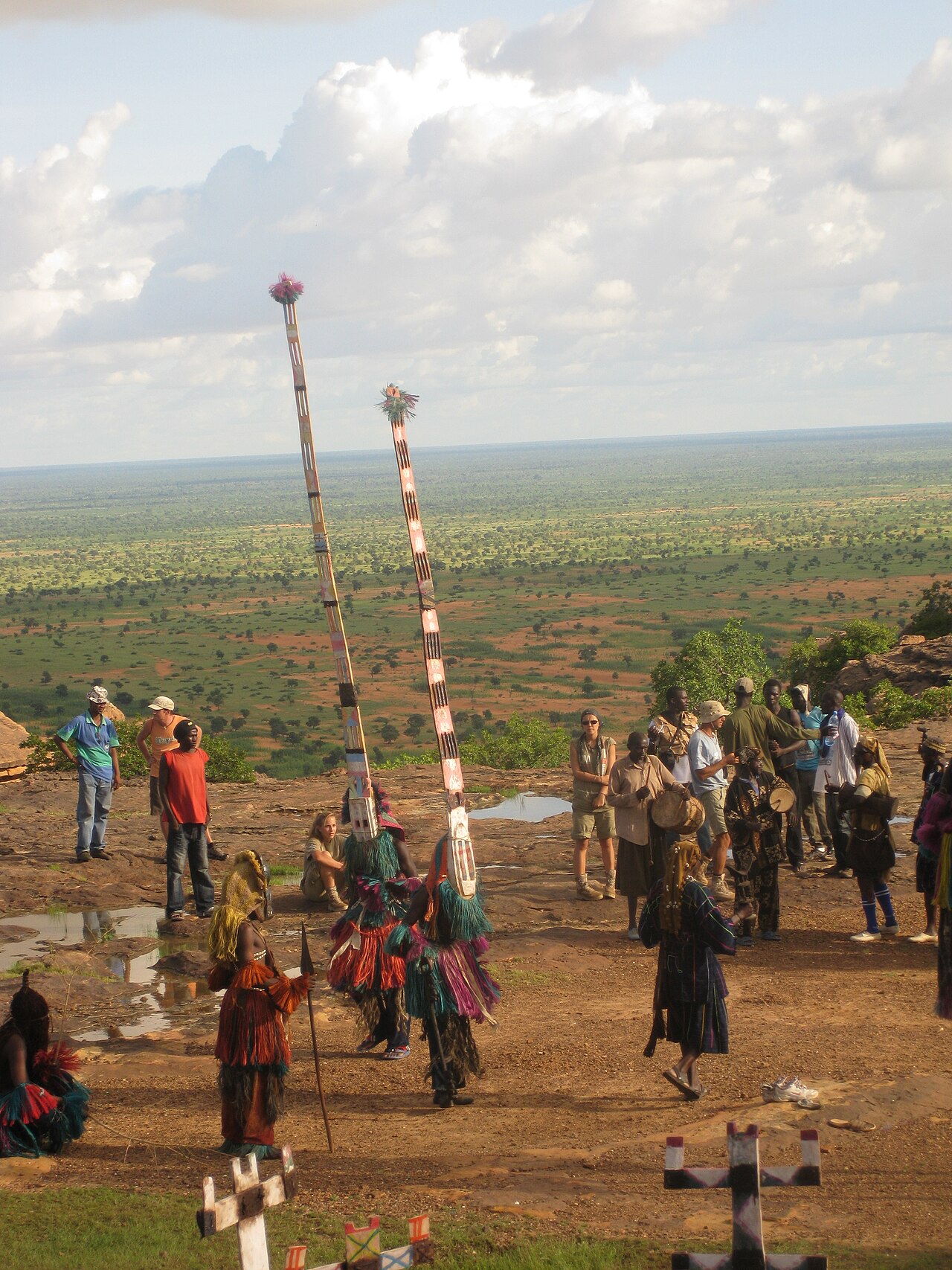
- Ancestral and Nommo masks — including the towering Sirige mask, a plank up to five metres tall carved with geometric steps, representing the celestial ladder and the path of the Nommo.
- Animal masks — the antelope (Walu), the hare (Dyommo), the bird, the hyena, and the crocodile, each embodying moral lessons from Dogon fables.
- Human and occupational masks — the hunter, the blacksmith, the Fulani woman, the old man, and the Satimbe, a mask honouring the first woman to have discovered the mask ritual.
- Composite and abstract masks — the famous Kanaga mask, with its double-bar cross resembling a lizard or a bird, and the multi-coloured Dama masks with fibre fringes and cowrie-shell eyes.
Materials matter. Most masks are carved from the light, soft wood of the puna (African locust bean) or sira tree, then painted with black (from charcoal or mud), white (kaolin clay), red (ochre or the wood of the sorgo), and yellow. Fibre from the sansevieria plant forms the flowing skirts and manes. The masks are periodically repainted before each ceremony — a renewal that is itself a ritual act.
How Are Dogon Masks Used in the Dama Ceremony?
The Dama is the great funerary ceremony of the Dogon — a multi-day festival that honours the dead and, in its most elaborate form, occurs roughly every twelve years, though individual villages stage smaller Dama ceremonies more frequently. The masks are its protagonists.
The ritual unfolds over days and nights of dancing, drumming, and chanting. Masked dancers emerge from the bush or from sacred caves, their identities concealed, moving in precise choreography to the rhythm of slit drums and iron bells. The Sirige dancer sweeps his five-metre plank in great arcs, tracing the path of the sun across the sky. The Kanaga dancers twirl in pairs. The Satimbe dancer — traditionally a woman’s mask performed by a man — carries a carved female figure on top, honouring the role of women in the origin of the ritual.
What Happens During the Dance?
The performance is not entertainment. It is a legal and spiritual proceeding. The masks escort the souls of the recently deceased out of the village and into the ancestral realm, freeing the living from mourning obligations and restoring the community’s ritual balance. In Dogon belief, an unperformed Dama leaves the dead restless and the living vulnerable.
The dance grounds are carefully chosen — often a broad plaza at the foot of the cliffs or a flat rock shelf. Elders sit in a semicircle, drummers beat the ganga (a long wooden slit drum) and iron bells, and the masks process in a strict order reflecting their rank in the spiritual hierarchy. The Sirige, the tallest and most sacred, leads or closes the procession depending on the village’s tradition.
Why Are Dogon Masks So Important to Dogon Society?
Dogon masks serve a social function as vital as their spiritual one. They encode law, history, and ethics. The antelope mask teaches the value of speed and alertness; the hare mask warns against cunning; the blacksmith mask honours the craftsman who forges the tools of survival. In a society without widespread literacy, the mask dance is a living curriculum.
Masks also structure the Awa society, the men’s association that guards the tradition. Membership is earned through initiation, and the society adjudicates disputes, organises ceremonies, and transmits knowledge from elders to youth. The mask is thus a badge of citizenship in the spiritual community.
The masks’ economic role has grown in recent decades. Mask carvings are now among Mali’s most celebrated art exports, displayed in museums from the Musée du Quai Branly in Paris to the Metropolitan Museum of Art in New York. The Dogon country has become a destination for travellers seeking authentic cultural encounters — a development that brings income but also raises questions about commodification.
How Have Dogon Masks Shaped Global Art and Culture?
The influence of Dogon masks on global art is difficult to overstate. Their geometric abstraction — the cubist planes of the Kanaga, the soaring verticality of the Sirige — resonated with European modernists in the early 20th century, alongside the better-known impact of masks from Côte d’Ivoire and Gabon. Pablo Picasso, Georges Braque, and the Surrealists collected and drew on African mask forms; the Dogon tradition formed part of that broader encounter.
More recently, Dogon masks have featured in major exhibitions, including the 2018–2019 “Dogon” show at the Musée du Quai Branly–Jacques Chirac in Paris, which drew on decades of ethnographic research and displayed hundreds of masks and statues. The masks also appear in films, fashion photography, and contemporary African art — a testament to their enduring visual power.
What Are the Challenges Facing the Dogon Mask Tradition Today?
The Dogon world is changing fast. Several pressures threaten the mask tradition:
- Security and tourism decline — Since 2012, armed conflict in northern and central Mali has disrupted travel to the Dogon country, shrinking the tourism income that many villages depend on.
- Climate change — Erratic rains have stressed the millet and onion farming that underpins the Dogon economy, pushing young people to migrate to Bamako or abroad.
- Religious change — Growing adherence to Islam and Christianity, alongside traditional belief, has altered the social role of the Awa society in some villages.
- Looting and the antiquities trade — The theft of masks and statues for the international art market has stripped some communities of their heritage.
Yet the tradition is resilient. In villages such as Tireli, Endé, and Sanga, elders continue to train young dancers. Local cultural associations, supported by UNESCO and Malian cultural bodies, run documentation projects and community museums. The Dama continues to be performed — sometimes for tourists, sometimes for the ancestors, often for both.
How Can Visitors Respectfully Experience Dogon Masks?
For travellers who reach the Bandiagara Escarpment, the mask tradition offers a rare window into a living culture — but it demands respect. A few practical principles:
- Hire local guides from Dogon villages; they ensure that fees reach the community and that you visit at appropriate times.
- Ask before photographing masks, dancers, or ceremonies; some rituals are closed to outsiders.
- Purchase crafts directly from artisans or cooperatives, and avoid antiquities that may have been looted.
- Dress modestly and follow the guidance of village elders and your guide.
The best time to visit is typically the dry season, from November to February, when travel is easier and cultural events are more frequent. The Dama itself is not a tourist show — but some villages stage mask dances for visitors with the community’s consent, offering a glimpse of the choreography without intruding on sacred rites.
Why the Dance of the Spirits Still Matters
The Dogon masks of Mali are not relics of a vanished past. They are living instruments of memory, law, and beauty — carved anew, repainted, and danced by communities that have held the Bandiagara Escarpment for centuries. In a world that often reduces African heritage to museum vitrines, the Dama insists on something more radical: that the ancestors are still present, still listening, and still dancing.
To witness a mask dance on the escarpment — the drums rolling across the rock, the five-metre Sirige sweeping against the sky, the elders watching in silence — is to understand that culture is not a monument but a practice. The Dogon masks endure because the Dogon people continue to give them breath. That is the true dance of the spirits: a conversation between the living and the dead that shows no sign of ending.