📅 Last updated: 26.08.2026
In the heart of Central Africa, long before the transatlantic slave trade reshaped the world’s economies and before European mapmakers carved the continent into colonies, the Kongo Kingdom stood as one of the most sophisticated, powerful, and diplomatically connected states on the African continent—a centralized, cosmopolitan empire whose influence stretched from the Atlantic coast deep into the interior, and whose legacy continues to pulse through the cultural bloodstream of modern Angola, the Democratic Republic of Congo, and the Republic of Congo.
- The Genesis of a Powerhouse: Origins and the Founding of Mbanza Kongo
- Diplomacy and Faith: The Kongo Kingdom Engages the World
- The Fabric of Power: Governance, Society, and the Role of the Manikongo
- The Art of the Kingdom: Expression and Influence
- The Unraveling: The Slave Trade, Civil War, and the Decline of the Kongo Kingdom
- Echoes in the Modern World: The Legacy of the Kongo Kingdom
- Rediscovering the Powerhouse: A Call to Remember
To speak of the Kongo Kingdom is to speak of a civilization that mastered governance, trade, and art on a scale that rivals any of its European contemporaries. At its zenith in the late 15th and 16th centuries, this was a state of perhaps 2.5 to 3 million people, administered through a complex hierarchy of provincial governors, district chiefs, and village headmen, all tethered to a monarch—the Manikongo—whose authority was both sacred and secular. Yet, for all its grandeur, the kingdom has been largely relegated to a footnote in global history, overshadowed by the narratives of its colonizers and the tragic human catastrophe that would unfold along its shores. It is time to restore the Kongo Kingdom to its rightful place in the pantheon of great African civilizations.
The Genesis of a Powerhouse: Origins and the Founding of Mbanza Kongo
The origins of the Kongo Kingdom are steeped in a mixture of oral tradition, migration history, and the slow crystallization of political power. The Bakongo people, the ethnic group that forms the kingdom’s core, began consolidating their political structures in the centuries preceding the arrival of the Portuguese in 1483. According to oral histories, the kingdom was forged through a series of conquests and alliances led by a figure named Lukeni lua Nimi, who is credited with founding the kingdom around the late 14th century. He is said to have crossed the mighty Congo River (then known as the Nzadi) from the north, establishing his authority over the local populations and creating a new political order centered on the town of Mbanza Kongo.
Lukeni’s achievement was not merely the conquest of territory but the creation of a durable political template. He established a royal lineage, the Ntotila, and instituted a system of succession that, while frequently contested, provided a framework for dynastic continuity. Mbanza Kongo, perched dramatically on a high plateau in what is now northern Angola, became the political and spiritual heart of the kingdom. The city, which the Portuguese would later, with characteristic arrogance, rename São Salvador, was more than a capital; it was a symbol of the kingdom’s unity and a bustling center of population, craft production, and ritual life. By the time of the first Portuguese contact, Mbanza Kongo was a significant urban settlement, a fact that the explorer Diogo Cão and his crew noted with astonishment when they arrived in 1483.
The kingdom’s expansion was not a random scattering of villages but a deliberate, structured process. The Manikongo governed through a council of elders and provincial governors, known as mani, who were typically appointed by the king from among his relatives and trusted allies. This system—a blend of feudal loyalty and centralized control—allowed the kingdom to administer a vast territory that stretched from the Congo River in the north to the Loje River in the south, and from the Atlantic Ocean in the west to the Kwango River in the east. It was a realm of incredible linguistic and cultural cohesion, bound together by the Kikongo language, shared religious beliefs, and a sophisticated system of taxation and tribute that funneled wealth from the periphery to the center.
Diplomacy and Faith: The Kongo Kingdom Engages the World
The arrival of the Portuguese in 1483 did not initiate a relationship of simple domination; rather, it began a complex, often tragic, but undeniably significant diplomatic and cultural exchange. The Kongo Kingdom, at the height of its power, was not a passive observer of European expansion. It was an active, intelligent player on the international stage, seeking to leverage its relationship with Portugal to cement its own regional dominance and gain access to new technologies and trade networks.
The pivotal figure in this early engagement was King Nzinga a Nkuwu, who, upon meeting the Portuguese emissaries, was intrigued by their technology and their religion. He was baptized as João I in 1491, a decision that was as much political as spiritual. His son, Afonso I Mvemba a Nzinga, who ruled from 1509 to 1543, became the great architect of Kongo’s Christianization. Afonso was a shrewd and visionary leader who saw in Christianity a unifying force that could be syncretized with Kongo spiritual beliefs, creating a new, powerful state ideology. He corresponded extensively with the Portuguese monarchs, writing long, detailed letters in Portuguese that are among the most remarkable documents of early modern diplomacy—a testament to a sophisticated African monarch engaging with Europe on terms of near-equality.
Afonso’s letters, many of which survive in Portuguese archives, reveal a man of profound intellect and political acumen. He requested priests, craftsmen, and teachers, not out of subservience, but to build a modern, literate, and skilled state. He established schools in Mbanza Kongo, and his son, Henrique, was sent to Lisbon to be educated, eventually becoming the first Black bishop of the Catholic Church in Central Africa in 1521. This was not the story of a culture being erased; it was a story of a culture adapting, absorbing, and reinterpreting foreign elements to strengthen itself. The Kongo Kingdom was engaging in a form of diplomatic statecraft that was sophisticated, ambitious, and deeply aware of its own agency.
Yet, the relationship was never equal. The Portuguese, and later other European powers, were primarily interested in the lucrative trade in copper, ivory, and, increasingly, enslaved people. The demand for captives, initially a trickle, soon became a flood, and it is here that the kingdom’s story takes its darkest turn. The transatlantic slave trade, a system of immense cruelty and violence, would ultimately tear the Kongo Kingdom apart, transforming it from a powerful, autonomous state into a fractured landscape of warring factions, all competing for the favor of European buyers on the coast.
The Fabric of Power: Governance, Society, and the Role of the Manikongo
To understand the greatness of the Kongo Kingdom, one must look beyond its diplomacy and delve into the intricate fabric of its internal governance. The Manikongo was not an absolute, unchecked autocrat. He was the spiritual and political linchpin of the state, a figure whose authority was derived from both his control of the material resources of the kingdom and his role as the intermediary between the living and the ancestors. His power was checked and balanced by a complex system of councils and provincial authorities that prevented the kingdom from becoming a simple, tyrannical despotism.
The central government was composed of a council of elders, the Mpila, which advised the king on matters of succession, war, and law. Alongside them were the mani, the provincial governors, who wielded significant local power. These governors were the backbone of the kingdom’s administration. They were responsible for collecting tribute, maintaining order, and raising armies in times of war. The king’s power was often exercised through his ability to appoint and dismiss these governors, but he had to do so with an eye to maintaining the delicate balance of power among the kingdom’s various noble families.
Society in the Kongo Kingdom was hierarchical but not rigidly closed. At the top were the nobility, the Mwisikongo, who held the major administrative and military positions. Below them were the free commoners, who worked as farmers, artisans, and traders. The kingdom’s economy was robust, based on a combination of agriculture, fishing, and a vibrant internal trade network. The Kongo were skilled weavers, blacksmiths, and potters, and their markets traded in a variety of goods, from locally produced cloth and iron tools to luxury items like salt and the highly prized nzimbu shells that served as a form of currency.
The spiritual life of the kingdom was a rich tapestry of beliefs. The Kongo people believed in a supreme creator god, Nzambi Mpungu, and a pantheon of lesser spirits and ancestors who intervened in the daily lives of the living. The nganga, or spiritual healers, were powerful figures who could communicate with the spirit world, diagnose illnesses, and interpret omens. When Christianity arrived, it did not simply replace these beliefs; it was woven into them. The cross, for example, was seen not as a new symbol but as a potent spiritual emblem that resonated with older Kongo concepts of the intersection between the world of the living and the world of the dead—the Kalunga line. This syncretism, a hallmark of Kongo resilience, allowed the kingdom to adopt Christianity without losing its cultural soul.
The kings of Kongo also developed a sophisticated system of law and justice. The rule of law was a cherished principle, and the king was seen as its ultimate guardian. Courts existed at various levels of society, and disputes were adjudicated through a combination of testimony, oath-taking, and, in some cases, trial by ordeal. This legal framework was a key factor in the kingdom’s stability, providing a mechanism for resolving conflicts that did not rely solely on violence.
The Art of the Kingdom: Expression and Influence
The artistic achievements of the Kongo Kingdom are a profound reflection of its worldview, its history, and its power. Kongo art is not merely decorative; it is a functional, spiritual, and communicative medium that carries deep layers of meaning. It is an art of power, of healing, and of memory, and its influence can be seen across the African diaspora, from the religious practices of Haitian Vodou and Cuban Palo Monte to the visual iconography of African American art.
One of the most iconic forms of Kongo art is the nkisi (plural minkisi). These are power objects, often carved in human or animal form, which were believed to be inhabited by a spirit. They were used for a wide range of purposes: healing the sick, avenging wrongs, protecting communities, and sealing oaths. The nkisi was activated by a nganga, who would drive nails, blades, or other sharp objects into the wooden figure to “awaken” its spirit and direct its power. Each nkisi was unique, with its own name, history, and specific function.
The nkisi nkondi, a type of “hunter” figure, is perhaps the most famous. These aggressive-looking figures, often depicted with an aggressive posture and a mirror in the belly—a portal to the spirit world—were used to enforce agreements, hunt down wrongdoers, and protect communities from evil. They are powerful, visceral works of art that convey a sense of contained, explosive energy. The artistry of these objects is undeniable, with their intricate carving, the careful placement of the mirror, and the accumulation of metal pieces telling a story of countless oaths sworn and rituals performed.
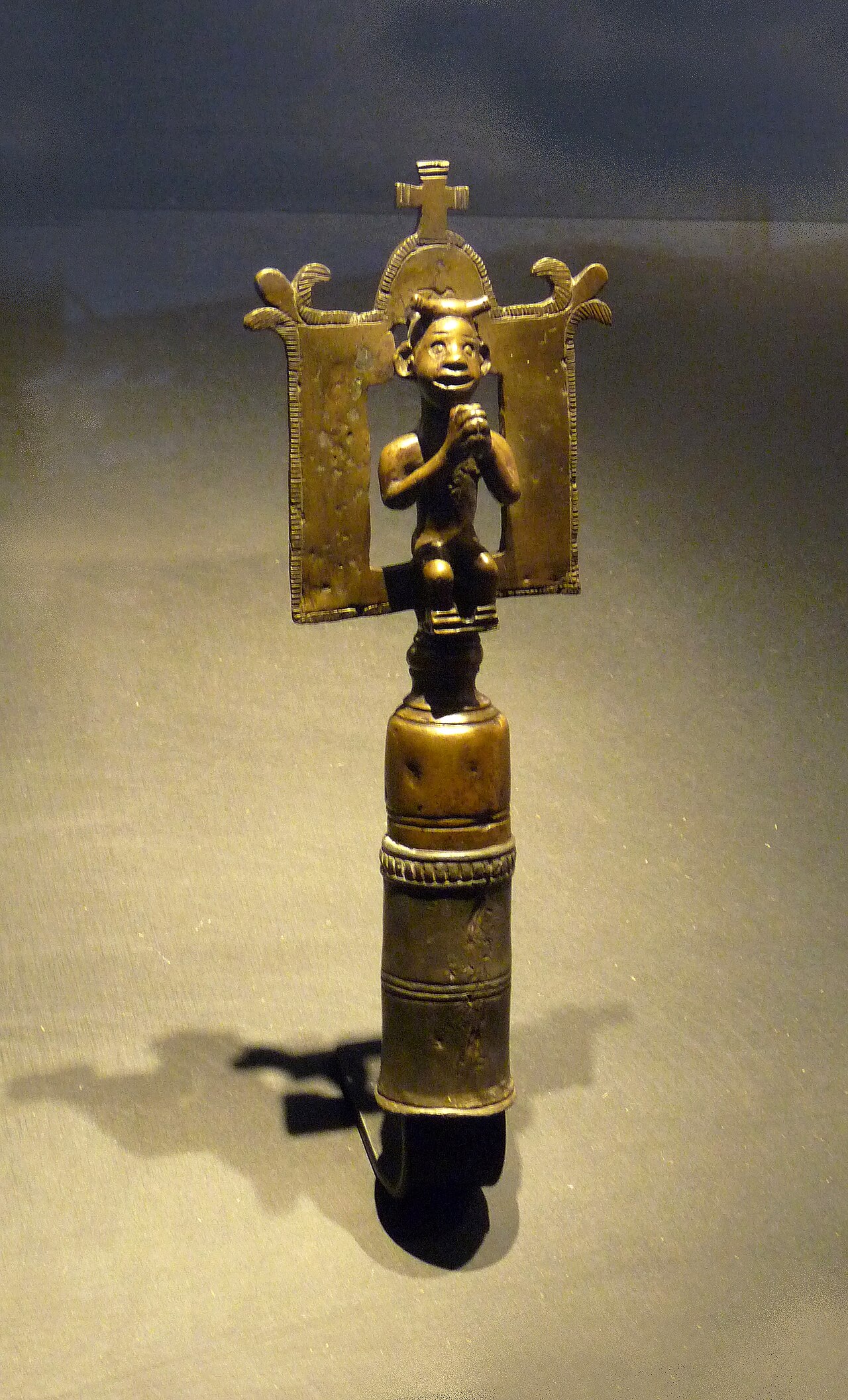
Alongside the minkisi, the Kongo produced exquisite cloth made from raffia (known as lubongo), which was a major trade item and a symbol of status and wealth. These textiles, woven with incredible skill and often adorned with geometric patterns, were used for clothing, ceremonial purposes, and as a form of currency. Kongo ivory carvings, particularly the oliphants (hunting horns), were also highly prized, often decorated with intricate scenes of daily life, royal processions, and Portuguese figures—a fascinating example of cross-cultural influence. The crucifixes produced in Kongo, which blended Christian iconography with Kongo artistic sensibilities, are another testament to the kingdom’s creative synthesis. They are not mere copies of European models but distinctly Kongo creations, reflecting a unique fusion of beliefs.
| Period | Key Event | Significance |
|---|---|---|
| c. 1390 | Founding of the kingdom by Lukeni lua Nimi | Establishes the centralized political structure and the Ntotila dynasty. |
| 1483 | Arrival of Diogo Cão and the Portuguese | Opens a new era of diplomatic, commercial, and cultural exchange with Europe. |
| 1491 | Baptism of King João I (Nzinga a Nkuwu) | Begins the gradual process of Christianization, a strategic move to consolidate power. |
| 1509-1543 | Reign of King Afonso I | The golden age of the kingdom; a period of literacy, diplomacy, and expansion. |
| 1665 | Battle of Mbwila | A pivotal defeat against the Portuguese that marks the beginning of the kingdom’s decline. |
| 1885-1914 | The Scramble for Africa | The kingdom is definitively partitioned among European colonial powers, ending its sovereignty. |
The Unraveling: The Slave Trade, Civil War, and the Decline of the Kongo Kingdom
The decline of the Kongo Kingdom is a complex and tragic story, but it is not a story of passive victimhood. It is a story of a state that was actively and violently destabilized by an external force—the transatlantic slave trade—and the internal divisions that this force ruthlessly exploited. The very economic and political structures that had made the kingdom great were turned into engines of its destruction.
Initially, the kingdom participated in the slave trade as a partner, selling war captives and criminals. However, the demand for enslaved labor in the New World grew exponentially in the late 16th and 17th centuries, and it soon overwhelmed the kingdom’s social and moral systems. The trade became a voracious appetite that could not be satisfied by traditional sources of captives. To meet the demand, the Kongo elite began to prey on their own populations, and more alarmingly, rival factions within the kingdom began to wage wars of conquest against each other, not for political supremacy, but for the primary purpose of capturing people to sell to European merchants on the coast.
The death of King Afonso I in 1543 marked the beginning of a slow, inexorable unraveling. Succession disputes became more frequent and more violent, as ambitious claimants to the throne sought support from the Portuguese and their own regional power bases. The kingdom fractured into a patchwork of warring fiefdoms, all nominally under the authority of the Manikongo but in reality acting as independent, predatory states. The Portuguese, ever the opportunists, played these factions against each other, arming different groups and establishing their own colonial foothold in Luanda to the south, which became the primary port for the export of enslaved people from the region.
The decisive blow came at the Battle of Mbwila in 1665. The then-Manikongo, António I, had grown increasingly frustrated with Portuguese interference and decided to challenge their power directly. He marched his army to face the Portuguese forces, but he was decisively defeated, and he was killed in the battle. The defeat at Mbwila did not instantly destroy the kingdom, but it was a crippling blow. It shattered the myth of Kongo military invincibility and left the kingdom permanently weakened and divided.
In the centuries that followed, the Kongo Kingdom existed as a shadow of its former self. The capital, Mbanza Kongo, was sacked and abandoned multiple times. The central authority of the Manikongo became largely symbolic, with power residing in the hands of various regional leaders. The kingdom was effectively a collection of small, weak states, vulnerable to the predations of its neighbors and the ever-increasing encroachment of European colonial powers. The slave trade continued to bleed the region, and the once-great civilization was reduced to a cautionary tale of what could happen when a society’s foundations are corroded by greed and violence.
Echoes in the Modern World: The Legacy of the Kongo Kingdom
Although the political entity of the Kongo Kingdom ceased to exist as a sovereign state by the late 19th century, its legacy is far from dead. It lives on in the identity, culture, and spiritual practices of millions of people in Central Africa and across the African diaspora. The kingdom’s story is not merely a historical curiosity; it is a living, breathing force that continues to shape the modern world.
The most tangible legacy is the Kikongo language itself, which is still spoken by over 7 million people in Angola, the DRC, and the Republic of Congo. It is a language of resilience, having survived centuries of colonialism and forced assimilation. The cultural traditions of the Bakongo people—their music, dance, art, and cosmologies—are a direct inheritance from the kingdom. The nkisi tradition, for example, did not disappear with the kingdom’s political decline. It evolved and adapted, finding new forms in the syncretic religions of the diaspora. The Kongo cross, a symbol that predates Christianity, is a central icon in Haitian Vodou, where it is known as the Bawon Samdi cross, and in Cuban Palo Monte, where it is used to mark the crossroads between worlds. This is a powerful example of how Kongo spirituality traveled with enslaved people and became a cornerstone of new, vibrant cultures in the Americas.
The legacy of the kingdom is also a powerful political and identity marker. The name “Kongo” is proudly claimed by the two modern nations, the Republic of the Congo and the Democratic Republic of the Congo, as well as by the Bakongo people who live in all three countries. This shared identity, rooted in the memory of a once-great state, has been a source of solidarity and political mobilization. The Bundu dia Kongo political-religious movement, which emerged in the early 21st century in the DRC, explicitly seeks to revive the Kongo Kingdom and its cultural heritage, demonstrating that the kingdom’s history is not just a matter of academic interest but a living political force.
Furthermore, the kingdom’s history challenges the persistent, damaging narrative that Africa was a continent of primitive tribes with no history of complex statehood before colonialism. The Kongo Kingdom, with its centralized government, its sophisticated diplomacy, its legal system, and its vibrant art, is a powerful counter-narrative. It demonstrates that Africa was home to advanced civilizations that were capable of engaging with the rest of the world on their own terms. The story of the Kongo Kingdom is a crucial part of the broader story of human civilization, and it is a story that deserves to be told with the nuance and respect it warrants.
Rediscovering the Powerhouse: A Call to Remember
The Kongo Kingdom is more than a forgotten state; it is a testament to the enduring power of human organization, creativity, and resilience. Its rise from a small chiefdom to a regional superpower, its sophisticated engagement with the Portuguese, and its tragic unraveling through the slave trade are all chapters in a story of profound significance. To forget the Kongo Kingdom is to participate in a form of historical erasure that has been too common in the telling of African history.
Rediscovering this kingdom is an act of intellectual justice. It allows us to see Central Africa not as a passive recipient of history, but as a vibrant, dynamic center of it. It allows us to see the connections between a 16th-century king in Mbanza Kongo and a 21st-century practitioner of Vodou in Haiti. It allows us to see the ancestors of modern-day Bakongo people as architects of a great civilization, not just victims of colonialism.
The story of the Kongo Kingdom is a complex one, filled with both triumph and tragedy. It is a reminder that power is fleeting, but culture and identity are enduring. It is a call to look beyond the simplistic narratives of conquest and colonization and to see the African past in all its glory, its complexity, and its pain. The Kongo Kingdom may be gone as a political entity, but its spirit, its art, and its people remain—a powerful, living legacy that continues to shape the world. In remembering the Kongo Kingdom, we do not simply look back; we look forward, armed with a fuller, richer understanding of the human story.