📅 Last updated: 28.10.2026
Yaa Asantewaa was in her sixties when she stood before the chiefs of Asante and asked them, in effect, whether they were men or cowards. The Queen Mother of Ejisu, a small state within the Asante Confederacy in what is now Ghana, had watched the British exile her king, demand the Golden Stool, and dismantle the sovereignty of a nation that had resisted European encroachment for nearly a century. Her response was not a petition or a plea. It was war.
Yaa Asantewaa (c. 1840–1921) was the Queen Mother of Ejisu in the Asante Empire, in present-day Ghana. In March 1900, after the British Governor Frederick Hodgson demanded the Golden Stool and the Asante king Prempeh I had been exiled to Seychelles, she led the War of the Golden Stool (the Yaa Asantewaa War), the final armed Asante resistance against British colonial rule. She was captured in 1901 and exiled to the Seychelles, where she died in 1921.
- Who Was Yaa Asantewaa, and Why Does Her Name Still Carry Weight?
- What Was the Golden Stool, and Why Did the British Want It?
- How Did Yaa Asantewaa's War Unfold?
- Yaa Asantewaa's Legacy Across Ghana and the Diaspora
- Key Facts and Timeline
- What Made Her Leadership Effective?
- How Is Yaa Asantewaa Remembered in Contemporary Ghana?
- Why Does Yaa Asantewaa Matter Beyond Ghana?
- The Queen Mother Who Refused to Kneel
Who Was Yaa Asantewaa, and Why Does Her Name Still Carry Weight?
Born around 1840 in Besease, a town in the Ejisu traditional area of Asante, Yaa Asantewaa was the sister of Kwasi Afrane, the ruler of Ejisu. Her brother’s position placed her in the line of royal women from whom a Queen Mother would be chosen, and she eventually assumed that role herself. In Asante political culture, the Ohemaa (Queen Mother) was no ceremonial figurehead. She held real authority: she nominated candidates for the stool, advised the chief, and served as a guardian of the community’s spiritual and political continuity.
Her rise to historical prominence came late in life, and that timing matters. By 1900, Yaa Asantewaa had spent decades watching the Asante Confederacy weakened by British military campaigns, internal divisions, and the disastrous aftermath of the Sagrenti War of 1874, when British forces under Sir Garnet Wolseley sacked Kumasi and forced a punitive treaty on the Asante. The final blow came in 1896, when the British arrested Asantehene Prempeh I and a group of senior royals and elders and sent them into exile in the Seychelles. The king was gone. The confederacy was leaderless. And then the British asked for the one thing the Asante would never surrender.
What Was the Golden Stool, and Why Did the British Want It?
The Golden Stool, or Sika Dwa Kofi, is not a piece of furniture. In Asante cosmology and political thought, it is the soul of the nation. According to tradition, it descended from the sky in a shower of gold and rested on the lap of Osei Tutu I, the founder of the Asante Empire, in the late seventeenth century. The priest Okomfo Anokye declared that the stool contained the spirit of the Asante people; its safety was inseparable from the nation’s survival. No one sat on it. The Asantehene’s authority derived from it, but the stool belonged to everyone.
British officials understood this, which is precisely why Governor Frederick Hodgson made his demand. On 28 March 1900, Hodgson summoned the Asante chiefs and elders to a meeting in Kumasi and announced that the Golden Stool must be handed over to the British governor. He reportedly declared that the Queen of England, as the paramount power, was entitled to it. The assembled chiefs were stunned into silence. Some later accounts describe them as too shocked to respond. It was in that silence that Yaa Asantewaa rose.
The Speech That Started a War
Her exact words survive through oral tradition and later retellings rather than a contemporaneous transcript, but the substance is consistent across sources. She challenged the men for their paralysis, asking whether they could sit by while the British took the sacred stool and the exiled king remained in captivity. She declared that if the men of Asante would not fight, the women would. Then she pledged to lead.
That speech, delivered by a woman in her sixties before an assembly of male chiefs, broke the paralysis. The War of the Golden Stool began within weeks.
How Did Yaa Asantewaa’s War Unfold?
The conflict, known variously as the Yaa Asantewaa War, the War of the Golden Stool, or the last Asante-British war, lasted from late March 1900 into early 1901. Yaa Asantewaa’s leadership was not merely symbolic. She worked alongside commanders including her grandson Kwaku Aboagye, the Ejisu chief Kwaku Afrane, and leaders from Mampong and other Asante states. The fighting centered on Kumasi, where the British garrison and the small fort were besieged for months.
The Asante forces cut telegraph lines, blocked supply routes, and pinned British and allied troops inside the fort. Relief columns sent from the coast were ambushed and harassed. The siege of Kumasi became one of the most serious challenges to British authority in West Africa during that period. But the Asante lacked the artillery and sustained supply capacity to take the fort outright, and the British eventually assembled a larger relief force under Major James Willcocks. By the end of 1900, the garrison had been relieved and the British went on the offensive.
Yaa Asantewaa and her allies continued a guerrilla resistance into 1901. She was captured that year, along with several other leaders, and exiled to the Seychelles. She never returned to Asante. She died in exile in 1921 and was buried there; her remains were later returned to Ghana and given a royal burial at Ejisu in 2004.
The Cost and the Aftermath
The war marked the end of armed Asante resistance to British rule. The Asante Confederacy was formally annexed into the Gold Coast colony in 1902. The Golden Stool, which the British never captured, was hidden by the Asante and only surfaced publicly in 1921, when a group of men who had removed its gold ornaments were tried and punished under colonial law. The stool itself survived. The nation’s soul, in Asante terms, had never been surrendered.
Yaa Asantewaa’s Legacy Across Ghana and the Diaspora
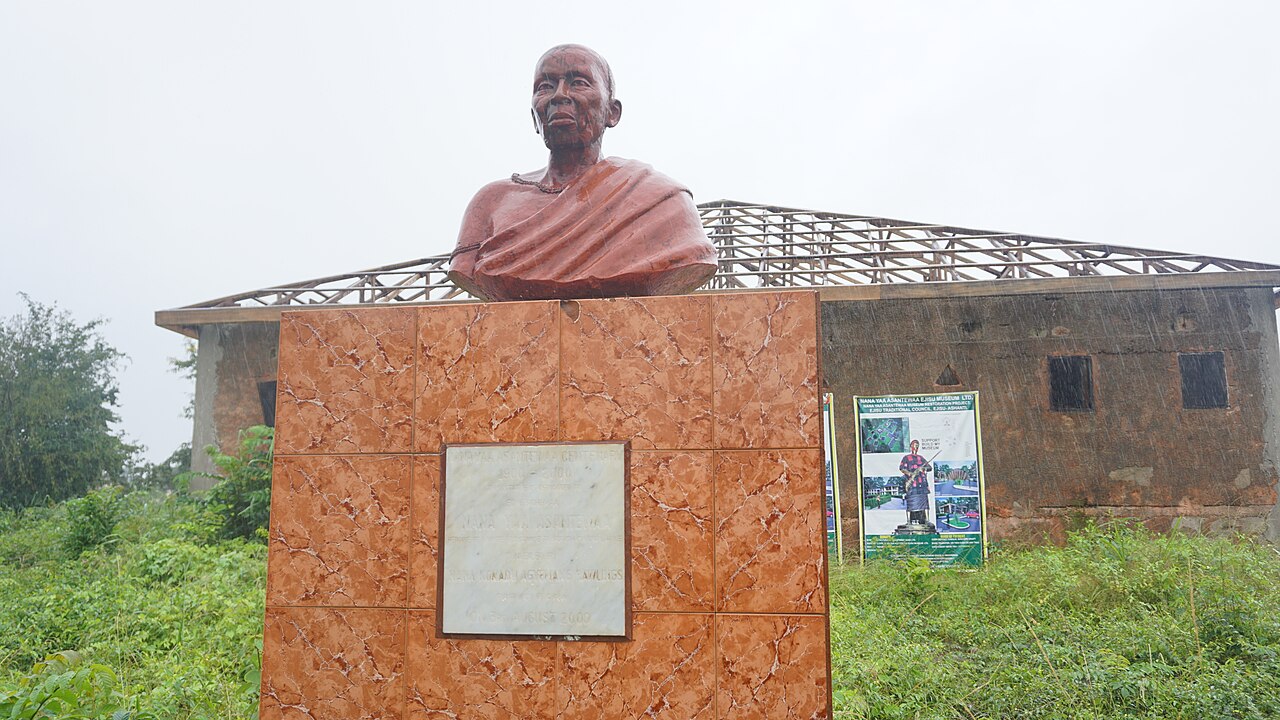
Yaa Asantewaa’s name today is attached to schools, streets, and institutions across Ghana. A girls’ senior high school in Koforidua bears her name. A statue of her stands at the Manhyia Palace Museum in Kumasi, and another commemorates her in Ejisu. In 2000, Ghana issued a commemorative stamp marking the centenary of the war. The Yaa Asantewaa Foundation and various cultural organizations keep her story alive, and her image appears in textbooks, murals, and public art from Accra to London.
Her significance extends well beyond Ghana. In the wider African diaspora, she is cited alongside figures like Nzinga of Ndongo and Matamba and Queen Liliʻuokalani of Hawaiʻi as an example of women who led anti-colonial resistance. In 2019, the British Museum in London included her in exhibitions on African leadership and resistance, and her story circulates widely in Pan-Africanist and Black feminist discourse.
The Yaa Asantewaa story also complicates any simple narrative of colonial conquest. The British won the military campaign, but they never obtained the Golden Stool, and the Asante monarchy was eventually restored: Prempeh I returned from exile in 1924, and his successor, Prempeh II, was restored to the Golden Stool in 1935. The Asantehene remains a powerful traditional ruler in modern Ghana, and the Asanteman Council still governs custom and tradition in the region.
Key Facts and Timeline
| Date | Event | Significance |
|---|---|---|
| c. 1840 | Birth of Yaa Asantewaa in Besease, Ejisu | Born into the royal family of Ejisu; later becomes Queen Mother |
| 1874 | Sagrenti War; British sack Kumasi | Wolseley’s campaign weakens Asante military power |
| 1896 | Prempeh I and senior royals exiled to Seychelles | Asante left without its king; tensions escalate |
| 28 March 1900 | Governor Hodgson demands the Golden Stool | Yaa Asantewaa’s speech rallies the chiefs to resistance |
| 1900–1901 | War of the Golden Stool; siege of Kumasi | Final armed Asante resistance to British rule |
| 1901–1921 | Yaa Asantewaa exiled to Seychelles; dies 1921 | Buried in exile; remains returned to Ejisu in 2004 |
What Made Her Leadership Effective?
Yaa Asantewaa’s authority rested on several foundations, and understanding them explains why her intervention mattered so much.
- Institutional legitimacy: As Queen Mother of Ejisu, she held a recognized constitutional role in Asante governance. Her call to arms carried the weight of an office, not just personal charisma.
- Moral clarity: The demand for the Golden Stool was a demand for the nation’s spiritual core. By framing resistance around the stool, she united disparate Asante states behind a cause none could publicly abandon.
- Timing and courage: She acted at the moment when male leadership had stalled. Her willingness to shame the chiefs into action broke a paralysis that might otherwise have ended in surrender.
- Continuity of purpose: Even after capture and exile, she remained a symbol. Her refusal to accept defeat gave the Asante a narrative of endurance that outlasted the war itself.
How Is Yaa Asantewaa Remembered in Contemporary Ghana?
In Ghana today, Yaa Asantewaa is a national icon. Her face and name appear in civic spaces, and her story is taught in schools as part of the broader narrative of Ghanaian resistance that culminates in independence in 1957. Kwame Nkrumah, Ghana’s first president, drew explicitly on Asante and broader Akan history in constructing a national identity, and Yaa Asantewaa fit naturally into that pantheon.
Her memory is also a living part of Ejisu and Asanteman. The Ejisu Traditional Council maintains her legacy, and the annual Yaa Asantewaa commemorations draw participants from across the region. In 2021, the centenary of her death prompted renewed attention, including calls for greater recognition of her role in Ghanaian and world history.
Her story has also entered global popular culture. She appears in children’s books, documentaries, and museum exhibitions. The 2018 film The Burial of Kojo, directed by Ghanaian filmmaker Blitz Bazawule, and various stage productions have referenced her. In 2022, the Ghanaian government announced plans for a museum in her honor at Ejisu, part of a broader push to develop heritage tourism around Asante history.
Why Does Yaa Asantewaa Matter Beyond Ghana?
The Yaa Asantewaa story speaks to questions that remain urgent: who has the right to define a nation’s sacred things, what resistance looks like when conventional power has failed, and how women’s leadership is remembered or forgotten. Her example challenges the assumption that anti-colonial resistance was exclusively a male enterprise. It also challenges the assumption that defeat in battle means defeat in history. The British won the war; they did not win the stool, and they could not erase the memory of the woman who told the chiefs of Asante to fight.
For the African diaspora, she is a reminder that the continent’s history of resistance is deep, varied, and often led by people whose names were not recorded in the colonial archives. For Ghanaians, she is a founding figure in the national story. For anyone interested in how ordinary people confront overwhelming power, she is a case study in courage that was specific, situated, and effective in ways that outlasted the immediate outcome.
The Queen Mother Who Refused to Kneel
Yaa Asantewaa died in exile in the Seychelles in 1921, far from Ejisu, far from the Golden Stool she had fought to protect. She never saw the restoration of the Asante monarchy or the return of Prempeh I. But the stool she defended was never surrendered, and the nation she rallied never forgot her. When her remains were returned to Ghana in 2004 and buried with royal honors at Ejisu, it was a homecoming more than eight decades in the making.
Her legacy is not a monument or a holiday, though she has both. It is the example she set: that authority without courage is hollow, that sacred things are worth defending, and that the people who are expected to remain silent can, in the right moment, change the course of history. In a continent whose modern story is often told through the actions of men, Yaa Asantewaa stands as a reminder that the Queen Mothers of Asante were not bystanders. They were architects of resistance, and one of them, at the age of sixty, looked the British Empire in the eye and refused to kneel.