📅 Last updated: 25.10.2026
The Walls of Benin once enclosed one of the largest and most sophisticated cities in the pre-colonial world — a vast network of earthen ramparts and moats that protected the capital of the Kingdom of Benin in what is now Edo State, Nigeria. For centuries, these earthworks stood as a statement of engineering ambition, urban planning, and political power in West Africa.
The Walls of Benin were a system of earthen banks and ditches — often called “benin earthworks” — built over several centuries around Benin City, capital of the Kingdom of Benin. At their height they stretched for thousands of kilometres across the region, enclosing a city of perhaps 100,000 people. They were largely destroyed during the British punitive expedition of 1897, and today survive only as fragments and archaeological traces.
- What Were the Walls of Benin and Why Are They Significant?
- Who Built Them, and When? The Kingdom of Benin's Long History
- The Walls of Benin in the Accounts of European Visitors
- How Were the Walls Constructed? Engineering Without Stone
- The 1897 Expedition and the Destruction of the Walls
- Key Dates in the Story of the Walls of Benin
- What Remains Today — and the Fight to Preserve It
- Why the Walls of Benin Matter for Africa and the World
- Rediscovering the Walls of Benin: A Lasting Perspective
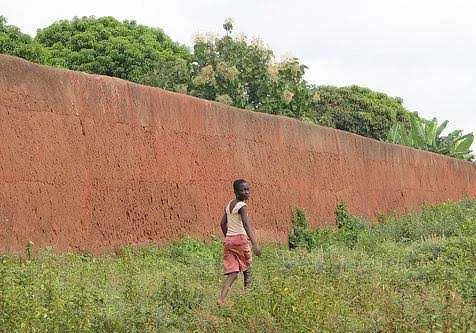
Standing at the edge of modern Benin City, you would not immediately see them. A low ridge of red earth, a shallow depression where water once pooled, a line of trees growing along an old boundary — these are the remains. Yet for the Edo people who built and defended them, the walls were not just fortifications. They were a cosmology made solid, a boundary between the ordered world of the oba (king) and the wilder lands beyond, and a physical record of a kingdom’s growth across more than five hundred years.
What Were the Walls of Benin and Why Are They Significant?
The Walls of Benin were a network of earthworks — banks of soil, ditches, and moats — constructed around and within Benin City and across the surrounding kingdom. They served defensive, administrative, and symbolic purposes: they marked the limits of the capital, controlled movement of people and goods, and expressed the authority of the oba. Their sheer scale has led some historians and archaeologists to describe them as among the largest earthworks ever built by human hands.
The most quoted figure comes from the British colonial administrator and antiquarian Fredrick William Hugh Migeod, who in the early twentieth century estimated the earthworks at roughly 16,000 kilometres in total length. That number has been repeated ever since, though modern archaeologists treat it with caution. What is certain is that the core walls around Benin City alone extended for many kilometres, and the wider system of boundary earthworks across the kingdom covered an enormous area.
What makes the Walls of Benin remarkable is not only their length but their construction. They were built without stone, without mortar, and without the wheeled transport and draft animals that shaped monumental architecture elsewhere. Edo builders used local laterite soil, dug by hand, shaped into steep banks, and faced with a ditch on the outer side. The result was a defensive system that could slow an approaching army and channel movement through controlled gateways.
Who Built Them, and When? The Kingdom of Benin’s Long History
The Kingdom of Benin emerged around the eleventh century, with its ruling dynasty — the Oba — tracing its origins to the legendary figure of Oranmiyan and the earlier Igodomigodo period. The city of Benin (Edo) grew into the capital of a powerful state that by the fifteenth and sixteenth centuries controlled trade routes reaching the Atlantic coast and the interior.
The walls were not built in a single campaign. They accumulated over centuries, layer upon layer, as successive obas expanded the city and its defences. Oral tradition and palace histories credit particular rulers with specific construction works, and the earthworks themselves show phases of building and rebuilding. This gradual accretion is part of what makes the Walls of Benin so significant: they are a physical archive of the kingdom’s development.
The Role of the Oba and the Guilds
Construction was organised labour on a grand scale. The oba commanded the work, and specialist guilds — including the Iwebo, Iweguae, and Ibiwe — played roles in the palace and city administration. Craft guilds of bronze casters, woodcarvers, and weavers flourished alongside the earthwork builders. The walls required the mobilisation of thousands of labourers over generations, a feat of coordination that speaks to the kingdom’s administrative capacity.
The Walls of Benin in the Accounts of European Visitors
European travellers who reached Benin City in the sixteenth and seventeenth centuries left vivid descriptions. The Portuguese, who established trade contacts in the late fifteenth century, were struck by the size and order of the city. Dutch and Portuguese accounts describe wide streets, a royal palace of great extent, and a city that impressed visitors accustomed to European capitals.
One of the most cited accounts comes from the Dutch physician and trader Olfert Dapper, whose 1668 book Naukeurige Beschrijvinge der Afrikaensche Gewesten (“Accurate Description of the African Regions”) compiled reports from Dutch traders. Dapper described Benin City as large and well-ordered, with a palace complex that included many buildings and courtyards, and streets that were broad and straight. He noted the walls and the scale of the royal compound.
These accounts are not neutral — they were written by traders and officials with commercial and colonial interests — but they corroborate the picture of a substantial, organised urban centre. The Walls of Benin were part of what made that impression: a city that announced its importance through the land itself.
How Were the Walls Constructed? Engineering Without Stone
The construction method was ingenious in its simplicity. Builders excavated soil from a ditch and piled it to form a bank, creating a barrier that was both defensive and drainage-managing. The outer face of the bank was often steepened, and the ditch could be filled with water to form a moat. In places, the earthworks were reinforced with local materials and maintained over generations.
The scale of labour required is staggering. Estimates of the volume of earth moved run into the millions of cubic metres. To put that in perspective, the Walls of Benin are sometimes compared to the Great Wall of China in terms of the quantity of material shifted, though the comparison is loose — the Chinese wall is stone and brick across mountainous terrain, while the Benin earthworks are soil across forest and savanna.
What the Earthworks Reveal About Edo Society
The walls tell us about more than defence. They reveal a society that could organise labour, plan infrastructure, and sustain a large urban population. Benin City’s layout — with the palace at its centre, broad avenues radiating outward, and walls defining districts — reflects a sophisticated understanding of urban space. The earthworks were part of a wider system that included roads, markets, and water management.
- Labour organisation: Construction required mobilising thousands of workers over centuries, pointing to strong central authority and guild structures.
- Urban planning: The walls defined districts and controlled movement, reflecting deliberate city design rather than haphazard growth.
- Symbolic power: The earthworks expressed the oba’s authority over land and people, marking the boundary between the ordered capital and the outside world.
The 1897 Expedition and the Destruction of the Walls
The end came swiftly. In January 1897, a British force under the command of Admiral Harry Rawson marched on Benin City in what became known as the Benin Punitive Expedition. The pretext was the killing of a British trading party led by James Phillips, who had attempted to visit the oba, Ovonramwen (Ovọnramwẹn), during a period of ritual restriction. The deeper context was British desire to control trade and remove a powerful rival state.
The expedition was brutal. British forces shelled and burned much of the city, including the royal palace. The oba was deposed and exiled to Calabar, where he died in 1914. Thousands of Benin’s famous bronze and ivory artworks — the Benin Bronzes — were looted and dispersed to museums and private collections around the world. The Walls of Benin were damaged and, over the following decades, progressively eroded, quarried for building material, and built over as the modern city expanded.
The destruction was not total in a single moment. The earthworks were a resource: laterite soil is useful for construction, and as Benin City grew, the old banks were levelled and their material reused. By the mid-twentieth century, much of the wall system had vanished beneath roads, houses, and farmland.
Key Dates in the Story of the Walls of Benin
| Period / Date | Event | Significance |
|---|---|---|
| c. 11th–13th century | Rise of the Kingdom of Benin and growth of Benin City | Early earthworks likely begun as the capital expanded |
| 15th–16th century | Portuguese contact and expansion of trade | City grows; walls and palace complex develop further |
| 1668 | Olfert Dapper’s published description of Benin City | Key European account of the city’s scale and order |
| 1897 | British punitive expedition | City burned, oba exiled, walls damaged, bronzes looted |
| 20th–21st century | Urban expansion and erosion | Most earthworks lost; fragments and archaeology remain |
What Remains Today — and the Fight to Preserve It
Today, the Walls of Benin survive mainly as fragments. In parts of Benin City and the surrounding area, you can still find stretches of bank and ditch, sometimes overgrown, sometimes incorporated into modern property boundaries. Archaeologists have documented sections of the earthworks, and local heritage groups and scholars have called for protection and recognition.
The loss is significant but not absolute. The memory of the walls persists in Edo oral tradition, in place names, and in the continuing campaign for the return of the Benin Bronzes — a campaign that has gained momentum in the twenty-first century, with museums in Germany and the United Kingdom agreeing to return some objects. The walls and the bronzes are part of the same story: the material culture of a powerful, sophisticated state, dispersed and damaged by colonial violence.
Modern Benin City is a bustling metropolis, the capital of Edo State, with a university, a vibrant arts scene, and a population in the millions. The oba remains a respected traditional ruler. The city’s heritage is not a relic but a living part of its identity — visible in the palace, in the bronze-casting traditions of Igun Street, and in the determination of Edo people to reclaim their history.
Why the Walls of Benin Matter for Africa and the World
The Walls of Benin challenge a persistent myth: that monumental architecture and complex urbanism were imported to Africa or were the exception rather than the rule. They were neither. They were the product of African engineering, African labour, and African political organisation, built over centuries by a society that understood its environment and shaped it to its needs.
Comparisons with other great earthworks — the walls of Great Zimbabwe, the earthworks of the Americas, the ramparts of ancient cities in Asia — are useful but should not obscure what is distinctive about Benin. The walls were not a single monument but a living system, maintained and extended across generations, integrated into the life of a city that was, by the standards of its time, large and cosmopolitan.
For the African diaspora, the Walls of Benin are part of a wider heritage of achievement that colonialism sought to erase or diminish. Their story — like the story of the Benin Bronzes — is one of brilliance, loss, and ongoing recovery.
- Engineering: The walls demonstrate large-scale earthwork construction without stone or mortar.
- Urbanism: They enclosed and organised one of the largest cities in pre-colonial West Africa.
- Heritage: Their destruction and the looting of Benin’s art are central to debates about restitution and historical memory.
Rediscovering the Walls of Benin: A Lasting Perspective
The Walls of Benin are not a ruin to be mourned but a history to be reclaimed. They remind us that the African past is not a blank space waiting to be filled in by outsiders, but a record written in earth, bronze, and memory by people who built cities, defended them, and understood the land they lived on.
Standing where a fragment of the old bank survives, you are standing on the edge of a world that European visitors once described with astonishment and that colonial forces sought to dismantle. The earth remembers. The work of archaeology, heritage protection, and restitution is the work of remembering aloud — and of ensuring that the Walls of Benin take their place, alongside the bronzes, in the story of what Africa built.