📅 Last updated: 15.10.2026
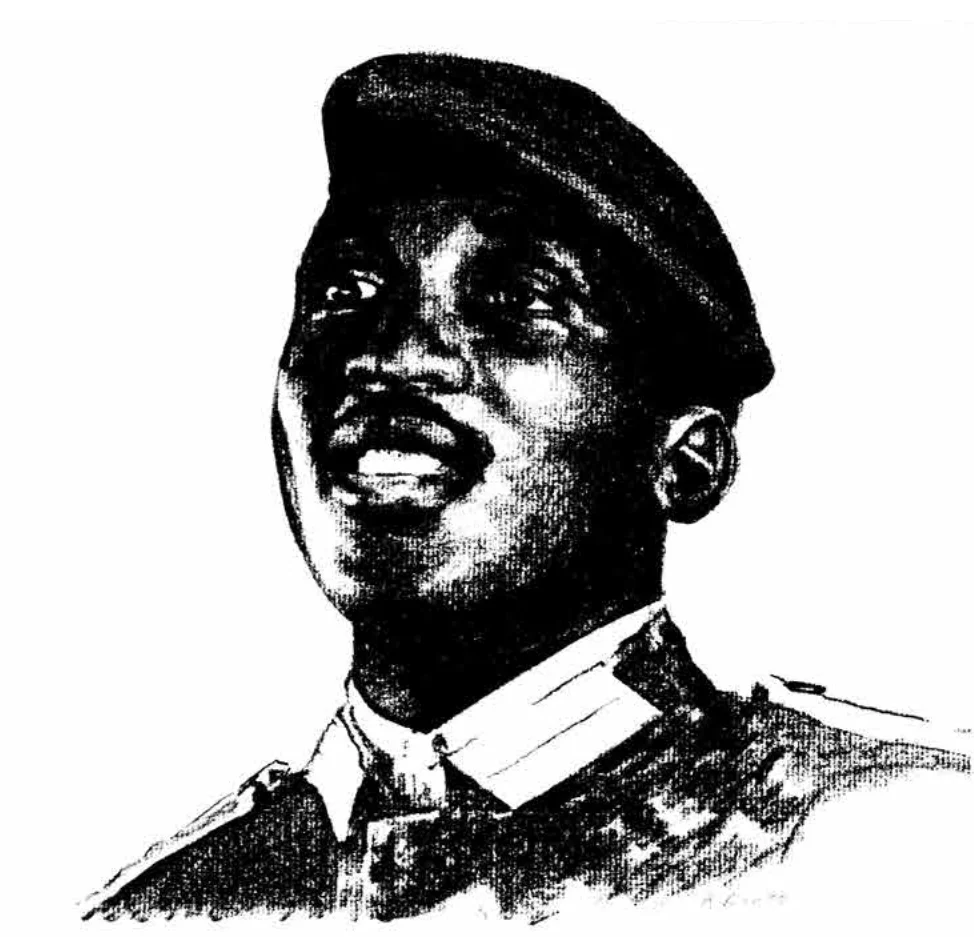
Thomas Sankara was a Burkinabè military officer, Marxist revolutionary, and Pan-Africanist who led Burkina Faso from 1983 until his assassination in 1987, packing an astonishing amount of transformation into just four years in power. He renamed the country from Upper Volta to Burkina Faso — “Land of Upright People” — and launched sweeping campaigns on health, education, women’s rights, and food sovereignty. His murder at 37 cut short one of the most ambitious experiments in African self-determination, yet his ideas have outlived every government that tried to erase them.
Thomas Sankara was the president of Burkina Faso from August 1983 to October 1987. He led a radical program of national development funded largely by austerity at the top, rejecting IMF-style borrowing while prioritizing vaccination, literacy, women’s rights, and local food production. He was assassinated on 15 October 1987 in a coup that brought Blaise Compaoré to power.
- Who Was Thomas Sankara Before He Took Power?
- What Did Thomas Sankara Actually Change in Burkina Faso?
- Why Did Thomas Sankara Reject Foreign Debt?
- What Was Thomas Sankara's Foreign Policy?
- Thomas Sankara Timeline: Key Dates and Events
- How Did Thomas Sankara Die — and What Happened Next?
- Why Thomas Sankara Still Matters Across Africa and the Diaspora
- The Man Behind the Myth
- What Thomas Sankara's Life Asks of Us Now
Who Was Thomas Sankara Before He Took Power?
Thomas Isidore Noël Sankara was born on 21 December 1949 in Yako, a town in the north of what was then French Upper Volta. His father, Sambo Joseph Sankara, was a gendarme and a devout Catholic; his mother, Marguerite Kinda, came from a Mossi family. The Sankara household was mixed — the family was Roman Catholic, but Thomas’s upbringing sat inside a predominantly Muslim region, and that early exposure to religious and ethnic plurality shaped his later insistence that Burkina Faso’s many communities were one nation.
He attended primary school in Gaoua and later the Lycée Ouezzin Coulibaly in Bobo-Dioulasso, the country’s second city and commercial hub. In 1966, at 16, he watched the military oust President Maurice Yaméogo — an early lesson in how fragile post-independence governments could be. He joined the army in 1969 and was sent to Antsirabe, Madagascar, for officer training, where he witnessed a popular uprising against the Malagasy government in 1972. He later said that revolt opened his eyes to the power of ordinary people.
Further training took him to France and Morocco. By the late 1970s he was a captain, a gifted guitarist who played in a military band, and a voracious reader of Marx, Lenin, and Fanon. In 1981, President Saye Zerbo appointed him Secretary of State for Information — and Sankara resigned within a year, saying, “I cannot work with people who do not want the people to speak.” That refusal cost him his position but made his reputation.
The 1983 Coup That Changed Everything
On 7 November 1982, a group of officers led by Jean-Baptiste Ouédraogo seized power. Sankara became Prime Minister in January 1983, but the government split almost immediately between moderates aligned with France and radicals around Sankara. In May 1983, Sankara was arrested and held in Ouagadougou. On 4 August 1983, Captain Blaise Compaoré — Sankara’s close friend and fellow officer — led a counter-coup that freed him and installed the National Council of the Revolution with Sankara as president.
He was 33 years old. Within weeks he delivered a speech to the nation that set the tone for everything that followed: “We must dare to invent the future.”
What Did Thomas Sankara Actually Change in Burkina Faso?
The numbers are the argument. Between 1983 and 1987, Burkina Faso — one of the poorest countries on earth, landlocked in the Sahel — ran one of the most intensive public health and education drives in African history. Sankara’s government vaccinated roughly 2.5 million children against measles, meningitis, and yellow fever in a single two-week campaign in late 1984, mobilizing thousands of health workers and volunteers. Measles deaths fell sharply. Infant mortality dropped. School enrollment rose from around 12 percent to roughly 22 percent in four years, with literacy campaigns in nine national languages.
He was also, by any measure, a frugal head of state. He sold the government’s Mercedes fleet and required ministers to drive Renault 5s — the cheapest car available in the country at the time. He cut his own salary to about $450 a month and refused the trappings of office. He wore a simple cotton tunic and rode a bicycle. When he traveled abroad, he flew economy. He told a group of officials, “I want to be the president of a country that is not corrupt.”
Land, Food, and the Fight Against the Desert
The Sahel drought of the 1970s and early 1980s had devastated the region. Sankara’s response was the “Battle of the Trees” — a mass tree-planting campaign to slow desertification — and a push for food self-sufficiency. He banned the export of grain during shortages and encouraged local production of rice, millet, and sorghum. He also created the “Battle of the Trousers” — a campaign against imported second-hand clothing that he argued undermined local textile industries.
Some of these campaigns were heavy-handed. The Committees for the Defense of the Revolution, set up as grassroots organs of popular power, sometimes overreached. Traders accused of hoarding were punished. The revolutionary tribunals, while popular, bypassed normal judicial process. Sankara’s own government acknowledged that the pace of change created friction.
Women’s Rights as a Revolutionary Priority
Sankara was unusual among African leaders of his era — or any era — in making women’s liberation a central plank of national policy. He appointed women to cabinet positions, including Joséphine Ouédraogo as Minister for Family Affairs. He banned female genital mutilation, forced marriage, and polygamy as a matter of state policy. He encouraged women to join the military and to work outside the home.
His most famous statement on the subject came in a 1987 speech: “There is no true revolution in Burkina Faso, and there will be no true revolution in Africa, unless women are involved in the struggle and in the transformation of society.” He also said, “The revolution cannot triumph without the emancipation of women.”
Why Did Thomas Sankara Reject Foreign Debt?
On 29 July 1987, at the Organization of African Unity summit in Addis Ababa, Sankara delivered what many consider his defining speech. He called on African nations to collectively refuse to repay foreign debt — what he called “a cleverly managed reconquest of Africa.” He argued that the debt had been contracted by corrupt regimes, that the money had often been stolen and stashed in foreign banks, and that the poor had no obligation to repay the rich.
“Debt is a cleverly managed reconquest of Africa. It is a reconquest that turns each one of us into a financial slave — that is, a slave who has no right to speak.” — Thomas Sankara, Addis Ababa, July 1987
He contrasted Burkina Faso’s approach with that of countries that accepted structural adjustment programs. Instead of borrowing, his government cut spending at the top and mobilized domestic resources. He acknowledged the country remained poor, but insisted the choice was between dependency and dignity. He also called for a united front of African states to negotiate debt cancellation collectively, a demand that echoed decades later in movements like Jubilee 2000.
He was equally blunt about foreign aid. He accepted humanitarian assistance but rejected conditions that came with political strings. He famously said, “He who feeds you controls you.”
What Was Thomas Sankara’s Foreign Policy?
Sankara’s foreign policy was Pan-Africanist and non-aligned, with a sharp anti-imperialist edge. He supported the African National Congress in its fight against apartheid South Africa, hosted ANC fighters in Ouagadougou, and refused to recognize the apartheid regime. He backed the Polisario Front in Western Sahara and the Sandinistas in Nicaragua. He criticized France’s role in Africa — particularly its military interventions — while maintaining diplomatic relations with Paris.
He was also a critic of Western-backed leaders on the continent, including Félix Houphouët-Boigny of Côte d’Ivoire, whom he accused of serving French interests. He called for a “United States of Africa” decades before the phrase became a staple of continental politics. His foreign minister, Blaise Compaoré, handled much of the diplomacy, and the two men were seen as a team — until they weren’t.
The Comrades Who Became Rivals
Sankara, Compaoré, and Henri Zongo had been close since their army days. They were part of a small group of radical officers who called themselves the “communist officers” — a label applied by their opponents. After 1983, Compaoré served as Minister of State and later Minister of Justice. But by 1987, differences had hardened. Compaoré was seen as more accommodating toward France and Côte d’Ivoire; Sankara was more confrontational. Compaoré also had ties to Liberian warlord Charles Taylor, whom Sankara had criticized.
In September 1987, Sankara publicly called on Compaoré to account for his actions. On 15 October 1987, soldiers loyal to Compaoré surrounded the Conseil de l’Entente building in Ouagadougou, where Sankara was meeting with advisers. Sankara, his bodyguards, and several colleagues were shot dead. He was 37. Compaoré took power and ruled for 27 years.
Thomas Sankara Timeline: Key Dates and Events
| Date | Event | Significance |
|---|---|---|
| 21 December 1949 | Born in Yako, French Upper Volta | Birth of a future Pan-Africanist leader |
| 4 August 1983 | Seizes power in a coup led by Blaise Compaoré | Becomes president at 33; National Council of the Revolution formed |
| 4 August 1984 | Renames country Burkina Faso | “Land of Upright People” — a break from colonial naming |
| Late 1984 | Mass vaccination campaign | ~2.5 million children vaccinated in two weeks |
| 29 July 1987 | OAU speech on debt | Defining anti-debt, anti-imperialist address |
| 15 October 1987 | Assassinated in Ouagadougou | Killed at 37; Compaoré takes power |
How Did Thomas Sankara Die — and What Happened Next?
The official account in 1987 claimed Sankara was killed in a “regrettable incident” during a coup attempt. For years, the truth was suppressed. In 2015, Burkina Faso’s transitional government reopened the case. In April 2022, a military court in Ouagadougou convicted Blaise Compaoré — then living in exile in Côte d’Ivoire — of complicity in Sankara’s murder and sentenced him in absentia to life imprisonment. Several others, including General Gilbert Diendéré, were also convicted.
The trial was a landmark: an African court holding a former head of state accountable for the killing of another. Witnesses described the shooting in detail. The court found that the assassination was a deliberate act, not a spontaneous mutiny. Compaoré has never returned to Burkina Faso to serve the sentence.
The Legacy in Burkina Faso Today
Compaoré ruled from 1987 until 2014, when mass protests — the “Burkina Spring” — forced him from power. He fled to Côte d’Ivoire. Since then, Burkina Faso has faced a severe security crisis, with jihadist insurgencies in the north and east displacing millions. In that context, Sankara’s memory has become more potent, not less. His face appears on murals and T-shirts across Ouagadougou. In 2023, the government of Captain Ibrahim Traoré — himself a young military leader who came to power in a 2022 coup — invoked Sankara’s legacy, renaming a boulevard and promising a return to his principles of sovereignty and self-reliance.
That appropriation is contested. Some Burkinabè argue that invoking Sankara while suppressing dissent betrays what he stood for. Others see any revival of his ideas as a step forward. The debate itself is a measure of his enduring influence.
Why Thomas Sankara Still Matters Across Africa and the Diaspora
Sankara’s appeal is not nostalgia. It is a template. He demonstrated that a poor, landlocked country could refuse the terms set by international financial institutions and still function. He showed that a head of state could live modestly and still command respect. He proved that women’s liberation was not a Western import but a precondition for African development.
His speeches circulate on YouTube and TikTok. His quotes appear on murals from Accra to Nairobi to Brixton. In 2021, the French government returned a saber that had belonged to him — a small gesture that acknowledged a larger debt. In 2023, a statue of him was unveiled in Ouagadougou. He is cited by activists in Senegal, Nigeria, South Africa, and the diaspora as a model of what African leadership could look like.
He was not without flaws. His government suppressed press freedom at times, and the revolutionary tribunals lacked due process. He alienated allies and underestimated his enemies. But he was, by the standards of his era, remarkably honest about his own limitations. “I am not a messiah,” he said. “I am a man like any other.”
Key Lessons from Sankara’s Four Years in Power
- Austerity at the top builds legitimacy. Selling the presidential Mercedes fleet and cutting ministerial salaries signaled that sacrifice was shared, not imposed.
- Public health can be transformed fast with mobilization. The 1984 vaccination campaign showed that community organizing can achieve what money alone cannot.
- Women’s rights are central to development. Sankara treated gender equality as a revolutionary necessity, not a side issue.
- Debt is a political relationship, not just an economic one. His call for collective refusal anticipated decades of debt justice activism.
- Pan-Africanism requires institutions, not just rhetoric. He pushed for continental coordination on debt, trade, and security.
The Man Behind the Myth
Sankara was a guitarist who loved Congolese rumba and played in a band called “Tout-à-Coup.” He was a Catholic who respected Muslim traditions and fasted during Ramadan out of solidarity. He was a father of two sons, Isidore and Philippe, and a husband to Mariam Sankara, who survived him and later became an activist for justice in his case. He was a reader of Che Guevara and a student of Thomas Sankara — the man who invented himself as a leader by refusing to accept the limits placed on his country.
He once said, “You cannot carry out fundamental change without a certain amount of madness.” That madness — the willingness to imagine a different Burkina Faso, a different Africa — is what keeps his name alive. He governed for 1,531 days. More than three decades later, those days still shape how Africans talk about sovereignty, dignity, and the possibility of another way.
What Thomas Sankara’s Life Asks of Us Now
The questions Sankara raised in the 1980s have not gone away. Who owns Africa’s resources? Who decides its economic policy? What does leadership look like when it is accountable to the poor rather than to foreign creditors? He answered those questions with his own life — and with his death. The soldiers who killed him thought they were ending a revolution. They were wrong. They made a martyr whose ideas proved harder to kill than the man himself.
In Ouagadougou today, his mausoleum sits near the spot where he was shot. Schoolchildren visit. Activists leave flowers. Tourists take selfies. And somewhere in the crowd, someone is always reading his speech from Addis Ababa, the one about debt and dignity. Thomas Sankara is not a relic. He is a provocation — a reminder that another Africa was always possible, and still is.